PART 2 — I FROZE THEIR ACCOUNTS AND TOOK BACK MY FARM
A nursing home as if I were a piece of old furniture that was no longer useful.
Chapter 2
PART 2 — I FROZE THEIR ACCOUNTS AND TOOK BACK MY FARM
A nursing home as if I were a piece of old furniture that was no longer useful.
As if these 73 years of life were worth nothing.
I couldn’t sleep that night. I lay awake in bed staring at the ceiling that leaks when it rains, thinking about every strange conversation from the past few months. The times Amber and Catherine would fall silent when I entered the living room. The whispered phone calls, the papers they would quickly put away when I came near.
I remembered when Amber came over 6 months ago with that green folder, insisting I signed some insurance documents I had signed without reading, trusting them like a fool. What was really in those papers?
Everything made sense now. David’s insistence that I go to the bank to update my information. the constant pressure for me to give them power over my accounts in case something happened to me. Catherine’s frequent visits, who before barely spoke to me, but now came with
store-bought cakes and fake smiles.
I got up before dawn and walked all over the farm. I touched every tree I had planted. The avocado trees I planted when David was 10, the mango trees that grew up with him. The garden where I taught my granddaughter to recognize plants before Amber decided it was too dangerous to bring her here.
This land has my footprints on every meter. My sweat watered every furrow. My tears fed every seed. And they wanted to take it from me like taking a toy from a child.
The next day, very early, I walked to Helen’s house. Her chickens were clucking in the yard, and the smell of burning wood came from her chimney.
I needed to think. I needed a place where I felt safe. Her small kitchen always smells of cinnamon and freshly brewed coffee.
“Helen, I think I have to
do something before it’s too late.”
She poured me coffee in that flowered mug and sat across from me. Her eyes, the color of old honey, looked at me with an understanding that only years of true friendship can give.
“What do you need, Margaret?”
“I need to go to the bank today and to the lawyer, too. But first, I need you to help me review all the papers I’ve signed lately.”
We went back to my house and sat at the dining room table. I took out all the folders, all the documents I had saved without fully understanding them. Helen has better eyesight than me, and she knows how to read the fine print.
“Margaret,” she said after an hour of reviewing, her voice trembling. “These papers you signed last month, they give David the power to sell properties in your name.”
My world swayed. I had
signed my own death sentence without knowing it.
“And this other one, this one gives him full access to all your bank accounts. Margaret, with these papers, they can do whatever they want with you.”
I cried for the first time in years. I cried like a child. I cried for my naivity, for my blind trust, for having raised a son capable of betraying me like this.
But the tears dried up quickly. In their place came something I hadn’t felt in a long time. rage. A clean, clear rage that filled me with an energy I thought I had lost.
We went to the bank together. There they explained everything David had tried to do over the last two months, loan applications using the farm as collateral, attempts to change the authorized signatures, requests for copies of all my bank statements.
“Mrs. Margaret,” the manager, a young woman with a concerned voice, told me, “Luckily, you had given us specific instructions years ago not to authorize anything without your physical presence. Your son seemed very upset when we told him we needed to speak with you first.”
“He even brought a lawyer last week, insisting he had a legal right.”
Very upset. Of course, he was upset. His plans to rob me were failing because of a detail he had forgotten.
Years ago when my husband died, I had been cautious. I had put those restrictions in place in case one day I lost my memory.
“What can I do to protect myself completely?” I asked.
“Cancel all the powers of attorney you have granted. Change all your passwords, establish new restrictions. And if you want my advice, Mrs. Margaret, do it today.”
Then we went to the lawyer, Mr. Davies, an older man, the kind who inspires confidence the moment you see him. His office is full of books and smells of old wood and wisdom.
“Mrs. Margaret, what you’re telling me is very serious, but it has a solution. These documents you signed can be revoked. You were under emotional distress. You didn’t have independent legal representation.”
He explained my rights. He showed me how to protect my assets, how to make sure no one could take what was rightfully mine.
I signed new documents. I changed all the authorizations. I put legal locks in place that neither David nor his wife nor his mother-in-law could break.
“And if they try to force me to sign something?” I asked.
“These documents protect you, Mrs. Margaret. No one can force you to do anything with your property. And if anyone tries, that’s called coercion, and it’s a crime. Besides, I have notified the bank and the notary’s office. Any document they try to submit with your signature will be verified directly with you.”
I returned home that afternoon feeling different, as if I had woken up from a long, confusing dream. The farm looked the same, the same green mountains in the background, the same infinite sky, the same trees I had planted with my own hands decades ago. But I was no longer the same woman who had left that morning. For the first time in months, maybe years, I felt in control of my own life.
That night, when David called to tell me about the trip, I already knew exactly what I was going to do. I let them leave. I let them believe they had won. That old Margaret would obediently stay home, taking care of the garden like just another employee.
But while they were packing their bags, I was packing mine, too. Not to go anywhere, but to stay. to plant my roots deeper than ever.
And when the bank phone rang the next day, I was ready. The storm was just beginning. But for the first time in a long time, I had the umbrella.
David’s call woke me up on the second day. His voice sounded different, higher pitched with that tone he used as a child when he knew he’d done something wrong.
“Mom, there’s a problem. The cards aren’t working. None of them.”
I sat up in bed slowly, feeling the morning sun stream through the window overlooking the yard. The chickens were already clucking, asking for their food. Life was going on as normal, while theirs was falling apart 200 m away.
“What kind of problem, David?”
“We can’t pay for anything. Not the hotel, not the food, not the gas. It’s like all the accounts are frozen.” I heard Amber screaming in the background. Her voice was distorted over the phone, but I managed to make out a few words. Useless. Your mother, fix this.
“Mom, I need you to go to the bank right now. It must be a system error.”
A system error. As if I were that naive.
“It’s not an error, David.”
Silence. A long silence filled with the sound of the waves I could hear in the background. They were at the beach under expensive umbrellas while I was supposed to be sweating in the garden.
“What do you mean it’s not an error?”
“I mean, I canled all the cards. I froze all the joint accounts. I revoked all the authorizations you had.”
Another silence. This one heavier than the last.
“Mom, you can’t do that. We depend on that money.”
“We,” as if we were partners. As if they had worked a single day on this farm to earn that money.
“And whose money do you think that is, David?”
“It’s family money. You can’t just leave us stranded here.”
Family. That word they had been using to manipulate me for months. Family when they needed money. Family when they wanted me to sign papers. But not family when they were planning to sell my house and lock me in a nursing home.
“David, come home. All of you right now.”
“We can’t come. We don’t have money for gas.”
“Then walk or borrow or do whatever you have to do, but come home.”
I hung up before he could answer.
My hands didn’t tremble this time. I felt strangely calm, like when the shock wears off after an accident and you realize you’re still alive.
That morning, I worked in the garden like never before. I planted new seeds of cilantro and parsley. I watered the tomatoes that were beginning to ripen. I pulled the weeds that were growing between the lettuce. Every movement was an affirmation.
This land is mine. These plants are mine. This life is mine.
Helen arrived around noon as always, but this time she didn’t bring her flowered mug. She brought a bag full of freshlymade pastries and a bottle of bourbon.
“To celebrate,” she said with a smile that crinkled her whole face.
“Celebrate what?”
“That you finally got your nerve back, Margaret.”
We sat on the porch eating pastries and taking small sips of the bourbon that burned my throat in the best way. The midday sun fell on us like a blessing.
“Do you think I did the right thing, Helen?”
“Honey, the only thing you did wrong was taking so long to do it.”
She then told me that for months she had seen how I was fading away, how I stopped smiling when I talked about David, how my shoulders had started to stoop under the weight of always being available for everyone.
“Your late husband, God rest his soul, once told me, ‘Helen, if anything happens to me, make sure no one takes advantage of Margaret. She’s too good for her own good.’”
Those words touched my soul. My husband had seen something I had refused to see for years.
The phone rang again at 3:00 in the afternoon. This time it was Amber.
“Mother-in-law, we need to talk.” Her voice had lost all its usual fake sweetness. Now it sounded sharp, desperate.
“Speak.”
“What’s going on? Why did you do that with the accounts?”
“What do you think, Amber?”
“I don’t know. That’s why I’m asking. We’re stranded here.”
I got up from the porch and walked into the kitchen. I needed to be moving for this conversation.
“You know what, Amber? I think you do know. I think you know exactly why I did what I did.”
“I don’t know what you’re talking about.”
“Don’t you? You don’t know anything about a conversation at Mr. Henderson’s law office. You don’t know anything about papers to sell the farm. You don’t know anything about plans to take me to a nursing home.”
Total silence. I couldn’t even hear the waves in the background anymore.
“Mother-in-law.”
“Don’t call me mother-in-law. Mothers-in-law are family. And you stopped being my family the day you decided to rob me.”
“It wasn’t robbery. It was for your own good. A woman your age can’t manage such a large property on her own.”
There it was. The truth finally. A woman my age. As if 73 were a disease. As if experience were a disability.
“And who decided that? You, your mother, my own son.”
“We were all worried about you.”
“Lies. You were worried about the money, about the property, about what you could get if I disappeared from the picture.”
I heard her pass the phone to someone else. It was Catherine.
“Margaret, let’s be reasonable. You can’t stay alone on that farm forever. You need help. You need care.”
Catherine’s voice was condescending, as if she were explaining something to a foolish child.
“You know what I need, Catherine? I need you and your daughter to stay away from my family. I need you to stop manipulating my son. And I need you to understand that this farm will be mine until the day I die.”
“You’re making a terrible mistake. Without us, you can’t handle the business. You don’t understand banks or taxes or anything.”
There it was again. The same old song. The poor old woman who doesn’t understand anything. The same woman who had managed this farm for 40 years. Who had raised cattle. Who had negotiated with buyers. Who had paid taxes and managed employees long before Amber even knew how to write her name.
“You know what, Catherine? You’re right about one thing. I did make a terrible mistake. But it wasn’t today. It was 6 months ago when I trusted you.”
I hung up for the second time that day.
This time I trembled a little, not from fear, but from a strange energy that was coursing through my body, as if I had been asleep for years and was finally waking up completely.
Helen was still on the porch, rocking gently and looking at the mountains.
“Everything okay?” she asked without turning to look at me.
“Everything’s perfect.”
That night, I had dinner alone for the first time in months without feeling lonely. I made myself some scrambled eggs with tomatoes and onions from my own garden. The silence of the house didn’t weigh on me. It embraced me.
After dinner, I went out to the yard and looked at the stars. It had been years since I had seen them so clearly. Maybe because it had been years since I had taken the time to look up.
They would be back tomorrow. Furious, desperate, probably with a new plan to convince me I had lost my mind. But for the first time in a long time, I knew exactly who I was and what I wanted.
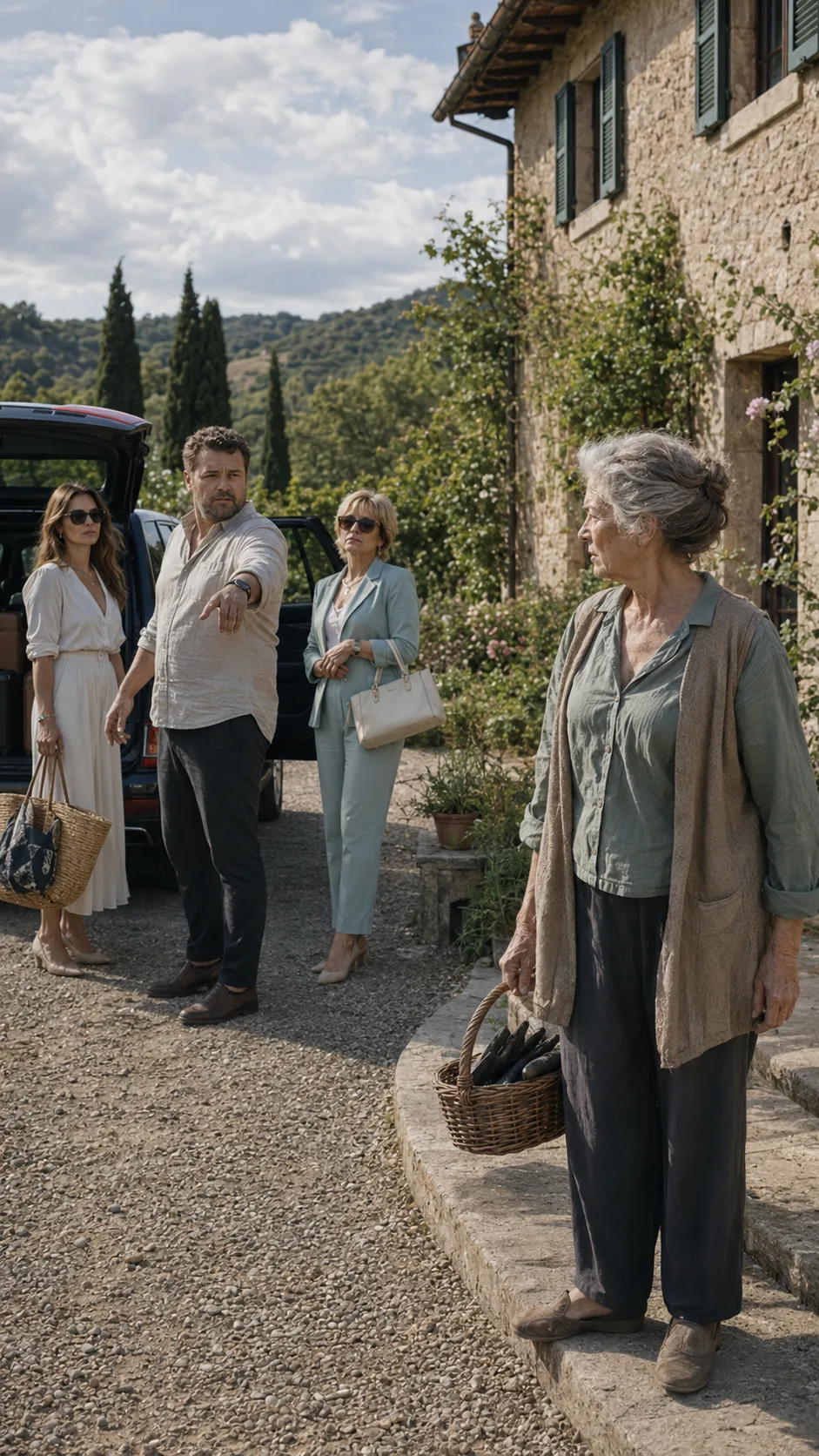
They arrived at dusk on the third day. Like a storm you see coming from afar.
David’s car kicked up a cloud of dust on the road that took several minutes to settle. I was watering the plants in the garden, but I left the hose running and sat in the rocking chair on the porch to wait for them.
They got out of the car like actors in a poorly rehearsed play. David first with that scolded child face he used to make when his father caught him in some mischief. Amber next in her wrinkled green dress and her hair disheveled from the trip and finally Catherine adjusting her sunglasses even though the sun was already setting.
None of them looked at me directly at first. They just stood there as if waiting for me to speak first, as if I owed them an explanation.
The silence stretched so long that even the crickets fell quiet.
“Well,” I finally said without getting up from the rocking chair.
“David was the first to walk towards the porch.” His steps sounded heavy on the wooden planks his father had laid 15 years ago.
“Mom, we need to talk. Talk.” He sat on the step. The position he used as a child when he wanted me to forgive him for something, but he was 40, 2 years old now, and childhood tricks no longer worked on me.
“I don’t understand what happened. Why did you do what you did?”
“You really don’t understand, David.”
Amber approached then with those high heels that had no place on a farm and made her walk like a duck.
“Mother-in-law, I think there was a misunderstanding. We never meant to hurt you.”
I looked at her directly for the first time. Her eyes were swollen. She had probably cried during the trip, but they weren’t tears of remorse. They were tears of frustration for having lost.
“A misunderstanding. Is that what you call planning to sell my house behind my back?”
“We just wanted what was best for you.” Catherine had stayed by the car, as if ready to flee at any moment. But her voice carried clearly to the porch. “Margaret, a woman your age, shouldn’t be alone in such an isolated place. It’s dangerous.”
I got up from the rocking chair for the first time since they arrived. My legs felt solid, firm, as if they had regained a strength I had forgotten I had.
“Dangerous? You know what’s dangerous, Catherine? Trusting family who plan to rob you. Signing papers without reading because you think your own son would never harm you.”
David stood up, too. In his eyes, I saw something I had never seen before. Fear. Fear that his plan had completely failed.
“Mom, the papers you signed were just to protect you so that if something happened to you, we could help you.”
“protect me by calling me crazy, by telling people in town I’m losing my memory.” The color drained from his face. He didn’t know that I had heard that conversation last week when they thought I was napping.
“I never—”
“Yes, you did. You told Mr. Henderson that I was starting to show signs of dementia, that sometimes I didn’t remember things, that it was necessary for you to have legal control over my decisions.”
Amber took a step back. Her heels sank into the soft garden soil.
“David, maybe we should go. She’s upset.”
“I’m not leaving. She’s my mom and I’m going to fix this.”
“Fix what exactly?” I asked. My voice came out louder than I expected, filling the space between us. “Fix this misunderstanding. Make you understand that everything we did was with you in mind.” End quote.
I stepped off the porch and walked until I was standing in front of him. David is tall. He always was. But at that moment, I felt taller than him.
“You want me to understand? Fine. Then explain to me why you had a buyer for the farm. Explain why you had already set aside money for a nursing home. Explain why Amber was looking up prices for apartments in the city.”
Every word I said was like a blow. I saw them shrink. Search for excuses they no longer had.
“Mom, we—”
“No more lies. I’ve heard enough lies.”
Catherine finally approached, walking with that fake elegance she uses when she wants to impress.
“Margaret, be reasonable. You can’t live alone forever. You need someone to take care of your affairs.”
“Someone like you. People who plan to rob me and then throw me out like an old dog.”
“No one was going to throw you out. The home we chose is very good. It has gardens and activities.”
There was the full confession. She wasn’t even trying to deny it anymore.
“A home with gardens and activities. And when did you ask me if I wanted gardens and activities?”
David ran his hands through his hair, frustrated.
“Because we knew you would say no. You’re too stubborn to accept help.”
“Help? Is selling my house help? Is stealing my savings. Help?”
“We weren’t going to steal anything. The money was going to be used to take care of you.”
“Lies. The money was going to be used for you to live comfortably while I rotted in a nursing home.”
Amber started crying again. Those manipulative tears she used whenever things didn’t go her way.
“Mother-in-law, please. We’re family. We can fix this family.”
“You call this family?” I walked to the garden and cut a white rose from the bush I planted when my granddaughter was born. I held it in my hands, feeling the soft thorns against my fingers. “Do you know what real family is? Family is Helen, who warned me about your plans. Family is Mr. Davies, who helped me protect my rights without asking for anything in return. Family is this land that has sustained me for 40 years.”
“But where your blood,” David shouted, desperate.
“Blood means nothing if the heart is rotten.”
Catherine stepped forward then with that fake smile she reserved for special occasions.
“Margaret, let’s be practical. You need us more than you think. Who’s going to take care of you when you get sick? Who’s going to manage the farm business?”
“I will take care of myself as I have for 73 years. And as for the farm business, I have some news for you.”
I went back to the porch and took from my purse the papers I had signed that morning with Mr. Davies.
“Yesterday, I signed a new will. Everything I have will go to a foundation that helps abused women. Not a single scent, not an inch of land will be for you.”
The silence that followed was different from all the others. It was a silence of defeat, of destroyed plans, of dreams of easy money evaporating like dew in the morning.
David sat on the step again, but this time not like a child seeking forgiveness. He sat like a man who finally understood the consequences of his actions.
“Mom, you can’t do that. I’m your only son.”
“Being my only son gave you rights, David, but it also gave you obligations, and you chose to betray me instead of taking care of me.”
Amber had stopped crying. Now she was looking at me with a pure rage that finally showed her true face.
“You’re crazy. Completely crazy. David, do something.”
“What do you want me to do?”
“I don’t know, but you can’t let her take everything from us.”
“No one is taking anything from you,” I said calmly. “You are simply losing something that was never yours.”
The sun had set completely. The first stars were beginning to appear in the violet sky. It was time for them to leave.
“Go,” I told them. “This house is no longer your home.”
David looked at me as if he hadn’t understood the words, as if it were impossible that his mother, the woman who had cleaned his scraped knees and prepared his favorite meals for 40 years, was telling him to leave.
“Mom, you can’t be serious.”
“I have never been more serious in my life.”
Amber approached then with the desperation of a cornered animal that made her look ugly despite all her makeup.
“Mother-in-law, think carefully. Without us, you have no one. What are you going to do when you get sick? When you need help?”
“I’m going to do the same thing I’ve always done. Solve my problems on my own.”
“But you’re 73 years old.”
“And you’re 35, but you act like you’re five. Age is no excuse for being useless.”
Amber.
Catherine had already gotten into the car, probably calculating that this battle was lost.
But she shouted from the window.
“Margaret, this isn’t over. We have legal rights. The papers you signed give us power.”
“Those papers?” I took the folder I had taken to the lawyer out of my purse. “Are you referring to these papers that have already been nullified? or these other ones where it’s proven that you pressured me to sign without legal representation.”
Her face fell even from a distance. I could see how reality hit her like a hammer.
“That’s impossible. Those documents are valid.”
“They were valid until Mr. Davies proved there was emotional coercion. It turns out the law protects senior citizens from abusive children. Who would have thought?”
David stood up abruptly, so fast that the step planks creaked.
“We are not abusive. Everything we did was for your own good.”
“For my own good, David, look around. Look at this farm I built with my own hands. Look at this house where I raised you. Do you really think I don’t know what’s good for me?”
I walked to the garden where my roses were. The same ones I had planted when he was little, and asked me why flowers had thorns, to protect themselves from those who want to hurt them. I had explained then. I never thought that one day he would be one of those threats.
“Look, David, do you see these roses? I planted them 20 years ago. I’ve cared for them, pruned them, protected them from pests. No one else knows how to care for them like I do. No one else knows how much water they need, when to fertilize them, how to protect them from the cold.”
I turned to him, holding the white rose I had cut.
“This farm is the same. I know how every foot of this land works. I know every tree, every animal, every problem that can arise. I’ve managed droughts, floods, pests, low prices, high prices. I’ve done it alone for years, especially after your father died.”
“But mom—”
“No, let me finish. In all these years, did you ever see me fail? Did a harvest ever get lost because of me? Were we ever unable to pay the bills? Did this family ever go hungry?”
He couldn’t answer because the answer was no. I had never failed. I had never let anything bad happen to this family.
“So why did you decide I could no longer take care of myself?”
“Why? Because Amber told me that there at Island, Amber told you.”
“And since when does Amber know more about my life than I do?”
Amber stepped forward with her fists clenched.
“I was just trying to help. Your son was worried about you.”
“Lies. My son was worried about the money and you were worried about getting a house without having to work to pay for it.”
“That’s not true, isn’t it? Then explain to me why the day after I signed the papers, you had already set aside $50,000 to buy an apartment in the city.”
David’s face went white. He didn’t know I had seen the messages on his phone when he left it on the table during lunch.
“How do you know that?”
“Because I’m not blind, David, nor deaf, nor stupid. I saw the messages with the real estate agent. I saw the floor plans for the apartment you wanted to buy with my money.”
Catherine got out of the car again, but this time she looked like a wounded beast.
“All of this is normal. Children always inherit from their parents. We were just speeding up the process.”
“Speeding up? Do you mean you were waiting for me to die?”
“No, I mean it was logical to plan for the future.”
“The future? My future? Without asking me what I wanted for my future.”
I walked to the fence that divides my property from Helen’s. In the distance, I could see the light from her kitchen. She was probably making dinner, unaware that the war that would define the rest of my life was unfolding here.
“Do you know what my future was in your plans? Three meals a day in a communal dining room. A single bed in a room I would share with a stranger. Scheduled activities as if I were a 5-year-old child. Visits once a month if you had time.”
“The home we chose was very good,” Amber protested.
“Did you visit it?”
“Well, we saw the pictures online.”
“The pictures online? You were going to lock up your husband’s mother in a place you didn’t even know in person.”
David approached then with that lost child face that broke my heart despite everything.
“Mom, forgive me. I know we messed up, but we can fix this. We can start over.”
For a moment, just a moment, I was tempted to forgive, to hug him like when he was little and had nightmares. To tell him everything was going to be okay.
But then I remembered the conversation I had overheard three nights ago when they thought I was asleep. David telling Amber, “It won’t be long now. When she’s in the home, we can do whatever we want with the farm. Start over as if nothing happened.”
“Yes, exactly. We can forget all this. David, look me in the eyes.”
He did. In those eyes, I saw the boy he had been, but also the man he had become. A man capable of betraying his own mother for money.
“I can’t forget. And even if I could, I don’t want to.”
“Why?”
“Because what you did taught me something important. That family is not just blood. Family is respect. It is affection. It is protection. You took all three things from me.”
Amber started walking towards the car, dragging her feet on the ground.
“David, let’s go. She’s not going to change her mind.”
“I’m not leaving. She’s my mom.”
“Your mom has already made her decision, and we can’t stay here like beggars.”
David looked at me one last time. In his eyes was something I had never seen before. The understanding that he had lost something forever. Not just the inheritance, not just the money, he had lost his mother.
“Is there really no way to fix this?”
“There was a way, David. It was called not betraying me.”
“Mom, go, please, before I say something I might regret.”
He stood there for what felt like hours, but was probably only minutes. Finally, he walked to the car with slow steps, as if each step pained him. Before getting in, he turned one last time.
“I love you, Mom.”
“I loved you, too, David. Past tense.”
The car started kicking up dust again. I watched the tail lights recede down the road until they became red dots in the darkness. When they disappeared completely, I sat on the porch step.
For the first time in days, everything was silent. And for the first time in years, that silence felt like peace.
I sat on the porch step until the stars completely filled the sky. The night air smelled of jasmine and damp earth, a scent that had always calmed me.
But that night had a different flavor. It tasted of freedom.
To be continued… Click “PART 3” to read the final part: 👉 PART 3 👈
Chapter complete
You have reached the end of this chapter.
Continue reading
A few more worlds to get lost in after this chapter.




