I TOOK MY DAUGHTER-IN-LAW’S PHONE FOR REPAIR—THEN THE TECHNICIAN TOLD ME TO LEAVE MY HOUSE IMMEDIATELY — PART 2
Tom locked the front door, flipped the sign to CLOSED, poured me a glass of water, and helped me sit down on a stool behind the counter.
Chapter 2
I TOOK MY DAUGHTER-IN-LAW’S PHONE FOR REPAIR—THEN THE TECHNICIAN TOLD ME TO LEAVE MY HOUSE IMMEDIATELY — PART 2
Tom locked the front door, flipped the sign to CLOSED, poured me a glass of water, and helped me sit down on a stool behind the counter.
“You need to go to the police,” he said.
I shook my head. I was still too shocked to think straight. “Who’s going to believe me? An older woman accusing her own son and daughter-in-law? Two people everyone respects?”
“Then you need to protect yourself and gather everything you can.”
I nodded.
I took out my phone and photographed every message, every date, every time stamp, every detail. I made sure to capture the parts about the doctor, the part about my supposed memory issues, the part about the life insurance, the house, the staging, all of it.
“They’re trying to build a story around me,” I said numbly. “A story that I’m confused.”
Tom’s face tightened.
When I had photographed everything, I looked at him and said, “I need you to restore her phone exactly the way it was. No signs anyone touched it.”
He agreed immediately.
Nearly an
hour later, Emily’s phone looked perfectly normal. If there had ever been a crack in the screen, it was gone. If there had ever been danger inside that device, it was hidden again behind a polished surface and a passcode made from a wedding date.
When I stepped out of the shop, the Dallas sky had never looked so gray.
I sat behind the wheel for nearly two full minutes before starting the car.
How could I go home now?
How could I look at Robert and tell him that our only child had written messages about ending our lives for money?
And yet I had to go home. I had to warn him carefully. If Michael and Emily realized we knew, they might change their timing. Or move faster.
The betrayal hurt almost more than the fear.
The boy I had carried, raised, fed, comforted, and loved through every
stage of life had been discussing our deaths as if he were balancing an account.
By the time I pulled into the driveway, I had one thought left: stay calm.
This was a fight for survival, and if Michael and Emily thought I was weak, forgetful, frightened, and easy to manage, then that was exactly what I had to let them believe for a little while longer.
They didn’t know I had survived harder things than they understood. They didn’t know what it had taken to raise a son while Robert worked out of state for long stretches. They didn’t know what breast cancer had taught me about pain, patience, and grit. They didn’t know what years in a crowded classroom had taught me about reading people long before they opened their mouths.
I gripped my own phone as if it were evidence, or a weapon, and walked inside.
Robert
was on the couch watching the news. The familiar sight of him—his silver hair, his soft face, one hand resting on the arm of the sofa—nearly undid me.
“Did you get Emily’s phone fixed?” he asked, eyes still on the television.
“Yes,” I said. “All done.”
Then I stood there, unable to move.
How do you tell the man you’ve loved for forty-five years that your son may be laying the groundwork to erase you both?
Robert turned the television off when he heard the strain in my voice.
“Susan? What is it?”
I sat beside him, unlocked my phone, and showed him the screenshots one by one.
I watched the understanding move across his face in stages. First confusion. Then disbelief. Then fear. Then a kind of pain so deep I thought he might collapse under it.
“No,” he whispered. “Michael wouldn’t.”
“I thought the same thing.”
“But that’s his number.”
“I know.”
“And Emily’s replies…”
“From her phone. The one I just picked up.”
Robert closed his eyes and drew in a long, careful breath. Then another. When he opened them again, something had hardened into place.
“What do we do now?”
I told him what I had already decided in the car.
“We document everything. We check every account. We change passwords, cancel cards, lock down anything he can access. We find out which doctor was involved. And we act normal until we have enough to protect ourselves properly.”
Robert rubbed a hand over his face.
“Emily’s coming tonight to pick up the phone,” I said. “We have to stay calm.”
“How am I supposed to look at her and not explode?”
“One step at a time,” I said, though my lips were trembling. “Our lives may depend on it.”
For the next hour we sat at the dining room table and reviewed our finances. What we found made my blood go cold all over again. There had been small withdrawals from our account every week for the past three months—seven hundred dollars here, eight hundred there, quiet enough not to set off immediate alarm, but together totaling nearly ten thousand dollars.
“Michael has access,” I said.
Robert nodded grimly. “Because we gave him power of attorney last year. Just in case something happened.”
The bitterness that rose in me was almost unbearable. We had trusted him so fully that we had handed him the tools.
We changed every password we could think of. We canceled any card he might have had access to. We called the bank and told them to block large transfers unless Robert and I approved them in person.
“What about the doctor?” Robert asked.
Dr. Parker had been our physician for more than fifteen years. He had come to our house for dinner before. He knew our history, our medications, our habits, our fears. The thought that Michael might have used him as part of this plan hurt in its own separate way.
“I’ll make an appointment tomorrow,” I said. “I want to hear from him directly about my so-called memory issues.”
When the doorbell rang that evening, Robert squeezed my hand once, hard. We looked at each other for a moment without speaking.
Then I stood, forced a smile onto my face, and opened the door.
Emily stood there in a pressed outfit with her wavy brown hair falling neatly over one shoulder. Elegant as ever. Composed as ever.
But now that polished look felt less like poise and more like a mask.
“Susan, I’m sorry for coming so late,” she said. “Was the repair okay?”
“All done,” I said, handing her the phone. “Tom did a great job. It looks brand-new.”
She turned it on, checked the screen, and smiled.
“Perfect. Let me pay you back.”
“No need,” I said quickly. “Tom fixed it for free. I’ve known him a long time.”
For the briefest second, she froze.
It was almost nothing. A tiny tightening at the brow. A flicker behind the eyes.
“Are you sure?” she asked. “I don’t want to trouble anyone.”
“It’s fine, dear. Would you like to come in for tea? Robert’s watching TV.”
“I can’t. I’ve got an early presentation tomorrow.”
She avoided my eyes when she said it. Her voice stayed smooth, but now that I knew what I knew, every movement seemed full of meaning.
I kept my own tone gentle.
“When is Michael coming back?”
“Tomorrow night,” she said too quickly.
Another lie. I already knew from the messages that he was home.
“Tell him to stop by,” I said. “We haven’t seen him in two weeks.”
“Of course.” She slipped the phone into her purse. “He misses you both too.”
Then, casually, she added, “By the way, have you seen the memory specialist Michael recommended?”
My stomach tightened, but I kept my face still.
“Not yet. No time.”
“Michael says you’ve been forgetting things lately,” she said. “Names. Appointments. Is that true?”
I smiled lightly.
“My memory is fine. In fact, I remember exactly when you wore that outfit before—at my cousin’s birthday last month.”
A flash of surprise crossed her face before she recovered.
“Well,” she said, “a checkup never hurts, especially at your age.”
“You’re right,” I said. “I’ll schedule it soon.”
The second the door closed, I leaned against it.
Robert was waiting in the living room.
“Did she say anything?”
“She tried to plant the story again,” I said. “They’re setting the stage ahead of time.”
He went pale.
“What now?”
“We keep moving,” I said. “Tomorrow I see Dr. Parker. Then I check the insurance policy. We need to know how much of this has already been put into motion.”
That night I barely slept.
Every creak in the house made me sit up. I checked the locks three separate times. The last time I went downstairs, I found Robert standing in the kitchen in the dark, drinking water.
His eyes were heavy with grief.
“I keep thinking about Michael as a little boy,” he said quietly. “He used to be scared of thunderstorms. He’d crawl into our bed whenever the weather turned bad. Where did that boy go, Susan?”
I had no answer.
How does a child once so full of love become someone capable of this level of calculation?
“We’ll find out,” I said, though the words felt thin. “And we’re going to get through this.”
The next morning, I called Dr. Parker’s office and said it was urgent. They fit me in late morning.
Before leaving the house, Robert and I checked our accounts again and uncovered something even worse.
A new life insurance policy had been opened in my name three months earlier.
I stared at the screen.
“What is this?”
Robert enlarged the digital document.
“Look at the signature.”
I leaned in.
“That’s not mine,” I said. “They forged it.”
The payout amount was $1.5 million.
Michael was listed as the sole beneficiary.
By then it had gone far beyond suspicious messages. There were forged documents. Withdrawn money. A doctor’s informal records. A policy waiting quietly in the background for the day my death could be explained away.
I drove to the clinic with my heart pounding hard enough to make my hands ache around the steering wheel.
The receptionist greeted me like any other morning.
“Good morning, Mrs. Miller. The doctor will see you now.”
When I stepped into his office, Dr. Parker looked uneasy before I had even sat down.
“Susan,” he said, “this is a surprise. Michael called me yesterday. He said you didn’t want to take the cognitive test.”
I sat in the chair across from him and kept my voice steady.
“That’s strange. Because I’m the one who asked for this appointment.”
He shifted in his seat.
“Michael told me you’d been showing some concerning signs. Forgetting names. Mixing up dates.”
I gave him a measured look.
“Interesting,” I said. “Because I don’t recall having any issues.”
He hesitated.
“Sometimes patients don’t recognize their symptoms, especially in early cognitive decline. In fact, you already have a preliminary note in your file.”
“A note based on what?”
“Michael showed me a few videos,” he said. “You seeming confused. Forgetting things.”
“Videos?” I said. “I want to see them.”
“He didn’t leave copies.”
I leaned forward.
“Dr. Parker, I’ve been your patient for fifteen years. Do you honestly believe I’m losing my mind, or did you simply believe my son?”
His silence told me more than his words.
Finally he sighed.
“Michael came in several times. He said you and Robert couldn’t manage things anymore. He asked me to document signs of possible decline and said you had agreed. I only wrote what he reported. I didn’t make a formal diagnosis.”
I held his gaze.
“Doctor, my son is planning to take my husband and me out.”
His face lost color.
“What?”
“I have proof,” I said. “And now I understand why he needed your help—to build records that would make anything that happened to me look natural.”
His hands shook as he adjusted his glasses.
“I had no idea. Susan, I thought he was concerned about you.”
I took out my phone and showed him the screenshots.
As he read, horror replaced confusion.
“Good Lord.”
“I want to see my record,” I said.
He turned his monitor toward me.
There it was in black and white: patient shows signs of cognitive decline as reported by her son. Frequent confusion, disorientation, forgetfulness of names and recent events. Recommended comprehensive neurological evaluation.
My voice went cold.
“This is fabricated, and you know it.”
“I documented what he told me,” Dr. Parker said weakly. “I didn’t make conclusions.”
“But you created a record that could be used against me.”
He lowered his head.
“What do you want me to do?”
“Print that record and sign it. Then create a new note stating that you examined me today and found no signs of cognitive impairment.”
He agreed immediately.
As he typed, I said one more thing.
“If anything happens to Robert or me, this record and this conversation will be among the first things the police see.”
I left the clinic carrying printed documents that proved at least part of the scheme had already been built.
From there I drove straight to the bank.
The branch manager, Mr. Martin, had known us for years. He looked startled by my request to revoke every authorization Michael had.
“Are you sure, Mrs. Miller?” he asked. “Your son was here last week. He said you and Mr. Miller wanted to extend his authority since Robert hadn’t been well.”
Another lie.
“My husband is perfectly fine, Mr. Martin. And yes, I’m sure. I’d like to review every transaction from the last six months.”
We went through them line by line.
In addition to the small withdrawals, there was something worse. Michael had requested a replacement credit card in Robert’s name, claiming the original had been lost.
“We issued a new one,” Martin said quietly, embarrassed. “He had power of attorney and has handled things for you before.”
“Cancel it immediately,” I said. “And block any future card requests unless both Robert and I are here in person.”
When I left the bank, I felt both relieved and terrified. Relieved because I had stopped part of it. Terrified because the structure of the plan was so much larger than I had first understood.
They had built layers. Financial access. Medical narrative. Legal authority. Insurance. Timing.
On the drive home, my phone rang.
It was Michael.
I let it ring twice before answering.
“Hi, son.”
“Hi, Mom. You okay? Emily said you took her phone in to get fixed. That was sweet of you.”
His voice was calm. Warm, almost. That was what made it so unsettling.
“It was nothing,” I said. “The technician is the son of an old colleague. He helped me out.”
“Nice. Hey, Emily and I were thinking of coming over for dinner tonight. It’s been a while since we all ate together, hasn’t it?”
A cold wave moved through me.
Why tonight?
Had Dr. Parker already contacted him? Had Emily noticed something in my face? Had they sensed movement?
“Of course,” I said lightly. “I’ll make your favorite lasagna.”
“Perfect, Mom. Oh, by the way—did you see that doctor I recommended? Emily said you hadn’t gone yet.”
“Yes,” I said. “I saw Dr. Parker this morning.”
Silence.
“And what did he say?”
“Nothing serious. Ran a few simple tests. Said my memory is perfectly fine.”
Another pause.
“Huh,” he said at last. “That’s good. Maybe get a second opinion too. You know how Dr. Parker can be.”
“I’ll think about it.”
“See you around seven.”
I hung up with shaking hands.
When I got home, Robert was at the table surrounded by papers. The worry in his face deepened as soon as he saw mine.
“Well?”
“He was involved,” I said. “Not knowingly, but enough. Michael manipulated him into creating a record. We also found the forged insurance. And now Michael and Emily are coming for dinner.”
Robert went pale.
“You think they suspect something?”
“I don’t know. But Michael sounded unsettled when I told him what the doctor said.”
We looked at each other and understood the same thing at once.
We would not eat or drink anything they brought.
We would record the evening.
Robert went to his study and came back with an old digital recorder. We tested it, hid it under the dining room table, and checked the batteries twice.
That afternoon I made lasagna with a heaviness in my chest I can still remember. Every movement felt unreal. Boiling water. Browning meat. Layering pasta. Wiping counters. Setting plates.
The ordinariness of it was almost worse than the fear.
How had my life become a scene in which I was preparing dinner for people who had been discussing how to remove me from it?
At exactly seven, the doorbell rang.
Robert and I exchanged one last look. The recorder was on. The plan was simple: act natural, watch everything, give away nothing.
I opened the door.
Michael stood there smiling, holding a bottle of wine. Emily stood beside him with a box of my favorite chocolates.
“Mom,” he said warmly, stepping in to hug me.
His arms around me made my skin crawl.
“It’s been too long.”
He handed me the wine. The label was expensive. Under any other circumstances, I might have been touched.
Now I only wondered what might be inside it.
Robert greeted them from the living room with a strained smile that matched mine. He offered coffee, juice, sparkling water—anything that would keep the wine closed for a few more minutes.
“Let’s save the wine for dinner,” Michael said, settling onto the couch.
For nearly half an hour we made conversation about work, traffic, the weather, a Rangers game Robert had half watched the night before. The atmosphere was so artificial it felt hard to breathe in it.
Emily watched me constantly.
Michael kept circling back to my routine.
“How’ve you been sleeping, Mom?”
“Any trouble with your medication?”
“How was your appointment today? Did the doctor order more tests?”
“It was routine,” I said evenly. “Nothing to worry about.”
“That’s strange,” he said with a frown. “He told me he suspected early Alzheimer’s.”
I gave him a look of mild surprise.
“Oh really? When did he say that?”
He blinked.
“Last week. When I called him.”
“Called him about what?”
“You know. The times you’ve seemed forgetful lately.”
“What times?”
He let out a dry little laugh.
“See? That’s exactly what worries us. Don’t you remember? Last week you forgot the neighbor’s name and left the stove on for hours.”
Not a word of it was true.
It was all part of the script they were trying to write around me.
“Funny,” I said calmly. “I talked to the neighbor yesterday and remembered her name just fine. And I haven’t used the stove all week. I’ve been microwaving leftovers.”
For the first time that evening, Michael’s smile faltered.
“Let’s eat,” Robert said smoothly, cutting through the tension. “Susan’s lasagna smells wonderful.”
At dinner, the performance continued.
I served the food while Robert discreetly kept the wine situation under control. We pretended to pour from Michael’s bottle, but the glasses Robert and I used had come from a different bottle waiting in the kitchen.
Michael raised his glass.
“To family,” he said. “And to good health.”
We all lifted our glasses. We pretended to sip. I watched them over the rim of mine.
Both Michael and Emily drank normally.
Maybe the wine wasn’t meant for that night. Or maybe they wanted to wait. Or maybe the bottle was simply part of the pressure—a symbol, a test, a prop.
Partway through the meal, Emily folded her hands and spoke in that careful, reasonable tone people use when they want to sound helpful while taking something from you.
“Michael and I have been talking. We’re worried about you and Robert living alone in such a big house.”
“That’s right,” Michael said. “Given everything lately, it might be better if you moved somewhere smaller. Or we could move in for a while. Help out.”
Robert stiffened beside me.
So that was one direction of the plan.
“That’s thoughtful,” I said. “But we’re doing fine, aren’t we, Robert?”
“Perfectly fine,” he said. “In fact, we’re thinking about taking a little trip soon. Maybe the coast.”
Michael glanced at Emily.
“A trip now?” he said. “I don’t think that’s wise, with your health and all.”
“Everything’s fine,” I said. “We can travel whenever we like.”
Emily smiled thinly.
“Then let me help you book it.”
“No need,” I said gently. “We can manage that ourselves.”
The rest of dinner felt like a chess game being played through ordinary conversation.
When I brought out cheesecake for dessert, Michael said, “I talked to a lawyer. He said we could set up full power of attorney for me. Just in case there’s an emergency.”
“What kind of emergency?” Robert asked.
“For example, if one of you had to be hospitalized. Or if Mom’s memory gets worse. That way I could make medical and financial decisions quickly.”
I looked at my son—the same face I had kissed on the forehead when he was feverish at six, the same face I had photographed at graduation, the same face that now seemed to belong to someone I had never met.
“No need for that,” I said. “We recently updated our paperwork. We even changed the insurance beneficiaries.”
Michael froze.
“Changed how?”
“Nothing major,” I said. “Just making sure everything’s clear.”
Emily placed a hand lightly on his arm, whether to calm him or warn him, I couldn’t tell.
“It’s always wise to review paperwork,” she said.
“Your lawyer Mark was very helpful,” Robert added smoothly.
There was no Mark. We invented him in that second, and the name landed exactly as Robert had hoped. Michael and Emily both shifted, recalculating something silently.
By the time they stood to leave near ten, the air in the house felt scraped raw.
Michael hugged me again. Emily kissed my cheek. The goodbye was full of all the gestures people use when they want to perform love in front of witnesses.
The moment the door closed, Robert and I both sank into chairs.
“They know something changed,” he whispered.
I nodded and picked up the recorder.
We replayed the evening at the dining table. Every word felt worse on the second hearing. Michael and Emily were still moving toward the same goal, but our actions—the doctor, the bank, the invented lawyer, the mention of changed paperwork—had made them cautious.
“They’ll act soon,” Robert said.
“They can’t wait much longer,” I said. “But we still need more.”
That night I slept with my phone beside my pillow and a chair propped under the bedroom doorknob, precautions I never imagined I would take against my own child.
The next morning, the sound of a car stopping outside jolted me awake.
I went to the window and saw Emily stepping out of a black SUV alone.
It was eight in the morning on a workday.
“Robert,” I whispered sharply. “Emily’s here.”
He was out of bed in seconds.
“Where’s Michael?”
“I don’t know.”
I went downstairs and opened the door before she could knock.
She looked startled to find me already there, but recovered quickly.
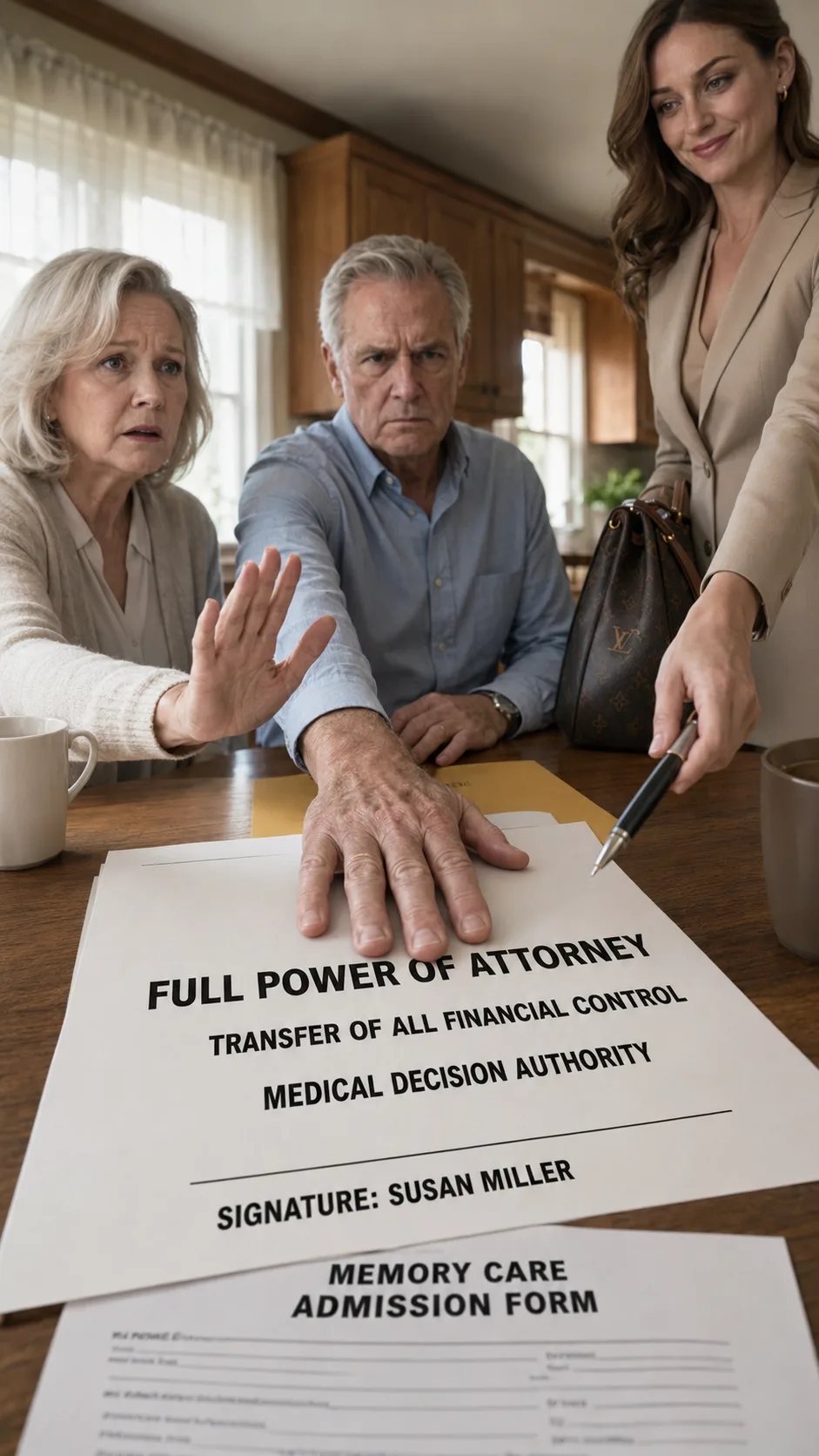
“Susan,” she said, “sorry for dropping by so early. I was on my way to work and thought I’d leave some documents Michael prepared for you.”
She held up a yellow folder.
“What documents?”
“Just the power of attorney we mentioned last night,” she said brightly. “And a few articles about early-stage memory treatments. Michael is really worried about you.”
A trap.
I could feel it at once.
The folder probably contained exactly what I thought it did: papers designed to shift control before we understood what had happened.
“Come inside,” I said. “It’ll be easier to go through them together.”
She hesitated.
“I’m already late for work.”
“It’ll only take five minutes,” I said, opening the door wider. “Robert just made coffee.”
Reluctantly, she stepped inside.
I led her to the kitchen, where Robert sat at the table with a mug in front of him, looking deliberately calm.
“Emily,” he said warmly. “What a nice surprise.”
“She brought some documents for us to sign,” I said, stressing the word us.
Robert understood instantly.
“Great,” he said. “Let’s take a look.”
As he opened the folder and flipped through the pages, Emily’s tension became more obvious. Her fingers tapped lightly on the tabletop. Her eyes tracked every page he turned.
“Well, this is interesting,” Robert said after a moment. “This would give Michael full control over our finances and medical decisions.”
“It’s just a precaution,” Emily said quickly.
“Because of my condition?” I asked.
She looked at me.
“The memory lapses. The confusion.”
“What confusion?”
She faltered.
“Michael said he noticed a few things.”
“Strange,” I said. “Dr. Parker didn’t notice anything yesterday.”
“Doctors can be wrong,” she shot back too fast.
“That may be,” Robert said. “But we’re not signing any of this. at me.
“The memory lapses. The confusion.”
“What In fact, we’re already in the process of revoking last year’s authorization.”
Emily’s face went still for a fraction of a second before the polite smile returned.
“Michael only wants to help.”
“We understand,” I said evenly. “But we prefer to manage our own lives.”
She stood abruptly.
“I really do have to go.”
“Of course,” I said, walking her to the door. “Tell Michael we’ll call him later.”
The second she left, Robert and I looked at each other and knew we had crossed into a new stage of the situation.
“They’re speeding up,” he said.
“Exactly.”
We examined the documents in detail. As we suspected, they were devastating if signed. Full authority over assets, bank accounts, medical decisions. There was even a voluntary admission form for a memory care facility—a place for patients with severe decline—with a blank signature line waiting patiently for a hand to fill it.
“They’re not even pretending anymore,” Robert said.
I photographed every page, made digital copies, and emailed them to my friend Stella, the only person outside the family I trusted completely. I gave her a brief explanation and told her to keep everything confidential.
Then Robert asked the question neither of us had been able to avoid.
“What now?”
We decided to speak to a lawyer before returning to the police. We still worried that some of what we had gathered from Emily’s phone might be challenged if it came to court. We needed someone who could help us protect both our lives and what remained of our control.
By that afternoon we were sitting in the downtown office of Laura Bennett, an attorney who specialized in family and criminal matters and had no connection to Michael.
We told her everything.
The phone repair. The screenshots. The withdrawals. The forged insurance. The doctor’s note. The dinner. The folder Emily had delivered that morning.
Laura listened without interrupting more than necessary. She took notes, asked sharp questions, and never once looked like she thought we were exaggerating.
When we finished, she took a slow breath.
“You’re dealing with several serious issues here,” she said. “Forgery, fraud, attempted asset theft, and what appears to be a conspiracy to take your lives.”
“Do we have enough to go to the police?” Robert asked.
“The messages are strong,” she said. “But because you accessed them through Emily’s phone without her consent, there could be legal complications. That said, given the level of danger, I believe we can build a very solid case.”
“What’s the first step?” I asked.
“Right now, I’m going to prepare documents revoking all previous authorizations. I’m also going to notarize statements confirming that you are both mentally competent and acting of your own free will. Then we file a formal complaint with everything you’ve gathered.”
We spent almost two hours there signing papers, giving statements, and laying out the next steps.
Finally Laura said, “The most important thing now is your safety. I do not want you going home tonight.”
Robert and I exchanged a look.
“You think it’s that immediate?” I asked, though I already knew her answer.
“Yes,” she said. “Emily showing up this morning means the pressure is increasing. Stay at a hotel under another name for a few days. We’ll start the process for additional protection.”
From Laura’s office we went straight to the police station.
The officer on duty, Lieutenant Charles Davis, listened to our account with his expression growing more serious by the minute.
“This is extremely serious,” he said. “I’ll assign investigators immediately. We can also arrange discreet surveillance of your home.”
When Laura’s recommendation that we stay away was mentioned, he nodded.
“I agree. Don’t return home tonight. Let my team install hidden cameras first. If they come back, and especially if they try anything inside the house, we’ll have proof that’s much harder to argue with.”
So that was the plan.
We would return home only briefly, while police were present, to pack essentials. Then we would go to a hotel under assumed names.
On the ride back, Robert stared out the taxi window for nearly the entire trip.
At last he said quietly, “I never thought I’d live to fear my own son.”
I reached for his hand, but there were no words strong enough for what he had said.
When we turned onto our street, the house looked as peaceful as it always had. The little front garden. The clean windows. The mailbox Michael had painted in high school. It was impossible to reconcile what it appeared to be with what it had become.
A plainclothes team arrived in an unmarked car. They entered through the back, installed tiny cameras in the kitchen, living room, hallway, and entry points, then explained how the footage would stream directly to the station.
While they worked, Robert and I packed the bare minimum: clothes, medications, important documents, chargers, a few things you grab when you are pretending this is temporary because you cannot bear the thought that it may not be.
I avoided looking too long at the family photographs on the walls.
Every memory felt contaminated.
Just as we were about to leave, my phone rang.
Michael.
I looked at the officers. One of them nodded for me to answer.
“Hello?”
“Mom, where are you? I stopped by the house and no one’s there.”
My heart clenched. He was already inside the timeline we were trying to stay ahead of.
“We’re out shopping,” I lied. “Needed a few things.”
“Oh, really? You two don’t usually go out without saying anything.”
His tone was easy. Practiced. That made it worse.
“It was a last-minute decision.”
“Well, I’ve got a surprise for you,” he said. “I’m waiting at the house.”
I went cold.
“A surprise?”
“Yeah. I brought a bottle of your favorite wine. Thought we could sit down and talk about those papers Emily dropped off.”
One of the officers gestured for me to keep him talking.
“That’s thoughtful, sweetheart,” I said. “We’ll be there in about half an hour.”
“Perfect. I’ll be here.”
The second the call ended, the officers radioed another unit.
“Suspect inside the residence,” one of them said. “Maintain distance. Surveillance active.”
The lead officer turned to us.
“We’re going to let him move freely for now. If he plants anything, tampers with medication, prepares something, the cameras will catch it. That becomes critical evidence.”
The logic was sound. Emotionally, it was brutal.
We waited at a nearby café with stale coffee and bright overhead lights, trying not to imagine what Michael might be doing in our kitchen.
After about forty minutes, an officer received a call, listened, and turned toward us.
“We’ve got something,” he said. “Something big.”
At the station we were taken into a monitoring room lined with screens.
Lieutenant Davis stood in front of one of them.
“Mr. and Mrs. Miller,” he said quietly, “you need to see this.”
On the screen, Michael entered the kitchen carrying two plastic bags. He looked around carefully. Then he began moving with calm, methodical focus.
He took out several pill bottles and mixed their contents into our medication in the cabinet.
Then he opened the bottle of wine he had mentioned on the phone and poured a small amount of white powder into it, shook it thoroughly, and resealed it.
Finally, he pulled a small device from his bag and attached it under the dining table.
“A microphone or a hidden camera,” one officer said.
I covered my mouth with both hands.
There are moments when truth becomes too solid to deny and too terrible to survive unchanged. That was one of them.
It was no longer suspicion. No longer screenshots. No longer fear built on inference.
My son was on camera, in my own kitchen, preparing to harm us.
Lieutenant Davis placed a hand on my shoulder.
“We have enough. I’m authorizing immediate arrest of Michael Miller and Emily Miller.”
“What about what he put in the cabinet?” Robert asked hoarsely.
“We’ll send it to the lab. From what it appears to be, it could cause serious harm. The powder in the wine looks like a strong sedative, possibly worse.”
I broke down then. Not loudly. Not dramatically. Just all at once, as if something inside me had finally lost the strength to stay upright.
If we had gone back that afternoon and shared that bottle like trusting parents, we might not have seen another day.
We had barely stepped out of the station when a female officer hurried over.
“Lieutenant Davis, update. Michael and Emily are both at the Millers’ residence. They appear agitated and may be looking for them.”
Davis gave the order immediately.
“Tactical unit. Move now.”
Then he turned to us.
“They’ve likely realized something’s wrong.”
“Can we come?” I heard myself ask.
Part of me wanted to run as far as possible from what was happening. Another part needed to see it end.
He hesitated, then nodded.
“You can ride in the patrol car. Stay inside. Do not intervene.”
On the way there, my heart pounded so hard it hurt. All I could think was: how had we arrived here? How had the child we raised come to this?
When we turned onto our street, several police cars were already surrounding the house. Over the radio, officers reported that Michael and Emily were still inside arguing.
“They know something is off,” one officer said. “They’ve been calling the parents’ phones nonstop.”
My phone had indeed been vibrating repeatedly in my purse. I ignored it.
Lieutenant Davis coordinated everything calmly over the radio.
“All units ready. Three, two, one, go.”
The front door burst open.
Michael ran out first. Emily followed, both of them carrying backpacks and scanning the street. They were heading for the car when officers came from every direction.
“Police! Hands up!”
The commands rang through the air.
For a second Michael looked as though he might run. Then he saw there was no way out. Slowly, he raised his hands.
Emily did the same.
They were cuffed and separated in seconds.
I watched from the patrol car window as my son, the boy I had once taught to tie his shoes and ride a bicycle, stood on our front walk in handcuffs beneath the porch light.
Lieutenant Davis came to our car.
“It’s done,” he said. “They’re under arrest. Charges include conspiracy, fraud, and forgery. We’ve seized the wine and the medication.”
Michael turned once while officers were moving him toward the squad car. His eyes met mine through the window.
There was no remorse in them.
Only anger. And disbelief at being stopped.
At the station, more evidence was found in the backpacks: pills matching the ones planted in our home, another container of the same white powder, plane tickets for an overseas flight leaving the next day, and several thousand dollars in cash.
“They were planning to leave quickly,” Davis said. “That much is clear.”
Robert held my hand so tightly it hurt. I welcomed the pain. It kept me from floating away from the reality of the moment.
Then Davis asked, “Would either of you like to see him?”
Robert shook his head immediately. He wasn’t ready. I understood that.
But in me there was a strange, almost unbearable need to look at Michael one more time and ask the question that had been burning through me since the repair shop.
Why?
To be continued… Click “PART 3” to read the final part: 👉 PART 3 👈
Chapter complete
You have reached the end of this chapter.
Continue reading
A few more worlds to get lost in after this chapter.




