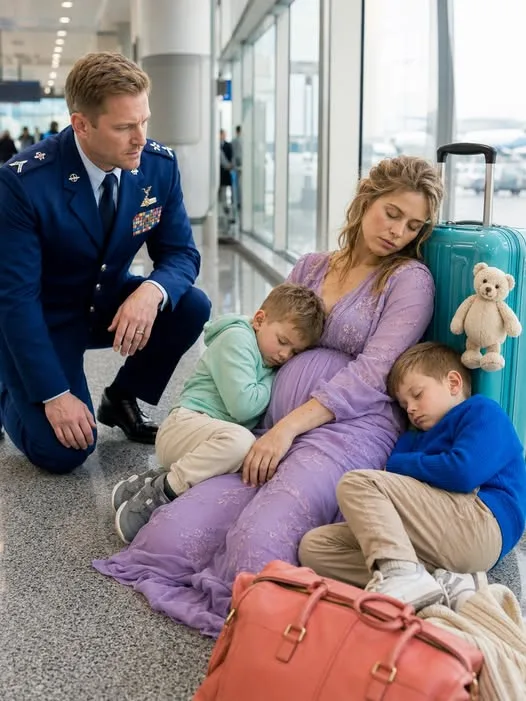
Daniel’s words changed everything.
Chapter 4
Daniel’s words changed everything.
A forged signature could be explained away as a mistake, an overzealous lawyer, or a document prepared but never executed. A dead notary could not.
Someone had manufactured the agreement from the beginning.
And whoever did it had assumed I would never see it.
I booked three rooms at one of my Chicago hotels and took Evelyn and the boys there. Eleanor demanded that I come home with her. I refused. For the first time in my life, I watched my mother walk away from me without knowing whether I would ever allow her back.
That afternoon, Daniel arrived with a forensic document examiner and a former federal investigator he used for corporate fraud cases.
The first finding came quickly.
The signature was not mine.
It had been constructed from two separate signatures lifted from documents I had signed years earlier. Under magnification, the examiner found microscopic breaks where the
strokes had been digitally combined before printing.
The second finding was worse.
The confidentiality agreement had been generated on a computer belonging to Vance Family Office. The metadata identified the user account of my mother’s longtime chief of staff, Raymond Cole.
Raymond had worked for our family for twenty-seven years. He had attended my father’s funeral. He had taught me how to drive a stick shift when I was sixteen.
I called him from the hotel conference room.
He did not answer.
Daniel sent an investigator to his home.
By evening, Raymond called back.
His voice sounded twenty years older.
“I’m sorry, Marcus.”
Those were his first words.
I put the call on speaker with Evelyn and Daniel present.
“Tell me exactly what happened,” I said.
There was a long silence.
Then he did.
My mother had ordered the agreement prepared after learning Evelyn was pregnant. She believed my father’s
health crisis and the company’s debt made any unexpected family development dangerous. She told Raymond that if I married Evelyn, certain investors might challenge the succession plan. She insisted she was protecting everything my father had built.
Raymond had copied my signature from a hotel financing document. The dead notary’s stamp had been taken from an old real-estate file because nobody expected anyone to verify it.
The family office attorney had arranged the transfer to Evelyn and drafted the letter claiming the money proved her acceptance.
Then came the part that made Evelyn cover her mouth.
My mother had also instructed staff to intercept mail addressed to me at the family residence and corporate office for three months. Letters from Evelyn were removed. Two were destroyed. One was kept in a locked file because Raymond could not bring himself to burn it.
“Where is it?” I asked.
“In the lower
archive room at the family office. Box seventeen. Folder marked Lausanne.”
Lausanne had nothing to do with Evelyn. It was a code label designed to make sure nobody opened the file accidentally.
I drove there with Daniel.
My access badge still worked.
At 8:40 that night, I opened box seventeen.
Inside was the life I should have had.
Evelyn’s original letter. A copy of the first ultrasound. A hospital bracelet from the twins’ birth. Three photographs. Notes from a private investigator my mother had hired to track Evelyn after she left Chicago.
The reports showed that Eleanor knew where Evelyn lived for nearly five years.
She knew the boys’ preschool.
She knew when Evelyn lost her job during the pandemic downturn.
She knew when one of the twins was hospitalized with pneumonia.
She knew Evelyn had eventually moved to New York and taken contract event work just to keep health insurance.
She knew all of it.
And she had never told me.
At the bottom of the box was a handwritten note in my mother’s unmistakable script.
Do not allow Marcus to make contact. The children will complicate succession and weaken negotiations. Their mother should have known her place.
I read that sentence three times.
Then I finally understood something I had spent my whole life refusing to see.
My mother did love me.
But she loved control more.
She loved the idea of the Vance family as an institution so fiercely that actual people had become expendable inside it.
The next morning, I called an emergency meeting of the Vance Family Trust.
Eleanor arrived with two attorneys. She still believed money and procedure could contain the damage.
I placed copies of the forged agreement, metadata report, investigator records, Evelyn’s intercepted letters, and Raymond’s recorded statement on the conference table.
Then I asked one question.
“Did you do this?”
Her attorneys told her not to answer.
She answered anyway.
“I did what your father would have done.”
That was her mistake.
My father had been difficult, proud, and obsessed with reputation. But he had also spent the final year of his life telling me that wealth meant nothing if it made me afraid to choose my own life.
“No,” I said. “You did what you wanted and used his name as cover.”
Under the trust agreement, fraud involving a beneficiary triggered an independent review. Daniel had already notified the trustees. Eleanor was removed temporarily from all administrative authority before lunch. Raymond resigned and agreed to cooperate. The family office attorney was referred to the state bar and later faced criminal investigation related to the forged notarization and fraudulent transfer documentation.
I could have kept the scandal private.
That was what Eleanor expected.
Instead, I authorized the company’s independent counsel to disclose the misconduct to our board and auditors. I refused to let the same family instinct that had buried Evelyn bury the truth again.
The consequences were immediate.
Two board members resigned. A lender demanded additional compliance oversight. Reporters learned that a governance review was underway. For several weeks, our company’s reputation took a beating.
The Boston acquisition went to another buyer.
I lost the largest deal of my career.
And strangely, I slept better than I had in years.
Because for the first time, I was no longer building my life on a lie.
The hardest part was not the investigation.
It was the boys.
You cannot recover six years with a press conference, a trust amendment, or a DNA result. And yes, the DNA test confirmed what my heart had already known: Noah and Ethan were my sons.
But they did not know me.
So I did not ask them to call me Dad.
I started smaller.
Breakfast.
A walk through Lincoln Park.
A museum visit where Noah corrected me about dinosaurs for forty minutes.
A Saturday afternoon teaching Ethan to float in the hotel pool while he clung to my shoulders and shouted that I was letting go too soon.
I wasn’t.
Not this time.
Evelyn was cautious with me, and she had every right to be. She did not fall into my arms because the conspiracy had been exposed. Six years of pain did not disappear just because I finally understood the cause.
We went to counseling.
We fought.
We apologized.
I learned how much she had sacrificed to protect the boys from believing their father had rejected them. She learned how completely I had been deceived. Neither truth erased the other.
Three months after the airport, I moved my corporate base back to Chicago for part of each month. Six months later, I bought a house ten minutes from the boys’ school. It was not a mansion. It had a crooked backyard fence, an old maple tree, and a kitchen Noah called too small until he discovered the pancake griddle.
Evelyn and I did not rush back into marriage.
We built something harder first.
Trust.
As for Eleanor, I saw her once during that first year.
She asked to meet me at a quiet restaurant near Lake Michigan. She looked smaller than I remembered. Not weaker exactly. Just stripped of the authority that had once entered every room before she did.
“I was trying to protect you,” she said.
I believed that she believed it.
“That is the problem,” I told her. “You decided protecting me gave you the right to choose who I loved, whether I became a father, and which truths I was allowed to know.”
She looked down at the table.
“Will I ever meet them?”
I thought about the photograph she had thrown away. The birthdays she had stolen. The note that said their mother should have known her place.
“That won’t be my decision alone,” I said. “It will be Evelyn’s, and eventually the boys’.”
For once, my mother had no power over the answer.
A year after the airport, I took Noah and Ethan to one of my hotels in Key West. At sunset, we stood on the dock while they argued about which of them looked more like me.
Evelyn sat nearby, laughing.
Ethan finally looked up and asked, “Dad, do you think we would’ve known you if we saw you when we were babies?”
The word Dad hit me harder than any accusation, any lost deal, any scandal.
I crouched beside him.
“I don’t know,” I said. “But I know I would have known you.”
For six years, I believed the worst thing that had happened to me was being abandoned.
I was wrong.
The worst thing was allowing someone else’s version of the truth to become my own because it was easier than asking harder questions.
I lost a seventy-million-dollar deal the day I found my sons.
I gained back the life my family had tried to erase.
And I never confused those two things again.
THE END.
Chapter complete
You have reached the end of this chapter.
Continue reading
A few more worlds to get lost in after this chapter.




