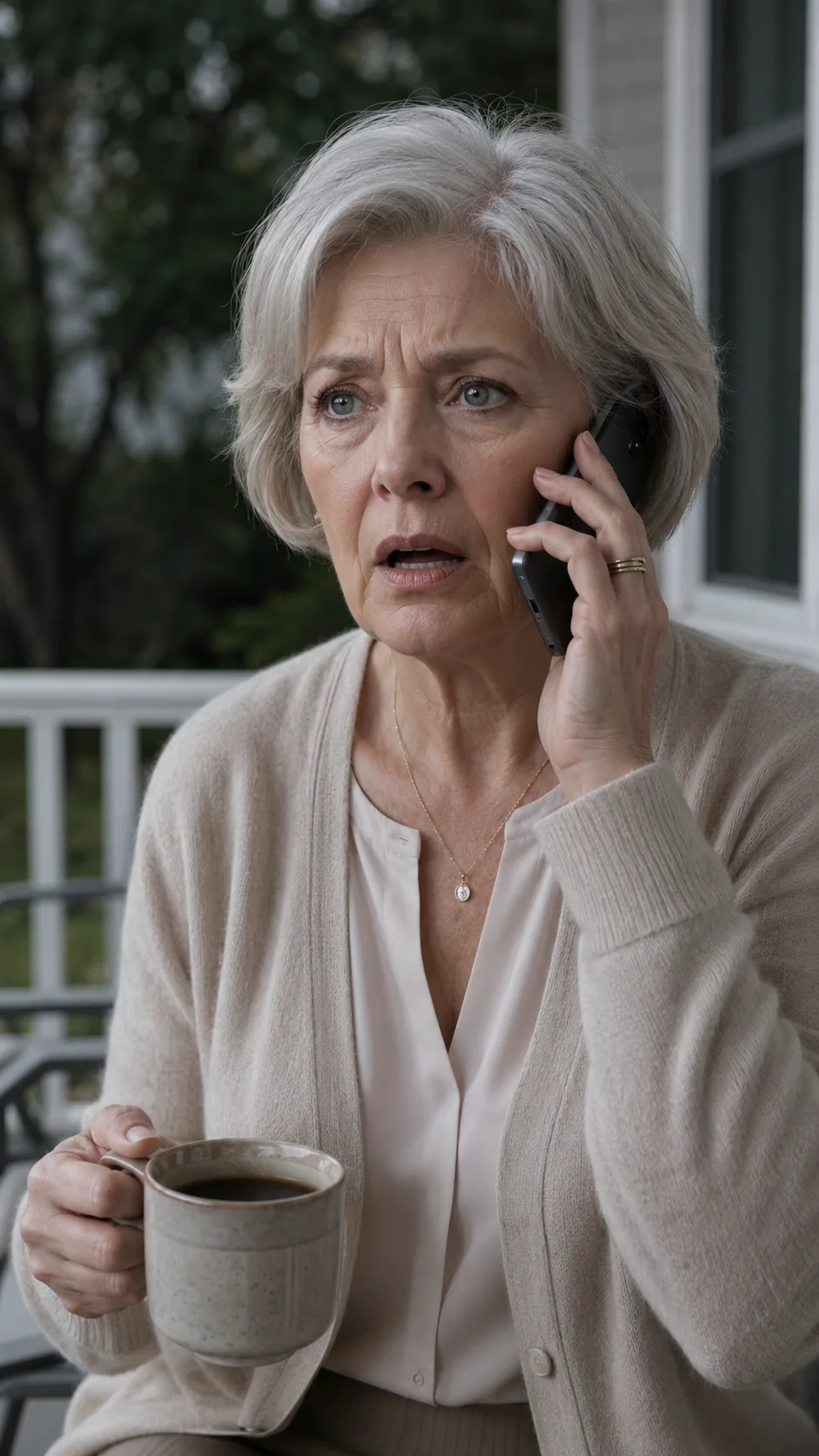
PART 3 — WHEN THEY CAME BACK TO MY GATE, I FINALLY SHOWED THEM WHAT CONSEQUENCES LOOK LIKE
I thanked Mr.
Chapter 3
PART 3 — WHEN THEY CAME BACK TO MY GATE, I FINALLY SHOWED THEM WHAT CONSEQUENCES LOOK LIKE
I thanked Mr.
Miller, hung up, and went back to my flowers.
Half an hour later, the old landline rang in my living room. Hardly anyone had that number anymore. I let it ring four times before answering.
“Hello.”
“Mom, finally!”
Richard’s voice crashed through the receiver.
“Do you know what just happened? They took the car. They actually took it. Melissa is standing in the street losing it.”
I moved the phone away from my ear slightly.
“Good morning, Richard. The children were not inside when it happened. Mr. Miller confirmed that. Don’t exaggerate.”
“Don’t exaggerate?” he said, almost laughing. “What is wrong with you? You froze the cards, killed the transfer, took the vehicle. We don’t have money in this awful place. You need help. We may have to get someone to evaluate you.”
There it was.
That quiet little threat people use when an older person becomes inconvenient. Not concern.
Control.
I sat down in Albert’s armchair and made my voice as hard as the wood around me.
“Listen carefully, Richard, because I will only explain this once. The vehicle belongs to the company. The cards were a courtesy. The transfers were generosity, not an obligation. All of that ended the moment you decided I was no longer worth basic honesty.”
“We didn’t abandon you,” he said. “This was an opportunity. We were going to call.”
“Yes,” I said. “You were going to call after you were settled. After the ocean-view apartment was secured. After the school transfer was done. After the moving truck was unpacked. After my role had been reduced to a video call and a distant grandmother.”
He went quiet.
“Let’s discuss something more important,” I said. “The lease guarantee.”
There was a pause so long it told me everything.
“What guarantee?” he asked finally, too quickly.
“The one attached to your Florida lease under my 2018 power of attorney. The one you had no permission to use.”
His breathing changed.
“Mom, we had to list somebody. They required assets. You have plenty. We were going to pay on time.”
“With what?” I asked. “With the money I sent every month? That money is gone. The guarantee is being challenged, and you now have until tomorrow to solve your own problem.”
Melissa’s voice burst into the call from somewhere beside him.
“You are unbelievably cold. We gave you grandkids. We brought joy into your life. And this is how you repay us?”
I smiled, though they could not see it.
“My grandchildren are always welcome with me,” I said. “Always. If the two of you lose your housing, send Lucas and Bella here and I will make sure they are safe. But I am no longer funding
a lifestyle built on disrespect.”
Melissa’s tone turned ugly and frantic.
“You’ll end up alone in that old house.”
“Alone and at peace is not the threat you think it is,” I said.
Then I added, softly,
“And tell Richard I visited the apartment. I saw the yellow-and-white blanket.”
Silence.
A heavy, guilty silence.
“It was just an old blanket,” Melissa muttered at last.
“No,” I said. “It was six months of work, love, and prayer. But that distinction would matter only to someone capable of recognizing care.”
Then I ended the call.
For several seconds, I sat in the stillness, my heart beating hard, not from fear but from release. I had finally said words I had swallowed for years. They had mistaken softness for weakness.
Now they knew otherwise.
That evening, just as the kettle began to whistle for tea, the doorbell rang. Through the peephole, I saw a courier with a clipboard.
The envelope she handed me was from the bank.
Inside was a notice about an attempted withdrawal of fifty thousand dollars.
Fifteen minutes earlier.
Someone had tried to access my accounts using an old saved password Richard once knew. The system had blocked it because the day before, on Miller’s advice, I had changed everything. Banking, email, cloud accounts, even the password on my home Wi-Fi and camera system.
I stared at that notice for a long time.
So that was where things stood.
No car. No cash flow. Possible eviction. And still, instead of accountability, he had tried one last time to reach into my accounts.
It was no longer simply selfishness.
It was desperation without principle.
I scanned the letter, emailed it to Miller as additional evidence, and then sat on the porch once again as darkness settled over the yard. Above me, the sky was full of stars. I thought of Lucas and Bella, those children caught inside the mess made by adults who had chosen pride over honesty.
I knew then that the quiet stage was over.
They would come.
Not by phone next time. In person.
If they did not have rent money, they could still find bus fare or borrow a cheap car. They would show up at my house claiming they needed to talk, claiming they needed help, claiming they needed to retrieve something, claiming family.
So I prepared.
I had the locks changed. I upgraded the camera system. I made sure audio was recording. Miller drafted a protective order he could file if their behavior crossed the line.
The woman I had been before that call was disappearing day by day.
In her place stood someone calmer.
Sharper.
Much less willing to be used.
Sunday arrived.
For twenty years, Sunday at my house had meant grilled meat, children’s laughter, footsteps in the hallway, paper plates stacked by the sink, coffee brewed all afternoon. That day, the air held only the smell of dark roast and lemon polish.
Everything was spotless.
Still.
Ready.
I knew they would come, and near noon they did.
An old, tired-looking car rolled up to the gate. I watched them on the office monitor. Richard got out first. His shirt was wrinkled, his beard untrimmed. Melissa climbed out behind him with her hair tied back in a hurry, her face bare, the confident shine missing. Then Lucas and Bella emerged, carrying backpacks that looked too heavy for their shoulders.
My heart pinched at the sight of the children.
But I did not move too quickly.
If I weakened at the wrong moment, everyone would learn the wrong lesson.
Richard tried the side gate with an old key.
Nothing.
Melissa snatched it from him, tried another, then another. When none worked, she shouted,
“You changed the locks? This is my husband’s house!”
Richard started pressing the doorbell over and over like a man trying to force his way through sound alone. I let them ring for several minutes. Long enough for the summer heat to settle on them. Long enough for the neighbors to look over and understand that something had finally shifted.
Then I stepped onto the porch.
I did not walk down to them right away. I stood above them for a moment and let them look up.
“Mom!” Richard called. “Open up. The key won’t work. The kids are hungry.”
I walked slowly to the gate and stopped on the other side.
“The key doesn’t work because this is no longer your home,” I said. “You moved out, remember? You just forgot to tell me.”
Melissa threw up her hands.
“Stop this. We spent twelve hours on a bus with two kids. We are exhausted.”
I looked directly at the children.
“Lucas. Bella. You may come in.”
Both adults froze.
“The gate will open for you,” I said. “You can shower, eat, and rest.”
Richard stared at me as if I had gone mad.
“Mom, I’m your son.”
“And those are my grandchildren,” I said.
I took the remote from my pocket and pressed the button. The gate slid open just enough for one person to pass through.
“Come on, darlings. Grandma has chocolate cake and cold juice inside.”
The children hesitated, looking at their parents. Melissa grabbed Bella’s wrist.
“No one goes in unless all of us go in.”
I held her gaze.
“Let go of my granddaughter. Do not place children in the middle of an argument to make yourself stronger.”
Something in my voice made her release Bella at once.
The children broke away and ran toward me. I folded them into my arms, smelling sweat, dust, sunscreen, travel, and the ache of children who had been dragged through adult failure. I kissed their heads and led them inside.
Then I turned back toward the gate.
“Now we talk.”
Richard kicked at the metal bars.
“You ruined everything in three days. The money, the car, the lease. We got forced out. We had to leave in the middle of the night.”
“And whose fault is that?” I asked. “Mine? Or the fault of the man who signed papers beyond his means and tried to hide me behind them?”
His face changed.
“You knew?”
“I know more than you think,” I said. “I know how you left the apartment. I know about the blanket. I know about the attempted withdrawal from my account.”
Melissa turned toward him.
“You told me you were going to ask her, not do something foolish.”
“Quiet,” he snapped.
I pulled a folder from under my arm and held it up.
“Bank notice. IP information. Records. Documents. Enough to make things very serious if I choose.”
Richard’s shoulders sagged. For the first time, his confidence was gone. In its place stood a tired man confronted with the bill for his own choices.
“What do you want?” he asked.
“The truth,” I said. “And structure.”
I slid a packet through the bars.
“Miller drafted an agreement. Read it.”
Richard unfolded the papers with shaking hands.
It required them to acknowledge the damage done to the apartment and the misuse of company resources. It required them to waive any claim to control over the family company during my lifetime. It required stable work and stable housing before the children would resume full-time life under their roof. And it gave them an alternative to deeper legal action if they cooperated.
Melissa looked over his shoulder, then stared at me as though I had become someone unrecognizable.
“You’re trying to take our children from us.”
“No,” I said. “I am protecting them from instability and teaching the two of you what responsibility looks like.”
“I’ll never agree to this,” she said.
“That is your choice,” I told her. “But if you refuse, Miller proceeds with everything else. You have a few minutes to decide whether pride is still worth more to you than repair.”
The street was quiet.
The children were inside my house, finally safe, eating cake at my kitchen table.
Richard looked at the papers, then at the house, then at me. For the first time in years, I saw something in his face that resembled respect. Fear had brought it there, yes. But it was real all the same.
“Do you have a pen?” he asked hoarsely.
I took one from my pocket and tossed it lightly through the gate.
It landed against the concrete with a small click.
He bent to pick it up.
I did not need to watch him sign to know he would.
Inside, Bella had chocolate on her upper lip.
“Grandma,” she asked, “aren’t Mom and Dad coming in?”
I smoothed her hair back from her forehead.
“Your parents have some grown-up things to work through, sweetheart. They’ll be nearby. But first they need to learn how to carry the weight of their own choices.”
“What kind of things?” she asked.
I poured myself another cup of coffee.
“The kind that help people become stronger. Kinder. More honest.”
A few minutes later, Richard pushed the signed papers back through the gate.
He was crying.
No mother feels nothing seeing her son brought low. A small pain moved through me. But beneath it, there was peace. Something poisonous had finally been cut away. Healing would not be easy, but at least now it could begin on honest ground.
The next stage was not punishment.
It was correction.
The apartment I arranged for Richard and Melissa after that was small. Two bedrooms. Ten blocks from my house. No ocean view. No staff. No luxury. Just walls, a kitchen, and a chance to start again properly. I paid the first stretch because I would not let my grandchildren pay for their parents’ mistakes, but I made one thing clear:
There would be no more allowance.
No more open accounts.
No more hidden rescue.
They would work. Budget. Learn.
And they did.
Six months passed.
It may sound short when measured on a calendar, but it is long enough to change the shape of a life when each day requires humility. By the time winter turned, my home no longer smelled like loneliness. It smelled like stew on the stove, sharpened pencils, children’s shampoo, and the paper-and-wood scent of homework spread across the dining table.
Lucas and Bella stayed with me during the week. I paid the school directly. I packed lunches, helped with spelling lists, and taught them to make their beds. On weekends, they stayed with their parents in the little apartment that Lucas once innocently called “Mom and Dad’s little house.”
Lunch on Sundays became our new ritual.
Only now it began on time.
Everyone helped.
No one drifted in late expecting a hot plate and an easy smile.
One Sunday at exactly noon, the doorbell rang. I opened it and found Richard standing there in worn jeans and a plain polo shirt. He had lost weight. The expensive suits were gone. So was the puffed-up certainty. In its place was a quieter expression I had not seen on him since he was young.
“Hi, Mom,” he said.
He bent and kissed my hand. Not as performance. Not as habit. As respect.
“Come in,” I said.
Melissa stood behind him with a glass dish covered in foil.
“I made pudding,” she said softly. “I found a recipe online. It isn’t as good as yours, but I wanted to try.”
“Thank you,” I told her. “Put it in the fridge.”
That simple sentence would once have been impossible between us.
The two-bedroom apartment had taught them many things. Richard now worked as an administrative assistant for a shipping company. Real hours. Real reporting. Real effort. Melissa had taken freelance proofreading, sold some of her clothes online, and learned the price of groceries in a way she never had before.
The first months had not been easy. There were arguments, tears, bruised pride, swallowed resentment. But there was also movement. Growth. Something steadier than apologies alone.
At lunch that day, Richard poured orange juice while Melissa carried in the rice.
“How was work?” I asked.
“Hard,” he admitted. “My supervisor is strict. But I got praised this week. I reorganized the file storage system. They said they may keep me after probation.”
“That’s good,” I said. “Honest work steadies a man.”
Melissa smiled shyly.
“I paid the electric bill this month myself,” she said. “And there was enough left over for milk and school supplies.”
I nodded.
“That matters more than appearances.”
After lunch, we went into the office. It had become our routine. Once a month, they brought me their household budget. Not so I could rescue them. So I could teach them how to read their own lives clearly.
Richard opened the notebook.
“We were short two hundred dollars this month because of medicine for Lucas.”
I went down the page with a red pen.
“No,” I said. “You were short because you also spent seventy dollars eating out last Saturday. If you had made sandwiches at home, the medicine would not have created a problem. Priorities first. Comfort second.”
He lowered his eyes.
“You’re right.”
Then I handed them an envelope.
Two hundred dollars.
Melissa looked surprised.
“It isn’t a gift,” I said. “It is payment for work if you want it. The roof drain is clogged, and the living-room curtains need washing. Finish both this afternoon and it’s yours. Refuse, and I hire someone else tomorrow.”
Richard looked at his hands, rougher now than they had been a year earlier. Then he looked at his wife.
“We’ll do it.”
Years ago, they would have laughed and told me to hire help.
That afternoon, I sat on the porch with Lucas and Bella while Richard cleaned leaves from the gutters and Melissa scrubbed the curtains in the wash basin. Their shirts were damp with sweat by the time they finished, but they were smiling in that tired, honest way people smile when they have actually earned the end of a day.
Lucas leaned against me and asked,
“Grandma, when will Mom and Dad be rich again?”
I put my arm around him.
“They’re already learning how to be rich in the important things,” I said. “Strong. Responsible. Kind. That kind lasts longer.”
Before they left that evening, Richard stopped by the gate.
“Mom.”
I looked up.
His eyes were red.
“Thank you,” he said. “Not just for the money today. For stopping me when you did. I hated you for it. But if I’d kept going the way I was going, I would have lost much more than Florida.”
My throat tightened.
I touched his cheek.
“I did not raise you to be spoiled, Richard. I raised you to be a man. It just took you a while to return to that path.”
Melissa stepped forward after him.
“I started learning to knit,” she said, almost embarrassed. “I watched some videos. It’s harder than it looks. I’m sorry about the blanket.”
I swallowed and nodded.
“Yes,” I said quietly. “It is hard. Most worthwhile things are.”
They drove away in the old used car they had bought themselves on installment. No luxury SUV. No beach view. No performance. But they had direction now.
That mattered more.
When the house quieted down, I went into the cabinet and took out a box of yellow-and-white yarn. I sat in my armchair and began the first stitches of a new blanket.
Not because the old one could be replaced.
It couldn’t.
But because the future can still be made by hand if you are willing to sit with the work.
My name is Lori. I am sixty-eight years old. For a little while, my son and his wife mistook me for the past. They thought age meant softness without strength. They thought love meant permanent access. They thought motherhood meant there would always be another check, another chance, another silence.
They were wrong.
A mother’s love can be soft as yarn.
But when it has to be, it can also be as strong as the needles that shape it.
I have learned that it is never too late to teach a grown child how to stand on his own feet. Never too late to stop confusing sacrifice with surrender. Never too late to remember who you are.
Now, when I look at my reflection in the glass after dark, I do not see a lonely old woman waiting for life to pass. I see a woman who took hold of the wheel again before everything crashed for good.
And life, as it turns out, goes on just fine when you stop financing disrespect and start requiring character instead.
THE END.
Chapter complete
You have reached the end of this chapter.
Continue reading
A few more worlds to get lost in after this chapter.




