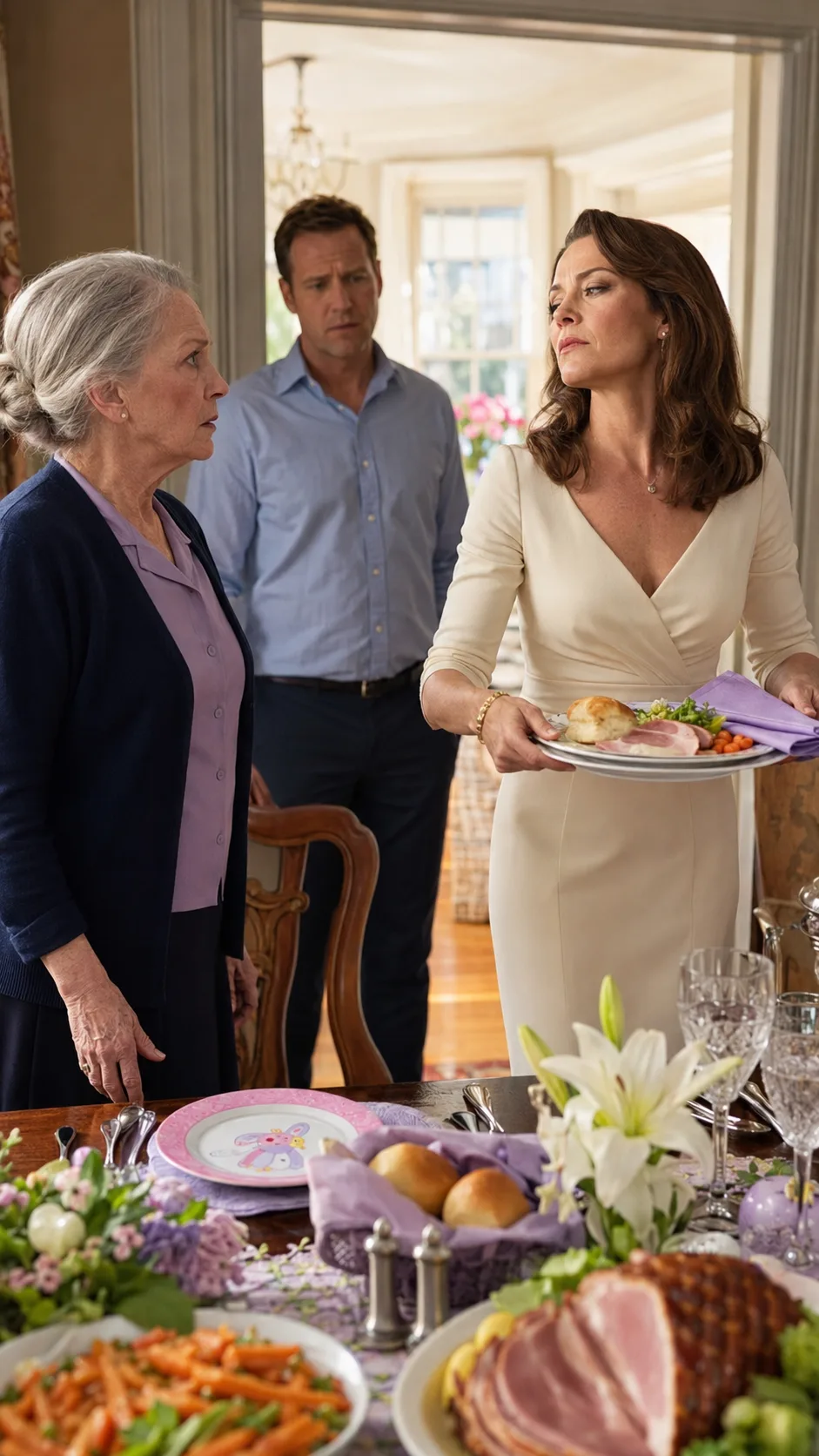
Harold Benson entered my house carrying a leather briefcase.
Chapter 3
Harold Benson entered my house carrying a leather briefcase.
Two police officers followed him.
Renee immediately stepped away from the table.
“This is ridiculous,” she said. “This is a family disagreement.”
Harold looked at the loan documents beneath my hand.
“Forging a property owner’s signature on a financial application is not a family disagreement.”
Renee’s face tightened.
“I did not forge anything.”
Scott stared at her.
“I saw the papers.”
“You saw copies,” she snapped.
Harold opened his briefcase and removed another folder.
“The bank has the originals.”
For the first time, Renee had no immediate response.
One of the officers asked her to step into the hallway.
She crossed her arms.
“I’m not going anywhere.”
The officer remained calm.
“Ma’am, we need to ask you questions regarding a suspected fraudulent loan application and attempted financial exploitation of an elderly property owner.”
“Elderly?” Renee repeated, glancing at me with a bitter smile. “She is perfectly capable of causing all
this trouble.”
Harold’s expression hardened.
“Her capability is exactly why your plan failed.”
Renee looked toward Scott.
“Say something.”
He stood beside the table, staring at the forged signature.
“Did you write her name?”
“I was trying to save us.”
“That isn’t what I asked.”
“You knew we needed money.”
“I didn’t know you forged my mother’s signature.”
“I told you she approved it.”
“You lied.”
Renee laughed sharply.
“Do not suddenly pretend to be innocent. You were happy to live here without paying rent. You were happy to let your mother cover everything while you pretended to have a job.”
Scott flinched as though she had struck him.
Sophie covered her ears.
“Stop yelling!”
I moved toward my granddaughter and placed an arm around her shoulders.
Ben stood beside us, still holding the plastic Easter egg.
Renee pointed toward me.
“This is what she wants. She wants everyone to
turn against me.”
“No,” I said. “I wanted to eat Easter dinner in my own dining room.”
The simplicity of that sentence silenced everyone.
I had not demanded control over their marriage.
I had not asked them to leave without warning.
I had not exposed Scott’s unemployment.
I had wanted a chair at the table I had purchased, beneath the roof I had repaired, beside the grandchildren I loved.
Renee had decided even that was too much.
The officer repeated his request.
“Please step into the hallway.”
Renee’s mother backed away.
“I didn’t know,” she kept saying. “I swear I didn’t know.”
Perhaps she was telling the truth.
Perhaps she had believed Renee’s claim that I wanted to move into a senior community.
But she had sat at my Easter table and watched her daughter carry my plate away.
She had said nothing.
Silence had become the most common language
in my house.
Scott’s silence when Renee changed the curtains.
His silence when she threw out Frank’s recliner.
His silence when she called my kitchen hers.
His silence when she introduced me as a woman who “stayed with them.”
His silence when she moved my chair.
Each silence had taught Renee that she could go further.
Until she believed she could take everything.
The officers escorted her into the hallway.
She began shouting before they reached the front door.
“You need me, Scott! You cannot handle those children without me!”
Scott covered his face.
Renee twisted toward me.
“You think you won? You’ll die alone in this house!”
Sophie began crying again.
I kept my voice steady.
“I would rather live alone than disappear in a crowded room.”
Renee’s expression twisted with hatred.
Then the front door closed behind her.
The house became quiet.
Not peaceful.
Not yet.
But honest.
Harold spoke privately with the officers while Scott sat down.
His shoulders shook.
Renee’s mother gathered her purse and coat.
She stopped beside me.
“Gail, I truly believed you wanted to move.”
“You believed what was convenient.”
Her eyes lowered.
“I’m sorry.”
I did not tell her it was all right.
Some apologies deserve time before they receive forgiveness.
She kissed Sophie and Ben, then left.
By sunset, the ham had gone cold.
The lilies were still open beneath the fading light.
The renovation folder sat unopened on the sideboard.
Renee was gone.
Harold explained that the investigation would continue. The bank had frozen the application before any money was released, but the forged documents and electronic communications were now evidence.
The protected trust remained valid.
The house could not be sold, mortgaged, transferred, or renovated without the trustee’s approval.
Sophie and Ben would remain the future beneficiaries.
Scott and Renee had no ownership rights.
Harold turned toward my son.
“You will need to arrange another place to live.”
Scott nodded without lifting his head.
After Harold left, Scott walked onto the front porch and sat on the steps.
For several minutes, I watched him through the window.
The man sitting outside looked smaller than the boy I remembered.
When Scott was seven, he had once fallen from his bicycle and split his knee open. He had cried so hard he could barely breathe.
I had carried him into the kitchen, cleaned the wound, and promised he would be all right.
A mother’s body remembers the weight of her child long after that child becomes too heavy to carry.
I went outside.
Scott heard the door open but did not look up.
“Mom,” he whispered.
I stood beside him.
“I’m sorry.”
His voice broke.
“I should have stopped her.”
“Yes.”
“I should have told you about the job.”
“Yes.”
“I was ashamed.”
“I know.”
He finally looked at me.
“I never thought she would actually try to take the house.”
“You watched her take smaller pieces of it every day.”
His face crumpled.
“I kept thinking if I stayed quiet, things would calm down.”
“Silence does not calm cruelty, Scott. It feeds it.”
He wiped his eyes.
“What happens now?”
“You find somewhere else to live.”
His shoulders stiffened.
“Mom, please.”
“You can see Sophie and Ben. You can get help. You can look for work. You can rebuild your life.”
I paused.
“But not in my house.”
He began to cry harder.
I loved him.
That was the terrible part.
I loved him even after everything.
But love is not the same as permission.
Love does not require surrender.
Love does not mean allowing your child to stand silently while someone erases you from your own life.
“I don’t know where to go,” he said.
“Harold has information about temporary housing. You also have friends. You have choices.”
“You’re really making me leave?”
“I am requiring you to grow up.”
He looked toward the yard.
“Will you ever forgive me?”
“I don’t know.”
The answer hurt both of us.
“But forgiveness and trust are not the same thing. Even if I forgive you, you will have to earn your way back into my trust.”
He nodded.
For once, he did not argue.
Inside, Sophie and Ben sat at the dining table eating cold rolls with butter.
When I returned, Sophie looked at the empty chair beside her pink plate.
“Grandma, are Daddy and Mommy coming back?”
“Your daddy will still see you. The adults are going to work things out.”
“Is Mommy in trouble?”
I chose my words carefully.
“Your mother made serious choices, sweetheart. Grown-ups have consequences too.”
Ben opened the plastic egg he had found.
Inside were two jellybeans.
He gave one to Sophie and offered the other to me.
I accepted it.
“Is Easter ruined?” Sophie asked.
I looked around the room.
The meal was cold.
The flowers were beginning to droop.
The chair Renee had moved had been returned to its original place beside Sophie.
But before I sat down, I placed both hands on its wooden back.
Then I moved it myself.
Sophie’s eyes widened.
I did not move it toward the sunroom.
I did not move it away from the family.
I carried it to the head of the table.
The place where Frank had once carved the ham.
The place Scott had assumed belonged to him.
The place Renee had begun treating as hers.
I sat down.
Sophie smiled through her tears.
“Grandma?”
“Yes, sweetheart?”
“Is Easter ruined?”
I looked at the house Frank and I had saved.
At the table I had prepared.
At the empty doorway where Renee’s shadow no longer stood.
Then I picked up the carving knife and sliced the ham.
“No,” I said.
“Easter is when things rise again.”
We reheated the carrots.
We passed the rolls.
Sophie told me she had found six eggs.
Ben insisted he had found seven.
The dining room slowly filled with the ordinary sounds of family again.
Not the family Renee had tried to control.
Not the family Scott had failed to protect.
A smaller family.
A wounded family.
But one that finally understood whose home it was.
That evening, after the children fell asleep, I walked through every room.
The curtains Renee had chosen still hung over the windows.
Her dishes remained in the cabinets.
Boxes of her belongings were stacked near the stairs.
But the house felt different.
It had not changed.
I had.
I entered the sunroom and looked at the wicker loveseat beside the fern.
My untouched glass of iced tea was still there.
No lemon.
After three years, Renee had never remembered how I liked it.
I carried the glass into the kitchen, added a slice of lemon, and drank it standing beneath the light.
The next morning, I called a locksmith.
Then I called a contractor.
Not Renee’s contractor.
A different one.
I asked him to remove nothing.
I wanted the kitchen wall to remain.
I wanted my downstairs bedroom exactly where it was.
I wanted Frank’s old workshop repaired.
And I wanted the dining-room chair at the head of the table reinforced.
Because I had finally learned that protecting your place does not make you cruel.
Setting a boundary does not make you selfish.
And refusing to be erased does not mean you stopped loving your family.
It means you finally remembered to love yourself too.
THE END
Chapter complete
You have reached the end of this chapter.
Continue reading
A few more worlds to get lost in after this chapter.




