Two Grandmothers Battled for One Baby—Until a Shocking Family Secret Stopped the Fight
The argument began over a baby name.
Chapter 1
Two Grandmothers Battled for One Baby—Until a Shocking Family Secret Stopped the Fight
The argument began over a baby name.
By the end of the night, no one in that room cared what the baby would be called.
My name is Sarah Anderson now, though for most of my life I was Sarah Brooks, daughter of Linda Brooks, a woman who believed dignity was something you carried even when you had nothing else.
My husband, Michael, came from the Anderson family.
Anderson.
That name was practically a religion to his mother.
Patricia Anderson had been a widow for twelve years, but she still carried herself like the queen of a dynasty. Her late husband, Thomas Anderson, had built a chain of luxury hotels across the Midwest. Their family portraits hung in polished hallways. Their Christmas cards looked like magazine covers. Their last name opened doors before anyone even asked for a first name.
Patricia loved saying things like, “The Anderson name has meant something for over a hundred years.”
My
mother, Linda, would smile politely and answer, “A name means nothing without character behind it.”
That was usually when the room got quiet.
From the moment Michael and I got engaged, our mothers disliked each other in that sharp, polite way that only older women can manage.
Patricia thought my mother was stubborn, plain, and overly proud for someone who had spent thirty years teaching elementary school.
My mother thought Patricia was arrogant, performative, and obsessed with appearances.
They argued about the wedding.
Patricia wanted a grand ballroom. My mother wanted a church reception with family food.
They argued about where Michael and I should live.
Patricia said, “A married couple needs a proper home.”
My mother said, “A married couple needs peace.”
They argued about baby showers, bassinets, discipline, holidays, baptism, family photos, and, somehow, the shade of pale blue we chose for the nursery.
But nothing compared to
the war that began after my son was born.
Noah.
That was the name Michael and I had quietly chosen months before delivery.
Simple. Gentle. Ours.
But Patricia didn’t like it.
“He should be named Thomas,” she said, standing at the foot of my hospital bed with a pearl necklace resting perfectly against her cream blazer. “After his grandfather.”
My mother, who was sitting beside me holding my hand, stiffened.
“My father’s name was Samuel,” she said. “Sarah loved him. He practically raised her after my husband died.”
Patricia gave her a thin smile.
“That is very touching, Linda. But this child is an Anderson.”
My mother’s eyes narrowed.
“He is also a Brooks.”
Patricia looked at the baby in my arms and said, “Not on paper.”
That was the first time I saw my mother almost lose her composure.
Almost.
She simply stood, adjusted the blanket around my shoulders,
and said, “Paper has never been the final measure of family.”
Two weeks later, Patricia hosted Noah’s one-month celebration at her house.
Not a small gathering.
A production.
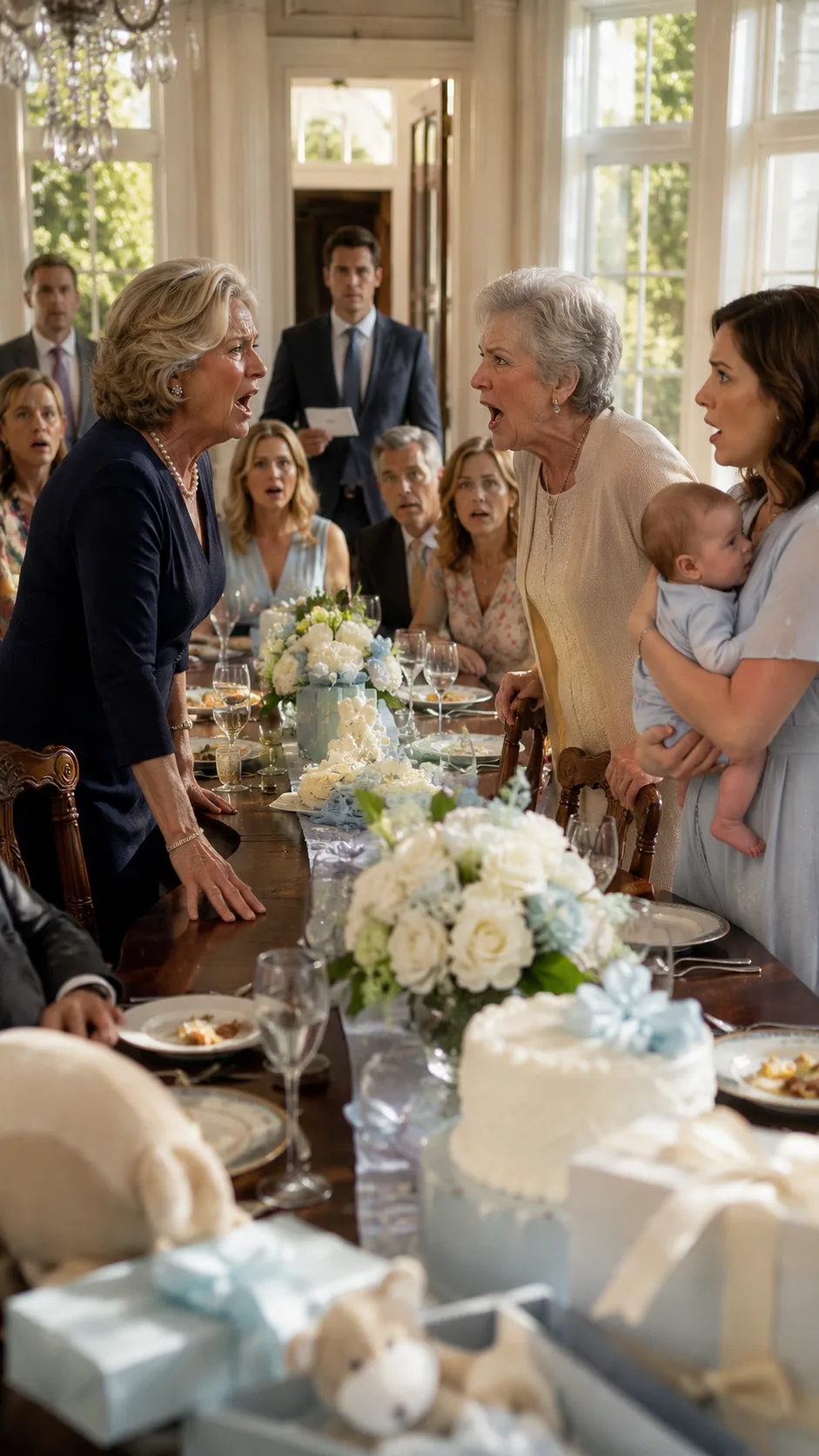
The Anderson estate sat on a hill outside Chicago, all white columns, trimmed hedges, and old money pretending not to show off. By noon, the dining room was full of relatives, business friends, neighbors, and people I suspected Patricia had invited just so they could witness her reclaim control.
There were silver trays, white roses, monogrammed napkins, and a huge cake with blue icing.
The cake said:
WELCOME BABY THOMAS ANDERSON.
I saw it before anyone else did.
My stomach dropped.
Michael was upstairs changing his shirt after Noah spit up on him. My mother was helping me carry the baby into the dining room.
She stopped when she saw the cake.
For a moment, she said nothing.
Then she turned to Patricia, who stood near the fireplace like she had been waiting for this.
“Patricia,” my mother said carefully, “why does that cake say Thomas?”
Patricia lifted her champagne glass.
“Because every child deserves a name with history.”
I felt heat crawl up my neck.
“We told you his name is Noah,” I said.
Patricia’s smile didn’t move.
“You are tired, darling. New mothers change their minds constantly.”
My mother stepped forward.
“My daughter did not change her mind.”
Patricia looked at her for the first time that afternoon.
“This is a family matter.”
The room froze.
My mother’s face went still in a way I knew too well. That was the expression she wore when a parent at school tried to blame her for their child’s behavior. Calm, but dangerous.
“My grandson is my family,” she said.
Patricia set her glass down with a soft click.
“He is the first Anderson grandson in this branch of the family. He will carry the name properly.”
My mother gave a small laugh, but there was no humor in it.
“Properly? You mean your way.”
“I mean with respect.”
“Respect is not obedience, Patricia.”
“And pride is not poverty dressed up as principle.”
A gasp moved through the room.
I actually felt it, like the air had been pulled backward.
My mother’s hand tightened around the baby blanket.
I stepped forward, but before I could speak, Patricia raised her voice.
“This child is my grandson. He is an Anderson. He belongs to this family line.”
My mother stood taller.
“He is also my grandson. He comes from people who worked, sacrificed, and loved without needing a portrait on the wall to prove it.”
Patricia’s face flushed.
“Do not lecture me about family.”
“Then stop acting like you invented it.”
That was when Michael walked in.
At first, I was relieved.
Then I saw his face.
He was pale.
Not tired pale.
Not stressed pale.
The kind of pale a person gets after seeing something they cannot unsee.
In his right hand was a white envelope.
“Michael?” I said.
He didn’t answer me.
He looked at Patricia.
Then at my mother.
Then down at Noah sleeping in my arms.
The room was silent except for the faint clink of someone setting down a fork.
Patricia noticed the envelope.
“What is that?”
Michael swallowed.
“I need everyone to hear this.”
My chest tightened.
Patricia’s eyes sharpened.
“If this is about the name, we can discuss it privately.”
“No,” Michael said. “We can’t.”
My mother took one step toward me, instinctively protective.
Patricia looked offended now.
“Michael, what have you done?”
He held up the envelope.
My heart slammed against my ribs.
I whispered, “Michael… is that about Noah?”
His eyes met mine immediately.
“No.”
Patricia stepped forward.
“Did you test that baby?”
The words hit the room like glass breaking.
My mouth opened.
My mother said, “How dare you.”
But Michael shook his head.
“No. I didn’t test Noah.”
His voice cracked.
“I tested myself.”
No one spoke.
Patricia blinked.
“What?”
Michael opened the envelope with trembling hands.
“I did one of those ancestry DNA kits months ago. Just for fun. Sarah got me one for Christmas.”
I remembered. We had laughed about it. I’d bought it because Michael always joked that the Andersons probably had Viking blood based on how seriously his mother took the family crest.
He pulled out the paper.
“I got a notification last week that there was a close biological match in the system. At first I thought it was a mistake.”
Patricia’s face changed.
It happened so quickly that I almost missed it.
Her mouth tightened.
Her hand moved toward the pearls at her throat.
Michael looked directly at her.
“Dad wasn’t my biological father.”
The room went completely still.
Patricia did not move.
One of Michael’s uncles muttered, “What the hell?”
Michael’s voice shook harder.
“Thomas Anderson raised me. Loved me. Gave me his name. But he was not my father.”
Patricia’s glass slipped from her fingers and shattered on the floor.
Noah stirred in my arms but didn’t wake.
For forty years, Patricia Anderson had built her entire identity around lineage. Around legacy. Around blood and name and inheritance.
And now her only son stood in front of everyone saying the Anderson bloodline she worshiped had never passed through him at all.
I looked at Michael, and my heart broke.
Because he wasn’t angry yet.
He was lost.
“Mom,” he said, barely audible, “tell me it’s wrong.”
Patricia’s lips parted.
Nothing came out.
Michael took a step toward her.
“Tell me there was a mistake.”
My mother stared at Patricia.
For the first time in all the years I’d known them, Linda Brooks did not look ready to argue.
She looked afraid.
Patricia’s shoulders began to tremble.
“Michael…”
He shook his head.
“No. Say it clearly.”
Patricia covered her mouth with one hand.
And then, in front of everyone, the proudest woman I had ever known began to cry.
“I knew,” she whispered.
The room erupted.
Voices rose at once.
“What?”
“You knew?”
“Patricia!”
Michael went completely still.
I will never forget his face.
It was not rage.
It was something worse.
A child hearing the floor disappear beneath him.
“You knew?” he said.
Patricia nodded, tears running down her cheeks now, cutting through the powder on her face.
“I knew.”
Michael backed away from her.
“All my life?”
She closed her eyes.
“Yes.”
He laughed once, but it sounded broken.
“All my life you told me I had to live up to the Anderson name. You corrected how I stood in photos. You made me memorize family history. You told me Dad’s blood ran through me.”
Patricia’s chin trembled.
“He was your father.”
“But you lied.”
“He loved you.”
“You lied.”
Patricia pressed both hands to her chest.
“I was nineteen when I met him.”
“Who?”
She opened her eyes.
“The man who was your biological father.”
I felt my mother inhale sharply beside me.
Patricia continued, each word coming out like it cost her something.
“It was before Thomas. Before the engagement. I was young, terrified, stupid in the way young girls are when someone makes them feel seen. He said he loved me. Then he disappeared.”
Michael’s jaw clenched.
“And Dad knew?”
Patricia nodded.
“When I met Thomas, I was already pregnant. I told him everything. I expected him to leave. Instead, he asked me if I wanted the child.”
Her voice broke.
“I said yes.”
No one interrupted now.
Even Patricia’s relatives had gone quiet.
“He married me,” she said. “He gave you his name before you were even born. He was there when you took your first breath. He was the first person to hold you.”
Michael looked down at the paper in his hand.
“You should have told me.”
“I was afraid.”
“Of what?”
Patricia’s eyes lifted to the Anderson portraits lining the dining room wall.
“Of losing everything. Of losing him. Of losing you. Of people looking at you like you were less.”
My mother’s voice cut through the room.
“So you made everyone else feel less first.”
Patricia flinched.
Linda stepped forward slowly.
“You wrapped yourself in a name because you were terrified someone would discover it wasn’t the whole truth.”
Patricia looked at her.
Something passed between them.
Something old.
Something I didn’t understand.
Then my mother sat down.
Hard.
The color had drained from her face.
“Mom?” I said.
She didn’t answer.
She opened her purse with shaking hands and pulled out an old leather wallet.
“Linda?” Patricia said.
My mother ignored her.
She slipped out a small faded photograph, the kind with softened corners and yellowed edges.
She held it for a moment like she was deciding whether to break the past open.
Then she placed it on the table.
Everyone leaned in.
In the photo were two young women sitting on the front steps of a brick building.
One had dark hair, serious eyes, and a simple cotton dress.
My mother.
The other had blonde hair tied back with a ribbon, one hand resting protectively over her stomach.
Patricia.
Patricia stared at the photo.
Her mouth opened.
Then closed.
Then opened again.
“No,” she whispered.
My mother looked up at her with tears in her eyes.
“You don’t remember me.”
Patricia shook her head slowly.
“I… I don’t…”
“I remember you,” my mother said. “Your name wasn’t Patricia Anderson then. You called yourself Patty.”
Patricia gripped the back of a chair.
My mother’s voice softened.
“It was at St. Agnes House. For young women who had nowhere safe to go.”
A murmur moved through the room.
Patricia looked like she might collapse.
“No one was supposed to know about that place,” she whispered.
“I know.”
My mother touched the photograph.
“I was there too.”
I stared at her.
“What?”
She looked at me.
“I never told you because it was not only my story.”
My throat tightened.
My mother, who had always seemed so certain, so unbreakable, suddenly looked like a girl carrying something heavy for too long.
“I was seventeen,” she said. “My parents sent me there after I got pregnant. I lost the baby before my fifth month.”
I gasped.
“Mom…”
She shook her head gently, as if asking me not to stop her.
“After that, I stayed for a while. Helped in the kitchen. Helped the newer girls. That was where I met Patty.”
Patricia was crying silently now.
My mother looked at her.
“You were terrified every day.”
Patricia’s hand covered her mouth.
“You helped me,” she whispered.
“Yes.”
The room was so quiet I could hear Noah breathing.
My mother continued.
“You came in wearing a blue coat that was too thin for the weather. You had no money. No family willing to claim you. You kept saying he was coming back.”
Patricia closed her eyes.
“He never did.”
“No,” my mother said. “He didn’t.”
Michael stared between them.
“You knew my mother?”
My mother nodded.
“She wouldn’t eat. She wouldn’t sleep. She was afraid if anyone found out, her life would be over.”
Patricia sank into the chair.
Linda’s voice shook now.
“I helped her hide letters. I sat with her during appointments. I lied to one of the sisters when she tried to contact Patricia’s parents. I told her Patty needed time.”
Patricia sobbed once.
“I remember someone singing at night.”
My mother smiled through tears.
“That was me.”
Patricia looked at her as if seeing her for the first time.
“It was you?”
“Yes.”
For years, Patricia had looked down on my mother as if Linda Brooks were some outsider trying to climb into the Anderson world.
But long before any Anderson mansion, before family portraits and pearls and silver trays, my mother had sat beside a frightened pregnant girl in a charity home and helped her survive.
Patricia pressed both hands over her face.
“Oh my God.”
My mother’s voice was quiet.
“You hated me for being ordinary. But I knew you before you had anything to hide behind.”
Patricia lifted her face.
“I didn’t know.”
“I know.”
“I would never have—”
“Yes,” my mother interrupted, not cruelly, but firmly. “You would have. Because you were still afraid.”
Patricia cried harder.
Michael sat down like his legs had stopped working.
I wanted to go to him, but Noah shifted in my arms. I looked down at my son, his tiny mouth twitching in sleep, completely unaware that the adults around him were watching their entire history collapse.
Then the doorbell rang.
No one moved.
The sound seemed absurdly normal.
One of Patricia’s housekeepers appeared at the dining room entrance, pale and uncomfortable.
“Mrs. Anderson,” she said, “there is a gentleman here. He says he needs to speak with Michael Anderson.”
Patricia wiped her face.
“Not now.”
The housekeeper hesitated.
“He says it is about a DNA match.”
Michael stood.
The paper in his hand crumpled slightly.
“What’s his name?”
The housekeeper looked down at a small card.
“Richard Brooks.”
My mother made a sound I had never heard before.
Not a scream.
Not a sob.
Something between both.
The photograph slipped from her fingers.
I turned to her.
“Mom?”
She was staring toward the hallway.
“No,” she whispered.
Patricia turned slowly.
“What did she say?”
The housekeeper repeated, “Richard Brooks.”
My mother gripped the table.
“My brother,” she said.
I felt the room tilt.
“Your brother?”
Linda nodded, eyes wide and wet.
“My older brother. He left home when I was sixteen. We lost touch. I haven’t seen him in over forty years.”
Patricia stood so abruptly the chair scraped behind her.
The front hallway grew quiet.
Then an older man appeared at the dining room door.
Tall.
Silver-haired.
Wearing a dark coat, his face lined but familiar in a way I couldn’t place at first.
Then he looked at Michael.
And I saw it.
The shape of the eyes.
The mouth.
The same small crease between the brows when he was trying not to fall apart.
Michael stared back at him.
The man held out a shaking hand, not to touch him, just as if reaching toward proof that he was real.
“Michael?”
Patricia whispered, “Richard.”
The man turned.
His face changed.
“Patty.”
Forty years disappeared in one breath.
Patricia’s knees buckled.
Michael caught her before she hit the floor.
The room exploded into whispers again, but I heard none of them clearly. My mind was racing too fast.
Richard Brooks.
Linda’s brother.
Patricia’s lost lover.
Michael’s biological father.
My husband was not biologically related to me. Thank God. But our families had been tied together long before we met.
Not through marriage.
Through secrets.
Through silence.
Through a young woman hiding a pregnancy and another young woman helping her survive it.
Richard stepped into the room slowly.
“I got a message from the ancestry company,” he said. “They said there was a close family match. A son.”
His voice broke on the word.
“I thought it had to be wrong.”
Patricia was shaking.
“You left.”
Richard closed his eyes.
“I didn’t know.”
“You disappeared.”
“My father found out about us,” he said. “He took my car keys, my money, everything. Sent me to work with an uncle in Oregon. By the time I got back, St. Agnes House told me no one by your name was there.”
Patricia shook her head.
“I used Patty Miller there. My aunt’s last name.”
Richard looked destroyed.
“I searched for Patricia Miller for years.”
My mother covered her mouth.
Richard turned toward her.
“Linda?”
She stood frozen.
He took one step toward her.
“My God. Linda.”
My mother’s face crumpled.
“You never came home.”
“I tried.”
“You never wrote.”
“I did. Dad sent them back unopened.”
My mother began crying then, openly, painfully.
For decades, she had believed her brother chose to vanish.
For decades, Patricia had believed Richard abandoned her.
For decades, Michael had believed he was the pure continuation of a family name that had never been his by blood.
And for years, Patricia and my mother had stood on opposite sides of every holiday, every dinner, every decision, never knowing they were both wounded by the same missing man.
Richard looked at Michael again.
“I didn’t know about you.”
Michael’s face was unreadable.
Richard swallowed.
“If I had known, I would have come.”
Michael looked at Patricia.
“Did Dad know who he was?”
Patricia shook her head.
“I never told him Richard’s full name. I couldn’t say it without falling apart.”
Michael laughed bitterly.
“So Dad raised another man’s son without even knowing his name.”
Patricia whispered, “He raised his son.”
Michael looked down.
For the first time all night, his face softened.
Thomas Anderson had not given Michael blood.
He had given him mornings at little league.
A hand on his shoulder after failure.
College tuition.
Bedtime stories.
The courage to become a gentle man in a family obsessed with strength.
Michael looked at Richard.
“I don’t know what to call you.”
Richard nodded, tears in his eyes.
“You don’t have to call me anything tonight.”
That one sentence broke something open in the room.
No demand.
No claim.
No Anderson pride.
No Brooks pride.
Just a man standing in front of the son he never knew and refusing to take more than he was allowed.
Patricia looked at my mother.
“Linda,” she whispered.
My mother wiped her face.
Patricia tried to speak, but the words tangled.
“I have treated you…”
“Yes,” my mother said.
Patricia flinched.
My mother continued, “You have.”
“I am sorry.”
The apology was small.
Not performative.
Not polished.
Just three words from a woman who had spent her entire life avoiding them.
My mother looked at the cake.
WELCOME BABY THOMAS ANDERSON.
Then she looked at Noah.
Then at Michael.
Then at Richard.
Finally, she looked back at Patricia.
“You were so busy protecting a name,” she said, “that you forgot the people inside it.”
Patricia nodded, crying.
“I know.”
“No,” my mother said softly. “Now you know.”
Michael walked to me then.
He placed one hand on Noah’s back and kissed my forehead.
“I’m sorry,” he whispered.
“For what?”
“For bringing all this into today.”
I looked at our sleeping baby.
“Maybe today is when it needed to come out.”
Across the room, Richard and Linda stood facing each other like two ghosts who had found their way back into daylight. He reached for her hand. She hesitated for one second, then took it.
Patricia watched them.
Her entire face looked different now.
Smaller.
Human.
Not the queen of Anderson estate.
Just Patty, the frightened girl from St. Agnes House who had been helped by Linda Brooks and loved by Richard Brooks and saved by Thomas Anderson.
The guests slowly began to leave. Not dramatically. Not all at once. Just quietly, as if they understood they had witnessed something too private to keep watching.
By evening, only family remained.
The cake sat untouched.
The blue icing had softened at the edges.
Patricia asked the housekeeper to remove it, but my mother stopped her.
“No,” she said.
Everyone looked at her.
Linda walked to the cake, picked up the silver knife, and scraped off the name Thomas.
Patricia flinched, but said nothing.
Then my mother looked at me.
“What did you name him?”
I held Noah closer.
“Noah Samuel Anderson.”
Patricia’s eyes filled again.
“Samuel?”
I nodded.
“For my grandfather.”
Then I looked at her.
“And Anderson for the man who raised Michael.”
The room went silent.
Michael’s eyes reddened.
Patricia covered her mouth.
Richard looked down, accepting the truth without resentment.
Thomas Anderson had not been Michael’s biological father.
But he was still his father.
That mattered.
Maybe more than blood.
Patricia walked slowly toward me.
For once, she did not reach for the baby as if she had a right to him.
She stopped and asked, “May I hold Noah?”
I looked at my mother.
My mother gave a small nod.
I placed my son into Patricia’s arms.
She held him carefully, almost fearfully, as if he were not a symbol anymore. Not a legacy. Not proof. Not property.
Just a child.
“Our Noah,” she whispered.
My mother stepped beside her.
Patricia looked at Linda.
For twenty years, those two women had competed for space in our lives. For holidays. For traditions. For influence. For the right to say, “my family.”
Now they stood shoulder to shoulder, looking down at the same baby.
Patricia let out a broken laugh.
“We spent all these years fighting over what to call him.”
Linda smiled through tears.
“And life had already called us family forty years ago.”
No one spoke after that.
There was nothing left to win.
In the weeks that followed, Patricia changed in ways I never expected.
Not overnight.
People like Patricia did not transform like movie characters in one scene.
She still corrected the florist at Noah’s baptism.
She still owned too many pearl necklaces.
She still had opinions about everything.
But she stopped saying “my grandson” like a possession.
She began saying “our grandson.”
She invited my mother for coffee without an audience.
The first time Linda went, she brought the old photograph from St. Agnes House. Patricia placed it in a silver frame and set it not in the hallway with the Anderson portraits, but in the family room, where people actually lived.
Richard stayed in Chicago for three months.
He did not try to replace Thomas.
He visited Michael slowly, carefully.
They took walks.
Shared coffee.
Talked about ordinary things first.
Baseball. Weather. Noah’s sleeping schedule.
The larger things came later.
Regret.
Absence.
Forgiveness.
One afternoon, I found Michael standing alone in Noah’s nursery, holding the ancestry test results.
“Are you okay?” I asked.
He folded the paper.
“I spent a week thinking this told me who I wasn’t.”
“And now?”
He looked at Noah asleep in the crib.
“Now I think it showed me how many people loved me before I even understood what love cost them.”
I leaned against him.
Outside, in the living room, Patricia and my mother were arguing again.
This time about whether babies needed socks indoors.
Patricia said yes.
My mother said no.
Their voices rose just enough for us to hear.
Michael and I looked at each other.
Then we laughed.
Because it sounded different now.
Not like war.
Like family.
And every time someone asked about Noah’s name, I told them the truth.
He was named for peace.
For a teacher’s father.
For the man who raised my husband.
For the family we thought began at a wedding but had really begun decades earlier, on the steps of a home for frightened young women, when one girl chose to help another survive.
By the end of that one-month party, no one remembered the name Patricia had ordered on the cake.
Because everyone was too busy trying to understand how two women who had hated each other for years had once saved each other long before their children were even born.
THE END.
Chapter complete
You have reached the end of this chapter.
Continue reading
A few more worlds to get lost in after this chapter.




