They Mocked the Ex-Wife in Court—Not Knowing She Was a Billionaire
Sweat gathered on Richard Sterling’s brow, though his custom Tom Ford suit remained perfectly pressed.
Chapter 1
They Mocked the Ex-Wife in Court—Not Knowing She Was a Billionaire
Sweat gathered on Richard Sterling’s brow, though his custom Tom Ford suit remained perfectly pressed.
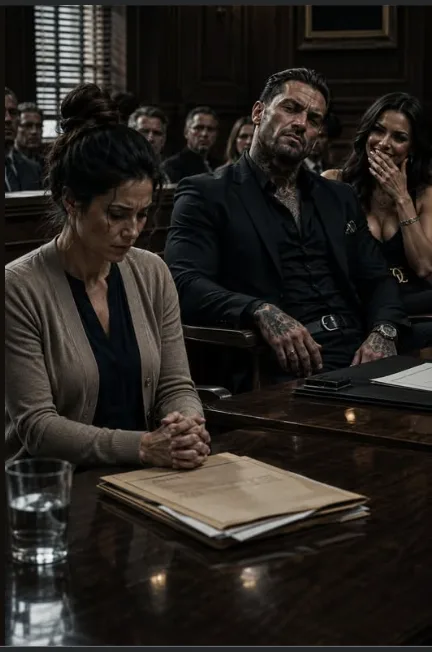
He leaned back in the mahogany chair of courtroom 302, a cruel, mocking smirk playing on his lips. Beside him, his new fiancée, Chloe, stifled a giggle, whispering something derogatory behind a manicured hand.
Across the aisle sat Audrey Kensington. Richard’s ex-wife looked remarkably small in her plain beige cardigan, staring down at her folded hands. To everyone in the room, she was a broken, penniless woman about to be steamrolled by Chicago’s most ruthless divorce attorney.
None of them realized they were sitting in a trap.
Courtroom 302 in the Cook County Courthouse was notorious for 2 things: its suffocating summer heat and the brutal, career-ending divorces presided over by the Honorable Judge Harrison Caldwell. On that crisp Tuesday morning, the air in the room was thick with a toxic blend of expensive cologne and palpable disdain.
Richard Sterling, a 42-year-old executive vice president of a mid-tier commercial real
estate firm, adjusted his silk tie and leaned back in his chair. He had the kind of aggressive, polished good looks that belonged on a country club brochure.
Beside him sat Gregory Pierce, a partner at 1 of Chicago’s most predatory family law firms. Pierce was a shark in a pinstripe suit, a man whose hourly rate could bankrupt a middle-class family in a week.
Directly behind Richard, sitting in the gallery despite the judge’s repeated glares, was Chloe Dupont. Chloe was 26, a former marketing assistant at Richard’s firm and his current fiancée. She was draped in designer logos: a Gucci belt, a Louis Vuitton tote, a Chanel jacket. She looked like a walking billboard of the wealth she believed she had successfully secured by stealing Richard from his marriage.
And then there was Audrey.
Audrey Kensington, 39, sat at the petitioner’s table. She wore a simple beige cardigan
over a modest navy blouse, her dark hair pulled back into a severe, unpretentious bun. She wore no jewelry, no designer labels. Her posture was perfectly straight, her hands folded neatly atop a manila folder resting on the table.
To the casual observer, she looked like a tired schoolteacher or an overworked librarian, someone utterly out of her depth in a high-stakes financial bloodbath.
“Your Honor,” Gregory Pierce boomed, his voice resonating against the wood-paneled walls, “we are here today because the petitioner, Ms. Kensington, refuses to accept reality. My client, Mr. Sterling, has offered a more than generous settlement. He has offered a lump sum of $75,000. In exchange, he simply asks to retain full ownership of the assets he single-handedly financed during their 10-year marriage: the Gold Coast penthouse, the Michigan lake house, and his retirement portfolio. Ms. Kensington’s continued demand for half of my client’s hard-earned estate
is not only mathematically absurd, but it borders on extortion.”
Judge Caldwell, a man with a shock of white hair and a perpetual scowl, peered over his wire-rimmed glasses.
“Extortion is a strong word, Mr. Pierce. Let’s stick to the financial disclosures.”
“The financial disclosures speak for themselves, Your Honor,” Pierce countered, stepping out from behind his desk to pace the floor.
It was theatrical, designed to humiliate.
“Throughout their decade-long marriage, Mr. Sterling was the sole breadwinner. He routinely brought in upwards of $500,000 a year in base salary and bonuses. And Ms. Kensington? She dabbled. She played on her computer. She called herself a freelance consultant, a title that, according to her own tax returns, yielded roughly $20,000 a year. She was a dependent, Your Honor. And now that the marriage is dissolved, she wishes to remain a dependent.”
A low snicker echoed from the gallery.
Chloe was whispering loudly to a friend she had brought along for moral support.
“She can’t even afford a decent lawyer,” Chloe murmured, loud enough for the first 3 rows to hear.
It was true that Audrey’s attorney did not look the part of a high-powered litigator. Evelyn Reed sat next to Audrey, her reading glasses perched on the end of her nose, quietly scribbling notes on a yellow legal pad. Evelyn ran a small boutique practice. She did not wear bespoke suits or flash expensive watches. She looked as unassuming as Audrey.
Richard leaned over to Pierce and muttered, “Look at her. She’s terrified. She knows she’s got nothing. Push for the legal fees, Greg. Make her pay for dragging this out.”
“Patience, Richard,” Pierce whispered back smoothly. “We let her bleed out on the stand today. By tomorrow, she’ll be begging to take the $75,000.”
Audrey heard the whispers. She felt the heavy, suffocating weight of their mockery.
Ten years earlier, she had married Richard because she believed in his ambition. She had loved his drive. But over the years, that drive had mutated into a grotesque narcissism. As Richard’s salary climbed, so did his ego. He began to view Audrey not as a partner, but as a piece of outdated furniture, something comfortable but decidedly unglamorous, something to be replaced when a newer, shinier model came along.
When he had handed her the divorce papers 6 months earlier, right after their 10th anniversary dinner, he had been utterly devoid of empathy.
“You’ve stalled, Audrey,” he had told her, standing in the foyer of the penthouse she had spent years turning into a home. “I’m moving up in the world, and you’re still just here. You have no ambition. You have no drive. Chloe understands my world. You just live in it.”
Audrey had not cried. She had not screamed. She had simply packed a single suitcase, called an Uber, and left.
Richard assumed her silence was the paralysis of a broken, helpless woman. He assumed she had retreated to a cheap apartment to lick her wounds and figure out how to survive on her meager freelance income.
He was wrong.
Spectacularly, unbelievably wrong.
“Ms. Reed,” Judge Caldwell said, breaking the heavy silence in the room, “does your client have a response to Mr. Pierce’s characterization of the marital assets?”
Evelyn Reed stopped writing. She tapped her pen twice on the desk, a small, rhythmic sound. Then she stood, smoothing down her sensible gray skirt.
“We do, Your Honor,” Evelyn said, her voice calm and remarkably steady. “We dispute Mr. Pierce’s assessment of the marital estate. Furthermore, we dispute the narrative that Mr. Sterling was the primary financial pillar of this marriage. We are fully prepared to proceed with the asset discovery process, and we believe the court will find Mr. Sterling’s settlement offer to be vastly disproportionate to the reality of the situation.”
Pierce actually laughed out loud.
“Disproportionate, Your Honor? We have provided 3 years of bank statements. Ms. Kensington’s primary checking account has a current balance of $14,200. Mr. Sterling’s assets are valued at roughly $4.2 million. The math is not complex.”
Audrey slowly raised her eyes and met Richard’s gaze across the room.
Richard flashed her a patronizing, pitying smile.
He mouthed the words, “Give up.”
Audrey did not smile back. She did not flinch.
Behind her plain exterior, a brilliant, calculating mind was quietly aligning the final pieces of a chessboard Richard did not even know he was playing on.
To understand the absolute delusion of Richard Sterling, one had to look back exactly 7 years, to the 3rd year of their marriage.
At the time, Richard had just been promoted to director at his firm. He was obsessed with status. He bought a Porsche he could barely afford and insisted they move into the Gold Coast penthouse, taking out a massive mortgage that stretched their monthly budget to its absolute breaking point.
Audrey, who had a degree in computer science and applied mathematics from Northwestern, had tried to warn him. She had shown him spreadsheets, projected interest rate hikes, and pleaded with him to build a safety net.
Richard had waved her off.
“You don’t understand leverage, Audrey,” he had said condescendingly, swirling a glass of expensive scotch. “You think like a middle-class clerk. I think like a wealth builder. Stick to your little website designs. Let me handle the real money.”
So Audrey did exactly what he asked.
She let him handle his money.
And she quietly began handling hers.
Audrey was not just doing website designs. She was a savant in data architecture. While Richard was out at steakhouses, schmoozing clients, and complaining to his colleagues about his unambitious wife, Audrey was sitting at the small desk in the spare bedroom, writing code.
She identified a massive inefficiency in how mid-level logistics companies tracked their supply chain overheads. Over the course of 18 months, working 12-hour days fueled by black coffee and sheer determination, she built a proprietary SaaS, software-as-a-service, platform to solve it.
She named the software Ethleguard Logistics.
She launched it quietly. Within 6 months, she had her first major corporate client. Within a year, she had 20. Because the software was entirely cloud-based and highly automated, her overhead was virtually zero.
The revenue poured in like a tidal wave.
At first, Audrey had wanted to tell Richard. She had planned a special dinner to celebrate her first $1 million in annual recurring revenue.
But that very night, Richard had come home drunk, furious about a bonus he had missed out on. He had taken his anger out on her, mocking her clothes, mocking her hobby, and telling her she was lucky he was around to keep a roof over her head.
That night, something inside Audrey snapped.
The love she had for him did not die instantly, but the trust completely evaporated. She realized that if she told Richard about the money, he would not celebrate her. He would co-opt it. He would use her success to inflate his own ego, spend her money on more flashy cars, and claim he had mentored her into success.
So Audrey built a fortress.
She hired a premier corporate structuring firm in Delaware. She created a blind trust, the Vanguard Oak Trust, which owned a holding company named Horizon Zenith Capital. Horizon Zenith Capital owned Ethleguard Logistics.
On paper, Audrey Kensington was entirely invisible.
She paid herself a modest consulting fee of $30,000 a year, direct deposited into the joint checking account she shared with Richard. This was the money she used to buy groceries and pay her portion of the utilities.
Richard never asked questions because Richard never cared.
He saw the $30,000 on their tax returns and felt vindicated in his belief that he was the superior provider.
By year 5 of their marriage, a global tech conglomerate took notice of Ethleguard. They saw it dominating the mid-market logistics sector and made a buyout offer. Audrey negotiated the deal entirely through her legal team in Delaware.
The final purchase price was $850 million, cash and restricted stock.
When the deal closed, Audrey sat at her desk in the spare bedroom, looking at an account balance that defied comprehension.
She was 34 years old, and she was nearly a billionaire.
She walked out to the living room, where Richard was aggressively playing golf on a VR headset, complaining about how his co-workers were idiots.
He did not even look at her when she walked in.
From that day forward, Audrey shifted from tech entrepreneur to apex investor. Horizon Zenith Capital began acquiring quiet, highly lucrative assets: massive tracts of commercial timberland in the Pacific Northwest, a series of high-end boutique hotels in Europe, and a 50% stake in a revolutionary lithium extraction startup.
By the time Richard handed her divorce papers, Audrey’s net worth had eclipsed $1.4 billion, and she had kept it utterly, entirely hidden from the man who shared her bed, but never bothered to ask about her day.
Back in courtroom 302, Gregory Pierce was thoroughly enjoying the sound of his own voice.
He had called Audrey to the stand for direct examination, a move designed purely to break her spirit early in the proceedings.
“Ms. Kensington,” Pierce said, leaning against the wooden railing of the witness box, invading her personal space. “Let’s talk about your contributions to this marriage. In the year 2021, did you purchase a new vehicle?”
“Yes,” Audrey said quietly.
“And what kind of vehicle was it?”
“A Honda Civic.”
“A reliable car,” Pierce noted, his tone dripping with sarcasm. “And how did you pay for this vehicle?”
“I leased it,” Audrey replied.
“You leased it because you couldn’t afford to buy it outright, correct?” Pierce pressed. “Because your income as a freelance consultant was a mere $28,000 that year?”
“Objection,” Evelyn Reed said mildly from her table. “Argumentative.”
“Sustained.”
“Mr. Pierce, stick to the facts,” Judge Caldwell warned.
“The fact, Your Honor, is that my client paid the mortgage, the insurance, the grocery bills, and the utility bills. He funded their lifestyle entirely,” Pierce said, turning his back to Audrey and facing the judge. He then spun back around, pointing a finger at her.
“Ms. Kensington, isn’t it true that during the month of October last year, your credit card was declined at a grocery store, and Mr. Sterling had to transfer funds into your account to cover a $100 bill?”
Chloe snorted from the gallery.
Richard smiled.
“Yes,” Audrey said.
Her voice did not waver.
“That is true.”
It was true.
What Pierce did not know was that Audrey’s card had been declined because she had triggered a fraud alert by attempting to wire $35 million to an escrow account in Geneva earlier that morning, and her bank had temporarily frozen all her domestic cards as a security measure. She had asked Richard for $100 to buy dinner, and he had lectured her for 20 minutes about her reckless spending habits before transferring the money.
“No further questions for this witness at this time, Your Honor,” Pierce said, strutting back to his table like a rooster. “I think the court has a very clear picture of the financial dynamics of this marriage.”
Judge Caldwell looked at Evelyn Reed.
“Ms. Reed, would you like to cross-examine?”
“Not at this moment, Your Honor,” Evelyn said. “However, I would like to formally submit our counter-discovery documents to the court and to opposing counsel. I believe they will provide a fuller picture of the marital estate.”
Gregory Pierce did not even bother to look at the thick stack of manila envelopes Evelyn Reed handed to his paralegal. He assumed it was a desperate attempt to scrounge up receipts for minor home improvements, or perhaps a pathetic attempt to lay claim to the equity in Richard’s Porsche.
“Your Honor,” Pierce sighed, exasperated, “we are willing to review whatever trivial expenses Ms. Reed has compiled, but I must reiterate my client’s position. We are asking for a clean break. Mr. Sterling retains his assets, his retirement, and his real estate. He assumes the remaining mortgage debt. Ms. Kensington takes the $75,000 and walks away. If she refuses, we will be seeking a court order to force the sale of nothing, and we will petition for Ms. Kensington to cover our legal fees for this egregious waste of the court’s time.”
Judge Caldwell frowned, flipping through the initial pages of the binder Evelyn had placed on his bench. He adjusted his glasses. He looked closer. He turned a page, then another, his brow furrowing deeper with every passing second.
“Mr. Pierce,” Judge Caldwell said, his tone suddenly devoid of its previous impatience.
It was now sharp, edged with confusion.
“Have you reviewed these documents?”
“Not yet, Your Honor. We literally just received them. I’m sure it’s just a ledger of grocery receipts,” Pierce said dismissively.
“I strongly suggest you look at them. Now,” the judge commanded.
Pierce frowned, annoyed by the judge’s tone. He snapped his fingers at his paralegal, who hastily handed him a duplicate binder. Richard leaned over, trying to see what the fuss was about. Chloe stopped texting in the gallery and leaned forward, sensing a shift in the room’s energy.
Pierce opened the binder.
The first document was a standard financial disclosure form. He skimmed past the personal information and looked at the section labeled assets, real estate.
He stopped breathing.
Listed under Audrey Kensington’s name was not a lease for a Honda Civic.
Listed there were properties.
One: commercial tower, 450 West Loop, Chicago, Illinois. Ownership, 100% via Horizon Zenith Capital. Valuation, $145 million.
Two: residential estate, Lake Forest, Illinois. Ownership, 100%. Valuation, $12.5 million.
Three: 3 boutique hotels, Paris, France. Ownership, 100% via Vanguard Oak Trust. Valuation, €68 million.
Pierce blinked rapidly. He felt a sudden cold dread pool in his stomach. He flipped the page to liquid assets and equities.
Account 1: J.P. Morgan Private Bank. Balance, $214.5 million.
Account 2: UBS Wealth Management, Geneva. Balance, $410 million.
Corporate holdings: 50% equity in Ethereum Lithium Corp. Estimated valuation, $650 million.
“What is this?” Pierce croaked.
His booming theatrical voice was completely gone. He sounded like a man who had just swallowed glass.
“Is this a joke? This is fraudulent documentation, Your Honor. This is perjury.”
Richard grabbed the binder from Pierce’s hands. He stared at the numbers. His eyes widened until they looked like they might pop out of his skull.
“$410 million? What is this, Audrey? What kind of sick prank is this?”
Audrey sat perfectly still.
She looked at Richard, her expression serene, almost pitying.
“Your Honor,” Evelyn Reed said, stepping forward. Her demeanor was no longer mild. It was commanding. “As the court can clearly see from the verified audited financial statements provided by Goldman Sachs, J.P. Morgan, and our corporate trustees in Delaware, my client, Ms. Kensington, possesses a net worth of approximately $1.42 billion. These assets were acquired during the course of her marriage to Mr. Sterling.”
Chaos erupted in courtroom 302.
“Billion?” Chloe screamed from the gallery, leaping to her feet. “She’s a billionaire? You said she was broke!”
She hit Richard on the shoulder.
“Silence in the gallery!” Judge Caldwell bellowed, slamming his gavel. “Bailiff, if that young woman speaks again, escort her out.”
Chloe clamped her hands over her mouth, her eyes wide with shock and horror as she stared at the woman in the cheap beige cardigan.
Richard was hyperventilating. His perfectly pressed suit suddenly felt like a straitjacket. He looked at his own lawyer, panic setting in.
“Greg. Greg, tell them this is fake. Tell them she’s lying.”
“Your Honor,” Pierce stuttered, visibly sweating now. “We—we had no knowledge of these assets. This completely changes the scope of the discovery.”
“It certainly does, Mr. Pierce,” Evelyn Reed interrupted smoothly. “Illinois is an equitable distribution state. Assets acquired during the marriage are subject to division. However, it is also a state that frowns heavily upon financial abuse, abandonment, and the dissipation of marital assets for the purpose of carrying on an extramarital affair.”
Evelyn walked over to the defense table and dropped another thinner folder in front of Pierce.
“What is this?” Pierce asked, terrified to open it.
“That,” Evelyn said, her voice ringing out clearly, “is a detailed accounting of Mr. Sterling’s financial activities over the past 3 years. You see, while my client was quietly building a billion-dollar empire, Mr. Sterling was busy committing fraud.”
Richard’s face drained of all color.
“Fraud? I never—I didn’t.”
“You did, Richard.”
Audrey spoke for the first time since she had left the witness stand. Her voice was not loud, but in the stunned silence of the courtroom, it carried like a gunshot.
“You forged my signature.”
Part 2
Evelyn opened the folder for Pierce, pointing a manicured finger at the highlighted documents.
“Two years ago, Mr. Sterling took out a second mortgage on the Gold Coast penthouse. He needed liquid cash to fund his lifestyle, specifically a series of luxurious vacations to St. Barts with his current fiancée, Ms. Dupont, and to purchase a $300,000 yacht.”
Evelyn turned to the judge.
“Because Ms. Kensington was technically a co-owner of the penthouse, her signature was required on the loan documents. She never signed them. Mr. Sterling forged her signature, secured a loan of $1.2 million, and squandered it entirely on an extramarital affair. We have the forensic handwriting analysis to prove it, as well as the paper trail of wire transfers from his private account to a yacht brokerage in Miami.”
Judge Caldwell looked at Richard with absolute disgust.
“Mr. Sterling, is this true?”
“I—I—”
Richard stammered, looking frantically around the room. The smug, arrogant executive was gone. In his place was a trapped, terrified animal.
“She—she wouldn’t have understood the leverage. It was an investment. I was going to pay it back.”
“By committing felony wire fraud and forgery?” Judge Caldwell asked, his voice dripping with venom.
“Your Honor,” Evelyn continued, twisting the knife, “Mr. Pierce stood here today and demanded that my client accept $75,000 and walk away, leaving Mr. Sterling with his hard-earned estate. We would like to officially reject that offer.”
Evelyn pulled out a final sheet of paper.
“Our counteroffer is as follows. Given Mr. Sterling’s egregious financial misconduct and felony forgery, we are petitioning the court for an unequal distribution of the marital estate. Ms. Kensington will retain 100% of her corporate holdings, liquid assets, and real estate acquired through Horizon Zenith Capital, as Mr. Sterling contributed absolutely nothing to their creation or maintenance, and actively impeded her career.”
She paused, letting the reality sink in.
“Furthermore, we are petitioning that Mr. Sterling assume sole responsibility for the $1.2 million fraudulent mortgage he originated. We are also demanding that he surrender his equity in the Gold Coast penthouse to offset the legal fees Ms. Kensington has incurred to uncover his fraud.”
“You’re taking everything,” Richard whispered, his voice cracking. “You’re leaving me with debt?”
Audrey looked at him, her face completely unreadable.
“I’m leaving you with exactly what you built, Richard. Nothing but a house of cards.”
Pierce was frantically whispering to Richard.
“Don’t say another word. Do you understand me? Shut up. You’re looking at prison time if they refer this to the district attorney.”
“We can fight this,” Richard hissed back, grabbing Pierce’s lapels. “She has a billion dollars. I’m entitled to half. The law says I’m entitled to half.”
“Mr. Sterling, control yourself,” Judge Caldwell warned.
Evelyn smiled a thin, dangerous smile.
“Mr. Sterling believes he is entitled to half of a fortune he routinely mocked, but there is 1 final detail we must address regarding the Vanguard Oak Trust, Your Honor.”
Evelyn handed a single document to the bailiff, who walked it up to the judge.
“When Ms. Kensington established the trust in Delaware,” Evelyn explained, “she included a standard moral turpitude and fidelity clause. It is a highly specific covenant stating that any beneficiary or spouse of a beneficiary forfeits all claims to the trust’s assets if they are proven to have engaged in documented financial infidelity or adultery that results in the dissolution of the marriage.”
Evelyn looked directly at Chloe, who was now weeping silently in the gallery.
“We have provided the court with over 400 pages of text messages, hotel receipts, and photographs documenting Mr. Sterling’s affair with Ms. Dupont, spanning back 2 and 1/2 years. By his own actions, Richard Sterling legally locked himself out of a billion-dollar fortune.”
Richard slumped into his chair as if he had been physically struck.
The air rushed out of his lungs.
He looked at the plain beige cardigan Audrey wore.
It was not a symbol of poverty.
It was armor.
She had sat there, letting him humiliate her, letting him dig his own grave while holding all the cards.
“Would you like me to continue with the reading of the asset forfeiture details, Your Honor?” Evelyn asked pleasantly. “Or should we allow Mr. Pierce some time to consult with his client about his impending bankruptcy?”
Judge Caldwell slammed his gavel down, the sound echoing like a thunderclap in the silent room.
“We are taking a 30-minute recess,” Judge Caldwell announced, his voice slicing through the pandemonium of courtroom 302.
He pointed a stern finger at Gregory Pierce.
“Counselor, I suggest you use this time to advise your client on his Fifth Amendment rights, because the moment we reconvene, I am forwarding these forged mortgage documents to the Cook County State’s Attorney’s Office.”
The crack of the gavel was definitive. The judge swept out of the room, leaving behind a suffocating silence that lasted only a second before the courtroom erupted again.
Pierce did not even pack his briefcase. He rounded on Richard, his face purple with rage.
“You forged a signature on a $1.2 million federal bank loan?” he hissed, his voice dropping to a furious whisper. “You lied to me during discovery. Do you have any idea what you’ve done to my firm’s reputation? To me?”
“Greg, please. You have to fix this,” Richard pleaded, his hands trembling as he reached for his lawyer’s sleeve. “She set me up. She hid a billion dollars.”
“She hid it legally, you idiot,” Pierce spat, violently shaking off Richard’s grip. “She put it in a Delaware blind trust. It’s airtight. But you committed felony wire fraud. I am a divorce attorney, Richard. I don’t do white-collar criminal defense. And even if I did, I wouldn’t touch you with a 10-foot pole. My retainer just tripled. And if you can’t pay it by noon, I am filing a motion to withdraw as your counsel.”
Pierce stormed out of the courtroom, leaving Richard standing alone at the defense table, looking like a man who had just stepped on a landmine and was waiting for the click.
In the gallery, Chloe was having a full-blown meltdown. The carefully curated illusion of her glamorous future had evaporated in the span of 20 minutes. She pushed past the wooden swinging gate, her expensive heels clicking frantically on the linoleum.
“Richard,” she shrieked, her voice stripped of its usual breathy, flirtatious tone. “Is it true you don’t have the money? You took out a loan for the boat?”
“Chloe, baby, keep your voice down,” Richard begged, looking nervously at the bailiff, who was watching them with undisguised amusement. “I can explain. We just hit a little bump. I’m still a vice president. I still make half a million a year.”
“Half a million?” Chloe interrupted, laughing hysterically. “You owe more than a million to the bank. You’re going to jail. I didn’t sign up for this. I signed up for a penthouse and St. Barts, not conjugal visits.”
Across the room, Audrey was calmly packing her beige canvas tote bag. Evelyn Reed handed her a sealed copy of the transcripts. Neither woman paid any attention to the soap opera playing out at the defense table. They moved with the quiet efficiency of snipers who had just confirmed their target was neutralized.
As Audrey turned to walk down the center aisle, Richard broke away from Chloe and blocked her path. His face was pale, slick with cold sweat. The arrogant sneer he had worn just an hour ago was entirely gone, replaced by the desperate, wide-eyed look of a drowning man.
“Audrey. Audrey, wait,” Richard stammered, holding his hands up placatingly. “Let’s just—let’s just talk about this as adults. We were married for 10 years. We loved each other once. You don’t want to see me go to prison, do you?”
Audrey stopped.
She looked up at him, her dark eyes completely devoid of the warmth he had spent a decade taking for granted. She did not look angry. She looked utterly indifferent, and that terrified him even more.
“We aren’t adults having a conversation, Richard,” Audrey said, her voice smooth and unbothered. “We are opposing parties in a litigation you initiated. And you didn’t love me. You loved the convenience of me. You loved having a quiet, unassuming wife at home while you played the big shot.”
“I made a mistake,” Richard practically whined, ignoring the fact that several law clerks had stopped in the hallway to watch the spectacle. “The loan, it was a bridge loan. I was going to pay it off with my year-end bonus. And Chloe, she meant nothing. A midlife crisis. You have a billion dollars, Audrey. You won. Just drop the forgery claim. Give me half of the penthouse equity and we walk away clean.”
Audrey tilted her head, studying him as if he were a fascinating, slightly pathetic insect.
“You still don’t get it,” Audrey said softly. “I didn’t hide the money to hurt you. I hid it to protect myself from you. I would have gladly shared my life with you if you had ever treated me as an equal. But you wanted a subordinate. Well, Richard, congratulations. You’re finally the smartest person in the room you can afford.”
She stepped around him, leaving him standing paralyzed in the doorway of courtroom 302.
“I’m leaving you, Richard,” Chloe yelled from down the hall, already furiously tapping on her phone, likely looking for a ride. “Don’t ever call me again.”
Richard watched his billionaire ex-wife walk calmly toward the elevators while the woman he had destroyed his marriage for practically ran toward the exit.
He felt his chest tighten, a crushing weight pressing down on his lungs.
The reality of his situation was finally crashing down around him, burying him alive.
The descent of Richard Sterling was not a slow decline.
It was a free fall.
Seventy-two hours after the explosive hearing in courtroom 302, the Cook County State’s Attorney formally opened an investigation into the fraudulent second mortgage. Subpoenas were issued to Richard’s bank, the mortgage brokerage, and most devastatingly, to his employer, Sterling and Barrett Commercial Real Estate.
On Monday morning, Richard swiped his key card at the glass doors of his downtown office.
The light flashed red.
He frowned, trying it again.
Red.
“Mr. Sterling?”
Richard turned to see 2 security guards standing behind him, their expressions grim.
“Mr. Barrett would like to see you in the ground-floor conference room. Immediately.”
William Barrett, the CEO and founding partner of the firm, was a ruthless businessman who protected his company’s reputation with religious fervor.
When Richard walked into the sterile, windowless conference room, Barrett was already seated, flanked by the head of human resources and the company’s internal legal counsel.
“Sit down, Richard,” Barrett commanded, skipping any pretense of a greeting.
“William, I can explain the subpoenas,” Richard started, his voice cracking slightly. “It’s a messy divorce. My ex-wife is trying to leverage some accounting errors.”
“Save it.”
Barrett interrupted, sliding a manila folder across the table.
“We received a grand jury subpoena this morning demanding all of your corporate emails, expense reports, and compensation history. The allegation is that you forged a federal document to secure a million-dollar loan. Our firm’s name is on your employment verification for that loan.”
“I am completely innocent,” Richard lied, though the sweat pouring down his face told a different story. “My lawyer is handling it.”
“Your lawyer, Gregory Pierce, dropped you on Friday,” the internal counsel noted dryly, looking at a tablet. “It’s public record on the court docket.”
Barrett leaned forward, his eyes cold.
“We handle hundreds of millions in client assets, Richard. We cannot have a vice president who is under active federal investigation for wire fraud and forgery. Effective immediately, your employment is terminated for cause under the moral turpitude clause of your contract. Your unvested stock options are forfeit. Your severance is denied. Hand your company phone and laptop to security. You will not be allowed upstairs to clear your desk. HR will mail your personal effects.”
“You can’t do this,” Richard shouted, slamming his hand on the table. “I brought in $4 million in commissions last year. You need me.”
“We need clean hands,” Barrett corrected coldly. “You’re toxic waste, Richard. Security will escort you out.”
Within 30 minutes, Richard was standing on the curb of Wacker Drive holding a cardboard box containing a framed photo of a golf course and a few expensive pens.
He had no job.
He had no lawyer.
And he had a crushing mountain of debt.
He hailed a cab and headed back to the Gold Coast penthouse, desperately hoping Chloe had cooled off and returned. He needed someone, anyone, to tell him this was going to be okay.
When he unlocked the heavy oak door of the penthouse, the silence was deafening.
“Chloe?” he called out, his voice echoing in the cavernous high-ceilinged living room.
No answer.
He walked into the master bedroom and froze.
The walk-in closet they shared had been entirely gutted on 1 side. All of Chloe’s designer clothes, the handbags he had bought her, the jewelry, gone.
Worse, she had not just taken her own things.
Richard walked back out to the living room and realized the empty spaces on the walls. The 2 original abstract paintings he had purchased in Miami were missing. The expensive espresso machine was gone from the kitchen counter. Even the vintage Rolex he kept in his desk drawer had vanished.
She had stripped the apartment of anything she could carry and pawn.
Richard sank onto the Italian leather sofa, burying his face in his hands.
His phone buzzed in his pocket.
He pulled it out, hoping against hope it was Chloe apologizing or Barrett saying it was a misunderstanding.
It was an automated text message from his bank.
Alert. Your primary checking account ending in 4402 is overdrawn by -$1,450. An automatic payment to Miami Yacht Brokerage has bounced.
He had forgotten to stop the auto-pay for the boat he had bought with the forged loan money.
He threw the phone across the room, watching it shatter against the marble floor.
Over the next 2 months, the walls closed in completely.
Without his $500,000 salary, Richard could not make the payments on the primary mortgage of the penthouse, let alone the fraudulent second mortgage. The bank initiated foreclosure proceedings. A week later, he woke up to the sound of diesel engines outside his building.
He looked down from his balcony just in time to see a tow truck hauling away his Porsche Macan.
He was forced to hire a cut-rate defense attorney named Arthur Pendleton, a man who worked out of a strip mall in the suburbs and constantly smelled of stale cigarettes and cheap coffee. Pendleton took 1 look at the evidence Evelyn Reed had handed over to the district attorney and gave Richard the brutal truth.
“They have you dead to rights, Sterling,” Pendleton said, coughing into a tissue. “The handwriting experts are unanimous. The wire transfers are tracked. If we go to trial, they will make an example out of you. You’re looking at 5 to 7 years in federal prison. Your only play is a plea deal.”
“I can’t go to prison,” Richard panicked, gripping the edge of Pendleton’s cheap laminate desk. “I’m a white-collar guy. I won’t survive. What’s the deal?”
“You plead guilty to a lesser charge of bank fraud. They recommend probation and community service.”
Pendleton paused, tapping a cigarette on his desk.
“But you have to pay full restitution to the bank. $1.2 million instantly, plus fines. If you can’t pay it, the probation deal is off the table and you do the time.”
Richard was trapped.
Utterly, hopelessly trapped.
He had no cash. His assets were either repossessed or locked up in the divorce litigation.
There was only 1 person on the planet who could save him from a prison cell.
He had to beg Audrey.
Part 3
Six months after the initial divorce hearing, courtroom 302 felt entirely different. The oppressive summer heat had given way to a biting Chicago winter, but inside, the atmosphere was chillingly calm.
Audrey Kensington sat at the petitioner’s table, looking exactly as she had 6 months earlier. She wore a tailored black blazer this time, but her demeanor was the same: composed, quiet, and utterly immovable. Evelyn Reed sat beside her, organizing a remarkably thin stack of papers.
Across the aisle sat Richard Sterling.
The transformation was shocking. He had lost at least 20 pounds, his cheekbones jutting out sharply beneath sallow skin. His custom Tom Ford suits had been sold to a consignment shop months earlier to pay Pendleton’s retainer. He wore a cheap, off-the-rack suit that hung loosely on his shrinking frame. His hair was thinning, unkempt. He looked 10 years older, his eyes darting nervously around the room, completely devoid of the arrogant spark that had once defined him.
Judge Caldwell took his seat at the bench, looking down at the 2 parties.
“We are here to finalize the dissolution of marriage between Audrey Kensington and Richard Sterling and to review the proposed final settlement,” Judge Caldwell announced. He looked at Richard with a mixture of pity and lingering disgust.
“Mr. Sterling, you are represented by Mr. Pendleton today.”
“Yes, Your Honor,” Pendleton wheezed, standing up briefly.
“Very well. Ms. Reed, you have the floor,” the judge prompted.
Evelyn stood, smoothing her skirt.
“Your Honor, after extensive mediation and in light of the parallel criminal proceedings regarding Mr. Sterling, we have reached a finalized agreement that both parties have signed.”
“Let’s hear it,” Judge Caldwell said, leaning back.
“Ms. Kensington will retain 100% of her pre-existing assets, including all corporate holdings under Horizon Zenith Capital, the Vanguard Oak Trust, and all liquid accounts. Mr. Sterling waives any and all rights to claim spousal support or equity in these assets per the moral turpitude clause triggered by his documented infidelity.”
Richard stared at the floor, his jaw tight.
He did not argue.
He could not.
“Furthermore,” Evelyn continued, her voice perfectly even, “Mr. Sterling is surrendering his 50% equity in the Gold Coast penthouse to Ms. Kensington. In exchange, Ms. Kensington has agreed to assume the remaining balance of the primary mortgage.”
Pendleton stood up.
“Your Honor, if I may. My client is agreeing to this total surrender of marital assets because Ms. Kensington has generously agreed to a secondary transaction outside of the marital estate, which is crucial to his pending criminal plea deal.”
Judge Caldwell raised an eyebrow, looking at Audrey.
“Is that so? Proceed.”
Evelyn smiled thinly.
“Your Honor, as the court is aware, Mr. Sterling must pay $1.2 million in criminal restitution by Friday to avoid a mandatory prison sentence. He is entirely insolvent. Therefore, Horizon Zenith Capital, my client’s holding company, has agreed to purchase Mr. Sterling’s fraudulent debt from the bank.”
Richard squeezed his eyes shut.
The humiliation of it burned like acid in his veins.
His billionaire ex-wife was buying his criminal debt to keep him out of jail.
“To be clear,” Evelyn emphasized, looking directly at Richard, “this is not a gift. It is a structured corporate loan. Horizon Zenith Capital is paying the restitution to the court on Mr. Sterling’s behalf. In exchange, Mr. Sterling has signed a legally binding promissory note. He owes Horizon Zenith Capital $1.2 million at an interest rate of 8%, to be garnished from his future wages for the rest of his natural life.”
Judge Caldwell let out a low whistle.
“He will be an indentured servant to his ex-wife’s corporation.”
“Precisely, Your Honor,” Evelyn said, unapologetically. “My client felt it was a more productive outcome than allowing him to sit in a taxpayer-funded prison cell. He will work, and he will pay back every single cent he stole against her name.”
“Mr. Sterling,” Judge Caldwell asked, leaning over the bench, “do you understand the terms you have agreed to? You are walking away from this marriage with absolutely nothing. And you are taking on a 7-figure debt to your ex-wife’s holding company.”
Richard slowly stood up. His hands shook as he gripped the edge of the table.
He looked at Audrey.
He expected to see triumph in her eyes. He expected to see a smirk, a glimmer of the mockery he had subjected her to for years.
But there was nothing.
She looked at him the way 1 looks at a closed book they have no intention of ever reading again. She had outplayed him, outsmarted him, and financially subjugated him.
And she was not even gloating.
To her, this was just business.
The final cleanup of a toxic asset.
“I understand, Your Honor,” Richard croaked, his voice barely above a whisper. “I accept the terms.”
“Then I am signing the final decree,” Judge Caldwell said, bringing his pen down on the document. “This marriage is officially dissolved. Mr. Sterling, consider yourself exceptionally lucky that Ms. Kensington has a better grasp of leverage than you do. We are adjourned.”
The gavel banged.
The sound finalized Richard’s utter ruin.
As the courtroom cleared, Richard lingered at his table, packing his few meager papers into a battered briefcase. He watched Evelyn Reed pack up her meticulous binders. Audrey stood, picking up her simple beige tote bag.
“Audrey,” Richard called out softly.
Audrey paused and turned to face him 1 last time.
“Why?” Richard asked, his voice breaking. “Why didn’t you just let me go to prison? Why buy the debt? Was it just to torture me? To own me?”
Audrey looked at him, adjusting the strap of her bag on her shoulder. The harsh fluorescent lights caught the quiet, unyielding strength in her face.
“You give yourself too much credit, Richard,” Audrey said calmly. “I didn’t buy your debt to torture you. I bought it because the bank was offering a distress sale, and I negotiated the purchase for 80 cents on the dollar. Horizon Zenith Capital stands to make a 20% profit on your repayment, plus the 8% annual interest.”
Richard’s mouth fell open.
He was stunned into absolute silence.
“You see,” Audrey continued, her tone completely devoid of malice, delivering the final, fatal blow to his ego, “you were never my husband in the end. You were just a bad investment, and I don’t let bad investments cost me money.”
With that, the billionaire turned and walked out of the courtroom, leaving Richard Sterling standing in the wreckage of a life he had arrogantly dismantled with his own 2 hands.
Two years passed after the heavy wooden doors of courtroom 302 closed on Richard Sterling’s lavish, deceitful life. Chicago’s blistering summers and brutal winters cycled through, but the financial hierarchy of the city had subtly shifted.
Audrey Kensington did not buy a superyacht. She did not purchase a fleet of neon sports cars, nor did she plaster her name across a hospital wing.
True to her nature, she remained an invisible force.
She upgraded her wardrobe from department-store cardigans to understated, bespoke Loro Piana cashmere, but she still drove herself to the grocery store.
Her company, Horizon Zenith Capital, however, had grown into an apex predator in the private equity ecosystem. Operating from a sleek, unlisted office overlooking the Chicago River, Audrey quietly orchestrated billions. Her success was so profound and efficiently managed that it began attracting the attention of the ultra-elite.
Just last month, she had politely declined a highly publicized joint venture acquisition offer from Ken Griffin, the billionaire founder of Citadel, simply because she preferred to keep her board of directors entirely independent.
Griffin had reportedly been stunned.
Nobody turned down Citadel.
But Audrey Kensington did.
She did not need the capital, and she certainly did not need the validation.
Evelyn Reed, who had since become Horizon Zenith’s chief in-house counsel, walked into Audrey’s corner office on a rainy Tuesday afternoon. She dropped a pristine, leather-bound folder onto Audrey’s glass desk.
“Quarterly reports,” Evelyn said, pouring herself a cup of green tea from a silver carafe. “The lithium extraction startup in Nevada just cleared its environmental hurdles. We’re projecting a 400% return by Q3.”
Audrey did not look up from her laptop, though a small smile touched her lips.
“Excellent. Roll 50% of the initial profits into the Vanguard Oak Philanthropic Arm. I want to fully fund that domestic abuse shelter initiative we discussed.”
“Done,” Evelyn said.
She paused, tapping her manicured fingernail against the leather folder.
“And I have the monthly disbursement report from accounting, including the special debt collection.”
Audrey finally looked up, closing her laptop.
“How is Mr. Sterling keeping up with his corporate obligations?”
Evelyn could not help but smirk.
“He’s remarkably punctual, mostly because he has no choice. The court-ordered garnishment takes exactly 35% of his gross income before it ever hits his checking account.”
Richard’s life had become a master class in irony.
Following his conviction for misdemeanor bank fraud, a plea deal that kept him out of a cell but permanently destroyed his corporate reputation, he had been entirely blacklisted from commercial real estate. No reputable firm in the Midwest would touch an executive with a forgery record.
Desperate, and drowning in the 8% interest he owed his ex-wife’s holding company, Richard had been forced to take a mid-level logistics management job at a regional freight carrier in the grim, industrial outskirts of Joliet.
He lived in a cramped, 200-square-foot studio apartment that smelled faintly of boiled cabbage and damp drywall. He drove a rusted 2008 sedan with a broken heater. Chloe, predictably, had never spoken to him again. She was last seen on Instagram tagging herself on a yacht in Monaco with a 60-year-old hedge fund manager.
But the true poetic justice of Richard’s existence was not the garnishment.
It was his daily routine.
“Did you know,” Evelyn said, her eyes gleaming with amusement, “that Pioneer Freight, Richard’s new employer, is 1 of the mid-market logistics companies that uses Ethleguard software?”
Audrey leaned back in her chair, steepling her fingers.
“I am aware. They signed a 5-year enterprise contract with us last November.”
“Which means,” Evelyn noted, “that every single morning when Richard Sterling logs into his cheap cubicle computer to track freight manifests for $12 an hour, the first thing he sees on his monitor is your company’s logo.”
It was devastatingly true.
Every day at 7:30 a.m., Richard sat beneath a flickering fluorescent bulb, typed his password into the employee portal, and was forced to stare at the sleek, blue Ethleguard Logistics splash screen. It was a daily, inescapable reminder that the woman he had belittled, the unambitious wife he had financially abused and discarded, was the architect of his entire reality.
She owned his debt.
She owned the software he used to scrape together a miserable living.
She owned the very air he breathed in the corporate world.
He was trapped inside the empire she had built while he was busy mocking her.
“Has he ever reached out?” Evelyn asked quietly, sipping her tea.
“Once,” Audrey replied, her tone completely neutral. “About a year ago. He sent an email to the corporate inbox begging to renegotiate the interest rate. He said he couldn’t afford to fix his car.”
“And what did you do?”
Audrey stood, walking over to the floor-to-ceiling window. She looked down at the sprawling, vibrant city below, a city of which she now quietly owned a significant fraction. The rain battered against the reinforced glass, but inside her office, it was completely silent, warm, and secure.
“I forwarded it to the automated customer service desk,” Audrey said softly. “They sent him a boilerplate reply about our strict corporate debt structuring policies.”
She turned back to Evelyn, her dark eyes clear and unburdened.
The ghost of Richard Sterling no longer haunted her. He was nothing more than a line item on a spreadsheet, a fractional yield in a billion-dollar portfolio.
“We are done looking backward, Evelyn,” Audrey said, her voice ringing with quiet, absolute authority. “Let’s focus on the European acquisitions. We have an empire to run.”
Chapter complete
You have reached the end of this chapter.
Continue reading
A few more worlds to get lost in after this chapter.




