MY DAUGHTER SAID I COST TOO MUCH — THEN SHE FOUND OUT I HAD 4.3 MILLION DOLLARS
PART 3
Two weeks passed between the accepted offer and the closing.
Chapter 3
MY DAUGHTER SAID I COST TOO MUCH — THEN SHE FOUND OUT I HAD 4.3 MILLION DOLLARS
PART 3
Two weeks passed between the accepted offer and the closing.
Those two weeks changed the way I moved through Christine’s house.
Not outwardly.
I still made dinner.
I still walked Murphy.
I still helped Becca memorize lines for The Wizard of Oz.
I still folded towels because I have never been able to watch clean laundry sit in a basket without feeling judged by it.
But inside, I had stepped back.
That is hard to explain unless you have done it.
I still lived there, but I no longer belonged to the tension.
When Greg muttered about the thermostat, I did not defend myself.
When Christine forgot to tell me her book club was coming until the women were already at the door, I smiled, made tea, and took my novel upstairs.
When Becca came to my room later and whispered, “Grandma, Mom didn’t mean to make you hide,” I patted the bed beside me.
“I’m not hiding,” I said.
She climbed up next to me.
“You’re in your room.”
“That’s different.”
She leaned her head against my shoulder.
“Are you sad?”
I looked at her little hand resting on the quilt.
“Sometimes.”
“Because of Uncle Harold?”
“Yes,” I said. “And other things.”
She nodded with the solemn understanding of a child who does not know the details but knows the weather.
“Mom’s stressed,” she said.
“I know.”
“Dad too.”
“I know that too.”
She was quiet.
Then she said, “But sometimes they act like you’re extra.”
The word broke my heart.
Extra.
Not unwanted.
Not loved.
Just extra.
A thing beyond the planned amount.
I kissed the top of her head.
“You are not responsible for grown-up feelings,” I said.
“I know.”
But she did not know.
Children always think they are somehow in charge of the air in a house.
The closing happened on a Friday morning in
a conference room with a long table, a bowl of peppermint candies, and a stack of documents thick enough to qualify as literature.
Patricia sat beside me.
The title agent explained each page.
I signed my name again and again.
Eleanor May Whitaker.
A name I had written on attendance forms, mortgage papers, permission slips, Christmas cards, sympathy cards, lesson plans, checks, and once, long ago, on a marriage license with Richard standing beside me grinning like the luckiest fool in Ohio.
When the title agent handed me the keys, she smiled.
“Congratulations, Mrs. Whitaker. The house is yours.”
The house is yours.
I held the keys in my palm.
They were ordinary keys.
Silver.
A little sharp at the edges.
Nothing about them revealed what they had returned to me.
I did not tell Christine that day.
Not because I wanted to punish her.
Punishment requires a desire to
make someone feel small.
I knew too well what that felt like.
I simply wanted one thing in my life to belong to me before anyone else had an opinion about it.
On Saturday, Christine and Greg were taking Becca to a soccer tournament two hours away.
The tournament had been on the calendar for months.
I had not arranged my move around their absence at first, but when the timing worked out, I did not correct it.
There is a difference between making a scene and leaving cleanly.
Harold understood that difference.
So did Richard.
I packed on Friday night.
It did not take long.
Six months in a lavender guest room does not accumulate the weight of a life.
My clothes went into two suitcases.
My books into six boxes.
Richard’s watch into my purse.
My grandmother’s quilt into a plastic storage bag, though I apologized to it as I did so because quilts deserve better.
I took the Welcome, Grandma sign from the mirror and laid it flat between two books.
I did not know if Becca would notice it was gone.
I hoped she would.
I hoped she would understand later that I kept it because it had been real.
At seven-thirty Saturday morning, Christine knocked lightly on my door.
“We’re leaving,” she said. “Becca wants to say goodbye.”
I opened the door.
Becca stood in the hallway wearing her soccer jacket, hair pulled into a ponytail, cleats in one hand.
She hugged me hard.
“Wish me luck,” she said.
“Kick only the ball,” I said.
She rolled her eyes.
“Grandma.”
“What? It’s excellent advice.”
She smiled, but her eyes searched my face.
Children notice suitcases.
Even when you hide them behind the bed.
“Are you going somewhere?” she asked.
Christine looked from her to me.
I kept my voice steady.
“I have some things to take care of today.”
“What things?”
“Grown-up things.”
She frowned.
“I hate when people say that.”
“I know.”
I touched her cheek.
“We’ll talk tonight, sweetheart.”
That did not satisfy her, but Greg called from downstairs that they were late, and the moment moved on without resolving itself.
By eight, their SUV pulled out of the driveway.
By eight-fifteen, the movers arrived.
Two men in navy sweatshirts, cheerful and efficient.
One of them had a daughter at Ohio State.
The other complimented my cast iron skillet and said his grandmother had one just like it.
They carried boxes down the stairs while Murphy followed them anxiously, toenails clicking against the hardwood.
I scratched his head.
“I’ll miss you too,” I told him.
He leaned his full golden weight against my leg.
Dogs understand departures better than people pretend they do.
By ten-thirty, the guest room was empty.
I vacuumed it.
I do not know why.
Habit, maybe.
Or gratitude.
Or the need to leave no one an excuse to reduce my leaving to a mess.
The lavender walls looked bare without my books and Becca’s sign.
The room seemed to have exhaled.
I walked through the house slowly.
The kitchen where I had cooked a hundred meals.
The dining table where I had sat through small humiliations and also real laughter.
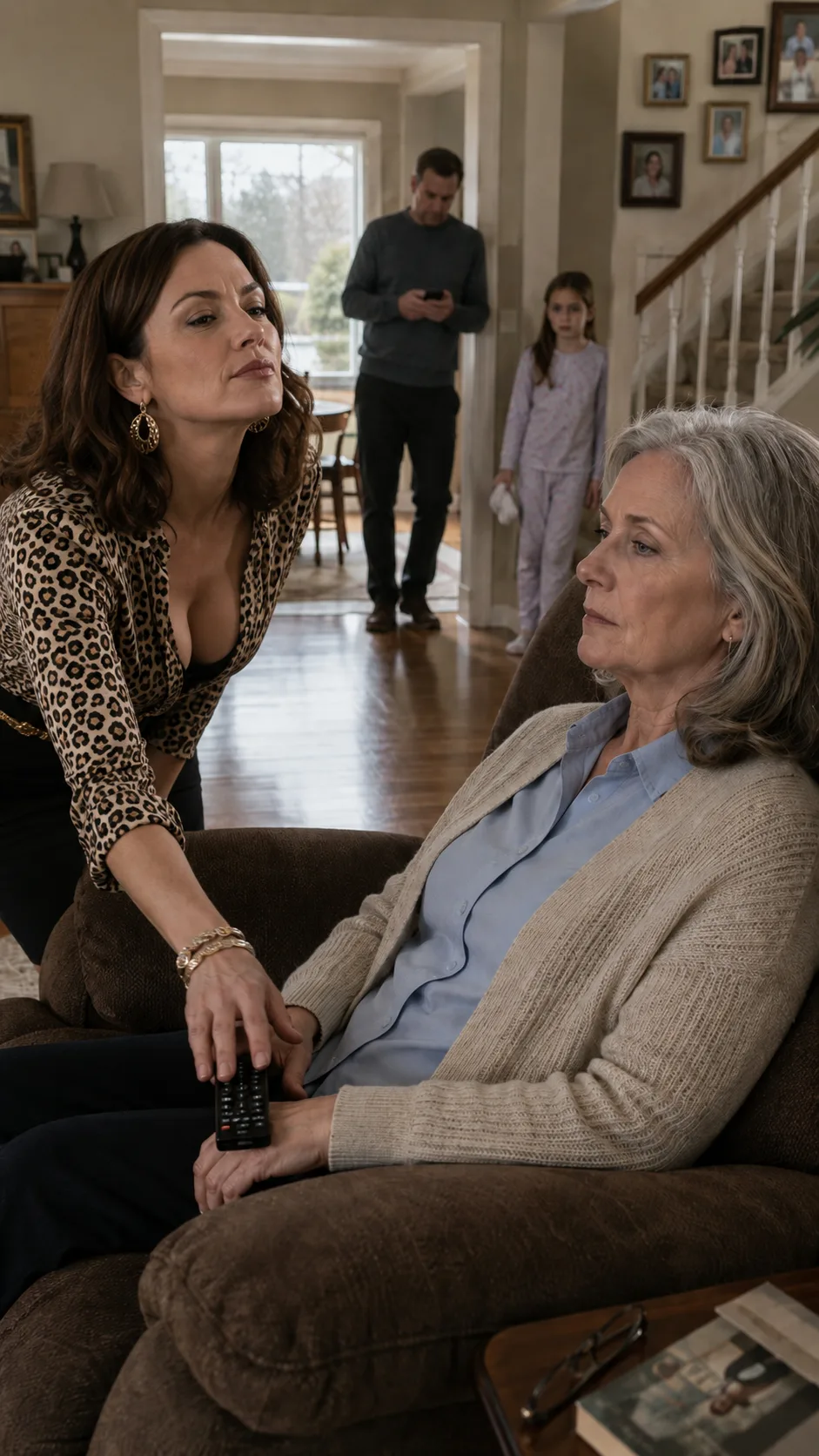
The living room where Christine had taken the remote from my hand.
The hallway where Becca’s backpack always landed in a heap.
The laundry room where I had sat on the floor after Harold died.
The backyard where Murphy liked to lie in a patch of sun beside the hydrangeas.
I did not hate that house.
That would have made leaving simpler.
But life rarely gives us clean categories.
That house had hurt me.
It had also held my granddaughter’s laughter.
It had made me smaller.
It had also given me six more months of watching Becca grow.
It had shown me where I did not belong.
And sometimes that is a gift, though it arrives dressed like rejection.
I left a note on the kitchen counter.
Christine, I found my own place. I’ll call you tonight. The guest room is all yours. Thank you for the six months. Mom.
I considered writing more.
I considered explaining the grocery bill, the remote, the careful conversations, the way the house had taught me to listen for my own inconvenience.
But Harold’s voice came back to me.
Not everything needs a speech, Ellie.
So I left the note as it was.
Then I locked the front door behind me and put the key through the mail slot.
It landed inside with a small metal sound.
Final.
But not cruel.
Just final.
When I arrived at Clover Street, the moving truck was already there.
The little American flag in the front planter lifted slightly in the breeze, as if greeting me.
I stood on the sidewalk for a moment before going in.
My house.
Not Harold’s.
Not Richard’s.
Not Christine’s.
Mine.
The word felt strange.
Almost selfish.
Then it felt like air.
The movers carried in my boxes.
I told them where to put the bed, the bookshelves, the old blue bowl, the kitchen table I had kept from Dayton because Richard had refinished it one summer and then talked about that accomplishment for the next fifteen years.
By two o’clock, the house was full of my things.
Not arranged perfectly.
Not yet.
But present.
My books filled the built-ins around the fireplace.
My grandmother’s quilt lay across the bed.
Richard’s photo sat on the dresser.
The cast iron skillet hung from a hook beside the stove.
The blue bowl rested on the kitchen counter, catching afternoon light.
I made tea in my own kettle.
I carried it to the screened porch and sat in the wide wicker chair I had ordered before the closing, green cushions still stiff from being new.
The creek moved beyond the garden.
A few leaves floated on its surface.
Somewhere nearby, a lawn mower started.
A church bell rang in the distance.
The house settled around me with little creaks and sighs.
And for a long time, I did nothing.
No laundry.
No dinner prep.
No listening for footsteps.
No calculating whether my presence had become too much.
I sat on my porch, in my chair, with my tea, and watched my creek move through the last gold of afternoon.
Christine called at six.
I let it ring twice before answering.
Not to punish her.
Just to remind myself I was allowed not to jump.
“Mom?” she said.
“I’m here.”
“I got your note.”
“I thought you would.”
Her breathing sounded uneven.
Behind her, I could hear car noise. They were probably driving back from the tournament.
“Where are you?”
“At my house.”
A pause.
“Your house?”
“Yes.”
“What does that mean?”
“It means I bought a house.”
The silence that followed was full of arithmetic.
I could almost hear her adding and subtracting possibilities.
“Mom,” she said carefully, “how?”
“Harold’s estate.”
Another pause.
This one longer.
“Harold left you money?”
“Yes.”
“How much?”
There it was.
The question arrived exactly when I expected it.
Not because Christine was greedy in some dramatic, villainous way.
Real life is rarely that theatrical.
She was startled.
She was practical.
She was already measuring what the number might mean.
For me.
For her.
For Greg.
For Becca.
For the future she had assumed would involve managing me rather than being surprised by me.
I looked out at the creek.
The late sun had turned the water copper.
In the Phoenix airport bookstore weeks earlier, while waiting for my flight back to Ohio, I had spoken with a woman about my age. We had both reached for the same mystery novel and laughed.
Somehow, as strangers do in airports, we told each other truths we might not have told people we knew.
I mentioned an inheritance.
She looked at me over her glasses and said, “Don’t tell them the number.”
I had smiled politely.
She touched my arm.
“I mean it,” she said. “The number changes everything. Tell them enough. That’s all anyone needs unless they’re your accountant.”
Now, standing on my screened porch, I understood the wisdom of that stranger.
“Enough,” I told Christine.
“Enough?”
“Enough to buy this house and live comfortably. That’s all you need to know.”
She was quiet.
Then she said, “Mom, I didn’t know.”
“No,” I said. “You didn’t.”
I could have made that sentence heavier.
I did not.
“Why didn’t you tell me?”
I watched a leaf fall from one of the sycamores.
“Because I needed to know what I wanted before anyone else told me what I should do.”
“That’s not fair.”
“Maybe not.”
“We would have helped you.”
“Christine,” I said gently, “you were asking me for my long-term plan.”
She inhaled sharply.
“That’s not the same thing as kicking you out.”
“I know.”
“Do you?”
“Yes,” I said. “And I also know how it felt.”
There was a sound on the other end, maybe her shifting the phone, maybe wiping her face, maybe turning away from Greg and Becca.
“Mom, I was stressed. Greg was stressed. The house felt crowded, and I didn’t know how to talk about it.”
“I believe you.”
“I didn’t mean to make you feel unwanted.”
“I believe that too.”
“But you did feel that way.”
“Yes.”
The truth sat between us.
Not shouted.
Not decorated.
Just placed there.
For once, neither of us picked it up too quickly.
Finally, Christine said, “What’s the house like?”
I looked around.
The porch screens.
The garden.
The creek.
The last light.
“It’s beautiful,” I said. “It has a porch and a garden. There’s a creek out back. The kitchen has a window over the sink.”
“Oh,” she said softly.
“Becca will like it.”
At the mention of her daughter, Christine’s voice changed.
“Can she visit?”
“Of course. Anytime she wants. You and Greg can too.”
Another silence.
“But this is my house,” I said. “And this is my life. I’m going to live it the way your father always told me I should.”
Christine was quiet so long I thought the call had dropped.
Then she said, “Dad would have loved that.”
It was not really a question.
She knew Richard.
She knew how he would have stood on that porch, hands on his hips, pretending to inspect the railing while already planning where to put bird feeders.
“He would have sat out here every evening,” I said. “Until I made him come inside for dinner.”
Christine laughed.
A small laugh.
Real.
Not polished.
Not defensive.
The laugh she had as a little girl when Richard used to pretend to lose at checkers.
“I’m sorry, Mom,” she said.
I closed my eyes.
“I know.”
“I’m really sorry.”
“I know that too.”
“I don’t know how to fix it.”
That was the first honest thing she had said in months.
“You don’t fix everything with one apology,” I said. “You just stop doing the thing you’re apologizing for.”
She was quiet.
“Okay,” she said.
We talked for another twenty minutes.
About Becca’s soccer game.
About the Munchkin costume.
About Greg’s mother and Thanksgiving.
About nothing important at all, which is sometimes the only bridge people can cross at first.
When we hung up, the porch had darkened.
I sat there until the creek was more sound than sight.
Then I went inside, locked my door, and made dinner in my own kitchen.
Scrambled eggs.
Toast.
Tea.
A meal no one would call too much.
Three weeks later, Becca came to visit.
Christine drove her down on a Saturday afternoon.
I watched from the front window as the navy SUV pulled up to the curb.
Becca got out before the car had fully settled, backpack bouncing against her shoulder.
She stopped on the sidewalk and stared at the house.
Then she looked at the little American flag in the planter, the porch swing Patricia had helped me find at an estate sale, the mums I had placed by the steps, and the front door painted a soft green.
Christine got out more slowly.
She looked nervous.
That made me sadder than I expected.
Not because I wanted her nervous.
Because daughters should not have to stand outside their mothers’ houses wondering how much forgiveness lives inside.
I opened the door.
Becca ran up the steps.
“Grandma!”
I hugged her so tightly she squeaked.
“You got taller,” I said.
“You saw me three weeks ago.”
“Still taller.”
She stepped inside and immediately began looking around with the serious attention of an inspector.
Christine followed, carrying a tote bag.
Her eyes moved over the living room.
The bookshelves.
The quilt folded over the back of the couch.
Richard’s photo on the mantel.
The blue bowl on the table.
“This is lovely,” she said.
“Thank you.”
Her voice was careful again, but differently this time.
Not rehearsed.
Respectful.
I showed them the kitchen, the porch, the garden.
Becca loved the creek immediately.
Of course she did.
Children and water understand each other.
She wanted to go down right away, but I told her we had apple cake to make first.
“My grandmother’s recipe,” I said.
“Your grandmother or my grandmother?”
“My grandmother. Your great-great-grandmother.”
Becca widened her eyes.
“That’s a lot of grandmothers.”
“It is. Which means we have to take the cinnamon seriously.”
Christine stayed for coffee.
At first, she perched on the edge of the kitchen chair as if she were visiting a museum display titled Mother, Newly Independent.
Then slowly, she relaxed.
She told me Becca had talked about the visit all week.
She told me Greg had asked if he should come and then decided maybe Becca and I needed time alone.
I appreciated that more than I expected.
Before Christine left, she stood by the front door.
“I can pick her up around six,” she said.
“Seven is fine,” I said. “We may need time for the creek.”
Becca, already tying an apron around herself, shouted from the kitchen, “Seven!”
Christine smiled.
Then she looked at me.
“Thank you.”
“For what?”
“For letting her come.”
“She’s my granddaughter.”
“I know. I just…”
She stopped.
I let her.
Not every unfinished sentence needs rescuing.
After Christine left, Becca and I made apple cake.
She peeled apples badly but enthusiastically.
Flour got on the counter, the floor, and somehow one of Murphy’s old hairs that had followed me on a sweater months earlier appeared on my sleeve like a ghost from the other house.
Becca stirred the batter with both hands on the spoon.
“This is hard,” she said.
“Most worthwhile things involve some stirring.”
“That sounds like teacher talk.”
“It is teacher talk.”
She grinned.
While the cake baked, we walked down to the creek.
The afternoon was bright and cool.
Leaves had begun turning amber and gold.
Becca found a flat stone and skipped it four times.
Four.
Her personal record.
She screamed in victory so loudly a bird shot out of a bush.
On the way back, she slipped her hand into mine.
“Grandma?”
“Yes?”
“Are you mad at Mom?”
I had expected the question eventually.
Children are braver than adults when it comes to asking what a room is made of.
“No,” I said.
“Were you?”
“Yes.”
She nodded.
“Are you mad at Dad?”
“A little.”
She considered that.
“He said you should’ve told them about the money.”
“Did he?”
“He said families shouldn’t keep secrets.”
I smiled faintly.
“What did your mother say?”
“She told him to stop talking where I could hear.”
“That sounds like your mother.”
Becca kicked a leaf.
“Should you have told them?”
I stopped walking.
So did she.
The creek moved beside us, steady and unconcerned.
“I think,” I said slowly, “that sometimes privacy looks like a secret from the outside. But they are not always the same thing.”
She frowned.
“That’s confusing.”
“Yes.”
“Can you say it like I’m eleven?”
I laughed.
“All right. Your mother had a right to know I was safe. She did not have a right to know every dollar I had.”
Becca thought about that.
“Because it was yours?”
“Because it was mine.”
“And Uncle Harold wanted it for you?”
“Yes.”
She nodded again.
“I think this is your real house.”
My throat tightened.
“You do?”
“Yeah. The other one felt like you were visiting.”
Eleven years old.
Sharp as a tack.
I looked toward the bungalow, the porch, the flag moving slightly in the breeze, the warm light in the kitchen window.
“I think you’re right,” I said.
That evening, after Christine picked Becca up and the apple cake was wrapped in foil on the passenger seat, I locked the door and returned to the porch.
I poured myself a glass of wine.
Not much.
I have never been much of a drinker.
But Harold had kept one very good bottle in his kitchen cabinet, and I had brought it from Scottsdale, saving it for the right moment.
The right moment, I decided, was not some grand celebration.
It was a quiet evening after my granddaughter had laughed in my kitchen and called my house real.
I sat in the green wicker chair and watched the creek.
I thought about Harold.
About all those Sunday phone calls.
About how he had never said, Ellie, are you lonely?
Never said, Ellie, do they appreciate you?
Never said, Ellie, you sound like you are disappearing.
He had simply listened.
Then, in the only way Harold knew how, he had built an answer.
Not with speeches.
Not with drama.
With accounts and signatures and careful planning.
With a note tucked into a legal file.
With a sentence that opened a door.
You spent your life making rooms better for other people. Make sure you keep one for yourself.
I thought about Richard too.
Richard, who would have loved the porch.
Richard, who would have pretended to complain about the creek because it would attract mosquitoes, then spent an entire weekend building a better path to it.
Richard, who once told me, after Christine left for college and I cried in the laundry room, that motherhood was the only job where success meant being needed less and loving anyway.
I had not understood then how many times a woman could be asked to disappear in the name of love.
Not all at once.
Not dramatically.
Just inch by inch.
Give up the bigger slice.
Take the smaller room.
Move your chair.
Keep the peace.
Do not make it awkward.
Be grateful.
Be useful.
Be easy.
Then one day, someone turns off the television in front of you and asks if you know how much you have cost them.
And if you are lucky, if someone loved you quietly enough, you remember the answer.
I cost more than you expected because I am a whole person.
I raised my glass toward the darkening yard.
“Thank you, Harold,” I said.
The creek kept moving.
The trees were turning amber and gold in the last of the evening light.
Somewhere down the street, a dog barked twice and then stopped.
A car passed slowly.
The porch screens held the cool air around me.
Inside, my kitchen waited.
My books waited.
My bed waited.
My life waited.
Not loudly.
Not urgently.
Just openly.
I finished my wine and went inside.
I washed the glass by hand, dried it, and placed it in the cabinet.
Then I stood for a moment at the sink, looking out the dark window toward the garden I could no longer see but knew was there.
That was enough.
After so many years of making sure everyone else had what they needed, I had finally learned the shape of enough.
It was not 4.3 million dollars.
It was not a house bought in cash.
It was not the look on anyone’s face when they realized I had options.
It was a key in my hand.
A porch light I could leave on or turn off.
A kettle on my stove.
A granddaughter’s laughter in the walls.
A brother’s quiet love still reaching me after he was gone.
It was dinner made in my kitchen, in my house, on my terms, in my life.
And that was more than enough.
THE END.
Chapter complete
You have reached the end of this chapter.
Continue reading
A few more worlds to get lost in after this chapter.




