PART 3 — EVERYTHING THEY WERE ABOUT TO LOSE
Confusion first.
Chapter 3
PART 3 — EVERYTHING THEY WERE ABOUT TO LOSE
Confusion first.
Then suspicion. Then fear.
She did not open it right away. She just held it as if it might explode. The assistant said something and gestured to the box. I could not hear the words, but I knew what they were. Inventory. Evidence. Formal notice. Law dressed in good manners.
Inside that envelope was nearly everything Tom had assembled. A notice asserting my financial and equitable ownership claims. A court-backed demand related to possession and occupancy. A summary of house records showing the down payment, major repairs, and recent property taxes had all been traced back to my accounts or documented contributions. There was a dated appraisal for the necklace and a note from the jeweler confirming the pearls matched the set purchased under my name in 1970. There were printed screenshots of messages from my son over the years.
Thanks for the help with the water bill, Ma.
Don’t
worry, I’ll pay you back.
We owe you everything.
Everything.
That word again.
Everything I gave. Everything they took. Everything they were about to lose.
Tom had asked me whether I wanted to pursue criminal charges over the necklace. “You could,” he said. “But it will cost time, energy, and peace.”
I looked at the pearls in that evidence photo and thought about the years I had already spent being exhausted by them. “No,” I said. “I want the necklace back. I want the house back. I do not want to spend another ounce of myself chasing punishment.”
He nodded once. “Then we reclaim what matters.”
That is exactly what we did.
We drove away before the first party guest even noticed something was wrong. Tom did not ask how I felt. He knew better than to crowd a sacred silence. By late afternoon, my phone began lighting up like
a Christmas tree.
The first call was from my son. I did not answer.
Then came a text. Mom, what did you do?
I still said nothing.
Then another call. Another text. Then a voicemail from my daughter-in-law’s mother, a woman who had never spoken to me unless the topic involved holiday menus or school pickup. “You can’t be serious,” she said. “During her pregnancy? This is cruelty.”
Cruelty.
Funny how quickly people remember a word once consequences knock on their own door. Nobody called it cruel when my belongings were packed on the porch like thrift-store donations. Nobody called it cruel when my necklace was stolen and displayed as a family heirloom. Nobody called it cruel when they whispered about needing the space as though I were furniture.
But one manila envelope, and suddenly everybody found their moral vocabulary.
I put my phone on silent.
That evening my son
sent a longer message. It began with, I wish you had just talked to me, and ended with, We never meant to hurt you.
Intentions do not scrub away impact.
Silence is still a choice.
He had chosen his for years, standing behind her with his eyes down and his arms folded while the woman who raised him was sanded away by daily disrespect. I once believed forgiveness had to be offered to everyone. Age has taught me that some apologies arrive too late to do any useful work.
That night at Ruth’s, I helped her trim sunflowers in the little workroom behind the shop. She handed me gloves and a pair of shears and said nothing. It was the first time in months my hands felt useful for something that did not end in someone else’s entitlement.
Later, while I drank chamomile tea in her kitchen, Tom sent me a photograph. The pearls were spread across black velvet, tagged, recovered, authenticated, returning to rightful owner.
I touched the image on my screen gently.
Not out of vanity. Not out of triumph. Because those pearls represented something they never understood: value, history, ownership, memory. They were proof that I had existed in that house as more than a convenience. Proof that I had loved and sacrificed and still had the right to take up space.
The next morning Tom called. “They have thirty days,” he said.
“Let them stay the full thirty,” I replied.
He paused. “You’re sure?”
“Yes. Let them wake up there every morning and remember it was never theirs to begin with. Let them walk through those rooms and feel the truth pressing against every wall.”
Another pause. Then he said softly, “Dorothy, you are something else.”
I smiled for the first real time in weeks. “No,” I told him. “I’m just remembering who I was.”
Over the next few days, the calls slowed. Then stopped. That silence felt cleaner than any apology they could have manufactured. I made copies of every document and locked them away in a fireproof box beneath my bed at Ruth’s. Not because I did not trust the law, but because I had finally learned not to trust people who say we’re family right before they take what belongs to you.
Two days after the notice arrived, there was a knock at the flower-shop apartment door.
I knew it was my son before I opened it. Mothers know the weight of their children’s footsteps even after those children forget how to say their names with tenderness.
He stood there looking older than I remembered and younger than a man his age had any right to look. Hunched shoulders. Raw guilt. Hands empty.
“Hi, Ma,” he said.
I did not answer. I just stepped aside and let him in.
Ruth was out. The little apartment was quiet except for the hum of the refrigerator and traffic from the street below. He sat at the kitchen table where I had once taught him to count coins from the store register, where I had cut crusts off sandwiches and wrapped scraped knees and waited past curfew with the porch light on.
“I know I should have come sooner,” he said, staring at a crack in the tile.
“You should have,” I replied.
He nodded. “We messed up. I didn’t think it would… I didn’t think you’d…”
“Fight back?” I asked.
He looked up at me then. Really looked. “I didn’t think you’d leave like that,” he admitted.
“And yet,” I said, “here we are.”
He rubbed his palms together the way he used to when he was nervous as a boy. “What we did was wrong. Kicking you out like that, it wasn’t fair. And the necklace—I swear I didn’t know she took it. But I should have known. I should have paid attention.”
Silence settled between us like fog.
“No,” I said at last. “You did pay attention. You just chose comfort over courage.”
He flinched.
“You let her disrespect me under my own roof. You let her erase me piece by piece while you stood there and watched. I cooked for your family. I paid your bills. I gave up my retirement, my business, my claim to that house because I believed you were worth the sacrifice. And when she told me to take my junk and leave, you hid behind her silence like a child.”
He dropped his head into his hands. “I didn’t know what to say.”
“You didn’t have to say much,” I told him. “You just had to stop her.”
He started crying then, not loudly, just enough that I could hear the shame in it. “I’m sorry, Ma.”
I studied him for a long moment. Not the little boy from the store. Not the man he pretended to be in front of his wife. Just someone in between. Lost. Small. Late.
“You called me family,” I said. “But family does not make you invisible. Family does not throw you away after taking everything.”
He whispered, “We want to fix this. I want you to come back. We’ll make room.”
“No,” I said, calm and firm. “I do not want a room. I want respect. I want memory. I want my name to mean something in that house again, not because I paid for it, but because I mattered.”
He swallowed hard. “You do matter.”
“Now?” I asked. “Now I matter because you’re afraid of losing something. Not because you remembered what I gave.”
He reached into his pocket then and set a folded piece of paper on the table. It was a child’s drawing, crayon and glitter, bent at the corners. Across the top, in my grandson’s uneven handwriting, it read: To Grandma, I miss you.
I stared at it, not because it softened me, but because it proved something. At least one small heart in that house had noticed my absence.
“I’m not doing this to hurt you,” I told my son. “I’m doing it because I deserve to be seen. Not just needed when it is convenient. Seen.”
He nodded and cried harder. “I know.”
We sat there in silence for a while. He did not ask for forgiveness. I did not offer it. Some wounds do not close just because someone finally admits they made them.
Before he left, he stood by the door and said, “I’ll call Tom. We’ll be out by the deadline.”
“Good,” I said.
He hesitated. “Ma. I do love you.”
I nodded once. “It matters,” I said. “But it is not enough.”
After he left, I sat down at Ruth’s table and exhaled for what felt like the first time in weeks. There were no hugs, no soaring speech, no miracle reconciliation. Just truth. Cold, clean, final.
It took thirty-one days for the house to be legally and practically mine again.
I had it photographed. Appraised. Cleaned. For a brief while, I even considered selling it outright. A realtor made a glossy brochure. The porch where they had left my things appeared on the cover beside words like charming and remodeled and heart of Texas. We got interest fast. One offer came in at nearly double what my husband and I had paid all those years ago.
And yet when the papers were in front of me, I hesitated.
The house had been wounded, but it had not betrayed me. People had. Walls remember who loved inside them. Floors remember footsteps. Kitchens remember hands. I was not ready to hand all of that away just because other people had made it painful.
A few days later, a young married couple came through to see it. Schoolteachers. Tired eyes. Respectful voices. No older than my son had been when he first brought his wife home. During the walkthrough, the husband saw the hooks by the back door and smiled. “Perfect for my mother’s gardening hats,” he said.
I looked at him. “She lives with you?”
His wife answered before he could. “Oh, yes. Since his father passed. She helps with dinner, watches the kids when we both work. We’d be lost without her.”
They said it the way people say grace. Not as a burden. As a blessing.
That was the moment I knew what to do.
I decided not to sell outright after all. I kept the deed in my name and offered them a lease at a fair price. They tried to pay more. I handed the extra back and told them there was only one condition.
“Treat every room like it remembers something,” I said. “Because it does.”
I told them the living room remembered a boy playing with wooden trains. The kitchen remembered a mother stirring gumbo and stew while humming under her breath. The porch remembered the weight of silence. And all of it deserved better now.
They promised me it would have it.
The day they moved in, I stood across the street with a small gift bag in my hand. Inside was a dish towel embroidered with Welcome Home, hand-stitched by me thirty years earlier. I had once meant it for my daughter-in-law. Funny how life redirects its tenderness.
I left the key under the mat and walked away.
With the house secured, the lease income coming in, and my finances finally back under my own control, I did something nobody in my family would have expected. I reached back toward the life I had before I became an afterthought in someone else’s household. The little grocery business my husband and I had built had long since grown into a small local chain under new ownership. A young woman named Camille had bought the name rights and preserved our recipes and some of our old store culture.
I called her.
When I told her who I was, she gasped. “You’re that Dorothy?”
I laughed. “The one who used to price apples by hand.”
We met for coffee the next day. She had a thousand questions, and for once in a long while, someone wanted my memory instead of my labor. By the end of the week, I had agreed to an advisory role and bought a modest block of shares with money I could finally call my own again.
“Not bad for a woman who got thrown out for needing space,” I told Tom over the phone.
He chuckled. “You’re not just getting space back, Dorothy. You’re taking back legacy.”
He was right.
I found myself a bright apartment high above downtown, not huge, but full of morning light. There was a balcony wide enough for tea and one stubborn cactus my husband had given me on our anniversary years before. “Like us,” he had said when he first brought it home. “Tough, quiet, and hard to kill.”
It had bloomed once after he died. I took that as a sign.
In my new place, mornings became my own again. I drank tea and watched the city wake up below me. People rushed by with coffee cups and tangled earbuds, and I watched them with the mild amusement of a woman who had already survived the hardest thing she ever thought would happen. In the afternoons I walked to a bookstore down the block. The young clerk learned my name by my third visit and always pointed me toward the memoir section with a grin, as if he were passing along state secrets.
I liked that. I liked being seen in small ways that did not cost me anything.
Still, there was one thread in my heart that kept tugging after dark. My grandson.
He did not call. He did not write. I did not blame him for that. Children learn silence from the grown-ups around them. They learn who matters by watching who gets interrupted and who gets listened to at the dinner table.
One memory in particular stayed with me. About a month before I left, he ran in from school, backpack unzipped, shoes untied, and shouted, “Grandma!” before quickly correcting himself to “Sorry, I meant Mom.” His mother barely looked up from her phone. But I felt that correction like a slap. Even his instinctive love had been trained into politeness.
That was the day I stopped baking his favorite cookies.
But I did not stop loving him.
I remembered the triangle toast. The way he used to trace the veins on my hands and whisper, “You’re like a map.” The way small children still know how to love people before adults teach them categories.
So I made him something.
A photo book.
I spent hours printing pictures, scanning old snapshots, choosing the ones where joy still looked unguarded. Him with jelly on his chin at age three. His father’s first bike ride. The old store before a summer storm. A Christmas when everybody looked tired and happy and poor and whole. Under each photo I wrote a little caption in my own hand.
On the last page, I taped a note.
If you ever read this, know that Grandma didn’t leave. She just kept living.
I wrapped the book in brown paper, tied it with string, and mailed it with no return address. Just a little sticker on the front that said, For when you’re ready.
That was the final gift I gave in that chapter of my life, not to my son or his wife, but to myself. The gift of not carrying bitterness farther than I had to. Not because they deserved mercy, but because I deserved peace.
Some people want revenge. Others want closure. What I wanted was room to breathe without being made to feel guilty for breathing. And slowly, with my cactus by the window, my work at the grocery chain, the lease on the old house, and a city view that belonged only to me, I got it.
The house settled into its new life beautifully. The young couple kept their word. The husband’s mother planted tomatoes in the backyard and waved at neighbors from the porch like she had always belonged there. When they sent the first rent check, they tucked in a note thanking me for trusting them with a home that clearly had history in its bones.
I kept that note in my desk drawer.
Across town, my son and his wife moved into a rental duplex near the highway. I heard bits and pieces through Tom and through the little quiet ecosystem of people who always know more than they say in a city. The rent was high. The landlord was strict. She went back to work six weeks postpartum. He picked up weekend shifts at a hardware store. They sold nursery furniture. They learned, perhaps for the first time in their marriage, what it felt like to pay every dollar themselves.
I did not rejoice in their hardship.
But I did not pity them either.
This was not revenge. It was reality, finally allowed to unfold without me cushioning every blow. When you build your life on someone else’s sacrifice and call it your own success, eventually the floor shifts beneath you.
On Mother’s Day, a card arrived. No long letter. No grand plea. Just a picture inside of my grandson holding up a crayon drawing of what looked very much like my cactus in a pot. I put it on the refrigerator. Not because all was forgiven. Not because I was pretending wounds had vanished. But because some parts of us deserve to stay soft even after everything.
In my new place, mornings are quiet. I drink tea. I read the paper. I listen to a city that does not know my history and, for that very reason, offers me a strange kind of freedom. Nobody here calls me Ma with contempt. Nobody shifts when I enter a room as if I have interrupted something important. Nobody borrows my heirlooms or counts my existence in square footage.
I belong because I decided I do.
Some nights I sit on the balcony with my cactus blooming beside me and think about everything I used to accept. The insults disguised as jokes. The labor offered in exchange for crumbs of kindness. The meals eaten in tense silence. The years I confused usefulness with love.
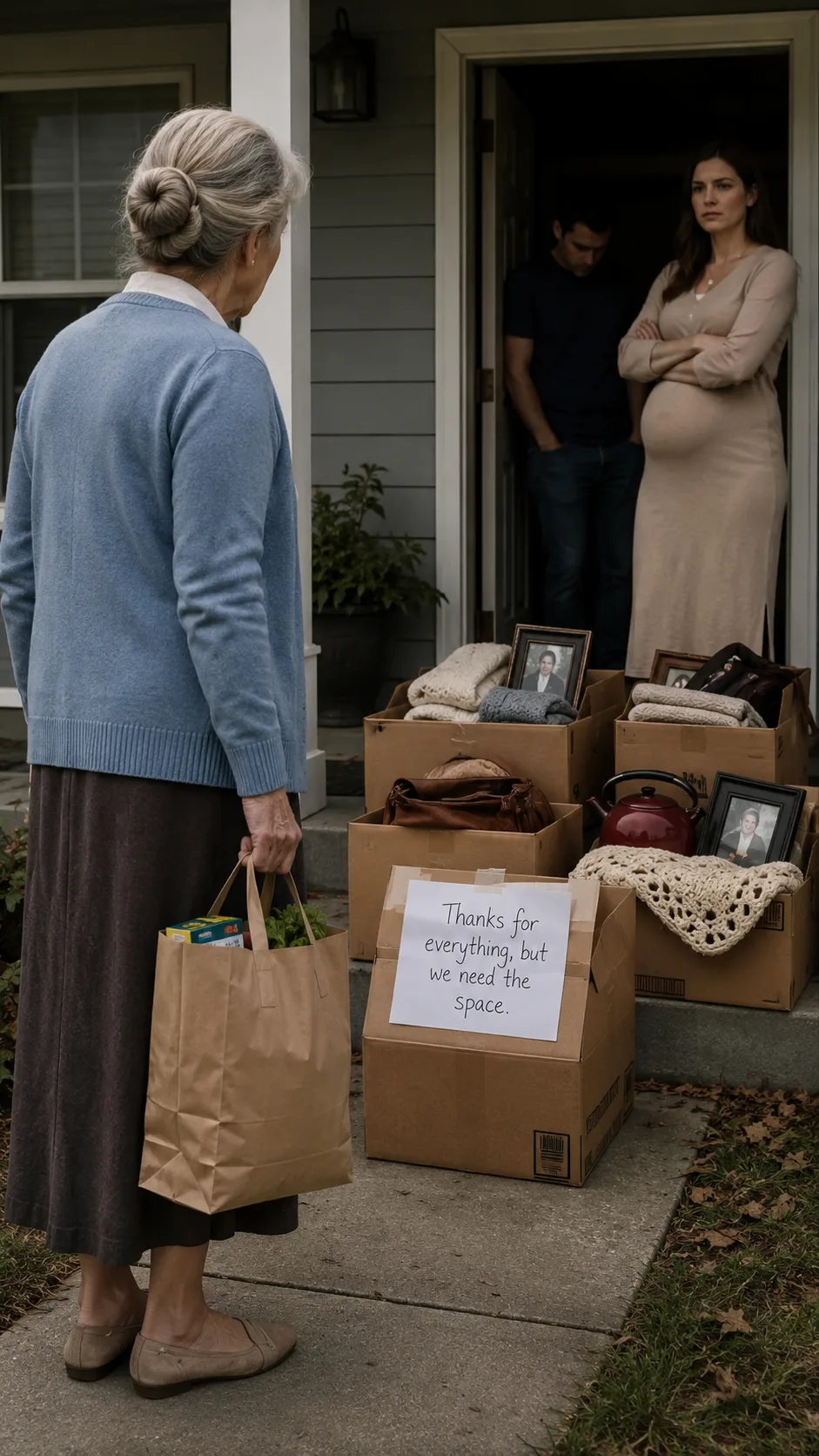
Then I think about that porch.
The boxes. The note. The way they thought they were making me smaller.
And I smile.
Because now I know what they never understood. I was never disposable. They wanted space, so I gave them emptiness. They wanted freedom from history, so I took my history with me. They wanted a home without memory, a life without my witness, and for one brief season I let them have exactly that, until the law and the truth arrived together at their front door.
I did not take the house back simply to win. I took back something greater. My voice.
The one they talked over at the dinner table. The one they ignored in the living room. The one they treated like background noise until it learned how to speak in records, signatures, deadlines, and boundaries. For years I whispered, waited, accommodated, and explained. Not anymore.
No one had to lose for me to stand up again. But they did lose, because they gambled on me remaining small. They bet on age making me weak. They mistook patience for surrender, kindness for helplessness, and grief for confusion.
They were wrong.
So no, I do not call what happened revenge. I call it restoration. I call it legacy. I call it breath returning to a body that had gone too long without enough air.
I am Dorothy. Mother. Builder. Survivor. A woman who once stood on a porch reading a thank-you note taped to the wreckage of her own life. A woman who now knows exactly what she is worth.
And if anyone ever asks what became of the woman they tried to put outside with her boxes and her memories and her silence, tell them this:
She lived.
She remembered.
And she was never quiet again.
THE END.
Chapter complete
You have reached the end of this chapter.
Continue reading
A few more worlds to get lost in after this chapter.




