Part 4 — The Envelope, the Keys, and the Two Words That Changed Everything
Over the next few days, her calls became more frequent, but the tone changed.
Chapter 4
Over the next few days, her calls became more frequent, but the tone changed.
She no longer sounded like someone trying to persuade me. She sounded like someone managing a process already underway.
She asked what furniture I cared about most.
She wondered aloud how many boxes my clothes might require.
Mark offered to help arrange people to handle the heavier things.
I answered without committing to anything.
Meanwhile, I went about my own business.
There were appointments Claire did not know about and decisions she had not been invited to discuss.
Every time I left the house, I experienced a strange mixture of sorrow and freedom.
I would pause in the driveway and look back at the front windows, remembering Christmas mornings and birthday parties, Edward carrying Claire inside after she fell asleep in the car, the night he and I returned from the hospital after losing his mother.
A house stores more than belongings.
It stores versions of ourselves.
The young wife
I had been still seemed to exist somewhere near the kitchen doorway. The exhausted mother stood invisibly at the bottom of the stairs. The widow who returned alone after Edward’s funeral had never quite left the bedroom hallway.
But memories were not chains.
I could honor what had happened there without surrendering the rest of my life to a building—or to the people waiting to inherit it before I was gone.
By Friday, Claire had decided the time for another discussion had arrived.
She called that morning and told me she wanted everyone to sit down and make some “practical decisions.”
That phrase again.
Practical.
Mark liked it because it made disagreement sound irrational.
I agreed to come.
Claire seemed momentarily surprised by how easy that was.
Then she thanked me in the warm, patient tone one might use with someone finally behaving sensibly.
I hung up and stood in
my quiet hallway.
On the table near the door were two things.
A white envelope.
And a set of keys.
I looked at them for a long time.
The envelope was plain enough to seem almost insignificant. No decorative stationery. No bright label. Nothing about it announced that the balance between my daughter and me was about to change.
That seemed appropriate.
The most important things in life often arrive without decoration.
I picked up the keys first.
Their familiar weight settled into my palm.
For years I had carried them without thinking. They had been ordinary objects, something tossed into a handbag or left beside the telephone.
That morning, they felt different.
Final, somehow.
I slipped them into my coat pocket and took the envelope in my hand.
Before leaving, I walked through the house once more.
Not ceremonially.
I did not touch every doorway or whisper
goodbye to rooms. That would have felt theatrical, and I had lived too long to mistake theatrics for meaning.
But I noticed things.
The faint scratch on the hallway floor from the time Claire dragged a chair across it at thirteen.
The uneven paint near the pantry where Edward had insisted he did not need masking tape.
The patch of afternoon light that always fell across the living-room rug.
For years, these imperfections had irritated me.
Now they looked almost tender.
I stood beside Edward’s photograph for a moment.
His expression was calm, amused around the eyes.
“You always said I waited too long to say what I meant,” I murmured.
The room, naturally, gave me no answer.
Still, I could imagine his.
Then I left.
When I arrived, Claire was already in the living room.
She had arranged everything neatly, as she always did when she wanted a conversation to feel official. Papers sat on one end of the coffee table. Two glasses of water waited on coasters. The cushions had been straightened so perfectly that no one appeared to have sat there all day.
Mark stood near the fireplace.
The moment he saw me, his expression brightened with the easy confidence of a man who believed the difficult part had already passed.
Claire studied what I was carrying.
Her eyes paused on the envelope.
Then on my coat pocket when the keys made the faintest sound as I moved.
She said nothing yet.
Mark stepped forward.
There was genuine satisfaction in his face, and perhaps even relief. From his perspective, this had all been unnecessarily complicated. A large house, an older woman living alone, an obvious next step.
Facts placed into a sensible order.
People like Mark often forgot that human beings were not columns on spreadsheets.
He smiled at me.
“Good. Now we can finally be practical.”
The word landed exactly as I expected it to.
Claire gave him a quick glance, perhaps warning him not to sound too triumphant.
It was too late.
I had heard him perfectly.
I did not respond.
Instead, I crossed the living room.
Each step felt strangely calm.
I thought of Claire’s midnight message.
She still thinks she has choices.
I thought of my grandson innocently assigning himself my guest room.
I thought of the real estate envelope with my address on it.
Then I thought of Sunday dinner, of Claire’s relief when I told her she might be right.
She had believed that sentence meant the argument was over.
Perhaps it had been.
Just not in the way she imagined.
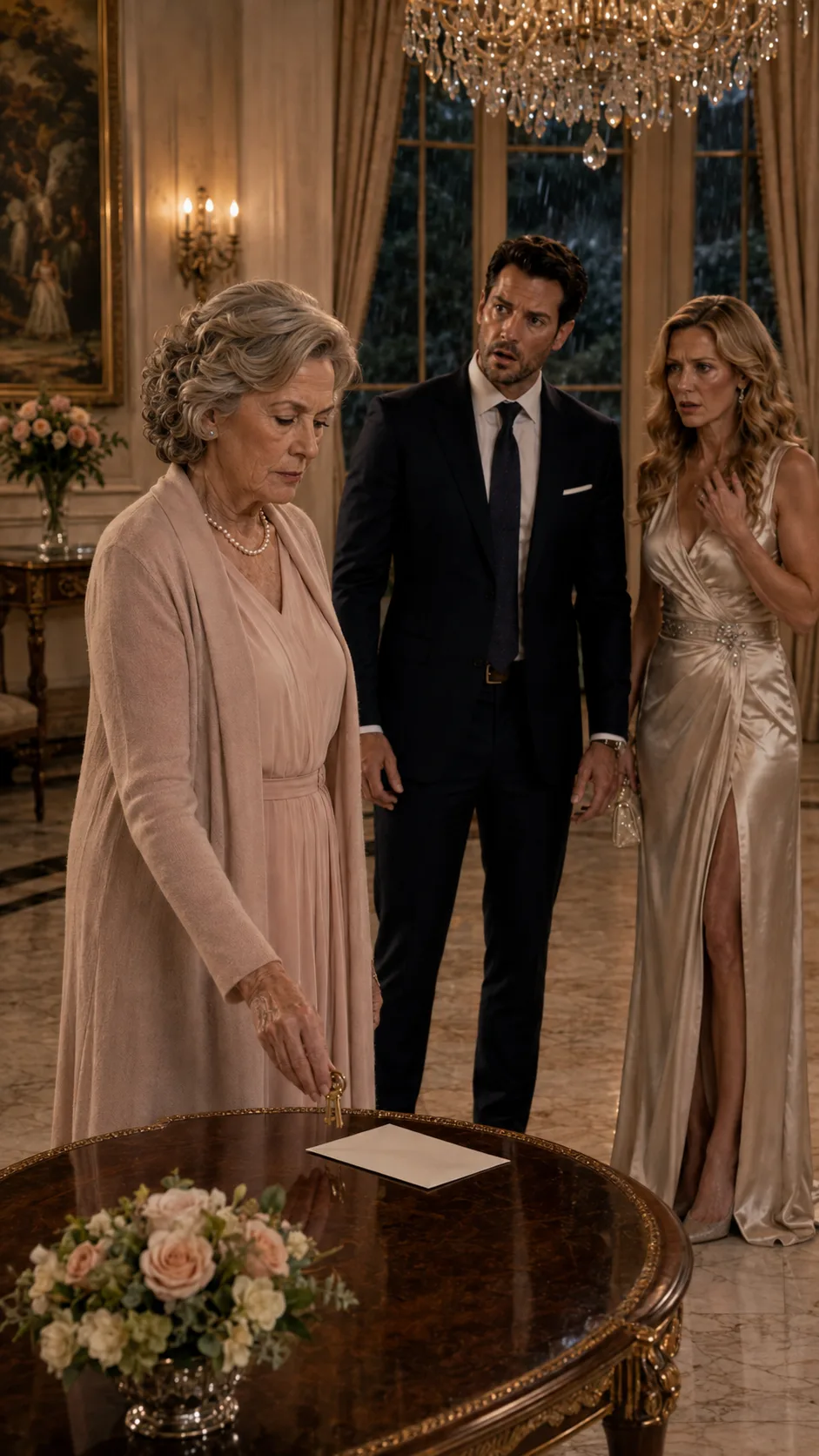
I reached the coffee table and placed the white envelope in the center.
Claire’s eyes fixed on it immediately.
Then I removed the keys from my pocket.
They touched the tabletop beside the envelope with a small, clean sound.
Mark’s smile faltered—not much, but enough for me to see it.
Claire leaned forward.
“What’s that?” she asked.
I remained standing.
There was something almost surreal about watching her calculate possibilities in real time.
Her eyes moved from the keys to the envelope and back again. She had expected documents, certainly, but only documents she understood. Brochures. Estimates. Lists. Forms she could explain to me.
This envelope had not come from her.
That was the problem.
Claire looked at my face, searching for a clue.
I gave her none.
Her composure held for another few seconds.
Then curiosity defeated caution.
She reached toward the envelope.
The movement was instinctive, almost proprietary.
Exactly the way she had begun reaching into every other part of my life.
Before her fingers could close around it, I placed two fingers gently on the top edge.
Claire stopped.
So did Mark.
Nothing about the gesture was forceful.
It did not need to be.
For the first time in months, my daughter was looking at something connected to my future and understanding that access was not automatically hers.
I met her eyes.
The confidence I had watched grow in her since Sunday vanished.
Not gradually.
All at once.
Her hand remained suspended above the table.
I could see the question forming behind her expression, followed quickly by something she had not allowed herself to feel before.
Uncertainty.
Perhaps even the first recognition that the woman standing in front of her had never stopped being capable of making her own decisions.
I kept my fingers resting lightly on the envelope.
Then, very quietly, I said the only two words necessary.
“Not yet.”
THE END.
Chapter complete
You have reached the end of this chapter.
Continue reading
A few more worlds to get lost in after this chapter.




