Part 2 — The Message That Proved She Thought I Had No Choice
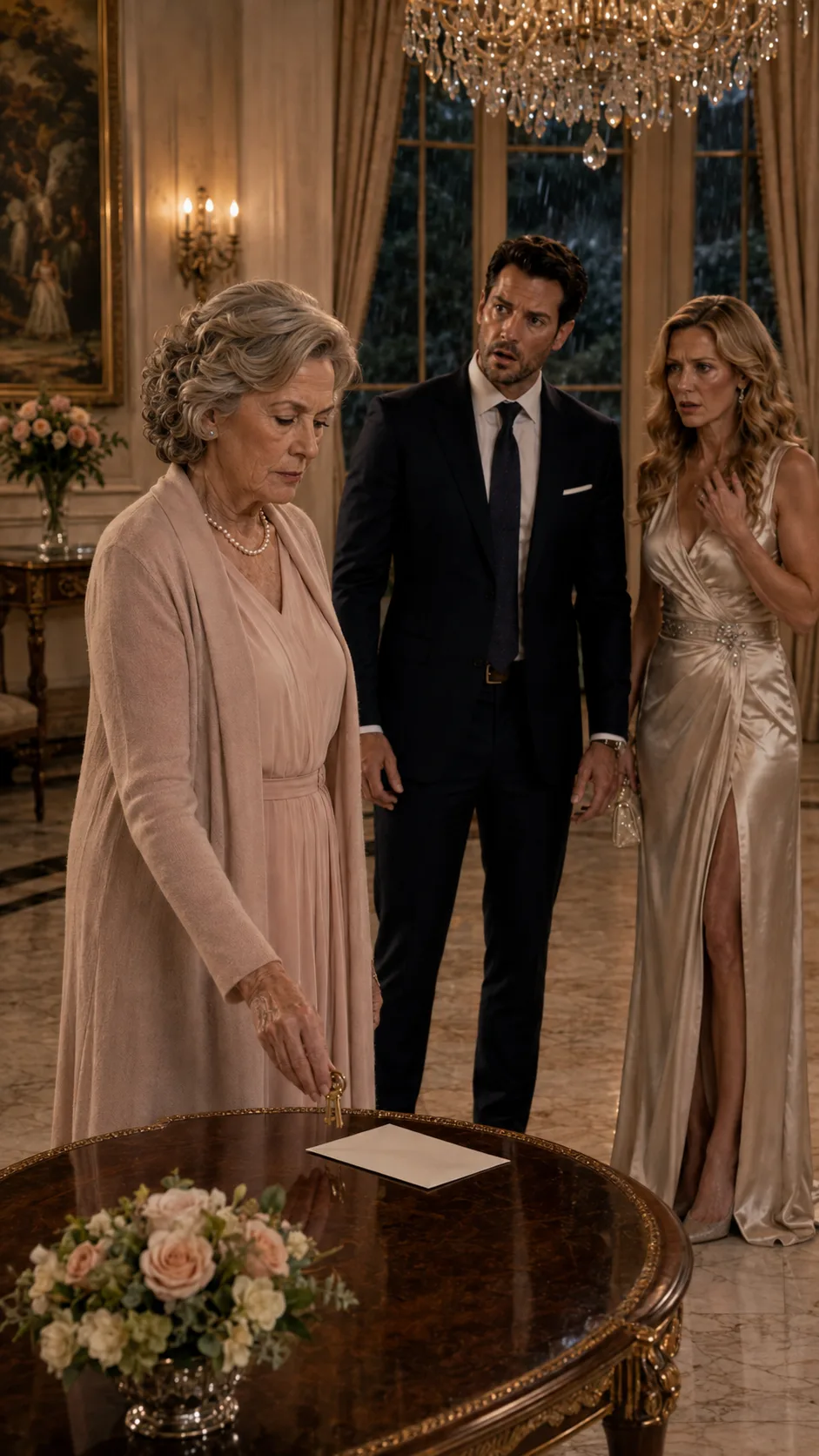
It had been mixed with circulars and advertisements near the front entry, probably slipped beneath Claire’s purse during one of her visits and forgotten when she left.
Chapter 2
It had been mixed with circulars and advertisements near the front entry, probably slipped beneath Claire’s purse during one of her visits and forgotten when she left.
The return address belonged to a downtown real estate office.
My first thought was that Claire and Mark were considering moving.
Then I saw the handwritten notation beneath the printed address.
It was my street.
My house number.
My address was on paperwork from a real estate office, but my name was nowhere on the envelope.
I stood there for several seconds with the mail in my hand, hearing only the old wall clock in the hall.
Tick.
Tick.
Tick.
There are moments when betrayal arrives dramatically, all shouting and slammed doors.
And there are moments when it arrives as a small piece of paper you were never supposed to see.
I put the envelope exactly where I had found it.
When Claire came back the following afternoon, I watched her eyes move immediately toward the entry table.
She saw it.
For a fraction of a second, her face
changed.
Then the smile returned.
She slipped the envelope into her handbag without mentioning it.
Neither did I.
That night, I lay awake thinking about my husband.
Edward had been practical about almost everything. He kept receipts in labeled folders, changed furnace filters before they needed changing, and believed every important document should exist in two places.
But whenever it came to Claire, he was hopelessly sentimental.
“She’s our girl,” he would say whenever I accused him of indulging her.
Even after she was married, even after she had children of her own, he still called her our girl.
I wondered what he would have made of the real estate envelope.
I knew what he would have wanted me to do.
Protect myself without destroying the family if there was still another explanation.
I tried to give Claire that possibility.
Then came 12:17 a.m.
I remember the exact time because
I had fallen asleep in my chair with a book open on my lap when my phone vibrated against the side table.
The room was dark except for the lamp beside me.
I picked up the phone expecting some automated message or perhaps Claire checking whether I was awake.
Instead, I saw her name above a single sentence.
“Don’t push too hard yet. She still thinks she has choices.”
For several seconds, I simply stared.
The message disappeared almost immediately.
Claire had deleted it.
But she had been too late.
I had already read every word.
She still thinks she has choices.
Not Mom is having trouble deciding.
Not I hope she understands why we’re worried.
Not even Give her time.
She still thinks she has choices.
My daughter had accidentally revealed something more important than any real estate document could have shown me.
She believed the decision about my
home had already been made.
The only person who apparently didn’t know it was supposed to be me.
I sat there until nearly two in the morning.
I did not cry.
That surprised me.
There had been a time when anything Claire did could reach straight through my defenses. When she was twelve and screamed that she hated me, I cried in the laundry room where she couldn’t see. When she moved away for college, I cried before I even reached home.
But that night, sadness arrived differently.
It hardened.
By morning, I knew exactly whom I needed to call.
Mr. Harlan’s business card had been tucked inside my Bible since Edward’s funeral.
He had handled our estate documents years earlier and had told me, after the service, that I should contact him if I ever needed help understanding anything financial or legal.
At the time, I assumed I never would.
I made coffee, opened my Bible, and removed the card.
My hands were perfectly steady when I dialed.
Mr. Harlan remembered me immediately.
I did not explain everything over the phone.
I simply said I needed advice regarding my home and that I preferred our conversation to remain private.
His tone changed at once.
We arranged to meet.
The following afternoon, I carried a folder into his office containing notes I had made from Claire and Mark’s questions, a photograph of the real estate envelope, and a screenshot of the message Claire had accidentally sent me.
Mr. Harlan read everything twice.
He asked careful questions.
Had I signed anything?
No.
Had I given Claire power of attorney over my property?
No.
Did anyone else have access to my financial accounts?
No.
Had I agreed verbally or in writing to sell the house?
Absolutely not.
Mr. Harlan leaned back and studied me for a long moment.
What I felt then was not fear.
It was clarity.
I had spent months responding to Claire’s behavior as a mother, trying to understand her motives, excuse her anxiety, preserve her dignity.
Mr. Harlan forced me to look at the situation differently.
Not as a mother protecting her daughter’s feelings.
As a homeowner protecting her own decisions.
My life did not become communal property simply because I had grown older.
That realization should have been obvious.
Yet families have strange ways of making obvious things difficult.
We discussed possibilities.
I listened more than I spoke.
By the time I left his office, the fear Claire apparently expected me to feel had disappeared.
In its place was something calmer.
A plan.
I returned home before sunset and stood for a while in the front yard.
The maples Edward planted when Claire was a toddler towered above the driveway now. Their branches crossed overhead, and the late sunlight turned the edges of the leaves gold.
For the first time, I allowed myself to ask a question I had avoided for years.
Did I still want the house?
Not whether Claire wanted it.
Not whether maintaining it was practical.
Not whether a woman my age was supposed to downsize.
Did I want it?
The answer surprised me.
I loved the house.
But loving something did not mean I had to cling to it forever.
The garden was becoming harder to maintain. Half the bedrooms remained closed unless family visited. Winters made the driveway exhausting. Edward was everywhere in the house, which had once comforted me but increasingly made the rooms feel like a museum to a life that had ended.
Maybe someday I would leave.
Maybe even soon.
But there was an enormous difference between choosing to leave and being maneuvered out.
Claire had confused my willingness to change with permission to control me.
That was the mistake I intended to correct.
Over the next several days, I behaved normally.
I called Claire about an appointment. I asked Mark whether my grandson still needed help with a school project. I discussed recipes and weather and whether the roses needed pruning.
Claire seemed relieved by my calmness.
More than once, she brought up how much easier life could be in a smaller place.
I never argued.
Each time, I simply said I was thinking about things.
What Claire did not know was that my thinking had already moved far beyond the choices she had prepared for me.
Sunday arrived warm and deceptively peaceful.
Claire and Mark came for dinner exactly at five-thirty.
Claire carried dessert, Mark brought wine, and anyone watching us from outside might have thought we were an ordinary family gathering for an ordinary meal.
Perhaps that was what made it feel so strange.
I had cooked roast chicken with rosemary, potatoes, green beans, and the rolls Claire loved as a child.
She complimented everything enthusiastically.
Mark discussed work.
I asked about my grandson.
For almost twenty minutes, no one mentioned my house.
Then Claire glanced at Mark.
It was quick.
A tiny exchange that most mothers would have missed.
I had been reading Claire’s face since the day she was born.
I knew exactly what it meant.
Now.
Claire wiped her mouth, reached toward the empty chair beside her, and lifted a slim stack of glossy brochures from her handbag.
She placed them on the table.
Bright photographs covered the fronts: landscaped courtyards, smiling gray-haired couples, airy apartments, dining rooms decorated like hotels.
Claire slid them toward me.
The gesture was gentle.
Prepared.
Almost ceremonial.
Click the blue “PART 3” below to read the next part: 👉 PART 3 👈
Chapter complete
You have reached the end of this chapter.
Continue reading
A few more worlds to get lost in after this chapter.




