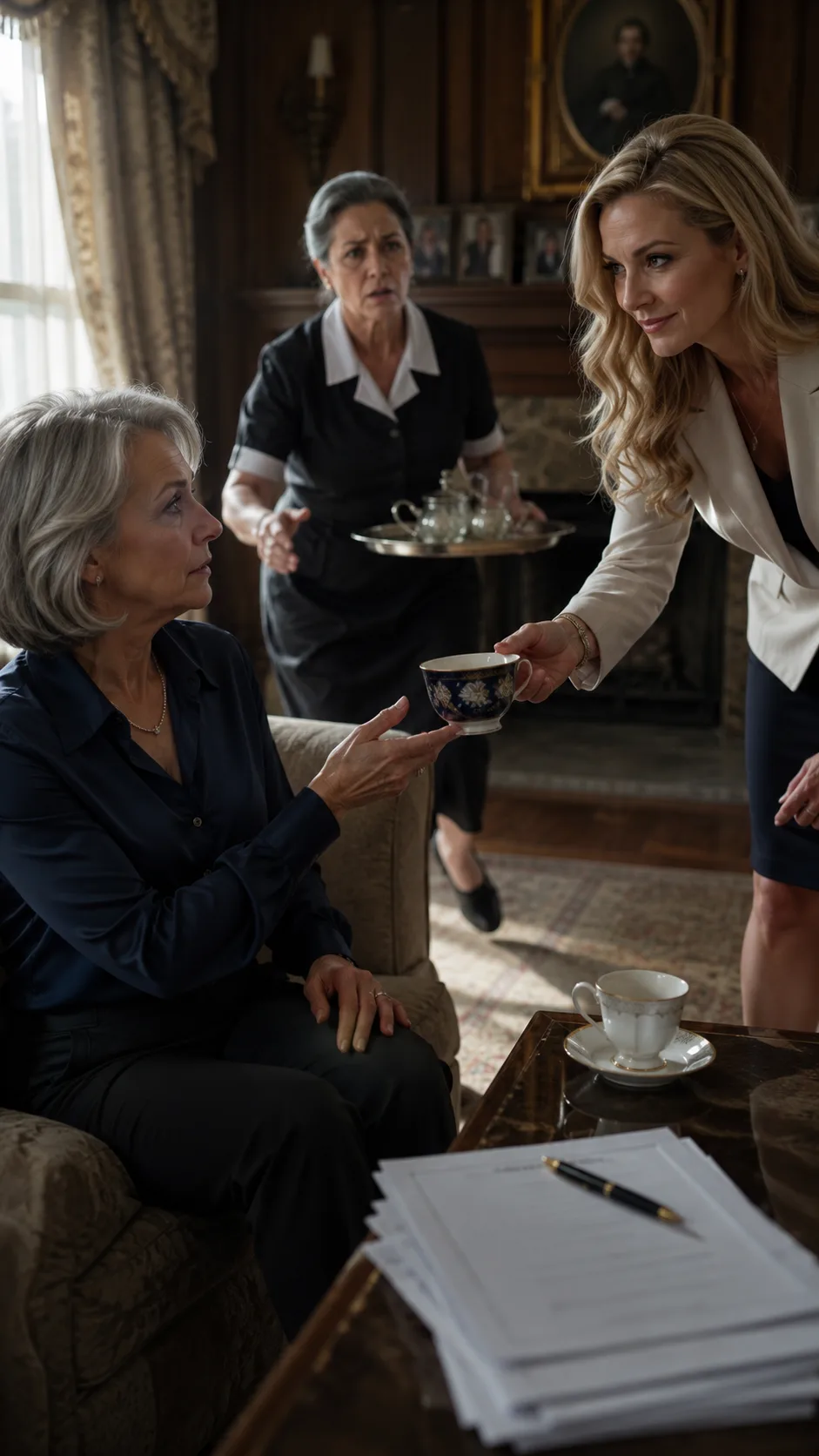
Six months later, Carlton and Ever sat at separate defense tables in Suffolk County Superior Court.
Chapter 3
Six months later, Carlton and Ever sat at separate defense tables in Suffolk County Superior Court.
Ever had recovered from the arsenic, but prison had stripped away her polished confidence. Her blonde hair was pulled back severely, and she kept her eyes on the table. Carlton looked smaller in an orange jumpsuit than he ever had in his tailored suits.
Neither of them looked at me.
The prosecution’s evidence was overwhelming.
Detective Sarah Chen showed the jury the arsenic vial found in Ever’s office, the insurance policies on my life, and records proving Carlton had stolen more than $300,000 from Whitmore Industries.
A medical expert explained that I had been poisoned gradually for months. The weakness, confusion, and nausea I believed were signs of aging were symptoms of arsenic accumulating in my body. The cup Ever drank contained the final dose—enough to trigger cardiac failure within hours.
Then Rosa took the stand.
She described watching Ever handle my coffee, recording my symptoms, and finally seeing her
add an unusually large amount from the vial.
“Why did you intervene?” the prosecutor asked.
Rosa looked at me.
“Because Mrs. Whitmore treated me like a human being for twenty years. I could not stand there and watch them kill her.”
Carlton’s attorney tried to portray Rosa as a resentful employee who had fabricated evidence. Then the prosecutor played the home-security recordings.
Carlton’s voice filled the courtroom.
“The old woman is getting suspicious.”
Ever laughed. “Another week, and she’ll be too weak to question anything.”
A second recording followed.
“Are you sure the final dose won’t show up?” Carlton asked.
“Only if they test for arsenic,” Ever replied. “She’s sixty-four. Everyone will believe her heart gave out.”
Then came the recording that ended any hope of portraying my son as Ever’s helpless victim.
Carlton said, “I’m enjoying watching her get weaker. She used to control everything. Now she can barely
finish a board meeting.”
Several jurors turned toward him with open disgust.
His defense attorney argued that Ever had manipulated him, but Carlton’s own words betrayed him. He had not sounded frightened. He had sounded delighted.
The prosecutor displayed Ever’s handwritten chart tracking my decline:
Fatigue.
Nausea.
Confusion.
Weight loss.
Final dose.
Cardiac event expected within forty-eight hours.
She had recorded my suffering like a laboratory experiment.
When it was time for my victim statement, I walked to the podium and faced the two people who had called themselves my family.
“For thirty-nine years,” I began, “Carlton was my only child. I believed that bond could survive anything.”
My son finally looked up.
“I planned to give him everything. The company. The house. Every asset Charles and I had built. There was never any plan to disinherit him. He did not try to kill me because he was desperate. He
tried to kill me because waiting for my natural death required more patience than he possessed.”
The courtroom was silent.
“Carlton and Ever poisoned more than my body. Every concerned question was surveillance. Every affectionate smile was camouflage. Every family meeting was another opportunity to weaken me.”
I looked at Rosa.
“But their cruelty revealed something else. Loyalty does not always come from blood. Sometimes it comes from the woman everyone dismisses as ‘the help’—the woman brave enough to risk everything to save a life.”
Then I faced Carlton again.
“I forgive you because I refuse to carry your poison inside me. But forgiveness does not mean trust. It does not mean reconciliation. And it does not erase consequences.”
The jury deliberated for three days.
Carlton and Ever were found guilty of attempted murder, conspiracy, embezzlement, and insurance fraud. Both received life sentences without parole.
I did not attend sentencing.
Instead, Rosa and I walked through my Beacon Hill house one final time. In Carlton’s childhood bedroom, I found photographs of the sweet boy he had once been—holding dandelions, laughing at birthday parties, sleeping against his father’s shoulder.
For years, I wondered when that child disappeared.
Then Rosa said, “Maybe what matters isn’t when he changed. Maybe what matters is what you do now.”
So I sold the house.
I repaired the company, restored the stolen money, and removed Carlton from every legal document connected to my estate. Then I created the Whitmore Foundation to protect older people from financial and physical abuse by their families.
I asked Rosa to become its executive director.
She stared at me. “Mrs. Whitmore, I’m a housekeeper.”
“No,” I told her. “You are the best investigator, protector, and judge of character I have ever known.”
Our first case involved a widow whose daughter was draining her bank account. The second involved a man whose son hid his medication to force him into signing over his home. The third began with a bank teller noticing a trembling customer making an unusual withdrawal.
Within five years, the foundation had helped hundreds of victims recover stolen assets, find safe housing, and prosecute relatives who believed family loyalty guaranteed silence.
Rosa became family to me—not because we shared blood, but because we chose honesty, courage, and protection.
Carlton wrote letters from prison. I returned them unopened. I had forgiven him, but he had never shown remorse. His letters spoke only of his suffering and what he had lost.
Ten years after the coffee incident, Rosa and I opened a residential crisis center for elderly abuse victims. At the dedication ceremony, a gold plaque bore her name.
She cried when she saw it.
“You saved my life with one moment of courage,” I told her. “Now that courage is saving people you may never meet.”
I am seventy-four now.
Every morning, Rosa and I sit together in the garden and drink coffee from two blue porcelain cups.
Sometimes she smiles and asks, “You trust me?”
And I answer, “With my life.”
The coffee Ever prepared was meant to end my story.
Instead, it exposed the truth, gave me a new purpose, and taught me that family is not defined by inheritance.
Family is defined by who protects you when protection costs them something.
THE END
Chapter complete
You have reached the end of this chapter.
Continue reading
A few more worlds to get lost in after this chapter.




