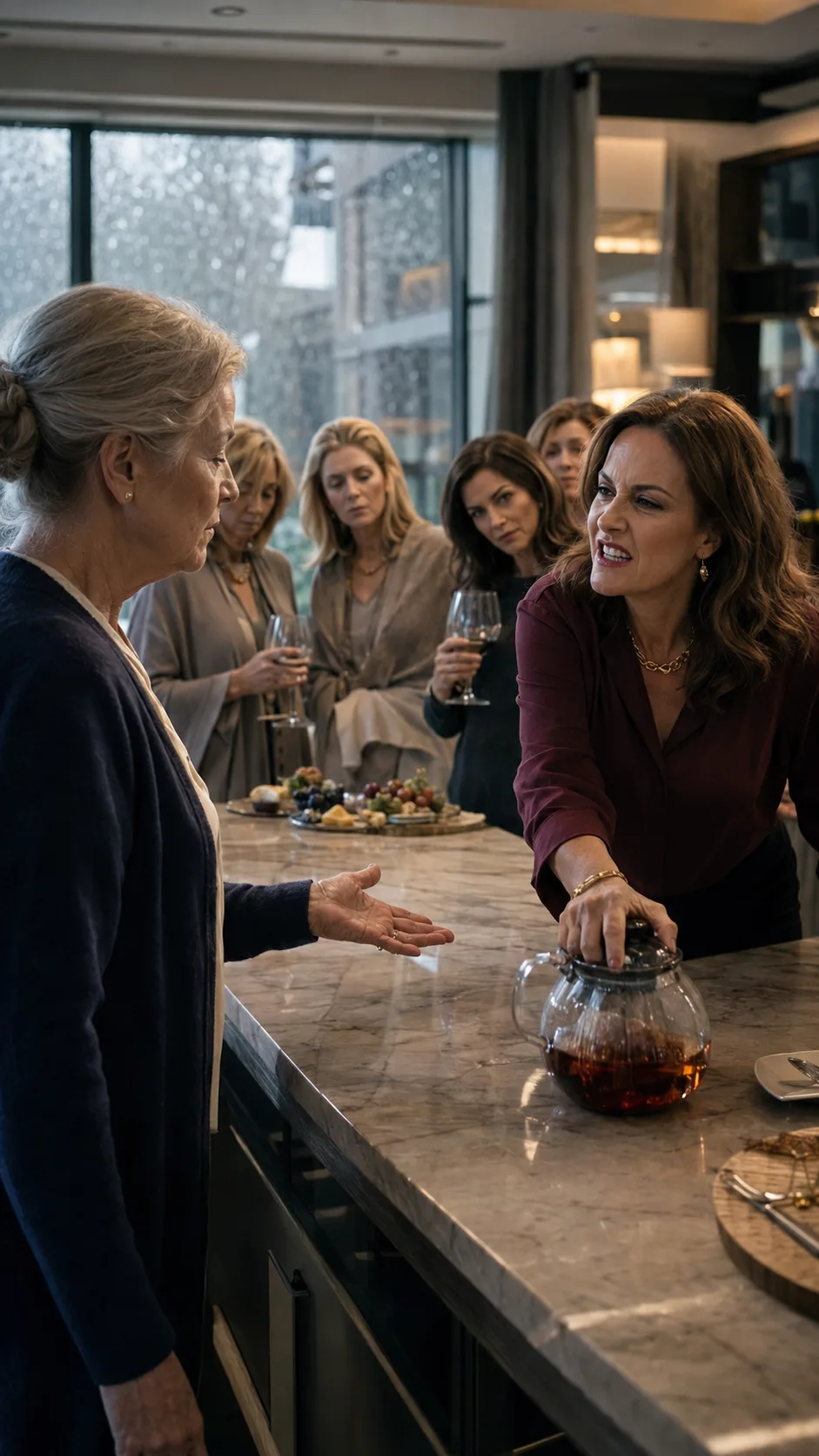
By Monday afternoon, everyone in the gated community knew something had happened at 412 Crestview Lane.
Chapter 3
By Monday afternoon, everyone in the gated community knew something had happened at 412 Crestview Lane.
The homeowners association president arrived at the house before Brenda could leave for her presentation.
Marcus had spent twelve years protecting the appearance and property values of the neighborhood. He was accustomed to complaints about landscaping, parking and paint colors.
He was not accustomed to receiving an injunction threatening to close the only secondary access road to the clubhouse.
Brenda met him on the front porch.
“What did your mother-in-law do?” he demanded.
“She’s confused,” Brenda said. “She doesn’t understand the documents she signed.”
Marcus held up the cease-and-desist letter.
“Her attorney understands them. The county records show that she owns the parcel.”
Brenda glanced toward the neighboring land.
“There must be a mistake.”
“There isn’t.”
“Then the association can keep using it while we work this out.”
“The notice says access ends immediately unless the outstanding taxes and lease violations are resolved.”
Brenda lowered her voice.
“Marcus, we have
known each other for years.”
“So have our lawyers.”
Several neighbors had begun watching from their windows.
Brenda’s presentation did not go well.
She arrived late and distracted. Her phone continued vibrating throughout the meeting as board members, attorneys and real estate agents attempted to contact her.
By lunchtime, two women from the book club had told others what they witnessed on Saturday.
By evening, everyone knew that Brenda had called the elderly woman who financed the house an old beggar.
Some details became exaggerated as the story spread, but the central fact remained unchanged.
The woman Brenda had humiliated owned a substantial interest in her home.
Scott called me repeatedly.
I ignored the first seven calls.
On the eighth, I answered.
“Mom,” he said, his voice breaking. “Please come back.”
“I won’t live in that basement again.”
“Brenda is upset. She didn’t mean what she said.”
“She meant every
word.”
“She apologized.”
“To you?”
He became silent.
“No.”
“Then she hasn’t apologized.”
“Can we meet with Arthur? Maybe restructure the loan?”
“You have attorneys. Let them communicate with mine.”
“You sound like a stranger.”
“I was your mother when I sold my home to help you. I was your mother when I cooked your meals, cleaned your kitchen and tried to keep peace inside your marriage.”
“You’re still my mother.”
“Yes. But I am no longer your victim.”
He began crying.
For most of Scott’s childhood, I had protected him from pain. When he fell from his bicycle, I cleaned his wounds. When he struggled in school, I stayed awake helping him study.
Even after he became an adult, I had solved problems before he was forced to face them.
That was part of the reason he had become weak.
I had protected him so completely that he never
learned how to protect anyone else.
“I love you,” I told him. “But love does not require me to surrender my dignity.”
“What am I supposed to do?”
“For once, Scott, make your own decision.”
The thirty-day deadline passed without payment.
Scott and Brenda attempted to refinance the house, but the existing mortgages, the new lawsuit and my secured claim made refinancing nearly impossible.
Brenda wanted Scott to borrow from his retirement account.
Scott refused.
She demanded that he ask me to waive the penalty.
I refused.
They listed personal property for sale: designer furniture, artwork, jewelry and a luxury vehicle.
The proceeds were not enough.
Their kitchen renovation, completed only eight months earlier, had been financed through a second mortgage.
Brenda’s perfect life had been built on debt.
Arthur explained each stage of the legal process to me.
A partition sale was not immediate. Scott and Brenda were given opportunities to contest the documents, negotiate a settlement or purchase my interest.
Their lawyer challenged the abuse clause.
Arthur submitted my written declaration and statements from three of Brenda’s guests.
One of the women who had looked away during the confrontation admitted she had heard every word.
Another said Brenda’s tone was “deliberately humiliating.”
Even the woman who had sneered into her wine glass confirmed that Brenda ordered me to return to the basement.
The court found enough evidence to enforce the agreement while the partition action proceeded.
Brenda blamed Scott.
“You signed this without reading it,” she shouted during one settlement meeting.
“You told me to sign it,” he replied.
“I trusted you.”
“And my mother trusted both of us.”
That was the first time Scott defended me in front of his wife.
It came four years too late.
But it was a beginning.
The homeowners association eventually negotiated a temporary access agreement directly with me. They paid the outstanding expenses and covered my legal fees related to the parcel.
Brenda was furious that Marcus dealt with me instead of her.
She had spent years building her identity around the house, the neighborhood and the people who attended her gatherings.
Now those same people knew she did not control the land beside her backyard.
Some stopped inviting her to events.
Others remained polite but distant.
The house became unbearable for Scott and Brenda.
Every room contained an argument.
Brenda accused Scott of ruining her future.
Scott accused Brenda of mistreating the woman who had made their lifestyle possible.
Six weeks after the foreclosure notice was served, Scott filed for divorce.
When he told me, he did not ask for money.
He did not ask me to stop the sale.
He only said, “I should have stopped her years ago.”
“Yes,” I answered.
“I thought staying neutral would keep the peace.”
“There is no neutrality when someone you love is being abused.”
He nodded.
“I know that now.”
Three months after the process server first arrived, the house at 412 Crestview Lane was sold through a court-supervised auction.
I did not attend.
Arthur attended on my behalf.
The sale proceeds first paid the primary mortgage. Then my judgment, including the secured amount, penalties and legal costs, was satisfied.
After the remaining debts and expenses were paid, less than $40,000 was left for Scott and Brenda to divide.
The marble kitchen disappeared from Brenda’s social-media photographs.
The designer furniture was sold.
The carefully landscaped backyard belonged to someone else.
Brenda moved into a one-bedroom apartment near her office.
She continued working at the marketing firm, but the confident image she had created around herself was damaged.
People remembered the story.
Not because an elderly widow had taken revenge, but because Brenda had publicly mocked the woman whose money supported her lifestyle.
She had mistaken my silence for ignorance.
She had mistaken my age for helplessness.
Most of all, she had mistaken generosity for surrender.
I made a separate decision about the second parcel.
A developer offered $220,000 for the land.
The association objected at first, worried about changes near the clubhouse, but the sale complied with county requirements.
I accepted the offer.
With the money recovered from the house and the parcel, I purchased a one-story cottage near the coast in Cannon Beach.
It was not as large as the home Richard and I had built.
I did not need four bedrooms.
The cottage had a wraparound porch, pale wooden floors and a garden filled with hydrangeas.
The kitchen was bright and sunny.
The first thing I bought was a glass tea kettle.
I placed it on the stove where no one could take it from my hand or tell me I was in the way.
For the first few weeks, the silence felt strange.
Then it began to feel peaceful.
I filled the walls with photographs Brenda had ordered me to remove.
There was Richard standing beside our first car.
Scott as a boy holding a fishing pole.
My parents on their wedding day.
Every photograph had space.
Every memory was welcome.
Scott began visiting on weekends.
At first, our conversations were awkward.
He was living in a small rented apartment and attending therapy. He had begun to understand how years of avoiding conflict had allowed Brenda to control both of us.
One Saturday, he brought groceries.
“I thought I could make dinner,” he said.
“You know how to cook?”
“No. But I’m learning.”
He burned the potatoes.
The roast was dry.
The gravy came from a jar.
We ate everything.
After dinner, we carried two cups of chamomile tea onto the porch and watched the evening fog move over the coast.
“I’m sorry,” Scott said.
I looked at him.
“For what?”
“For every time I saw what she was doing and pretended not to see it.”
I waited.
“For letting her move your chair. For letting her remove Dad’s photographs. For letting you eat alone downstairs.”
His voice shook.
“And for believing that silence made me a good husband.”
I placed my hand over his.
“I forgive you.”
He exhaled, but I continued.
“Forgiveness does not erase consequences.”
“I understand.”
“You will have to earn back trust.”
“I understand that too.”
After that, he visited nearly every weekend.
Sometimes we talked about Richard.
Sometimes we spoke about therapy, work and the future.
Sometimes we simply sat in silence.
But it was a different kind of silence.
It was no longer the silence of fear.
It was the silence of two people learning how to rebuild something that had nearly been destroyed.
Months later, one of Brenda’s former book-club friends sent me a letter.
She apologized for not defending me that afternoon.
She wrote that she had looked away because she was uncomfortable and afraid of creating a scene.
Her words reminded me of Scott.
People often believe silence protects them from conflict.
In reality, silence usually protects the person causing the harm.
I wrote back and accepted her apology.
But I never returned to that neighborhood.
I did not need to stand in front of the empty house or watch another family move into it.
My life was no longer connected to 412 Crestview Lane.
My life was here—beside the ocean, among the hydrangeas, in a kitchen filled with sunlight.
Sometimes people think growing old makes a person weak.
They see gray hair, quiet manners and trembling hands, and assume there is nothing left beneath the surface.
They forget that elderly hands may have signed mortgages, built companies, raised children and buried the people they loved.
They forget that the quietest person in the room may be the one who laid the foundation beneath everyone else’s feet.
Brenda called me an old beggar.
She ordered me into the basement of a home purchased with my husband’s legacy.
She believed she could push me into the shadows and continue enjoying everything I had helped provide.
But when she tried to remove me from the house, she discovered the truth.
The foundation had never belonged to her.
And when I finally walked away, I took it with me.
THE END
Chapter complete
You have reached the end of this chapter.
Continue reading
A few more worlds to get lost in after this chapter.




