PART 2 — Thirty Days to Leave
I looked at Christopher.
Chapter 2
I looked at Christopher.
He was forty-two years old, tall like me, with his late mother’s narrow face and my father’s stubborn jaw. I had raised him after Elaine died. I had packed his lunches, paid his tuition, sat beside him through fevers, heartbreaks, failures, and funerals.
Now he stood in my hallway and called what Jessica had done to May an accident.
I heard every excuse he had made over the years.
Jessica was tired.
Jessica was stressed.
Jessica had been drinking.
Jessica felt insecure.
Jessica did not mean it.
Jessica loved the family in her own way.
No.
Not this time.
“Get out,” I said.
Christopher’s face changed. “Dad.”
“Get your wife. Get your daughter. Get out of my house.”
Jessica laughed once from the kitchen. “Lawrence, I barely touched her. She’s always dramatic.”
I did not look at her.
I looked only at my son.
“Thirty seconds,” I said. “Or I
call the police.”
The room went silent.
Then Patricia stood.
“I’ll walk you out,” she said.
It was not an offer.
Christopher picked Lily up from the living room floor. The child cried against his shoulder, reaching for the wooden blocks she had left behind. Jessica opened her mouth as if she still planned to argue, but Patricia stepped close enough to make the direction of the evening clear.
They left without coats.
Without leftovers.
Without goodbye.
When the front door closed behind them, the dinner party was over.
Everyone knew it.
And for the first time in years, so did I.
After Christopher and Jessica left, the house did not become peaceful.
It became hollow.
Robert found the broom and swept the blue porcelain into a dustpan. Ellen knelt with paper towels and wiped sauce from the tile. The church couples murmured apologies, touched May’s shoulder with the awkward
kindness of people who had witnessed something too intimate, then left one by one.
Someone blew out the candles.
Someone covered the food.
Someone pushed the dining chairs back into place, as if furniture could repair dignity.
Within twenty minutes, only May and I remained.
She sat on the sofa with a blanket around her shoulders, staring at nothing. The red marks on her chest were darker now, uneven shadows beneath the edge of her blouse. She kept rubbing the cuff of her cardigan between her thumb and forefinger.
“I should have used the white platter,” she said.
I turned toward her. “Stop.”
“Lawrence—”
“She put her hands on you.”
“She was upset.”
“She shoved you into a wall.”
May closed her eyes.
I hated how quickly she reached for blame that did not belong to her. I hated how many years our family had trained her to do that.
To apologize for being hurt. To soften the truth so no one else had to feel guilty.
“That was not about a platter,” I said. “That was about control.”
Her face broke then, quietly. Tears slipped down her cheeks without sound. I pulled her against me, and she cried like someone trying not to be a burden even while falling apart.
“I don’t want you to lose your son because of me,” she whispered.
That nearly broke me.
Because she believed it.
Because somewhere, deep inside her, May thought the consequence of Jessica’s cruelty would be her fault.
I held her tighter.
“You are my wife.”
“I know.”
“No,” I said. “I don’t think you do.”
She looked up at me.
“I chose you nine years ago,” I said. “I am choosing you now.”
Later, after May went upstairs, I walked into my office and closed the door.
The house still smelled faintly of soy sauce, steam, and disaster. The kitchen floor was clean, but I could still see the place where the platter had broken.
I opened the third drawer of the file cabinet.
The folder was there.
CHRISTOPHER PROPERTY AGREEMENT.
Six years earlier, when Christopher and Jessica were expecting Lily, they could not qualify for the house they wanted. Their credit was uneven. Their savings were thin. Their apartment was cramped.
I owned a rental property on Westmont Drive, a three-bedroom house near a good elementary school.
Christopher loved it.
Jessica loved it more.
So I offered them a lease-to-own arrangement.
Not a gift.
A path.
They would pay below-market rent. A portion would count toward a future purchase option if they completed the terms and remained in good standing. I covered repairs. I carried taxes and insurance longer than I should have. I gave my son a chance no bank would have given him.
My attorney, Sharon Kuwada, drafted the agreement.
Christopher could have taken it to his own lawyer.
He did not.
He signed it at my kitchen table while Jessica talked about nursery colors and cabinet hardware.
Now I read the clause Sharon had added because I had insisted on one safety provision. At the time, I had thought it unnecessary. Insurance against a storm I never expected.
It allowed termination with written notice if the tenant household created a credible risk to the safety or peaceful enjoyment of my family.
I read that sentence three times.
Then I called Sharon.
It was Saturday night, 9:32.
She answered on the second ring. “Lawrence?”
“No,” I said before she could ask if everything was all right. “I need you to prepare a termination notice for Westmont. Thirty days. Under the safety clause.”
Silence.
Then her voice changed. “What happened?”
I told her.
The dinner.
The argument.
The shove.
May hitting the wall.
Christopher calling it an accident.
The witnesses.
The marks on my wife’s chest.
When I finished, Sharon let out a slow breath. “Is May safe?”
“Physically, yes. Emotionally, no.”
“Do you want to file a police report?”
“Not tonight.”
“You may need one.”
“I know.”
She paused. “Lawrence, if you do this, Christopher and Jessica may fight it. They have lived there six years. They will say they invested money, improved the house, built a life there. This will be painful.”
“I don’t expect painless.”
“They have a child.”
“I know.”
“You are sure?”
I thought of May against the wall, her hands behind her like she was trying to hold herself together. I thought of Jessica’s face. I thought of my son’s voice.
It was an accident.
“I am sure.”
“Then we do it properly,” Sharon said. “No threats. No changing locks. Certified mail. Legal compliance. If they refuse, we file.”
“Do it.”
Monday morning, the notice arrived in my email.
The language was cold, clinical, and merciless.
Thirty days.
Termination for cause.
Failure to vacate would lead to formal proceedings.
I printed it.
Read it.
Signed what needed signing.
Then I drove to the post office and mailed copies by certified mail to Christopher and Jessica.
At 2:04 p.m., the receipt confirmed delivery.
Signed by Christopher.
At 2:31, my phone rang.
I answered.
“Dad, what is this?”
His voice shook, not just with anger.
With fear.
“It is a termination notice.”
“You’re evicting us?”
“I am ending the lease-option agreement. If you are not out by the deadline, Sharon will begin formal proceedings.”
“This is our house.”
“No,” I said. “It is my house. You have an agreement.”
“We’ve lived here six years.”
“Yes.”
“We painted the nursery. We planted trees. Lily took her first steps in that living room.”
I closed my eyes.
I had known this would hurt.
Knowing did not make it easier.
“You built those memories under a contract you did not respect and responsibilities you did not honor.”
“That isn’t fair.”
“Neither is calling what happened to May an accident.”
He breathed hard into the phone. “Jessica made a mistake.”
“She had two days to apologize. She did not.”
“She’s embarrassed.”
“She should be.”
“She wants to apologize now.”
“She wants to keep the house.”
Silence.
Then, softer, “Dad, please. We have nowhere to go.”
“You have thirty days.”
“We put seventy thousand dollars into that house.”
“You paid reduced rent and option consideration under a written agreement.”
“You sound like a lawyer.”
“I sound like a man who finally read what he should have enforced years ago.”
His voice cracked. “Dad.”
For a second, I heard the boy again. The ten-year-old who held my hand at Elaine’s funeral. The teenager who sat on the porch pretending not to cry. The young man who called home when he had no one else.
My son.
Still my son.
But love does not require surrendering your wife’s safety.
“Christopher,” I said, “this was not the first time.”
He said nothing.
“You know it wasn’t.”
“She’s in therapy.”
“She should have gone before she put her hands on someone.”
“She barely touched her.”
There it was again.
The shrinking.
The smoothing.
The old script.
“Patricia saw it,” I said. “Robert and Ellen saw it. Everyone at that dinner saw it. And so did you.”
He had no answer.
“You have thirty days.”
I hung up.
He called again.
And again.
Then May’s phone rang.
She sat beside me on the sofa, staring at Christopher’s name on the screen.
“You do not have to answer,” I said.
She let it ring.
The next morning, Jessica came to the house while I was at a meeting in Portland.
May texted me at 10:11.
Jessica is here.
I called immediately. “Do not open the door.”
“I’m not.”
“How long has she been there?”
“Ten minutes. She keeps ringing the bell.”
“I’m coming home.”
By the time I reached the driveway, Jessica was gone. May sat at the kitchen table, pale, both hands wrapped around a cup of tea.
“She knocked for fifteen minutes,” May said. “Then she just stood there.”
I installed a doorbell camera that afternoon.
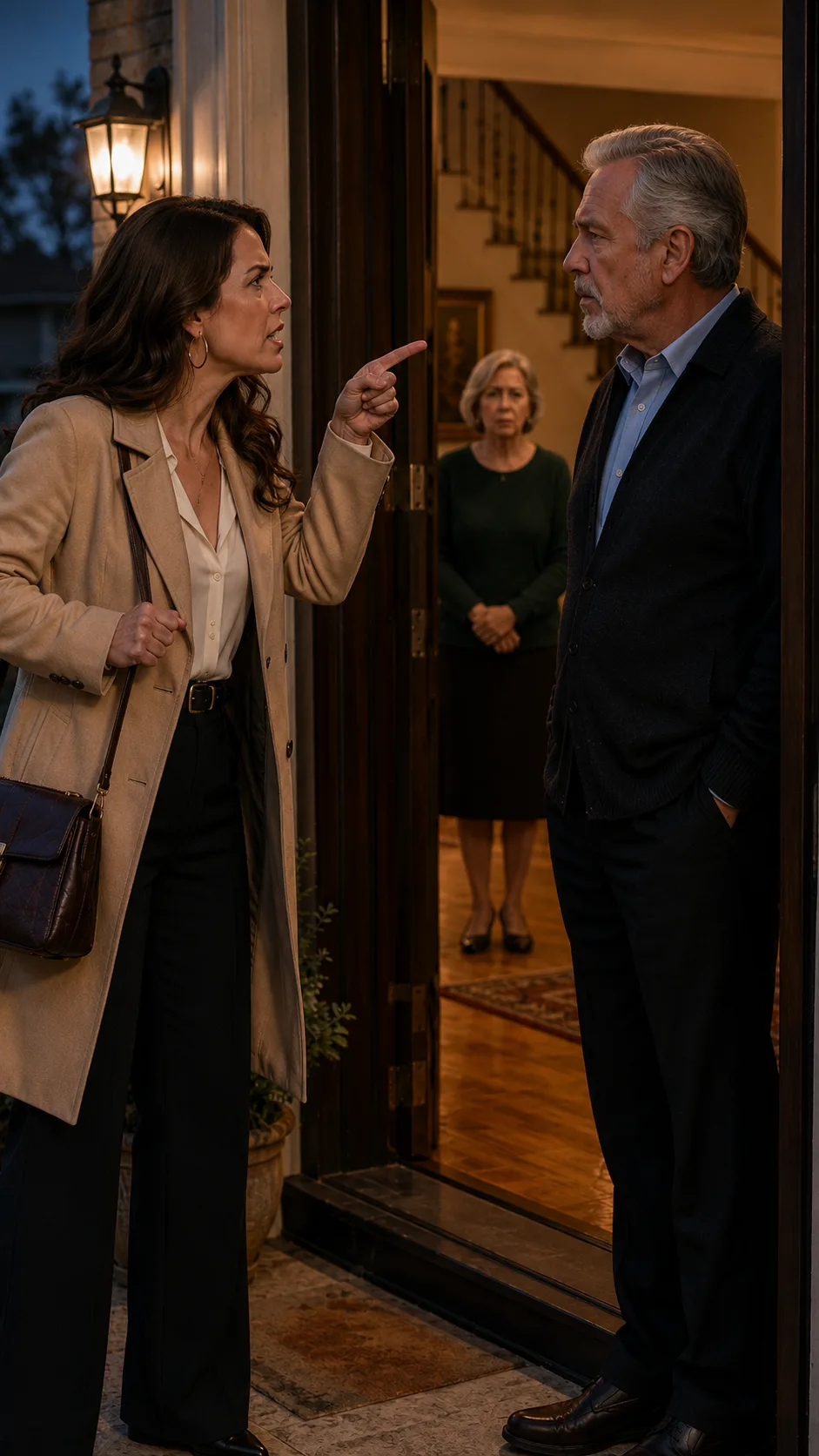
At six that evening, Jessica came back.
This time I opened the door.
Click the blue “PART 3” below to read the next part: 👉 PART 3 👈
Chapter complete
You have reached the end of this chapter.
Continue reading
A few more worlds to get lost in after this chapter.




