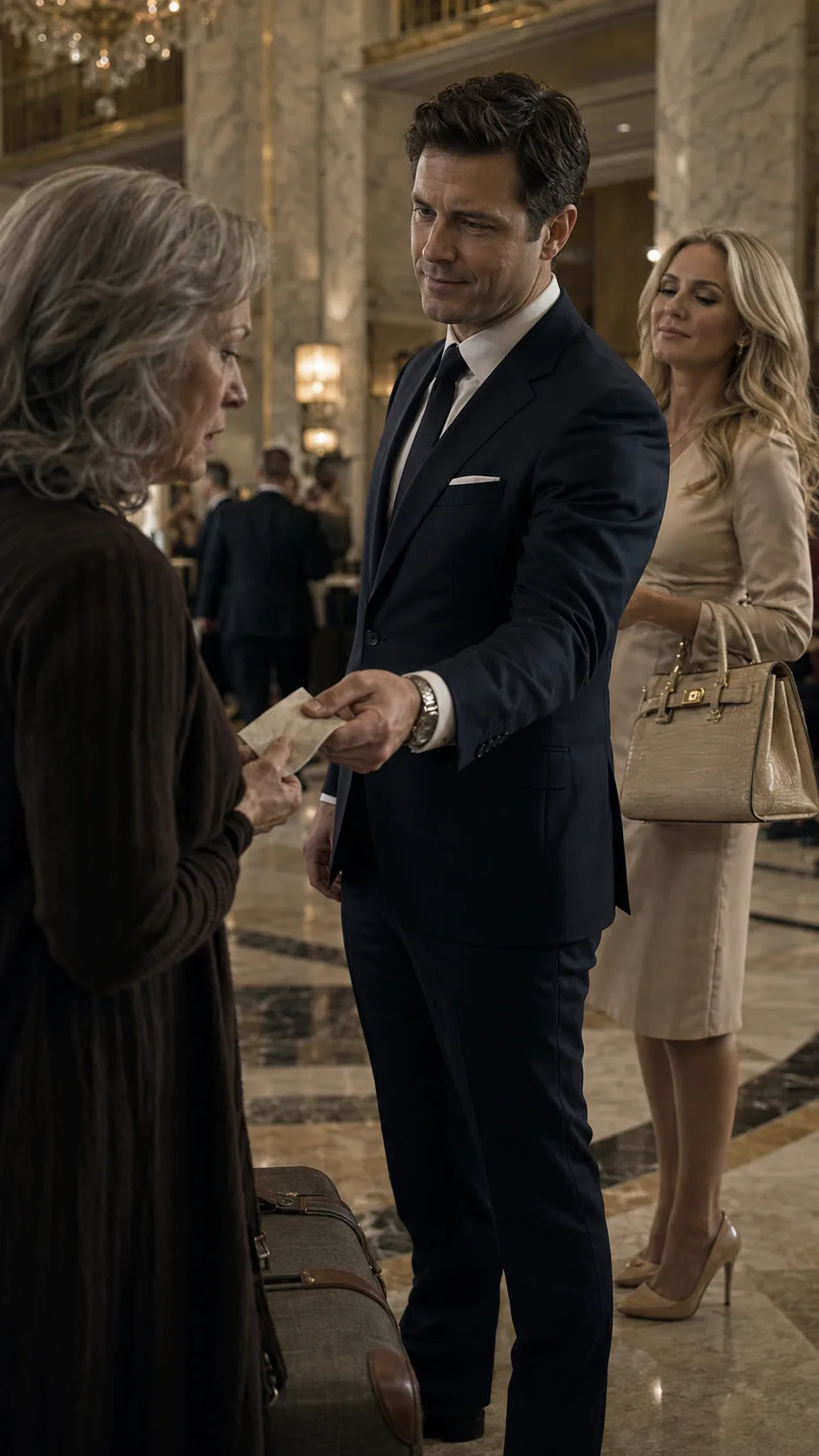
PART 2 — THE KEY TO A BURIED FAMILY SECRET
They walked away slowly, as if they were strolling in a park.
Chapter 2
PART 2 — THE KEY TO A BURIED FAMILY SECRET
They walked away slowly, as if they were strolling in a park.
Michael with his hands in his pockets, Danielle with her designer purse hanging from her shoulder, both laughing softly, whispering things to each other. I watched them pass through the hotel’s glass doors, get into that shiny black sedan, and disappear into the morning traffic of Los Angeles. Just like that. As if nothing had happened. As if I weren’t his mother. As if the last three days hadn’t existed.
My legs stopped responding. The paper with the bill was shaking so much in my hands that the numbers became blurry.
$11,000.
I made $800 a month cleaning houses. $11,000 was more than a year of my life working until my back broke. And my son knew it. He knew exactly how much I earned, how much I had, how much I didn’t have. He knew I couldn’t pay that. Never could.
The blonde receptionist cleared her throat softly from
the counter.
“Ma’am, will you be paying in cash or with a card?”
Her voice was kind, professional, but there was something in her eyes. Pity. She was watching my humiliation in real time and trying to be polite about it.
I opened my mouth, but no sound came out, only a choked gasp, as if someone had kicked me in the stomach.
Around me, the lobby was still alive. A young couple laughed next to the marble fountain. A man in a suit talked on the phone in English, gesturing with his free hand. A family with small children dragged suitcases toward the elevator. Everyone living their normal lives while mine was falling apart in pieces right in front of them.
I felt heat on my cheeks, pure humiliation running through me like liquid fire.
“I… I don’t have it.”
The words came out broken, barely a whisper. The
receptionist tilted her head, waiting. Her pink nails tapped softly on the keyboard.
“Ma’am, if there’s a problem, I can call the manager.”
Problem. That small word to describe the abyss I had just fallen into. My son had abandoned me in a luxury hotel with no way to pay. He had used me. He had brought me here knowing exactly what he was going to do, planning it, enjoying it.
The tears began to fall without permission, thick, hot, loaded with rage and shame. The guests started to look at me, some with curiosity, others quickly looking away, embarrassed to witness something so intimate and painful.
The receptionist grew nervous.
“Ma’am, please calm down. Calm. We’ll figure this out.”
But her voice sounded hollow. There was no solution. I didn’t have $11,000. I didn’t even have $1,000. I barely had enough for the bus ride home.
Suddenly, I heard
slow steps dragging across the marble. Steps of someone older. I looked up with soaked eyes and saw an elderly woman coming out from behind the counter. She must have been over eighty years old, completely white hair pulled back in a bun, deep wrinkles that told decades of stories, and honey-colored eyes that looked at me with a strange intensity. She wore the hotel uniform, but hers was different, older, as if she had been wearing the same fabric for thirty years.
She approached me with short but firm steps. The blonde receptionist looked at her, surprised.
“Emma, you don’t have to—”
But the elderly woman raised a wrinkled hand, silencing her.
Emma. That name didn’t mean anything to me then.
The elderly woman stopped in front of me, so close I could smell her soft perfume of lavender and thyme. She studied my face as if she were looking for something specific. Her eyes scanned my features with a mixture of astonishment and sadness.
“You are Mr. Harrison’s daughter.”
Her voice was raspy but firm. The question hit me like a punch to the chest. Harrison. My father. No one had said that name in front of me for more than thirty years. He had died when I was thirty-five, leaving me alone with a small child and no inheritance. Only blurry memories of a serious man who worked too much and spoke little.
“Yes… yes, I am his daughter.” My voice came out broken, confused. How did this woman know who my father was?
Emma closed her eyes for a moment, as if she were holding back a huge emotion. Then she opened them and a solitary tear rolled down her wrinkled cheek.
“I worked for your father for thirty-three years, from the time I was twenty until the day he died.”
The lobby seemed to freeze. The sounds became distant. Only she and I existed in that suspended moment.
“Your father was a great man. Difficult, demanding, but great. I was the housekeeper in his house. I cleaned, cooked, took care of his things.”
Her voice trembled with every word, loaded with a weight I didn’t understand.
“Before he died, he called me to his bed. He was very sick. He could barely speak. He took my hand and told me something I never forgot.”
Emma reached into the pocket of her uniform and pulled out a yellowed envelope, folded, battered by the years. The corners were worn, the ink on the front almost erased. But there, in shaky handwriting, was my name: Sandra.
“He told me, ‘Emma, someday my daughter is going to come here. She is going to be alone. She is going to be lost. When you see her, give her this. It is the only thing I can give her now.’”
She held the envelope out to me with trembling hands. I looked at it without daring to touch it.
“He knew I would work here. He arranged for me to be hired at this hotel thirty years ago. He told me to wait, that someday you would arrive. And here you are.”
Her voice broke completely.
“After thirty-three years, I can finally fulfill my promise.”
I took the envelope with numb fingers. It was heavy. Something solid was inside, something more than paper. I opened it slowly, feeling every second stretch like hot rubber. Inside was a folded letter and an old rusted metal key. The key had a number engraved on it, 447, and hanging from it was a small leather tag with a handwritten address.
I unfolded the letter—my father’s handwriting. That slanted writing I remembered from the few times he signed documents at home. The words hit me like stones.
“Sandra, if you are reading this, it is because you finally discovered that nothing in our family was what it seemed. Forgive me for the secrets. Forgive me for leaving you without explanation. This key opens a storage unit at the address Emma will give you. Inside you will find the truth about who I really was and about who you are. Go alone. Trust only yourself. Your father, Robert Harrison.”
I read the letter three times in a row, but the words still made no sense. Secrets. Truth. Who I really was. Every sentence was an enigma wrapped in fog. My father had been a quiet, hard-working man who left early and came home late. He never talked about his job. He never shared anything personal. When he died, I expected some small inheritance, something to help me raise Michael. But there was nothing, only debts that I had to pay by selling the few pieces of furniture that were left.
And now, thirty years later, a rusted key and a letter telling me that everything had been a lie.
I looked up at Emma. She was watching me with those honey-colored eyes full of something that seemed like pity, barely mixed with urgency.
“What is in that storage unit?”
My voice sounded louder than I expected, cutting the thick silence that surrounded us. Emma shook her head slowly.
“I don’t know. Your father never told me. He only asked me to give this to you when I saw you lost and alone. And here you are.”
I looked again at the leather tag hanging from the key. The address was written in almost faded black ink: Industrial Street 447, Warehouse 12, east side.
I knew that area. It was an abandoned part of the city, full of old warehouses and broken streets where no one went after sundown. A dark, forgotten place, perfect for hiding secrets you didn’t want anyone to find.
“Ma’am…”
The voice of the blonde receptionist abruptly brought me back to reality—and to the hotel bill. She was still standing there holding that paper with $11,000 that I couldn’t pay. The humiliation hit me again. But now there was something more. Rage. A cold, sharp rage that grew in my chest like cutting ice. My son had done this to me. He had brought me here knowing exactly what was going to happen, planning it.
Emma turned to the receptionist with an authority I didn’t expect from someone so old.
“I will take care of the lady’s bill. Put it in my name. I will pay it in installments from my salary.”
The receptionist opened her mouth to protest, but Emma silenced her with a look.
“Your father saved my life more times than I can count. This is the least I can do for his daughter.”
I didn’t know what to say. The words were stuck in my throat. This woman, this stranger who had kept a secret for three decades, was paying my debt. A debt my own son had created to destroy me.
“I… I can’t accept this.”
Emma took my hands in hers, wrinkled and cold.
“Yes, you can, and you are going to. But first, you are going to go to that address. You are going to open that storage unit and you are going to find out why your son did what he did.”
Her words chilled my blood.
“What do you mean?”
Emma squeezed my hands with surprising strength.
“Your father told me things before he died. Things about your family, about secrets he kept buried his whole life. And he told me that someday someone would come looking for that truth. Someone of your blood. But he didn’t expect it to be you who needed it. He expected it to be another.”
A shiver ran down my spine.
“Who else knew about this?”
Emma let go of my hands and took a step back, as if saying the next thing cost her physical effort.
“Your son was here six months ago. He asked for me. He said he was researching his grandfather’s life for a family project. I told him I had worked for Mr. Harrison, that I knew him well. He asked me many questions, too many, about properties, about money, about inheritances.”
The world tilted under my feet. Michael had been here. He had talked to Emma. He had investigated my father. Six months ago. Six months of planning this, planning to bring me here, humiliate me, leave me with nothing.
But why? What had he discovered that I didn’t know?
“What did you tell him?”
My voice was barely a trembling whisper. Emma lowered her gaze, ashamed.
“I told him your father had properties, that he had left things unresolved. I didn’t give him details, but it was enough. I saw how his eyes lit up, pure greed, and I knew I had made a mistake.”
I felt nauseous. My son had come here, had manipulated this elderly woman to get information, and then had designed this whole thing—the trip to the hotel, the luxuries, the fake smiles—all to leave me in ruins while he looked for what my father had hidden.
“I need to go to that storage unit.”
The words came out firm, loaded with a determination I didn’t know I had. Emma nodded slowly.
“Go now, before he gets there first. Because if Michael finds out where it is, he won’t leave you anything.”
I left the hotel like a sleepwalker. The key clenched in my fist until the metal cut my skin. The midday sun hit my face, blinding me for a moment. The city kept moving, indifferent to my pain. Cars sped past. People walked hurriedly. Street vendors shouted their products. And I stood there holding on to a rusted key and a truth I still didn’t understand.
I took a bus toward the east side. The trip lasted almost an hour. I sat next to the window, watching how the city changed from clean, modern buildings to old constructions with graffiti and broken windows. The streets became narrower, dirtier, more dangerous. When I reached my stop, the sun was beginning to set, painting the sky orange and dark violet.
Industrial Street 447 was exactly as I remembered it from decades ago. An endless row of rusted metal warehouses with corroded doors and huge padlocks. Some had broken windows. Others were completely sealed. Weeds grew between the cracks in the pavement. Trash accumulated in the corners. The silence was heavy, broken only by the distant sound of dogs barking.
I walked slowly, counting the numbers on the doors. Warehouse 8, Warehouse 9, Warehouse 10. My heart was pounding so hard I could feel it in my throat. Finally, I arrived. Warehouse 12. A dark gray metal door taller than me with a huge padlock that seemed not to have been touched in decades. Thick cobwebs hung from the corners. Dust covered every inch.
I took the key out of my pocket. My hands were trembling so much that it took me three tries to get it into the lock. When it finally went in, the metal screeched with a sharp sound that gave me goosebumps. I turned the key slowly. The padlock opened with a dry click that echoed in the silence. I took off the padlock and let it fall to the ground. Then, with both hands, I pushed the door. It opened slowly, grinding as if it were screaming in pain. A blast of cold, damp air came out from inside, bringing with it the smell of mildew, rusted metal, and something else. Something old. Something that had been waiting to be discovered for thirty years.
I looked inside. Total darkness. Only shadows dancing in the gloom. I reached for my cell phone, turned on the flashlight, and took the first step toward the truth my father had buried. And what I saw inside made me realize that my life would never be the same.
My cell phone light cut through the darkness in a trembling beam that barely illuminated six feet ahead. The inside of the warehouse smelled of abandonment, of years of accumulated silence between cold metal walls. My footsteps echoed against the cracked concrete floor, each echo multiplying until it became ghostly whispers. I advanced slowly, sweeping the light across every corner, every shadow that seemed to move.
The space was larger than I imagined, about sixty-five feet long, maybe thirty feet wide. The walls were covered with rusted metal shelves full of cardboard boxes rotted by humidity. Some had collapsed, spilling their contents onto the floor—yellowed papers, destroyed folders, blurry photographs.
In the center of the warehouse was an old wooden table covered in dust so thick it looked like gray velvet. And on that table, perfectly centered as if someone had left it there yesterday, was a large, thick manila envelope, intact, dust-free, as if time hadn’t touched it.
I approached slowly, my heart hammering against my ribs. This didn’t make sense. Everything else in the warehouse was destroyed by decades of abandonment. But that envelope looked new. Someone had been here recently.
I reached out my trembling hand and picked it up. It was heavy, full of more than just paper. I opened it carefully and poured its contents onto the table.
Documents. Dozens of documents. Property deeds, birth certificates, death certificates, old black-and-white photographs, and a brown leather notebook with folded corners.
I gripped the phone light between my teeth to free my hands and started to look through them. The first deed was for a house in the center of the city. Address: Liberty Avenue 328, registered in the name of Robert Harrison, my father. Date, 1982. I had never seen that address. I never knew my father owned properties beyond the humble house where I grew up.
I checked the next document. Another property, and another, and another. Five houses in total, all in expensive areas of the city, all registered during the 1970s and 1980s.
How was this possible?
My father worked in a textile factory. He earned enough to support us. But there were never any luxuries, never any vacations or new cars or expensive clothes. My mother sewed our skirts from scraps. I wore shoes until the soles fell off. And my father had five properties.
My hands trembled holding those papers that rewrote my entire family history.
I picked up one of the birth certificates. The name stopped my heart.
“Ramon Harrison Delgado. Date of birth, April 15th, 1968. Father’s name, Robert Harrison. Mother’s name, Victoria Delgado.”
I read the document three times, but the words didn’t change. My father had another child, a son who was born six years before me. A son with another woman. A brother I never knew existed.
I searched frantically through the papers. I found another certificate.
“Gabriella Harrison Torres, born in 1975. Father, Robert Harrison. Mother, Martina Torres.”
Another daughter, three years younger than me.
My breathing became ragged, short. My father had another family, maybe two, maybe more. While I grew up believing we were his only world, he had other children, other women, other parallel lives that never intersected with mine.
The photographs confirmed everything. I picked one up and brought it closer to the cell phone light. My father, young, maybe thirty years old, with his arm around a dark-haired woman with a wide smile. She was holding a baby. Behind them, a large house with a garden. In the next photo, my father with another woman, blonde this time, in front of a shiny car. In another, he was alone, standing in front of an office building, wearing a suit and tie.
He wasn’t a factory worker. He was someone else entirely.
I opened the leather notebook with trembling hands. The pages were full of my father’s slanted handwriting. They were records, meticulous notes of income and expenses.
“January 1978, rent collection, $3,200. Payment to Victoria, $500. Payment to Ellen, my mother, $400. Savings for new property, $2,300.”
Page after page, year after year, a cold, calculated record of how he divided his money among his different families.
I sank onto the concrete floor, the notebook pressed against my chest. Everything I believed about my father was a lie. He wasn’t a humble man who worked hard to support us. He was a businessman who had accumulated properties, renting out houses, exploiting tenants, maintaining multiple families in ignorance. And my mother never knew. She never suspected that the money he gave her was only a fraction of what he really had.
But that still didn’t explain why Michael had done what he did. How had he discovered all this? And why was abandoning me at that hotel part of his plan?
I searched through the documents until I found a recent one. A letter dated seven months ago written in handwriting I didn’t recognize.
“Dear Michael Henderson, in response to your investigation into the estate of Robert Harrison, I confirm that the mentioned properties are still registered in the name of the deceased. However, there is a sealed will deposited in this notary office that cannot be opened until all legitimate heirs are located and notified. The recognized heirs to date are Ramon Harrison Delgado and Gabriella Harrison Torres. Sincerely, Notary Public Number 47.”
There it was. Michael had investigated his grandfather, had discovered the existence of the properties, the will, the other heirs, and he had decided that this fortune was his. But to claim it, he needed me, the other legitimate daughter, to disappear, or be so destroyed that I couldn’t fight legally.
That’s why the hotel, that’s why the humiliation, that’s why leaving me without money. He wanted to break me emotionally, ruin me financially, so that when the time came to open that will, I wouldn’t have the strength or the resources to claim anything.
A metallic sound pulled me out of my thoughts. It came from outside. Footsteps. Someone was walking near the warehouse. I jumped to my feet, put the most important documents in my purse, and turned off the cell phone flashlight. The darkness swallowed me whole.
The steps were getting closer—slow, heavy, intentional. They stopped right in front of the warehouse door.
“I knew you would come here, Mom.”
Michael’s voice cut through the silence like a knife, icy, without a trace of the fake affection he had used over the weekend. I turned on my phone and pointed the light toward the door. He was there, a silhouette outlined against the orange sunset sky. He no longer wore the expensive sunglasses or the perfect smile. His face was hard, his eyes shining with something dark I had never seen in him before.
“Emma told you, didn’t she? The stupid old woman couldn’t keep her mouth shut.”
He took a step inside. I backed away instinctively.
“I spent six months researching your father. Six months discovering that the saintly grandfather I never knew was actually a liar who accumulated a fortune while keeping us in poverty. And now that fortune belongs to me.”
“He had other children, Michael.” My voice sounded firmer than I expected. “There is a will, other heirs. It is not just yours.”
He let out a dry, humorless laugh.
“Those heirs don’t know you exist. And if you don’t exist legally, you can’t claim anything. That’s why I needed to destroy you first. Leave you broke, without resources, without dignity, so that when the time comes to open that will, you will be so broken that you can’t fight.”
Danielle appeared behind him, her arms crossed, and that cold expression that I now understood was her true face.
“The hotel was my idea,” she said with poisonous pride. “An emotional and financial blow at the same time. Elegant, don’t you think?”
They laughed together, and the sound turned my stomach. My son and his wife had planned this as if it were a game, as if I weren’t human, as if my pain were entertainment.
“I won’t let you keep it.”
The words came out before I could think them. Michael took another step toward me and this time his expression became menacing.
“You have no choice, Mom. You are already ruined. You are already left with nothing. And when I’m done with you, you won’t even have a place to live.”
But then, from the darkness at the back of the warehouse, a deep masculine voice cut the air like thunder.
“She is not alone.”
We all froze. The voice had come from the shadows at the back of the warehouse, grave and firm, loaded with authority. I turned the cell phone light toward it, and the figure of a man slowly emerged from the darkness.
He was tall, broad-shouldered, maybe about sixty years old. He had closely cropped gray hair, deep wrinkles around his eyes, and a square jaw that was strangely familiar. He wore simple clothes—denim pants and a dark green shirt—but there was something about his posture that commanded respect. He stopped about ten feet from us, his arms crossed over his chest. His eyes swept over Michael with contempt before settling on me with an expression I couldn’t decipher. There was pain there, and also recognition.
“Who the hell are you?” Michael took a step forward, trying to regain control of the situation, but his voice sounded less sure.
The man didn’t answer immediately. He just stared at me, studying me as if he were seeing a ghost.
“I’m Rey,” he finally said, his voice husky. “Ray Harrison. Your brother.”
Click the blue “PART 3” below to read the next part: 👉 PART 3 👈
Chapter complete
You have reached the end of this chapter.
Continue reading
A few more worlds to get lost in after this chapter.




