Tiffany began the livestream without tears.
Chapter 3
Tiffany began the livestream without tears.
She was furious now.
“Those recordings are fake,” she shouted. “Miriam edited them because she wants to destroy us.”
More than two thousand people were watching. The questions came faster than she could delete them.
Why does the voice sound exactly like yours?
Can you show proof that you paid rent?
Why did you live with her for two years if she was so terrible?
Tiffany claimed technology could imitate anyone’s voice. She insisted she and Jamal had contributed financially, but when viewers asked for receipts, she became defensive.
“We don’t have to prove anything to strangers!”
That answer ended the illusion.
Jamal entered the frame and tried to sound reasonable.
“My mother has always been difficult. She takes everything out of context.”
Then someone asked, “If she was abusive, why did you take her bedroom and make her sleep in a utility room?”
Neither of them answered.
Tiffany ended
the livestream.
Clips spread everywhere within hours. This time, the headlines were different.
DAUGHTER-IN-LAW’S STORY FALLS APART LIVE.
SON CANNOT EXPLAIN RECORDINGS OF ABUSE.
I released the full audio files, unedited and dated. I also posted my medical evaluation after Jamal claimed I was mentally unstable. There was no hidden context and no confusion. People heard Tiffany mocking my age, heard Jamal discussing retirement homes, and heard both of them laughing about ignoring my birthday.
The cosmetics company where Tiffany worked dismissed her. Jamal’s employer placed him on indefinite leave. They blamed me, but I understood the truth at last.
I had not destroyed their lives.
I had stopped protecting them from the consequences of their own behavior.
Elias filed a lawsuit for emotional distress and defamation. Their lawyer threatened us at first, then withdrew their claim that I had evicted them illegally. The deed, police reports, recordings, witness statements,
and financial records left them nowhere to hide.
Two months later, I entered the courtroom.
Tiffany was pregnant. Jamal sat beside her, pale and silent.
Their attorney argued that the stress of the case endangered the baby. The judge looked at Tiffany and said, “Pregnancy does not erase responsibility.”
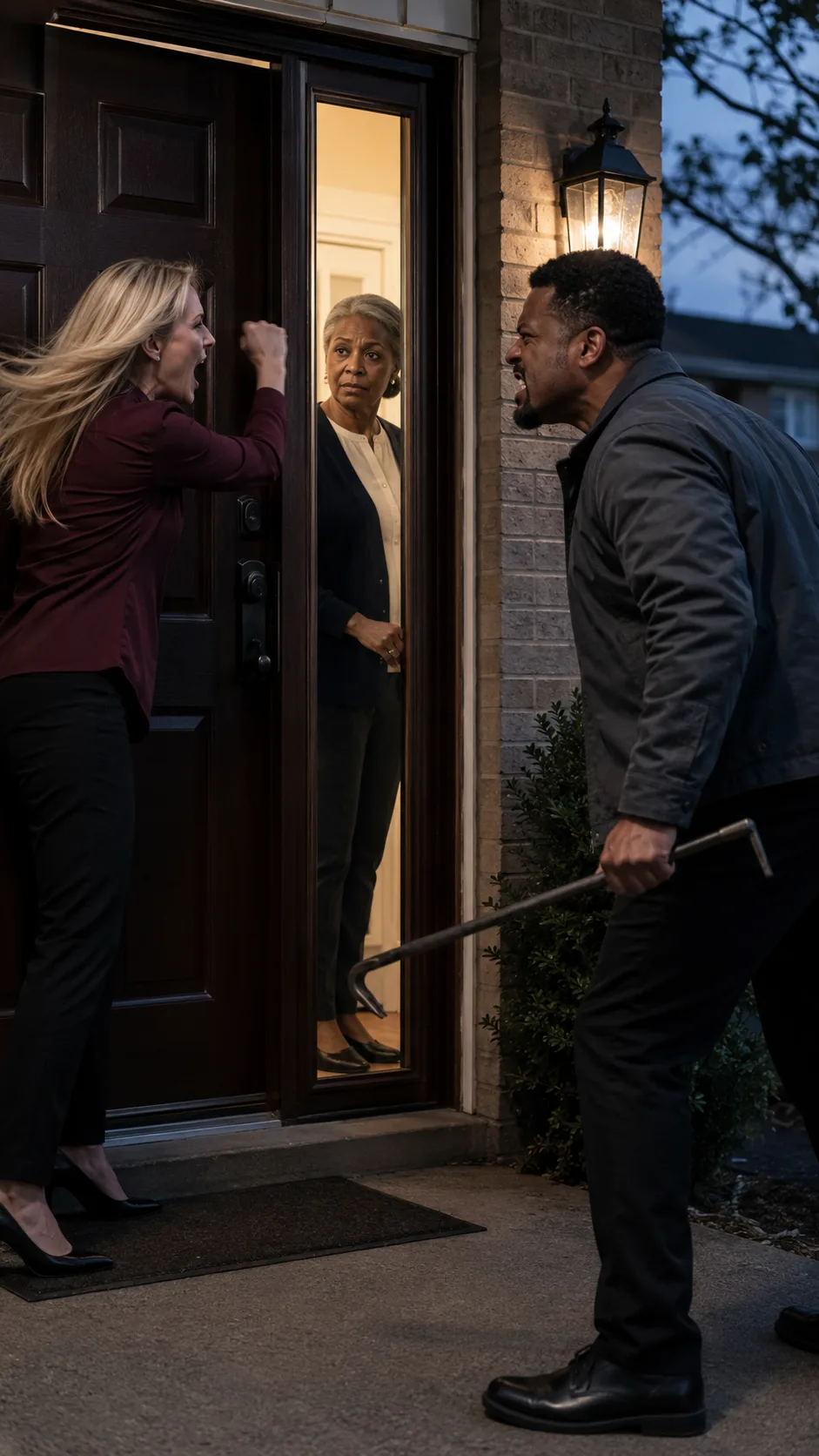
Kesha testified about Tiffany saying she wanted me placed in a facility so they could keep my house. Mr. Lewis described seeing Jamal with the crowbar. Elias played the recordings and presented the messages.
The judge ruled in my favor.
Jamal and Tiffany were ordered to pay thirty thousand dollars in damages.
In the hallway, Tiffany screamed that I had ruined the family.
“I did not ruin anything,” I told her. “I defended myself.”
Jamal began to cry.
“Mom, please. We can start over.”
I looked at the man I had raised and felt grief, but not weakness.
“This was not
one mistake,” I said. “It was two years of deliberate choices.”
I walked away.
They paid five hundred dollars each month. I placed every payment into a separate account. When the final dollar arrived, I donated the full amount to a shelter for older women suffering family abuse.
The shelter expanded its rooms, hired legal support, and helped dozens of women escape homes where their children controlled their money, threatened them, or treated them like servants.
My story spread beyond the court case. Community centers invited me to speak. Women approached after meetings and whispered that their own sons or daughters treated them the same way.
I always told them, “The loneliness you fear is less painful than the company destroying you.”
Years passed.
I wrote a book about reclaiming dignity. It sold far beyond anything I expected. The royalties allowed me to travel, support the shelter, and build a peaceful life filled with friends who respected me.
Jamal contacted me four years after the lockout.
He looked older. Tiffany had left him and taken their son, Maris.
“What she did to me made me understand what I did to you,” he said. “I was a monster.”
His apology sounded sincere, but sincerity did not erase damage.
“I forgive you enough to stop carrying hatred,” I told him. “But forgiveness does not mean you can return to my life.”
He accepted that and left.
Later, he began mailing photographs of Maris every six months. I kept them in an album and wrote my grandson a letter explaining that I had loved him from a distance, even though the adults around him had made a relationship impossible.
Five years after the night Jamal raised the crowbar, Tiffany contacted me.
Maris had found my book.
“He knows you are his grandmother,” she said. “He wants to meet you.”
I agreed under strict conditions: one meeting in a public park, Tiffany at a distance, and the right to leave whenever I chose.
Maris arrived holding her hand. He had dark hair, curious eyes, and a nervous smile.
He walked toward me alone.
“You’re Miriam?” he asked.
“Yes.”
“Is it true you’re my grandma?”
I nodded.
His face brightened.
“That’s good,” he said. “I always wanted one.”
We talked for an hour. He loved dinosaurs, adventure books, and drawing. Before leaving, he hugged me.
“Can I see you again, Grandma Miriam?”
This time, I said yes.
Now I see him once a month in parks, museums, and cafés. Tiffany respects my boundaries. Jamal remains outside my life. I hope they both continue changing, but my peace no longer depends on their repentance.
Today, the shelter bears my name: the Miriam Dubois Support Center.
My home is quiet, filled with plants, sunlight, music, and photographs of a grandson who calls me brave.
Some people still say a mother should never lock out her son.
They did not sleep in the utility room.
They did not hear the insults.
They did not feel themselves disappearing.
I did.
And I learned that family is never an excuse for abuse, kindness without boundaries becomes self-destruction, and choosing yourself is not cruelty.
It is survival.
The morning I changed those locks, I thought I was closing a door on my family.
In truth, I was opening the door to my own life.
THE END
Chapter complete
You have reached the end of this chapter.
Continue reading
A few more worlds to get lost in after this chapter.




