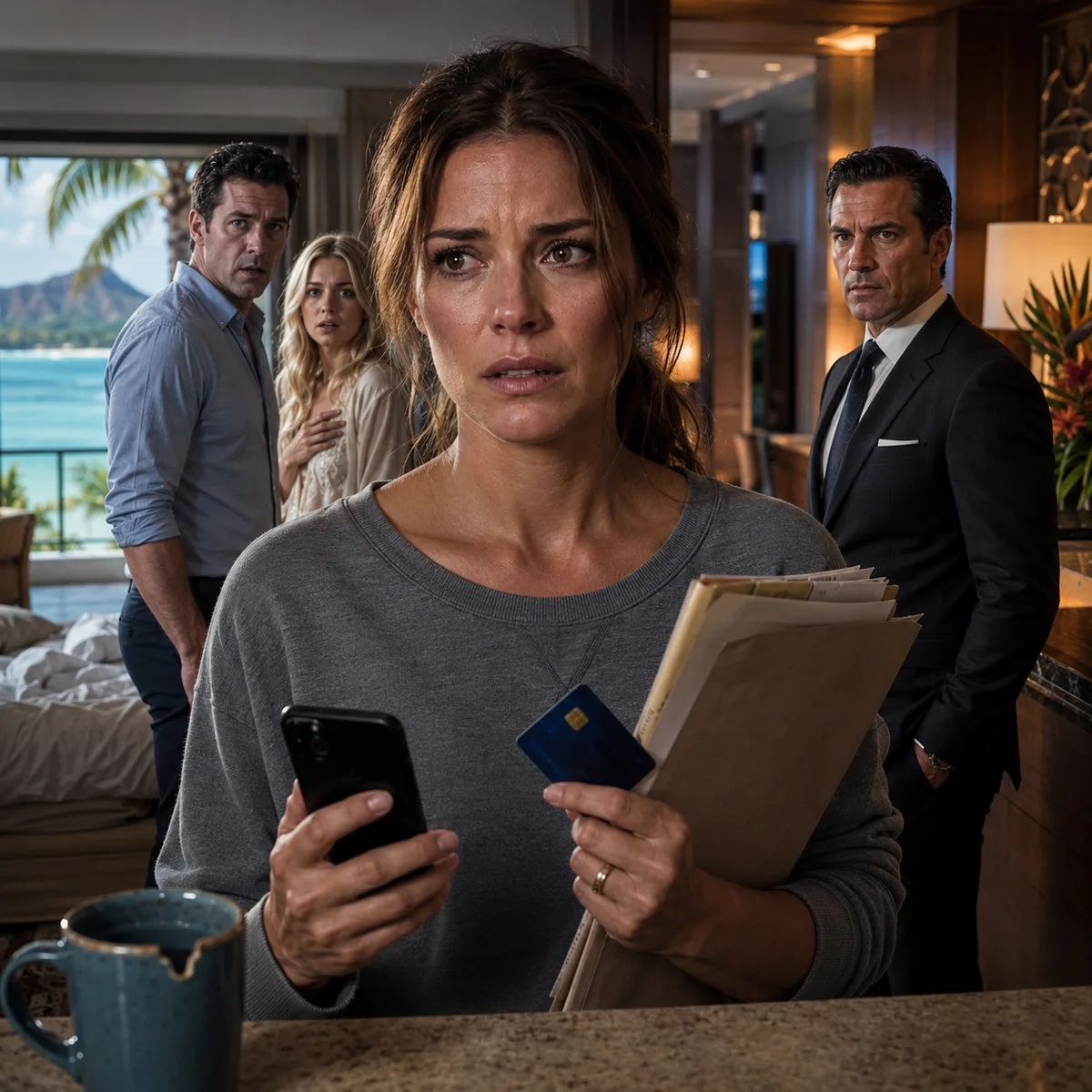
PART 4 — I OPENED ROOM 318 AGAIN
The apartment smelled like him.
Chapter 4
PART 4 — I OPENED ROOM 318 AGAIN
The apartment smelled like him.
That was the hardest part.
His cologne in the hallway. His coffee mug in the sink. His gray sweater thrown over the chair. His running shoes by the door. The ordinary evidence of a man who had left for a fake business trip and expected to come back to a wife who would never know.
I walked room by room with my phone camera.
Desk drawer.
File cabinet.
Laptop bag.
Receipts.
Statements.
Old cards.
I did not destroy anything. I did not throw his clothes out the window. I did not make the kind of scene people later use to call a woman unstable.
I documented.
By evening, I had changed the locks with my lawyer’s approval because Ethan was not on the lease renewal after a paperwork change he had ignored the year before. That was one of the few lucky accidents of my life.
By the next morning,
Marjorie filed the first round of papers.
Not just divorce.
Financial misconduct.
Unauthorized use of credit.
Hidden debts.
Fraudulent applications.
Infidelity mattered, yes, but Marjorie treated it like what it was in court: not the engine, but the smoke. The engine was money.
“Judges see affairs every day,” she told me. “But when someone uses a spouse’s identity and credit to fund the affair, that becomes a different conversation.”
Ethan tried to come home that Friday.
I saw him first through the peephole.
He looked exhausted. Unshaven. Angry under the sadness.
He knocked softly at first.
“Clara.”
I stood inside the apartment, barefoot on the floor we had picked together.
He knocked again.
“Please. Open the door.”
I did not.
Then he tried his key.
It did not work.
That sound—metal turning uselessly in the lock—gave me a satisfaction so sharp I had to sit down.
“Clara,” he said, voice
low. “Don’t be childish.”
Childish.
Because I changed the lock after he stole from me.
Because I refused to be available for emotional cleanup.
Because I did not open the door and let him rehearse another version of reality in our living room.
I texted him one sentence.
All communication goes through my attorney.
He pounded once, hard enough to rattle the frame.
Then my neighbor Mrs. Donnelly opened her door across the hall.
Mrs. Donnelly was eighty-two, widowed, Catholic, and the building’s unofficial surveillance system. She wore house slippers and an expression that had frightened delivery men for years.
“Ethan,” she said, “do we need to call someone?”
His voice changed instantly.
“No, ma’am. Everything’s fine.”
She looked him up and down.
“Doesn’t sound fine.”
I almost smiled.
He left.
The divorce stretched across months.
Nothing about it was as clean as people imagine when they say, “I’d leave
immediately.” Leaving is one thing. Untangling is another.
There were accounts to divide.
Debts to identify.
Statements to subpoena.
Emails from Ethan that started with apology and ended with blame.
Messages from his mother, Patricia, who had always smiled at me like I was a useful appliance.
Clara, this is humiliating for the family.
Clara, marriages go through hard seasons.
Clara, you could resolve this privately.
That last one made me stare at my phone for a full minute.
Then I typed back:
He could have betrayed me with his own money.
She never replied.
Ethan’s father called once.
I almost did not answer, but curiosity won.
“Clara,” he said, sounding older than I remembered. “I’m not calling to excuse him.”
“Good.”
A pause.
“I’m calling to tell you Patricia won’t say it, so I will. What he did was wrong.”
That surprised me.
I sat down at the kitchen table.
“Thank you.”
“He’s my son,” he said. “But wrong is wrong.”
The sentence was simple. Old-fashioned. Almost plain.
It helped more than he probably knew.
Madison submitted a written statement three weeks later.
Marjorie emailed it to me with the subject line: Relevant.
I waited an hour before opening it.
Madison’s statement was not dramatic. That made it stronger.
She wrote that Ethan had presented himself as separated. That he had claimed the Hawaii trip was partly corporate. That he had said the card was his business account. That he had discussed a future with her while concealing active financial dependence on his wife. That when confronted, he became controlling and verbally aggressive.
At the end, she added one line that I read several times.
I understand I caused Mrs. Hale pain, and I regret my part in accepting a story I wanted to believe.
I did not forgive her that day.
But I stopped needing to hate her.
That was its own kind of release.
Ethan lost his job in April.
Not for cheating.
Companies can survive employees behaving badly in their personal lives, especially if those employees make enough money for someone.
He lost it because Madison had gone to HR, and HR had gone through travel records, and travel records had teeth. He had mixed personal charges with corporate claims. He had lied about locations. He had used company time and company language to cover private conduct.
His title vanished from LinkedIn on a Thursday.
By Friday, Patricia had emailed again.
This time, no greeting.
Are you happy now?
I did not answer.
Happiness was not the point.
There is a difference between revenge and refusing to bury evidence so a man can keep his reputation clean.
Older women know this. Quiet women know this. Women who have smiled through dinners, covered bounced payments, written thank-you notes to rude in-laws, and kept family peace at the cost of their own sleep know this.
Sometimes people call you cruel because you stop protecting them from the truth of what they did.
The first court hearing took place in a county courthouse that smelled like old paper, floor polish, and vending machine coffee.
I wore a navy dress, low heels, and my father’s silver watch. My mother sat behind me with her purse on her lap. Luca had flown in from Hawaii, sunburned and furious, wearing a suit he clearly hated.
Ethan walked in with his attorney and his mother.
He looked thinner.
For one treacherous second, I felt sorry for him.
Then he glanced at me and looked away, like I was the embarrassment.
That cured me.
His attorney tried to frame the situation as a marital misunderstanding.
A card used within a marriage.
A trip taken during emotional confusion.
A private matter exaggerated by hurt feelings.
Marjorie stood and opened the folder.
The folder.
I had come to love that folder in a way that was probably unhealthy.
It contained timelines. Receipts. Signatures. Bank records. Screenshots. Emails. The hotel’s debt acknowledgment. Luca’s written account. Daniel’s security note. The receptionist’s simple statement that Ethan insisted the card was authorized despite the holder not being present.
Marjorie did not raise her voice.
She did not need to.
Facts are most elegant when they are allowed to walk in quietly and sit down.
By the end of that hearing, Ethan no longer looked at me like an emotional wife.
He looked at me like a witness.
The settlement did not give me everything.
Life rarely does.
But it gave me enough.
The fraudulent debts were assigned where they belonged. My credit was protected. Ethan’s claims against my savings failed. The joint obligations were separated under terms that made Patricia audibly gasp in the hallway.
Outside the courtroom, she approached me.
She wore pearls and a cream coat, the same kind of careful outfit she had worn to every family event where she made me feel slightly underdressed and permanently temporary.
“You didn’t have to take it this far,” she said.
My mother stepped forward, but I touched her arm.
I wanted to answer this one myself.
“Yes,” I said. “I did.”
Patricia’s eyes narrowed.
“Marriage requires grace.”
I looked at her pearls, her perfect lipstick, her controlled little mouth.
“No,” I said. “Marriage requires honesty. Grace is what people ask for after they spend your money.”
For once, Patricia had no reply.
Luca laughed under his breath all the way to the parking lot.
The divorce became final on a rainy Monday in September.
There was no movie moment.
No choir.
No sudden feeling of freedom bursting through the clouds.
I signed papers in Marjorie’s office while traffic hissed outside on wet pavement. A printer jammed. Someone down the hall microwaved soup. Marjorie handed me copies in a plain legal envelope.
“That’s it,” she said.
“That’s it?”
“That’s it.”
I waited for some grand emotion.
It didn’t come.
I just felt tired.
And then, underneath the tired, something else.
Space.
Not joy yet.
Not peace exactly.
But space where fear used to stand.
That night, I went to dinner with my mother and Luca at a small Italian place in Jersey City where the tables were too close and the waiter called everyone sweetheart. We ordered too much pasta. My mother insisted on dessert. Luca raised his glass of red wine.
“To room 318,” he said.
I shook my head.
“Absolutely not.”
“To my sister, then.”
My mother lifted her glass.
“To Clara.”
I looked at them both.
For years, I had mistaken endurance for loyalty. I had thought love meant covering shortfalls, smoothing tension, accepting explanations that insulted my intelligence because the alternative was admitting I had built a life with someone who saw my trust as a resource.
But that night, between my mother’s tiramisu and Luca complaining about New Jersey weather, I understood something I wish I had known earlier.
Family is not the people who ask you to stay quiet so dinner isn’t awkward.
Family is the people who sit beside you when the truth ruins the table.
A year after the phone call, Luca asked me to come back to Oahu.
At first, I refused.
“I am not spending money to visit the scene of the crime,” I told him.
“It’s not a crime scene,” he said. “It’s an island.”
“It’s room 318.”
“It’s also beaches, plate lunches, and your brother, who is very handsome and underappreciated.”
“You are ridiculous.”
“And correct.”
He kept asking until I said yes.
By then, my life had settled into a shape I recognized as mine.
I had moved into a smaller apartment with better light.
I had opened new accounts.
I had rebuilt my credit.
I had learned the strange pleasure of buying groceries without someone sighing at the receipt.
I had also learned that healing is not a straight road. Some mornings, I woke relieved. Some nights, I remembered Ethan laughing in our old kitchen and felt grief sweep through me so sharply I had to sit down.
Both things were true.
That is what people don’t like about real endings.
They are rarely pure.
When I landed in Honolulu the second time, the air felt different.
Or maybe I did.
Luca met me again at baggage claim, but this time he was smiling.
“No folder?” he asked.
I held up my beach bag.
“Sunscreen. Book. Sunglasses. Emergency cannoli would have been nice.”
“I live in Hawaii, Clara.”
“And yet you call yourself Italian.”
He drove me to the hotel with the windows down. The city looked brighter than I remembered. Not because it had changed, but because I was no longer arriving as a woman following a lie across the ocean.
When we reached the lobby, the same columns stood there. The same open-air view of the water. The same polished floor. A different receptionist smiled at me.
I felt my chest tighten.
Luca noticed.
“You don’t have to stay here.”
“Yes,” I said. “I do.”
He had reserved room 318.
I hated him for that for about twelve seconds.
Then I understood.
Some doors have to be opened twice.
The room looked different.
No petals.
No champagne.
No boutique bags.
Just a clean white bed, sunlight on the floor, a balcony door open to the sound of the Pacific. The hotel had changed the artwork. The walls were freshly painted. The dresser where Madison had left the necklace was empty.
I stood in the doorway for a long time.
The first time, I had entered that room as evidence.
This time, I entered as myself.
That evening, Luca took me to a little place near Kapahulu for plate lunch. We ate teriyaki chicken, rice, mac salad, and lemonade so sweet it made my teeth ache. Afterward, we walked along Waikiki until the sky turned orange.
Tourists passed us with shopping bags. A street musician played somewhere near the avenue. The air smelled like salt, grilled meat, and sunscreen.
At the shoreline, I took off my sandals and stepped into the water.
Warm waves covered my feet.
I closed my eyes.
For months after the divorce, I had thought healing meant reaching a day when Ethan no longer hurt me.
But standing there, I realized healing was not the absence of hurt.
It was the return of choice.
I could remember and still move.
I could grieve and still laugh.
I could be betrayed in a place and come back to that place without asking the betrayal for permission.
Luca stood beside me, hands in his pockets.
“Do you regret it?” he asked.
I looked toward Diamond Head, dark against the soft sky.
I thought of Ethan. Madison. Patricia. The courthouse. The folder. The blue card. The version of me who made toast for dinner while her husband toasted champagne over the Pacific.
“No,” I said. “But it still hurts.”
Luca nodded.
“That doesn’t mean it was wrong. It means it was real.”
Later, we had dinner at the hotel restaurant.
When the check came, I took out my new card.
My name.
Only my name.
No shared access. No hidden user. No man turning my credit into his camouflage.
The server ran it and brought it back with a smile.
I signed the receipt slowly.
Clara Moretti.
I had taken back my maiden name that spring. Not because marriage had ruined the other one, but because I wanted to hear my brother say my name again the way he had on the phone that morning: like someone worth protecting.
After dinner, I walked alone through the lobby.
Near the front desk, a couple was checking in. The man laughed while the woman leaned against his shoulder. I wondered, briefly, what their story was. I hoped it was kinder than mine.
Then I saw Daniel, the security manager, near the office door.
He recognized me and gave a small nod.
“Good to see you back, Mrs. Moretti.”
Mrs. Moretti.
Not Mrs. Hale.
Not Ethan’s wife.
Me.
I smiled.
“Good to be back.”
Upstairs, in room 318, I opened the balcony door and let the ocean fill the room.
For a long time, I stood there with the curtains moving behind me, thinking about how Ethan had chosen Hawaii because he thought distance would protect him. He thought an ocean could hide a lie. He thought my trust was a wallet he could keep reaching into. He thought my brother was just a hotel manager. He thought I was too tired, too loyal, too embarrassed, too married to open the right door.
He got the island wrong.
He got the hotel wrong.
He got the brother wrong.
Most of all, he got the wife wrong.
Because I arrived in Oahu chasing the worst truth of my life.
But I left with better things.
Proof.
A clean name.
A family that did not ask me to swallow humiliation for the sake of appearances.
And the certainty that a woman does not always need to scream to change the ending.
Sometimes she only needs to block the card.
Catch the flight.
Hold the folder steady.
And open the door to room 318.
THE END.
Chapter complete
You have reached the end of this chapter.
Continue reading
A few more worlds to get lost in after this chapter.




