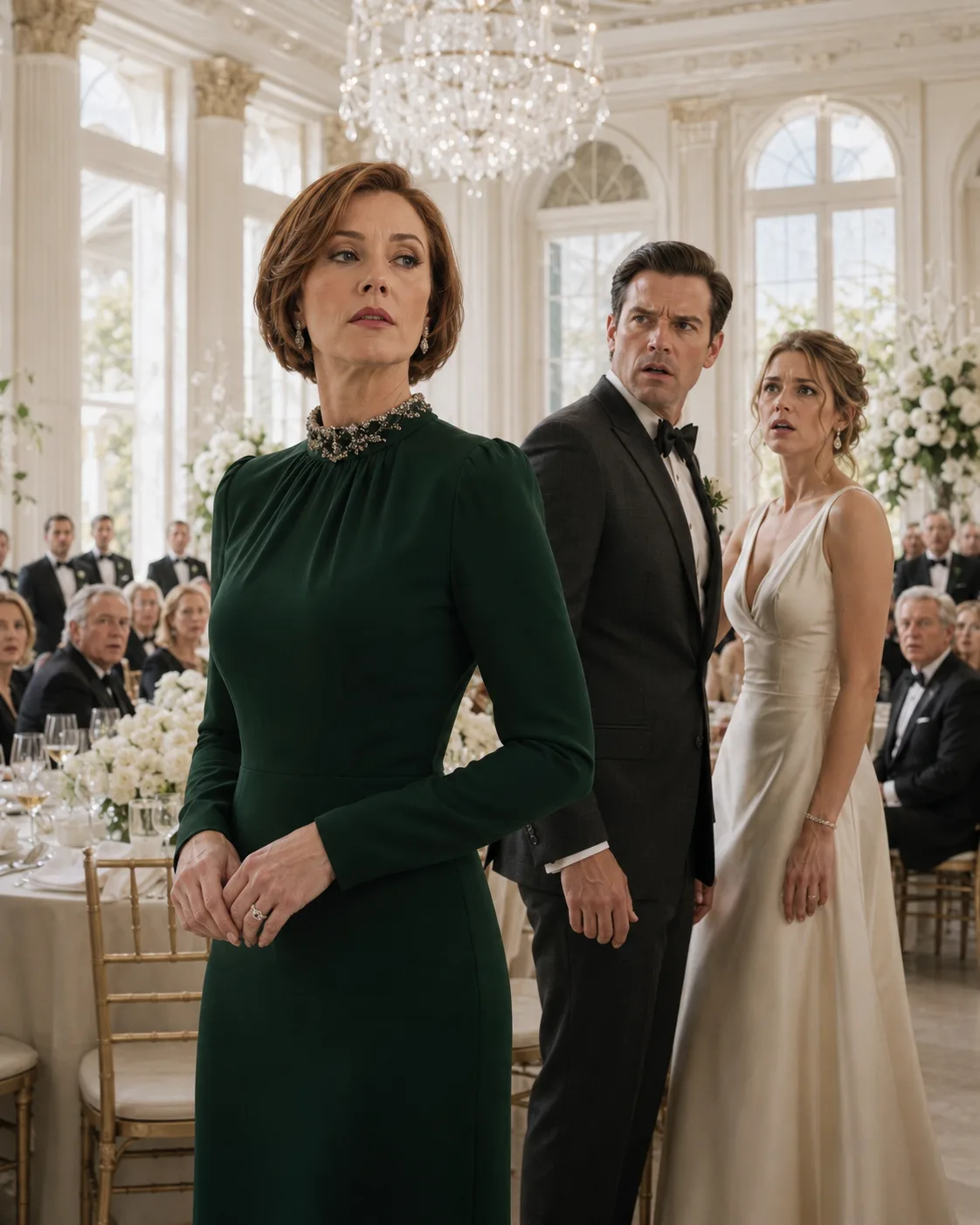
The mistress sent me sixty photos hoping I would cry, but I made her famous before midnight.
Bianca had wanted an audience of one.
Chapter 1
Bianca had wanted an audience of one.
By nightfall, I would give her a larger one.
The gala began under chandeliers and soft music, the kind of expensive calm that can make cruelty look polished if no one names it.
I arrived alone at 7:15.
I wore a long black dress with sleeves to the wrist and no jewelry except my mother’s pearl brooch. My hair was drawn back neatly. My lipstick was muted. Every line of me was intentional.
People glanced at me and then away, as they often did. They had learned to see me as Julian’s quiet wife, the graceful background to his public life.
Julian stood near the entrance with Bianca at his side.
That was the first insult of the evening.
He did not hide her.
He displayed her.
Bianca wore a white gown too bright for a charity gala, and my mother’s pearl necklace rested at her throat.
The sight was
so intimate in its disrespect that an older woman near the donor wall stiffened. But no one intervened. Public rooms are full of people who witness wrong and wait for permission to name it.
Bianca saw me first.
Her smile widened, then softened into performance. She touched the necklace with two fingers, making sure I saw it.
Julian followed her gaze. For a fraction of a second, guilt crossed his face. Then pride covered it.
“Evelyn,” he said, stepping forward as cameras turned. “There you are.”
He offered his cheek.
I allowed the air near my face to receive him.
Not a kiss. Not a refusal dramatic enough for gossip. Just absence.
Bianca tilted her head. “I hope you don’t mind the seating adjustment. Julian said I could help him host tonight.”
I looked at the necklace.
The clasp was slightly twisted because she had fastened it carelessly. My mother
would have noticed. She had always adjusted that clasp before meetings, before hospital visits, before photographs in the garden.
A small ache opened inside me.
I let it open.
Then I closed the door over it.
“It suits the evening,” I said.
Bianca blinked.
She had expected tears. Or anger. Or at least a crack in my voice she could hold like a trophy.
Calm deprived her of victory.
A photographer approached. Julian slid one hand behind Bianca’s waist and extended the other toward me as if arranging furniture.
“Let’s get one with all of us.”
I stepped back half an inch.
The movement was tiny, but it made the photographer hesitate.
“You two should enjoy the attention,” I said.
Julian’s smile hardened. Bianca leaned closer to him, mistaking my restraint for retreat.
The camera flashed.
Inside the ballroom, the central sponsor table had been rearranged exactly as promised. Bianca
sat at Julian’s right hand. My name card had been moved two seats away, facing a pillar.
It was the sort of insult designed to look accidental unless the victim made it visible.
The table fell quiet when I arrived.
Bianca placed her silver clutch on what had once been my chair. “Oh, I hope this is fine.”
Julian pulled out her chair first. “You prefer being away from the center, Evelyn.”
I rested my hand on the back of the chair facing the pillar.
The room held its breath in that particular way rooms do when everyone understands a humiliation but no one knows whether it is safe to admit it.
“I prefer people to know where they belong,” I said.
Bianca laughed too quickly.
Julian leaned close enough that only I could hear him clearly, though everyone watched. “Do not start.”
I turned my head slightly. “I haven’t.”
He mistook the softness of my voice for weakness.
I sat by the pillar without argument.
It was a gift.
Let them show everyone exactly what they thought they could do to me.
Dinner began. Plates appeared. Speeches warmed the room. Julian performed beautifully when applause was available. He spoke about compassion, loyalty, and the duty of powerful people to protect the vulnerable.
As he spoke, Bianca touched my mother’s pearls again and again, each gesture a little blade.
My phone lay face down beside my plate.
Beneath the table, it buzzed.
Another message.
This was your bed, right?
I did not open it.
The evidence was already complete.
During the second course, Julian stood to greet a major donor. Bianca used the moment to lean toward me. Her perfume was sweet and aggressive.
“You’re very composed,” she whispered. “I thought you’d be more broken.”
It was exactly the sort of line designed to make a woman lower herself in public.
I took a slow sip of water. The glass left no mark on my lipstick.
“You mistake quiet for broken because quiet is where your conscience should be,” I said.
Bianca’s smile faltered.
She looked away first.
No one at the table spoke.
That was fine. I did not need witnesses to clap. I needed them to remember.
At nine, the main program began. The lights dimmed. Julian took the stage to applause. Bianca sat in my original seat, glowing under the low light, the stolen necklace bright at her throat.
Julian lifted both hands as if blessing the room.
He thanked the fund, the sponsors, the board, the families.
He thanked Bianca by name for bringing youthful vision to the campaign.
He did not mention me.
That omission was not new.
What was new was how many people noticed.
Julian moved into his closing remarks. His voice lowered, rich with practiced sincerity. He spoke of legacy. He spoke of children. He spoke of trust.
On the screen behind him, images of smiling families appeared in soft focus.
At the bottom of the donor list in the printed program, in small type, sat the sentence Julian had insisted remain vague for years.
Founding legacy gift, private family office.
He had hidden my name because he needed the room to believe he stood at the center.
Tonight, the center would move.
Julian lifted his glass.
“To the people who give without needing recognition.”
I almost admired the irony.
Almost.
At the far side of the ballroom, a staff member I trusted gave me one small nod.
No words. No drama.
The first domino.
I rose from the chair by the pillar.
Only a few people noticed at first. Bianca noticed. Julian noticed a moment later, and a warning flashed in his eyes.
I did not walk toward the stage.
I walked toward the side wall and stood near a column where the room could see me without feeling I had demanded the spotlight.
The ballroom lights dimmed further for the tribute video.
Julian turned toward the massive screen behind him, expecting grateful families and his company logo.
Bianca lifted her phone to record him.
She wanted proof of his importance. Proof that she had chosen the winning side.
The first image appeared.
Not the intimate photos.
Not the private humiliation she had sent, hoping to make me shatter.
I would not turn myself into a spectacle of another woman’s vulgarity.
Instead, the screen showed Rosecliffe House at dawn, white against the sea.
A caption appeared below it.
Rosecliffe Legacy Retreat was donated in memory of Eleanor Hart and remains owned and protected by the Eleanor Hart Foundation.
A murmur moved through the ballroom.
Julian froze with his glass still raised.
The next image showed the south door and its restricted plaque.
Then came the entry log from the previous night.
Names blurred except for two.
Julian Hart.
Bianca Vale.
Timestamped at 11:42 p.m.
No long explanation. No legal lecture. Just a door, a date, and two names where they had no right to be.
Bianca lowered her phone.
The third image appeared.
Bianca in the entry hall wearing my mother’s pearl necklace, smiling with the memorial plaque visible behind her.
The photo had been cropped for decency and sharpened for meaning.
The room saw the necklace.
The room saw the plaque.
The room understood.
Someone at a nearby table whispered my mother’s name.
Julian turned toward the control booth, panic cracking his polished face. He looked for a technician to blame, a staff member to command, anyone lower than him who might restore the lie.
No one moved.
The screen changed again.
My mother’s portrait appeared. She wore the same pearls at her throat, dated fourteen years earlier.
No caption was needed.
Bianca’s hand flew to the necklace as if it had become hot against her skin.
For the first time all evening, she looked less like a woman wearing a prize and more like a thief caught under perfect lighting.
I stepped forward.
I did not climb onto the stage. I stood at floor level below it, where the whole room could see me without theatrics.
Julian stared down at me. The microphone in his hand had become useless.
“Evelyn,” he said sharply.
That single word carried every command he had ever given me.
Stop.
Smile.
Protect me.
Stay in your assigned seat.
I looked at him, and the room felt the answer before I spoke.
“No,” I said.
It was the smallest word of the night.
It landed like a door locking.
The screen changed to a clean list.
Rosecliffe House was not Julian’s property.
The legacy donor funds were not Julian’s gift.
The gala emergency program was not Julian’s project.
The necklace was not Bianca’s accessory.
The public story Julian had told for years began to crack in plain language, one line at a time.
Julian recovered enough to laugh.
It was a brittle sound.
“This is a private marital issue.”
I turned slightly so the room could hear me.
“It stopped being private when you used my mother’s house, my foundation’s event, and my family’s name to humiliate me in public.”
Bianca stood so quickly her chair scraped the floor.
Her face had gone pale beneath her blush. She reached for the necklace clasp, but her fingers fumbled. The pearls trembled at her throat.
A camera near the aisle turned toward her.
That small mechanical movement frightened her more than my voice had.
Julian saw it too. His instincts returned. He stepped down from the stage, smiling too hard.
“Ladies and gentlemen, please ignore this. My wife is emotional.”
The word emotional drifted through the room and died there.
I looked neither frantic nor wounded enough to fit his sentence. I stood in perfect control while he moved too quickly, spoke too loudly, and reached for my arm in front of two hundred witnesses.
Before his fingers touched me, a security officer stepped between us.
He said nothing.
He simply stood there, broad-shouldered and calm.
Julian stopped.
The absence of words made it worse. No one argued with him. No one begged him. The room merely watched him discover that his command did not reach as far as he thought.
Bianca finally unclasped the necklace.
It slipped into her palm in a trembling coil.
She looked around for somewhere to put it.
No one offered a hand.
I walked to her. Every step was quiet.
Her eyes filled, not with remorse yet, but with fear of being seen differently. The same woman who had sent sixty photos in the dark now wanted darkness back.
“Set it on the table,” I said.
Bianca obeyed.
The pearls rested beside an untouched champagne flute.
I did not snatch them. Stolen things become smaller when the rightful owner has to wrestle for them. I took a folded handkerchief from my clutch, lifted the necklace carefully, and held it not as a trophy but as something rescued.
The room was silent enough to hear the pearls settle in my palm.
Julian’s face flushed.
“You’re humiliating yourself,” he said.
I looked at him.
“No, Julian. I am returning your work to its true author.”
The next slide appeared.
A photo Julian had posted three months earlier showed him standing in front of Rosecliffe House with a caption about building his legacy.
Beside it was the foundation record proving he had never owned, funded, or managed the property.
The contrast was simple enough for every person in the room to understand before Julian could bury it under language.
A donor pushed back his chair.
Another lowered his phone with a look of disgust.
Bianca stared at Julian as if seeing him without lighting for the first time. He had told her I was dependent. He had told her the house was his. He had told her the necklace was a gift he could give.
Now she stood in front of the people she had wanted to impress, holding nothing but exposure.
I turned to the room.
“Tonight’s program will continue,” I said. “The children this fund supports will not lose a single grant because of one man’s vanity.”
At first, no applause came.
People were too stunned.
Then, from the back table where several nurses from the pediatric wing sat, one woman began to clap.
Others followed, uncertain at first, then stronger.
The applause did not feel festive.
It felt like a verdict.
Julian stood under it with his jaw clenched, realizing too late that I had not come to ruin the gala.
I had come to save it from him.
Part 3
The applause made Julian angrier than shouting would have.
Shouting he understood. Tears he could dismiss. A wife standing calmly while the room chose her version of reality over his was something his pride had no tool for.
“You have no idea what you just did,” he said through his teeth when the lights shifted back and the orchestra began playing softly again.
“I know exactly what I did.”
The program resumed because I had designed it that way.
A short film about the pediatric wing played on the screen. Staff moved through the room with trained calm. Donors, still tense, turned their attention back to the reason they had gathered.
That was the second part of Julian’s punishment.
The night did not collapse around him.
The world did not end because his ego had been wounded.
The work continued, and his importance shrank inside it.
Bianca sat down slowly. Her hands were bare at her throat. Without the necklace, she looked younger, smaller, and less certain of the story she had been selling herself.
She glanced at Julian, waiting for him to protect her.
Julian did not look back.
He was busy calculating how to survive.
When the doctor from the children’s wing took the stage, her voice trembled once, then steadied. She spoke about parents sleeping in hospital chairs, families choosing between medication and rent, children who deserved care without their mothers begging strangers for gas money.
I listened carefully.
That was why Julian’s behavior had crossed the line beyond betrayal. He had tried to turn a room built for sick children into a stage for his vanity and Bianca’s cruelty.
At the end of the program, the guests rose for a standing ovation.
I rose too.
Julian remained seated half a second too long, then stood when he realized cameras were watching.
Bianca clapped with stiff little movements, eyes fixed on the tablecloth.
Afterward, in the reception hall, Julian tried to intercept me near the side corridor. He had recovered part of his public face, but his eyes were bright with panic.
“We can fix this,” he said. “You made your point. I’ll handle Bianca.”
I looked past him at the ballroom where workers gathered programs and glasses.
“You still think she is the problem?”
“She sent those photos, didn’t she?” His voice sharpened. “She’s unstable. She wanted attention. You and I can present this as a misunderstanding.”
There it was.
The turn.
Julian had brought Bianca into my home, flaunted her in public, given her stolen symbols, and now that approval was slipping away, he was ready to discard her as the sole villain.
Bianca stood a few feet away, close enough to hear.
Her face changed as Julian spoke. Shame arrived slowly, followed by anger. Not noble anger. Wounded vanity. Still, it cracked the alliance he thought he controlled.
I kept my eyes on Julian.
“You both made choices.”
His mouth tightened. “Be careful.”
That warning would have frightened me once. It would have sent me into nights of overthinking, measuring every possible loss.
Now it sounded almost nostalgic.
He had no idea how little remained in his hands.
Across the room, Bianca’s phone began vibrating. Then again. Then again. Her face drained as she looked at the screen.
The gala had not ended, but the first image of her wearing the stolen necklace had already spread through private chats.
Not the explicit photos.
I had not released them.
I did not need to.
Bianca had wanted to be famous as the woman chosen over the wife.
Instead, she was becoming famous as the woman who wore a dead mother’s pearls into that dead woman’s foundation event.
That was cleaner.
Crueler, perhaps, because it was deserved and undeniable.
Julian reached for his own phone. His notifications moved faster than his fingers.
A sponsor wanted clarification.
A board member requested an emergency call.
A journalist asked for comment.
Someone from his company had sent only three words.
What happened tonight?
He stared at the screen, and I watched realization settle over him.
It was not the affair that would ruin him. Powerful men survived affairs all the time when the story could be reduced to private weakness.
What would ruin him was the visible pattern.
Pretending to own what was not his.
Using charity as costume.
Humiliating the woman whose resources had carried him.
Bringing his mistress into rooms built by the mother of the wife he had mocked.
The public could forgive desire. It loved to forgive men for desire.
It was less forgiving when desire exposed theft, arrogance, and stupidity.
Bianca finally spoke, voice thin.
“Julian said the house was his.”
Only a few people heard.
It was enough.
Julian turned on her so quickly that any remaining illusion of tenderness died.
“Not now.”
Bianca flinched.
I looked away.
I had no need to watch the romance collapse.
Rot always looks dramatic when light reaches it.
The next morning, Julian’s face appeared everywhere, but not in the way he had spent years arranging.
The headlines did not scream. They did not need to.
Chairman’s gala turns tense after donor estate misuse is revealed.
Foundation source confirms emergency grants remain protected.
Brand consultant seen wearing memorial necklace without permission.
Bianca’s name spread faster than Julian’s because she had made herself photogenic in the wrong moment. The image of her touching the pearls became the symbol. She had wanted me to weep over private photos. Instead, the city saw her in a white gown smiling beneath a dead woman’s legacy and decided the story for itself.
I read only the first few pieces.
Then I put the tablet face down and ate breakfast.
The house felt different with Julian gone. He had not come home after the gala. He had stayed at a hotel or at Bianca’s apartment, though I doubted Bianca’s door had remained inviting once sponsors began calling.
The absence did not feel lonely.
It felt like a room after heavy furniture has finally been removed and the floor can breathe.
At nine, Julian called twelve times.
I answered the thirteenth.
“You need to release a statement saying this was a private misunderstanding,” he said.
“No.”
“Evelyn, listen to me. My board is nervous. My partners are asking questions. This affects hundreds of employees.”
There it was, the old shield polished for emergency use.
When he wanted praise, the company was his genius.
When he faced consequences, the company became innocent workers.
I did care about the employees. That was exactly why Julian could not be allowed to keep using them as hostages for his reputation.
“The employees will be protected,” I said.
He went quiet.
In that silence, I could almost hear him understanding that I had already moved beyond anger into action.
“What does that mean?”
“It means you should read what arrives this morning.”
I ended the call.
The envelope reached his office at ten.
The document was short, direct, and stripped of the kind of language he could hide behind. His company had used Rosecliffe House, foundation staff, and donor-facing materials under permissions granted through my office. Those permissions were withdrawn. The emergency grant partnerships would continue through a new management structure. Employee salaries tied to the charitable program were secured for six months by a separate reserve.
Julian’s access to foundation properties, images, donor lists, and family references ended immediately.
No theatrical threat.
Just doors closing one by one.
By noon, Julian arrived at my townhouse without an appointment.
The housekeeper did not let him pass the foyer.
I watched from the top of the stairs as he stood below in yesterday’s suit, his hair less perfect, his eyes rimmed red from either sleeplessness or anger. He looked smaller beneath the framed portraits of my family, though he tried to stand as if they owed him space.
“I am your husband,” he said.
The housekeeper remained silent.
I appreciated her more for that than any speech.
I descended halfway down the stairs.
Julian looked up. For years, he had liked the opposite position. Me below him in photographs, beside him at events, slightly behind him at doors. Now he had to lift his face to meet mine.
“You sent documents to my office before speaking to me,” he said.
“You sent another woman into my mother’s room before speaking to me.”
His expression flickered. Shame almost formed.
Then resentment swallowed it.
“You’re going to destroy everything over photos.”
“No,” I said. “I am ending the arrangement that allowed you to confuse my restraint with ownership.”
He laughed, sharp and ugly. “Listen to yourself. This cold performance. You think people admire it? They’ll call you bitter.”
Once, that would have touched the deepest bruise.
Bitter was the word used on women who remembered too clearly, objected too calmly, or refused to make betrayal comfortable for everyone else.
Now the word slid off me like rain.
“People may call me whatever helps them sleep,” I said. “They will not call your lies mine.”
Julian’s eyes moved to the pearl brooch at my collar. He looked at it with irritation, as if my mother had become an opponent in the room.
“I made you visible,” he said.
I almost pitied him then. Not enough to soften, but enough to see the poverty beneath his arrogance. He truly believed visibility meant standing near him while he absorbed the light.
“No,” I said. “You taught me the cost of disappearing for someone unworthy.”
His face hardened. “Bianca is ready to say you planned this to ruin her.”
“The messages are saved. The entry logs exist. The necklace had witnesses.”
He said nothing.
“And if Bianca wants to lie again,” I added, “then she can become even more famous.”
The sentence landed gently.
That made it worse.
Julian turned and left, slamming the door harder than dignity allowed.
That evening, Bianca began messaging me from an unknown number.
I didn’t know the necklace was your mother’s.
Then another.
Julian told me the house was his.
Then another.
He said your marriage was already over.
Then another.
Please. He’s blaming everything on me.
I let the messages collect unanswered.
There is a difference between being lied to and enjoying the lie because it crowns you.
Bianca had not merely believed Julian loved her. She had worn the necklace. She had sat in my chair. She had sent the photos with the intention of breaking another woman’s heart and then waited to hear the shatter.
Whatever Julian had promised her, she had chosen the pleasure of cruelty.
I would not erase that because consequences had arrived faster than expected.
Three days later, I went to Rosecliffe House.
The drive along the coast felt longer than usual. Sea wind pressed against the car. Bare trees twisted above the road. When the gates opened, the house appeared white and still on the cliff, beautiful in the way old things are beautiful when they have survived human foolishness.
Inside, the staff had already cleaned the south suite.
I stood in the doorway for a while.
The bed linens were gone. The crystal glasses had been removed for inspection. The balcony doors were open to cold air.
Nothing looked damaged.
And yet the room felt wrong, as if laughter had left fingerprints.
I walked to the memorial cabinet where my mother’s crystal set belonged. One glass was missing from its usual place, taken as evidence after appearing in Bianca’s photo.
For the first time since 2:13 that morning, grief rose close to tears.
Not because Julian had slept with another woman. That wound was real, but ordinary compared with the deeper violation.
He had brought contempt into a room I associated with my mother’s quiet strength. He had let Bianca play dress-up with memory. He had turned legacy into a backdrop for betrayal.
I touched the cabinet door.
The glass reflected my face, composed but tired.
I allowed myself one breath that shook on the way out.
Then another.
No one saw.
That mattered.
Privacy, when chosen by the wounded, can be healing.
Privacy forced by the guilty is a prison.
I was learning the difference.
Downstairs, the house manager had prepared staff reports. I read them in the library. Julian had instructed the staff to leave the south wing unattended. Bianca had ordered champagne and complained that the vintage looked old-fashioned. She had taken selfies in the portrait hall despite being told photography was restricted.
Julian had laughed and said, “Evelyn won’t mind.”
I closed the folder slowly.
Evelyn won’t mind had become the anthem of my marriage.
He had used it to give away my time, my spaces, my introductions, my forgiveness, my silence. He had built a whole life on the assumption that I would not mind enough to stop him.
That assumption ended with a quiet instruction.
The south suite would be closed for restoration.
Rosecliffe House would no longer host corporate vanity weekends.
It would be converted into a recovery residence for families traveling with sick children. Rooms once used for networking would hold exhausted parents. The terrace where Bianca posed would become a place where siblings could breathe between treatments. The house would return to service.
That decision gave me more relief than any headline.
On my way out, I stopped beneath the brass plaque in the entry hall.
The same plaque from Bianca’s photo.
The same plaque Julian had tried to crop out of his life.
I took one photograph myself.
No people.
No performance.
Just the plaque, the polished floor, and morning light touching my mother’s name.
The foundation posted the announcement that afternoon.
Rosecliffe House would become a family recovery residence connected to the pediatric wing Eleanor Hart loved.
There was no mention of Julian.
No mention of Bianca.
The caption focused on families, rest, dignity, and continuity.
Within an hour, the post spread far beyond the foundation’s usual audience.
People understood the contrast without being told.
Julian had used the house for ego.
I was turning it into shelter.
Bianca had posed there for humiliation.
I was opening it for healing.
That was a kind of fame too.
A week later, Julian’s board asked him to step back from public-facing charity partnerships pending review. His company would continue operating under temporary oversight for programs tied to the foundation. Employees were informed that salaries and active projects were protected.
The story Julian wanted, that I had burned everything down in bitterness, could not survive the facts.
I had saved what deserved saving and removed the man who confused himself with the building.
The divorce filing went out on a Thursday morning.
No dramatic press conference.
No tearful interview.
No revenge tour.
Just a clean legal document and the return of my own name.
That afternoon, Bianca came to Rosecliffe with no cameras and no white gown. Security sent me her image from the gate. She stood in a beige coat too thin for the wind, hair pulled back, face bare enough to make her look suddenly ordinary.
I considered ignoring her.
That would have been fair.
But fairness and usefulness are not always the same.
I allowed her into the front sitting room. Not the south wing. Not the library. Not any room touched by memory.
She entered holding a phone and a small envelope.
“I brought things,” she said.
I waited.
“Messages. Screenshots. Voice notes.” Her fingers shook. “He told me which rooms to use. He told me what to send you. Not the exact words, but he said if you saw enough, you’d agree to a quiet divorce.”
There it was.
The plan beneath the cruelty.
Julian had not only betrayed me. He had tried to engineer my shame into compliance. He thought if I broke privately, I would accept a settlement that protected his public life and left him with the story.
Bianca swallowed. “He said you’d never fight because you cared too much about looking elegant.”
The insult was so familiar that it no longer cut.
“Why bring this now?” I asked.
“Because he’s blaming me.”
Honesty, even selfish honesty, was better than performance.
“And because?” I asked.
Bianca looked down at her hands. Her red polish was chipped at the edges.
“Because I wanted to hurt you,” she said quietly. “I didn’t just believe him. I liked thinking I had won. I liked thinking you were old news. When I sent those photos, I wanted you to feel small.”
The room held the sentence without softening it.
I looked at the young woman across from me. Bianca was not a monster from a fairy tale. That would have been easier. She was a person who had found power in another woman’s pain until the mirror turned.
“I won’t forgive you today,” I said.
Her eyes filled.
I continued, “But if you tell the truth where you lied, you may one day become someone who does not need another woman’s humiliation to feel chosen.”
Bianca nodded once.
She left the envelope on the table and walked out smaller than she had come in, but perhaps more real.
Months passed.
Rosecliffe changed slowly.
The south suite became three family rooms with warm blankets, quiet lamps, and a view of the sea. The portrait hall held children’s drawings in simple frames during the first opening weekend. My mother’s crystal cabinet remained locked, but no longer felt like a shrine to grief. It felt like memory standing guard over usefulness.
On the morning the first family arrived, a little boy with a shaved head and bright red sneakers pressed his hands to the window and whispered, “Mom, we can see the ocean.”
His mother began to cry.
Not loud tears.
Not defeated tears.
The kind that come when a body has been holding too much for too long and finally finds a place to set it down.
I stood in the doorway with the house manager beside me.
She asked softly, “Are you all right, Mrs. Hart?”
I looked at the ocean, at the open doors, at the rooms no longer poisoned by vanity.
“My name is Evelyn Hart,” I said. “And yes. I think I finally am.”
That evening, I returned home and opened the folder named 2 13 one last time.
The sixty photos were still there.
I did not delete them because history should not be erased just because healing has begun. But I moved them into the legal archive, locked away with the other evidence.
They had arrived as weapons.
They had become witnesses.
Bianca had sent them hoping for my tears.
Julian had counted on my silence.
They both forgot that quiet women are often quiet because they are listening, remembering, and deciding exactly where the truth should land.
I closed the laptop.
On the dresser, I placed my mother’s pearls beside her brooch.
Then I turned off the light and slept alone in a room that finally felt like mine.
THE END
Chapter complete
You have reached the end of this chapter.
Continue reading
A few more worlds to get lost in after this chapter.




