Nobody sat down at first.
Chapter 3
Nobody sat down at first.
That was how I knew they had expected an easy afternoon.
Gwen stood near the kitchen island with her purse hooked over one arm, her sunglasses now pushed into her hair like a crown that had slipped. Leonard hovered beside the table, still holding his folder. The realtor, whose name I had not bothered to learn, looked at the door as if wondering whether professional dignity allowed retreat.
Abigail Reed placed her briefcase on my kitchen table.
The sound was small.
It landed like a judge’s gavel.
“Before we begin,” Abigail said, “I need to ask whether anyone here has a signed authorization from Mrs. Whitman permitting a valuation, listing discussion, sale preparation, or representation agreement regarding this property.”
The realtor cleared his throat.
“I was told this was a family matter.”
“It is,” Abigail said. “That is why it needs paperwork.”
Gwen gave a polite little laugh. “We’re not
trying to do anything illegal.”
“No one said illegal,” Abigail replied. “I said unauthorized.”
Leonard finally sat down.
“Mom,” he said, softer now, “we were worried about you.”
That almost worked.
Almost.
Because once, those words would have undone me. I would have heard the boy with scraped knees, the teenager asking for gas money, the young man calling from his first apartment because he had forgotten how long to boil eggs.
But I had also heard him say “It’s not a big deal” about my house.
I looked at him and said, “Were you worried before or after Gwen called the realtor?”
He flinched.
Gwen stepped in. “Leonard is your son. He has every right to be involved.”
Abigail opened the folder.
“Emotionally, perhaps. Legally, no.”
She slid the first document across the table.
“The Whitman Home Protection Trust was executed nine years ago by Raymond and Loretta Whitman.
After Mr. Whitman’s death, Mrs. Whitman became sole trustee and sole lifetime beneficiary. This home cannot be sold, borrowed against, transferred, listed, or managed by Leonard Whitman, Gwen Whitman, or any outside party without Mrs. Whitman’s written consent.”
The realtor stared at Leonard.
Leonard stared at the paper.
Gwen stared at me.
For the first time since I had known her, she did not say my name.
Abigail continued.
“There is also a coercion clause.”
Gwen’s eyes flickered.
“A what?”
“A provision Raymond insisted upon,” Abigail said. “If any future heir attempts to pressure Mrs. Whitman into selling, misrepresents control over the property, arranges an unauthorized sale, or tries to obtain proceeds through manipulation, that person may be removed from any future beneficial interest.”
Leonard’s face went pale.
“Dad wrote that?”
“No,” Abigail said. “I wrote it. Your father demanded it.”
The kitchen became terribly still.
Outside, the rose bush
brushed against the window in the wind.
Leonard leaned back in his chair as if the room had tilted.
“Dad thought I would do that?”
I wanted to answer gently.
I truly did.
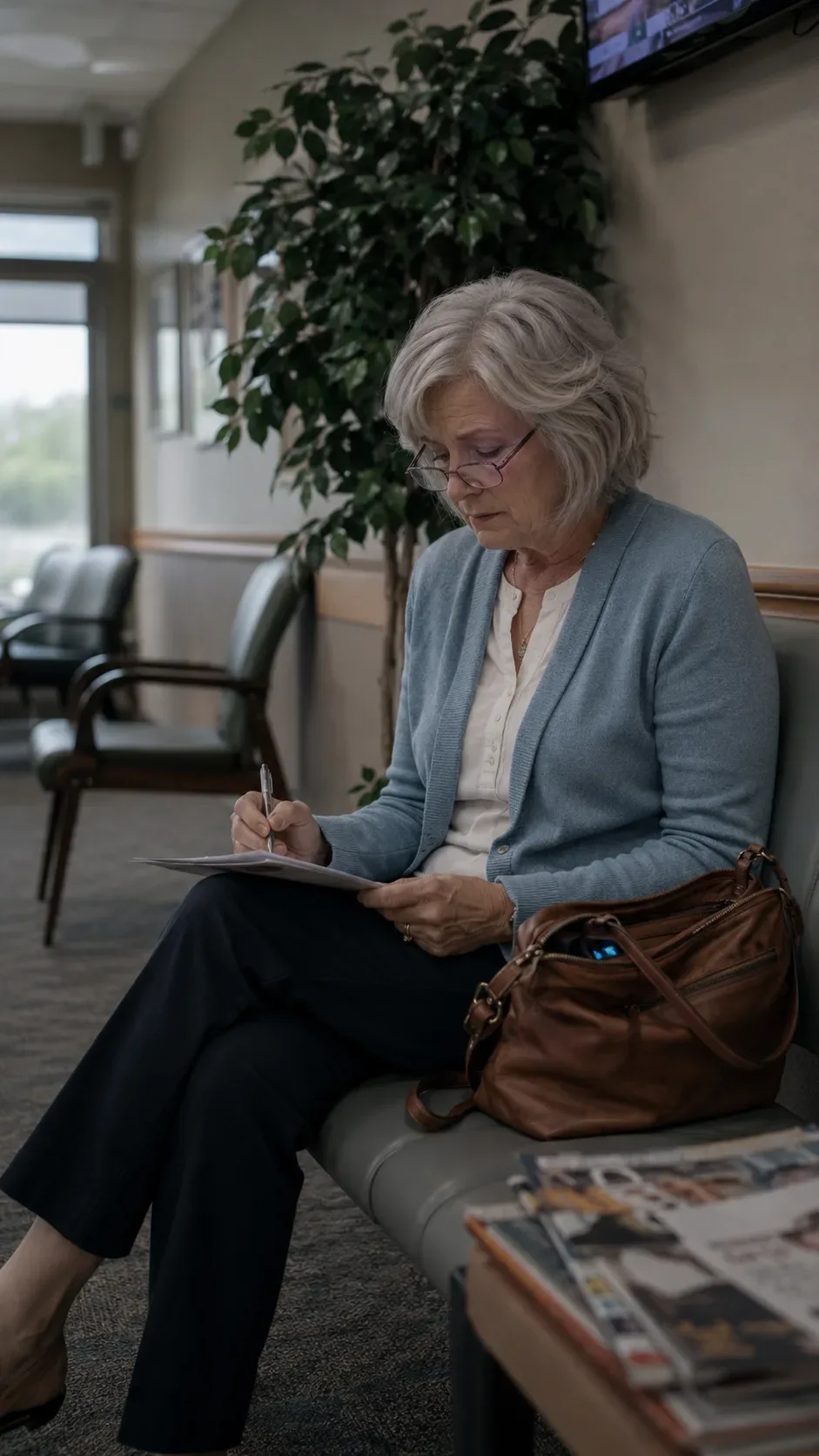
But gentleness had carried me all the way to a cardiologist’s waiting room where my own son let his wife discuss my home like a liquidation plan.
“Your father thought people change when money gets close,” I said. “He hoped you wouldn’t. He protected me in case you did.”
Gwen’s cheeks flushed.
“This is ridiculous. We never pressured anyone. We were planning ahead.”
“You planned a senior community,” I said. “You planned a realtor. You planned an account for proceeds you had no right to touch.”
“It was for your security.”
“My security,” I said, “was sitting in this folder before you ever married my son.”
The realtor stood.
“I’m going to step out.”
Wise man.
He left so quickly the screen door barely finished swinging before Gwen turned on Leonard.
“You told me she would listen.”
There it was.
Not “we were wrong.”
Not “I’m sorry.”
She blamed the weak link in the plan.
Leonard looked at his wife, then at me.
For one second, I saw the fight inside him. Pride against shame. Marriage against mother. Convenience against memory.
Then his eyes dropped to the table.
“I didn’t think it would go this far,” he said.
“But it did,” I answered.
“I thought if we presented it clearly—”
“You mean if you presented it as already decided.”
He closed his mouth.
Abigail slid another paper forward.
“Mrs. Whitman has also updated her emergency contact, healthcare directive, and financial agency documents. Leonard, you are no longer her default decision-maker.”
That hurt him more than the house.
I saw it immediately.
His head lifted.
“Mom?”
I folded my hands on the table. They were steady now.
“Yesterday, I sat in a doctor’s office after you and Gwen told me you had discussed selling my home without asking me. I looked at the emergency contact line, and I realized I could no longer trust the first name I was about to write.”
His eyes filled.
Gwen looked away, impatient with emotion she could not use.
Leonard whispered, “I’m your son.”
“Yes,” I said. “That is why it hurt.”
He covered his face with one hand.
The gesture was so familiar it nearly broke me. Raymond used to say Leonard rubbed his nose only when he knew he had lost the argument but had not yet found the courage to admit it.
This time, I waited.
At last Leonard said, “I’m sorry.”
Gwen exhaled sharply. “Leonard—”
“No,” he said.
It was the first real word he had spoken all day.
He looked at her, and something in his posture changed. Not dramatic. Not heroic. Just a man finally standing where he should have stood before.
“No, Gwen. We crossed a line.”
Her mouth opened.
He turned back to me.
“I let you become a problem to solve,” he said. “I’m sorry, Mom.”
I believed he meant it.
I also knew belief was not the same as trust.
“Thank you,” I said. “But an apology is not a key.”
Gwen grabbed her purse.
“So what now? You cut us off? You sit here alone in a house full of old furniture to prove a point?”
I stood then.
Slowly.
Not because I was weak.
Because I wanted every word to have room.
“This house is not old furniture,” I said. “It is thirty-six years of mortgage payments. It is your husband’s height marked on a pantry door. It is Raymond’s terrible backsplash. It is the porch he failed to build and the garden I kept alive after he died. It is not an asset you get to harvest because my age makes you impatient.”
Gwen had no answer.
People like Gwen often mistake silence for defeat. But this time, silence belonged to me.
Abigail closed the folder.
“Mrs. Whitman will be sending formal notice to the realtor’s office that no listing is authorized. Any further attempt to represent, value, market, or discuss sale of the property without her consent will be documented.”
Gwen laughed once, small and bitter.
“You’re making us sound like criminals.”
“No,” I said. “I’m making you sound exactly as involved as you chose to be.”
Leonard stood.
He looked older than he had when he arrived.
“I’ll call you tomorrow,” he said.
“No,” I replied. “You’ll write to me tomorrow. An email. No pressure. No plans. No suggestions about where I should live. Just the truth about why this happened.”
He nodded.
“And after that?”
“After that,” I said, “we see whether you can be my son without trying to be my manager.”
His face crumpled slightly.
But he nodded again.
Gwen left first.
Leonard paused at the door. For a moment, he looked past me into the house — really looked. At the worn banister. At the framed school photo in the hallway. At the place where his father’s boots used to sit.
“I forgot it was home,” he said.
I did not soften my voice.
“Yes,” I said. “You did.”
After they drove away, Abigail stayed for tea.
The house was quiet again, but not empty.
For the first time in two days, my chest felt loose enough to breathe.
That evening, I opened the cream envelope one more time. Behind the legal copy, there was a smaller note from Raymond.
Loretta, if you are reading this, someone has mistaken your kindness for permission. Don’t let them. The house is yours. The life is yours. Make them knock.
I laughed.
Then I cried.
Then I made tea in Raymond’s mug and sat on the back porch, listening to the step that still creaked because some repairs are allowed to remain imperfect.
The next morning, an email from Leonard arrived.
No excuses.
No realtor.
No Schaumburg.
Just one line at the top.
I forgot you were a person before you were my mother.
It was not enough.
But it was a beginning.
I printed it, folded it once, and placed it in Raymond’s envelope.
Not because Leonard had earned his place back.
Because I had finally reclaimed mine.
THE END.
Chapter complete
You have reached the end of this chapter.
Continue reading
A few more worlds to get lost in after this chapter.




