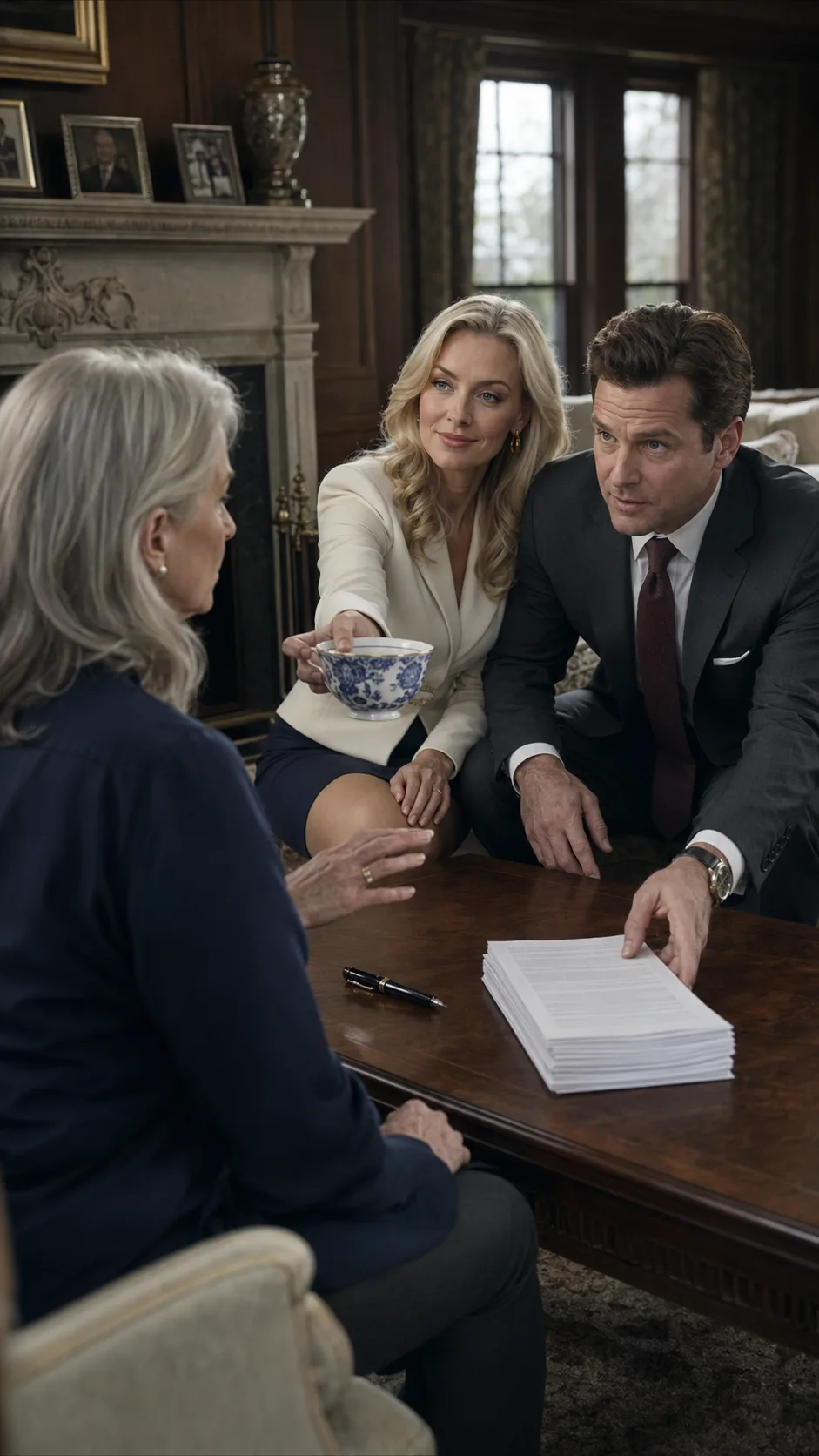
PART 3 — THE RECORDINGS THAT DESTROYED THEM
“We have to be careful,” Carlton replied.
Chapter 3
PART 3 — THE RECORDINGS THAT DESTROYED THEM
“We have to be careful,” Carlton replied.
“If we move too fast, it might raise suspicions. Besides, I’m enjoying watching her get weaker. She used to be so controlling, always telling me how to run things. Now she can barely make it through a board meeting without getting dizzy.”
The cruelty in his voice was worse than the criminal intent.
This wasn’t just about money or inheritance.
Carlton had genuinely enjoyed watching me suffer.
“I keep thinking about the will reading,” Ever continued.
“When that lawyer reads out that everything goes to you, and there’s nothing for Rosa, nothing for any of those employees who think they’re so loyal. I wish I could see their faces.”
“Don’t worry, baby,” Carlton said.
“We’ll have plenty of time to enjoy it. Forty years of marriage, maybe fifty. We’ll be rich for the rest of our lives.”
Sullivan stopped the recording.
“Mrs. Whitmore, there’s something else you need to know
about this last conversation. Rosa wasn’t the only person who heard it.”
I looked up sharply.
“What do you mean?”
“Your security system at home includes audio recording in the main living areas,” Sullivan said.
“We obtained a warrant for those recordings, and we found that several of the conversations Rosa documented were also captured by your home security system.”
I had no idea the system recorded audio.
Most people don’t.
The installer probably mentioned it when it was set up, but it’s not something homeowners typically think about.
However, it meant we had independent verification of Rosa’s recordings.
Carlton’s defense team couldn’t claim she fabricated the evidence.
Sullivan pulled out another folder.
“There’s also this. We found a detailed timeline in Ever’s handwriting documenting the progression of your poisoning and the expected timeline for your death.”
She handed me a photocopy of a handwritten document.
In Ever’s neat script,
I saw a medical chart tracking my declining health over three months.
Week 1–2: fatigue, mild nausea.
Week 3–4: increased weakness, digestive issues.
Week 5–6: confusion, dizziness, weight loss.
The document continued for 12 weeks, ending with: Final dose. Cardiac event expected within 24–48 hours.
“She was tracking my symptoms like a laboratory experiment,” I said, my voice barely above a whisper.
“Mrs. Whitmore,” Sullivan replied, “Ever has a background in chemistry. She worked for a pharmaceutical company before she married your son. She knew exactly what she was doing, and she documented it because she wanted to perfect the method for potential future use.”
The implications of that statement hit me like a physical blow.
Future use.
“We believe that if this had succeeded, Carlton and Ever might have targeted other elderly family members or business associates,” Sullivan continued.
“Ever’s computer contained research on several other people in your
social circle, including their health histories and financial situations.”
The scope of their planning was breathtaking in its callousness.
This wasn’t a crime of passion or desperation.
It was the methodical work of people who had discovered they enjoyed causing suffering and wanted to perfect their technique.
“There’s one more recording I need you to hear,” Sullivan said.
“This one was made the morning of the incident, before Rosa intervened.”
She started the final audio file, and I heard Carlton and Ever in what sounded like a last planning session.
“You’re sure about the dosage?” Carlton asked.
“Absolutely. I calculated it based on her current level of toxicity. This amount will cause cardiac arrest within two hours.”
“And you’re sure it won’t be traceable?”
“By the time anyone thinks to test for arsenic, it’ll be metabolized enough to look like natural causes. The coroner will see an elderly woman with recent health problems who died of heart failure. Case closed.”
“What about Rosa?”
“What about her? She’s just the help. Fire her the next day. Give her some story about downsizing. She’ll be too busy looking for another job to ask questions.”
“I love you, Ever,” Carlton said.
“I love how smart you are. How you think of everything.”
“I love you too, baby. After today, we’ll never have to worry about money again. We’ll never have to pretend to care about your boring mother and her precious little company.”
The recording ended, and the office fell silent except for the hum of the air conditioning.
I sat there staring at the speaker, trying to process the fact that my son had just told his wife he loved her for planning to murder me.
“Mrs. Whitmore,” Sullivan said gently, “I want you to know that with this evidence, we have an ironclad case. Even the best defense attorney in the country won’t be able to explain away eight recordings and written documentation of a murder plot.”
“What kind of sentence are they looking at?” I asked.
“With the premeditation evident in these recordings, the financial crimes, and the systematic nature of the poisoning, we’re seeking life without the possibility of parole for both Carlton and Ever.”
Life without parole.
My son would die in prison.
And part of me felt like that was exactly what he deserved.
But another part—the part that remembered the little boy who used to climb into my bed during thunderstorms—felt like something inside me was dying too.
“There’s something else,” Sullivan said.
“Ever’s attorney has approached us about a plea deal. She’s willing to testify against Carlton in exchange for a reduced sentence.”
I looked up sharply.
“What kind of reduced sentence?”
“Twenty-five years instead of life. She would be eligible for parole when she’s 58.”
“And what would she testify about?”
“According to her lawyer, Ever claims the entire plot was Carlton’s idea. She says he threatened to leave her if she didn’t help him and that he convinced her you were planning to cut him out of your will completely.”
The audacity of it took my breath away.
Even facing life in prison, Ever was still trying to manipulate the situation to her advantage.
“Mrs. Whitmore, I need to ask you directly,” Sullivan said.
“Is there any truth to the claim that you were planning to disinherit Carlton?”
“Absolutely not,” I said.
“My will has remained unchanged since my husband’s death 15 years ago. Carlton inherits everything, including the business and all personal assets. There was never any discussion of changing that arrangement.”
So Ever’s claim—that Carlton felt threatened about his inheritance—was false.
Completely false.
If anything, I had been discussing ways to transition more control of the company to Carlton over the next few years.
He knew he was my sole heir.
Sullivan made notes on her legal pad.
“That’s what we expected, but we needed to hear it from you directly. Ever’s plea offer is contingent on her testimony being credible, but if she’s lying about Carlton’s motivation, her deal falls apart.”
“Are you going to accept her offer?” I asked.
“That depends partly on you,” Sullivan replied.
“As the victim, your input is important to our decision. However, I should tell you that even without Ever’s testimony, we have enough evidence to convict both of them.”
I thought about the woman who had smiled at me while poisoning my coffee, who had tracked my declining health like a scientist documenting an experiment, who had laughed about my impending death with my own son.
“I don’t want her to get a reduced sentence,” I said firmly.
“Ever was not a victim of Carlton’s manipulation. She was an equal partner, and she should face the full consequences of that choice.”
Sullivan nodded.
“I’ll inform her attorney that the plea offer is rejected.”
As I prepared to leave the district attorney’s office, Sullivan handed me one final document.
“This is a victim impact statement form. When this goes to trial, you’ll have the opportunity to address the court and explain how these crimes have affected your life.”
I took the form, thinking about what I would say to a room full of strangers about the betrayal that had nearly cost me everything.
How do you explain the feeling of discovering that your own child values your money more than your life?
How do you articulate the loss of faith in every relationship you’ve ever trusted?
That evening, I sat in my hotel room with Rosa, who had come to update me on the status of the house and the business.
She looked older than her 52 years, worn down by the stress of the past few weeks and the knowledge that she had been living in the middle of a plot.
“Mrs. Whitmore,” Rosa said quietly, “I need to tell you something. When I was recording Mr. Carlton and Mrs. Ever, I heard them talk about other things too. Things about you.”
“What kind of things?” I asked.
Rosa hesitated, clearly uncomfortable with what she was about to share.
“They used to make fun of you. They would laugh about how easy it was to fool you, how you believed everything they told you about caring for you and wanting to help with the business.”
My chest tightened, but I forced myself to listen.
“Mr. Carlton used to do impressions of you—the way you talk in business meetings, the way you worry about the employees. Mrs. Ever would laugh and say you were pathetic, that you were so desperate for their love that you would believe anything.”
The cruelty of it was almost worse than the plot.
They hadn’t just wanted me gone.
They had actively despised me while pretending to love me.
“Rosa, why didn’t you tell me this sooner?” I asked.
“Because I thought it would hurt you too much,” she said, “and because I was afraid that if you knew how much they hated you, you might not fight back when the time came.”
But she was wrong about that.
Knowing the depth of their contempt didn’t make me want to give up.
It made me want to fight even harder.
“Mrs. Whitmore,” Rosa continued, “there’s something else. The police asked me to keep working at the house while they finished their investigation. They wanted me to document anything else I found. Yesterday, I discovered something in Mr. Carlton’s office.”
She reached into her purse and pulled out a photograph.
It showed Carlton and Ever at what looked like an expensive restaurant, raising champagne glasses in a toast.
They were both smiling broadly, looking happier than I had ever seen them.
“I found this in a frame on his desk,” Rosa said. “When I looked at the date stamp, it was taken the day after your last doctor’s appointment—when you told them you were feeling weak and dizzy.”
They had been celebrating my deteriorating health.
While I was worried about my symptoms and considering medical tests, Carlton and Ever had gone out for champagne to toast the success of their plot.
“Rosa,” I said, studying the photograph, “I want you to give this to Detective Chen. I want the jury to see exactly how Carlton and Ever felt about slowly killing me.”
She nodded and put the photograph back in her purse.
“Mrs. Whitmore, I need to ask you something,” Rosa said.
“When this is all over—when the trial is finished and they’re in prison—what are you going to do?”
It was a question I had been avoiding because I didn’t know the answer.
My entire life had been built around relationships and institutions that no longer existed.
My son was gone, not just to prison, but to a moral darkness I couldn’t comprehend.
My company would need to be rebuilt from the financial damage Carlton and Ever had inflicted.
My house would forever be the place where someone tried to end my life.
“I honestly don’t know,” I admitted.
“Everything I thought I knew about my life turned out to be a lie. I need to figure out how to build something new.”
Rosa reached across the table and took my hand.
“Mrs. Whitmore, for 20 years you treated me with kindness and respect. You helped my family when we needed it, and you never made me feel like I was just the help. Whatever you decide to do next, I hope you know that you have people who care about you.”
For the first time since this nightmare began, I felt a spark of something that wasn’t grief or rage or fear.
It was hope.
Not hope that my old life could be restored, but hope that a new life—built on truth and genuine relationships—might be possible.
Six months later, I sat in the front row of Suffolk County Superior Court, watching my son being led into the courtroom in shackles.
Carlton had lost weight during his time in jail, and his expensive suits had been replaced with an orange jumpsuit that made him look smaller somehow, diminished in a way that had nothing to do with physical appearance.
Ever entered separately, her blonde hair pulled back severely and her face pale without makeup.
She kept her eyes fixed straight ahead, never once looking in my direction.
The woman who had smiled while poisoning my coffee for months couldn’t even meet my gaze now that she faced the consequences of her actions.
The trial had drawn significant media attention.
Mother targeted by son and daughter-in-law was the kind of story that fascinated and horrified people in equal measure.
I had declined all interview requests, but the courtroom was packed with reporters, curious onlookers, and a few employees from my company who had come to show their support.
District Attorney Sullivan had warned me that defense attorney Jonathan Blackwood would try to paint Carlton as a victim of Ever’s manipulation, despite the recordings that clearly showed both of them planning my death with equal enthusiasm.
What she hadn’t prepared me for was how painful it would be to listen to Carlton’s lies about our relationship.
“Ladies and gentlemen of the jury,” Blackwood began in his opening statement, “this is a case about a troubled young man who fell under the influence of a manipulative woman with a background in chemistry and a talent for psychological control.”
I watched Carlton’s face as his lawyer portrayed him as weak and easily influenced.
There was no shame there.
No recognition that he was allowing another person to take responsibility for his choices.
The man sitting at the defense table bore no resemblance to the son I had raised.
“Ever Whitmore preyed on Carlton’s insecurities about his inheritance,” Blackwood continued.
“She convinced him that his mother was planning to disinherit him, that the only way to secure their future was to take desperate action.”
Prosecutor Sullivan objected immediately.
“Your Honor, there’s no evidence that Mrs. Whitmore ever planned to change her will or disinherit the defendant.”
“Sustained,” Judge Harrison ruled.
“The jury will disregard that last statement.”
But I knew the damage was done.
Blackwood was planting seeds of doubt about my relationship with Carlton, suggesting that I had somehow driven him to desperation through my own actions.
The prosecution’s case was methodical and devastating.
Detective Chen testified about the evidence found in Carlton and Ever’s home and offices.
The medical examiner explained how arsenic poisoning works and how close I had come to death.
Rosa took the stand and walked the jury through months of observations, her quiet dignity making her testimony even more powerful.
When the recordings were played in court, the room fell completely silent.
Hearing Carlton and Ever discuss my death in their own voices, laughing about my suffering and planning their celebration, created an atmosphere of shock that even Blackwood couldn’t dispel.
“I love how smart you are, how you think of everything,” Carlton’s voice echoed through the courtroom as he praised Ever for calculating the fatal dose.
I watched the jurors’ faces as they listened.
Several jurors looked physically ill.
One woman in the front row was crying.
Whatever sympathy Blackwood hoped to generate for Carlton was evaporating with each cruel word.
The most damaging evidence came from Ever’s own documentation.
Prosecutor Sullivan displayed enlarged copies of Ever’s handwritten timeline, showing the jury exactly how she had tracked my declining health week by week, planning my death like a scientific experiment.
“The defendant didn’t just plan to kill Mrs. Whitmore,” Sullivan told the jury.
“She enjoyed watching her suffer. She documented every symptom, every sign of weakness, as if she were conducting a research study on the best way to murder someone.”
When it came time for the defense to present their case, Blackwood called several character witnesses who testified about Carlton’s good reputation before his marriage.
His college roommate, a former business partner, even our family pastor spoke about the Carlton they had known.
But their testimony felt hollow against the weight of the evidence.
It didn’t matter what kind of person Carlton had been before Ever if he had become someone capable of slowly poisoning his own mother.
Blackwood’s strategy became clear when he called Dr. Patricia Vance, a psychiatrist who specialized in psychological manipulation and coercive control.
“In my professional opinion,” Dr. Vance testified, “Carlton Whitmore exhibits all the classic signs of someone who was psychologically manipulated by a skilled predator. Ever Whitmore used her knowledge of chemistry and psychology to create a situation where Carlton felt he had no choice but to participate in her plan.”
Prosecutor Sullivan’s cross-examination was brutal.
“Dr. Vance, you’ve testified that Carlton was coerced into participating in this plot. Can you explain to the jury how someone could be coerced into stealing $300,000 from his mother’s business accounts?”
“Well, financial crimes often accompany other forms of abuse—”
“Dr. Vance, have you listened to the recordings where Carlton expresses joy at watching his mother suffer? Where he tells Ever he loves how smart she is for planning the perfect murder?”
“Victims of psychological manipulation often adopt the language and attitudes of their abusers as a survival mechanism.”
“So when Carlton laughed about his mother’s death and said he couldn’t wait to inherit her money, he was really expressing trauma?” Sullivan asked.
Dr. Vance hesitated.
“It’s… it’s possible.”
Even Blackwood looked uncomfortable with how his expert witness was being dismantled.
The idea that Carlton was purely a victim of Ever’s manipulation was impossible to maintain when confronted with his own words expressing genuine enthusiasm.
The prosecution’s rebuttal was devastating.
Sullivan called Dr. Michael Torres, a forensic psychiatrist who had interviewed both Carlton and Ever.
“Both defendants show clear signs of antisocial personality disorder,” Dr. Torres testified.
“They lack empathy, have a grandiose sense of entitlement, and show no genuine remorse for their actions.”
This wasn’t a case of one person manipulating another.
This was a partnership between two individuals who discovered they shared a willingness to commit crimes for financial gain.
When it came time for victim impact statements, I had debated whether to speak at all.
What could I say that would adequately express the devastation of discovering that your own child wants you gone?
How do you explain the feeling of having your entire life revealed as a lie?
But as I walked to the podium and looked out at the crowded courtroom, I realized my words weren’t really for Carlton or Ever.
They were for the jury, for the reporters who would write about this case, for anyone who might someday find themselves wondering if they could trust the people closest to them.
“My name is Evelyn Whitmore,” I began, my voice steady despite the emotion threatening to overwhelm me.
“Carlton is my only child. For 39 years, I believed that meant something. I believed that no matter what happened in the world, we would always have each other.”
I paused, looking directly at Carlton for the first time since the trial began.
He was staring at the table in front of him, unable—or unwilling—to meet my eyes.
“For months, Carlton and Ever slowly poisoned me while I trusted them completely. They stole from my business while I included them in important decisions. They took out life insurance policies on me while I planned for their future inheritance. They laughed about my suffering while I worried about my declining health.”
My voice grew stronger as I continued.
“But the worst part wasn’t the physical poisoning. The worst part was the emotional poisoning. Every kind word, every expression of concern, every moment of apparent affection was a lie designed to keep me vulnerable while they planned my death.”
I saw several jurors wipe away tears.
But I also saw Carlton finally look up at me.
For just a moment, I thought I glimpsed something that might have been remorse in his eyes.
“Carlton once promised to take care of me after his father died,” I said.
“Instead, he chose to betray every value I tried to teach him, every lesson about love and loyalty and family. He didn’t just try to destroy my body. He destroyed my faith in the possibility of unconditional love.”
I paused, gathering myself for the final part.
“I survived thanks to a woman named Rosa Martinez who risked everything to save my life. Rosa showed me that loyalty still exists in this world, even when it comes from unexpected places. Carlton and Ever tried to destroy my life, but Rosa’s courage reminded me there are still people worth trusting, still relationships worth building.”
I looked directly at Carlton one last time.
“I forgive you because carrying hatred would poison me more surely than anything you ever put in my coffee. But I will never trust you again, and I will never pretend what you did was anything less than evil.”
As I returned to my seat, I felt something I hadn’t experienced in months.
Peace.
Not the peace of having my old life restored, but the peace of having finally spoken the truth.
The jury deliberated for three days.
When they returned, the forewoman stood and delivered verdicts that would change everything.
“On the charge of conspiracy to commit murder in the first degree, we find the defendant Carlton Whitmore guilty.”
Carlton’s shoulders sagged, but he showed no other emotion.
“On the charge of attempted murder in the first degree, we find the defendant Carlton Whitmore guilty.”
“On the charge of embezzlement, we find the defendant Carlton Whitmore guilty.”
“On the charge of insurance fraud, we find the defendant Carlton Whitmore guilty.”
The verdicts for Ever were identical.
Guilty on all counts.
Judge Harrison scheduled sentencing for the following week, but the outcome was predetermined.
With the premeditation clearly established and the financial motive proven, both Carlton and Ever faced life in prison without the possibility of parole.
As the courtroom emptied, I remained in my seat, trying to process the finality of what had just happened.
Carlton would die in prison.
The little boy who used to bring me dandelions was gone forever, replaced by someone I would never understand.
Rosa appeared beside me, her face showing the relief of someone who had carried a terrible burden for too long.
“Mrs. Whitmore,” she said quietly, “it’s over.”
“Yes,” I replied, though I wasn’t sure if I meant the trial or something larger.
“It’s over.”
As we walked out of the courthouse together, past the reporters and cameras and curious onlookers, I realized that while one chapter of my life had ended in the most painful way possible, another chapter was beginning.
The question now was what I would choose to do with whatever time I had left.
A week later, Judge Harrison sentenced both Carlton and Ever to life in prison without the possibility of parole.
I didn’t attend the sentencing hearing.
I had heard enough of their voices, seen enough of their faces, given enough of my emotional energy to their crimes.
Instead, I spent that day with Rosa, going through the house one final time before putting it on the market.
Every room held memories that had been poisoned by knowledge, and I knew I could never live there again.
In Carlton’s childhood bedroom, I found a photo album filled with pictures from happier times—birthday parties, family vacations, holidays when we all seemed to love each other genuinely.
I stared at those images, trying to reconcile the smiling child in the photographs with the man who had been sentenced to die in prison.
“Mrs. Whitmore,” Rosa said from the doorway, “are you all right?”
“I was just trying to figure out when it all went wrong,” I said.
“When Carlton stopped being the child I raised and became someone who could plan my death.”
“Maybe it doesn’t matter when it happened,” Rosa said gently.
“Maybe what matters is what you do now.”
She was right.
I could spend the rest of my life trying to understand how love had turned to hatred, how family had become betrayal.
Or I could choose to focus on the loyalty that still existed in the world—the kind of relationship Rosa had shown me was possible.
That evening, I made two phone calls that would reshape my future.
The first was to my attorney, instructing him to establish a charitable foundation in Rosa’s honor, dedicated to protecting elderly people from financial and physical abuse by family members.
The second was to Rosa herself.
“Rosa,” I said when she answered, “I have a proposition for you. I’m starting a new chapter of my life, and I’d like you to be part of it. Not as my housekeeper, but as my partner.”
There was silence on the other end of the line.
Then Rosa’s voice, thick with emotion.
“Mrs. Whitmore, I would be honored.”
Six months after Carlton and Ever’s conviction, the Whitmore Foundation opened its doors, with Rosa as executive director and me as chairman of the board.
We worked with law enforcement, social services, and medical professionals to identify and investigate cases of elder abuse.
Our first case came from a nurse who noticed that an elderly patient’s health declined dramatically after family visits.
Our second came from a bank teller who was concerned about large withdrawals from an elderly customer’s account.
Our third came from a neighbor who heard screaming from the house next door.
Each case reminded me that Carlton and Ever weren’t unique.
They were part of a larger pattern of people who prey on vulnerability and trust, who use love as a weapon to justify cruelty.
But each case we helped also reminded me that Rosa wasn’t unique either.
There were people everywhere willing to stand up for what was right, even when it cost them something.
The foundation became my new purpose, my new family.
Not the biological family that had tried to destroy me, but the chosen family of people who shared my commitment to protecting those who couldn’t protect themselves.
I never saw Carlton again.
He wrote letters from prison, but I returned them unopened.
There was nothing he could say that would change what he had done, no explanation that would restore the trust he had shattered.
Ever died in prison three years after her conviction, after a violent incident with another inmate.
I felt nothing when I heard the news.
Not satisfaction, not grief.
Just the dull recognition that someone who had caused great pain was no longer capable of causing more.
Carlton remained in prison, and as far as I knew, he would stay there until he died.
Sometimes I wondered if he ever thought about the family he had destroyed, the mother he had tried to murder, the life he had thrown away for money he would never live to spend.
But mostly I tried not to think about him at all.
The foundation grew, expanding to serve elderly victims across New England.
Rosa proved to be a brilliant administrator, her quiet competence and genuine compassion making her beloved by staff and clients alike.
On the fifth anniversary of the foundation’s opening, we held a celebration dinner for our supporters and volunteers.
As I looked around the room at the faces of people who had dedicated themselves to protecting the vulnerable, I realized something profound.
Carlton and Ever had tried to poison my faith in human nature, just as they had poisoned my coffee.
But they had failed.
Their cruelty had been answered by Rosa’s courage, their betrayal balanced by the loyalty of strangers who became friends, their hatred overwhelmed by a community of people committed to love in action.
The coffee they prepared for me had been meant to be my last.
Instead, it had become the beginning of a new life built on truth, justice, and the kind of family that chooses each other rather than simply sharing blood.
As I raised my glass to toast the work we were doing, I thought about the morning Rosa had whispered:
“Don’t drink. Just trust me.”
She had saved more than my life that day.
She had saved my faith in the possibility of goodness.
And that, I realized, was worth more than any inheritance.
Ten years have passed since that October morning when Rosa saved my life with a whispered warning and a spilled cup of coffee.
I am 74 now, and as I sit in my garden watching the sunrise paint the sky in shades of pink and gold, I can honestly say these have been the most meaningful years of my life.
The house where Carlton tried to kill me was sold within months of his conviction.
I couldn’t bear to live with those memories.
Couldn’t walk through rooms where my own son had planned my death.
Instead, Rosa and I found a beautiful Colonial in Wellesley, far enough from Boston to feel like a fresh start, but close enough to continue our work with the foundation.
Rosa lives in the guest house on the property, though the distinction between guest and family disappeared long ago.
She is 72 now, her hair completely silver, but her eyes still sharp with the intelligence that saved both our lives.
We share morning coffee each day, a ritual that began as necessity but became the anchor of a relationship deeper than blood.
The Whitmore Foundation has grown beyond anything I could have imagined.
What started as a way to channel my grief into purpose has become a nationally recognized organization with offices in 12 states.
We’ve helped prosecute over 300 cases of elder abuse, recovered millions of dollars in stolen assets, and created support networks for victims who thought they had nowhere to turn.
Rosa serves as our national director now, though she jokes she’s the only executive director in America who still insists on doing her own grocery shopping and refuses to hire a housekeeper.
“I know what happens when you trust the wrong people,” she says with a smile that has never lost its warmth despite everything she’s seen.
Our work has brought us into contact with heartbreak on a daily basis.
Adult children who drain their parents’ bank accounts.
Caregivers who steal medications and sell them.
Family members who isolate elderly relatives from friends and social services while systematically exploiting and harming them.
But it has also shown us the incredible resilience of the human spirit.
I’ve met 90-year-old women who started over after losing everything to family fraud.
I’ve watched 80-year-old men testify against their own children with dignity and courage that humbled everyone in the courtroom.
I’ve seen people who had every reason to become bitter and suspicious instead choose to remain open to love and connection.
Three years ago, we opened the Rosa Martinez Crisis Center, a residential facility for elderly victims of abuse who need safe housing while their cases are investigated.
Rosa cried when we unveiled the sign bearing her name, insisting she didn’t deserve such recognition.
“Rosa,” I told her that day, “you saved my life when you had every reason to stay silent. You risked everything to protect someone who couldn’t protect herself. If that doesn’t deserve recognition, I don’t know what does.”
The center has become a model for other cities, a place where victims can heal while receiving the legal and emotional support they need to rebuild their lives.
Many of our residents are in their 70s and 80s, starting over after decades of harm they never reported because they couldn’t bear the shame of admitting their own children were stealing from them.
I spend two days a week at the center leading support groups and helping new residents navigate the legal system.
It’s difficult work, listening to stories that mirror my own experience of betrayal and manipulation.
But it’s also healing work—finding meaning in suffering by using it to help others.
Last month, we helped a 78-year-old woman named Margaret, whose son had been forging her signature on checks for over a year.
When she discovered the theft and confronted him, he convinced her she was developing dementia and couldn’t trust her own memory.
She lived in confusion and self-doubt for months before a bank teller noticed irregularities and called our hotline.
“I thought I was losing my mind,” Margaret told me during her first week at the center.
“My own son kept telling me I was imagining things, that I was paranoid. I started to believe him.”
“That’s what abusers do,” I replied, thinking of the way Carlton had dismissed my concerns about my health while he and Ever slowly poisoned me.
“They make you doubt your own perceptions so you won’t trust what you’re seeing.”
Margaret’s son was eventually prosecuted and sentenced to five years in prison.
She recovered most of her stolen money and, more importantly, her faith in her own judgment.
Six months later, she became a volunteer at the center, helping other victims recognize the signs of financial abuse.
“I want to make sure no one else goes through what I went through,” she said.
“I want them to know they’re not crazy, they’re not imagining things, and they’re not alone.”
That phrase has become our unofficial motto.
You’re not alone.
Because isolation is the weapon abusers use most effectively.
They cut their victims off from friends, family members who might ask questions, professionals who might notice problems.
They create a world where the victim has no one to turn to except the person who is hurting them.
The foundation has also become personal in ways I never expected.
Dr. Sarah Chen, the detective who investigated Carlton’s crimes, became a close friend and now serves on our board of directors.
She retired from the police force five years ago and works with us full-time, training law enforcement officers to recognize and investigate elder abuse.
“Your case changed how I approach these investigations,” she told me recently.
“Before, I might have assumed family members were innocent until proven guilty. Now, I know that sometimes the people who seem most concerned are the ones causing the harm.”
We’ve also developed relationships with prosecutors, judges, and victim advocates across the country.
The network of people committed to protecting elderly victims has grown exponentially, and I’m proud our foundation helped create connections between professionals who might otherwise work in isolation.
But perhaps the most unexpected development has been my relationship with other family members who were never part of Carlton’s world.
Charles’s sister, Margaret, reached out to me five years ago, saying she had been following the foundation’s work and wanted to reconnect.
“I lost touch with you after Charles died,” she admitted over lunch at a restaurant near her home in Vermont.
“I was dealing with my own grief, and Carlton seemed so protective of you. I assumed you wanted space to heal as a family.”
Margaret is 81 now, a retired teacher with grandchildren who adore her.
She had no idea what Carlton and Ever were planning, no knowledge of the systematic abuse I endured.
When she learned the truth, she was horrified and heartbroken.
“I keep thinking about all those years we could have stayed in touch,” she said.
“If I had been around more, maybe I would have noticed something was wrong. Maybe I could have helped.”
“Margaret,” I told her, “Carlton and Ever were experts at hiding what they were doing. They fooled me for months, and I was living with them. Please don’t blame yourself for not seeing something they worked very hard to conceal.”
Margaret now volunteers with the foundation and has become one of my closest friends.
She represents the family connection I thought I had lost forever.
The continuation of my relationship with Charles through someone who loved him too.
Her presence in my life has been healing in ways I didn’t expect.
When she tells stories about Charles as a young man, or shares memories of family gatherings from decades ago, she helps me remember that not all family relationships are built on manipulation and lies.
“Charles would be so proud of what you’ve built,” she told me recently as we walked through the foundation’s headquarters.
“He always said you had a gift for turning pain into purpose.”
I think about Charles often, especially when I’m struggling with difficult cases or feeling overwhelmed by the scope of elder abuse in our society.
I wonder what he would think about Carlton’s crimes, whether he would be angry or heartbroken or both.
I wonder if he would understand my decision to cut Carlton out of my life completely, or if he would urge me to maintain some connection despite everything.
But mostly, I think Charles would be proud that I chose to build something positive from the ashes of our family’s destruction.
He would appreciate that Rosa and I created a new kind of family, one based on choice and shared values rather than biology.
Carlton is still in prison, serving his life sentence without possibility of parole.
He continued writing letters for several years after his conviction, but I returned them all unopened.
Eventually, the letters stopped coming.
I don’t know if he gave up hope of reconciliation or if something happened to him.
I’ve chosen not to find out.
Sometimes people ask if I feel guilty about cutting off all contact with my only child.
The question used to bother me, but I’ve learned to answer it honestly.
I feel no guilt about protecting myself from someone who tried to kill me.
“He’s still your son,” a well-meaning friend said once.
“Don’t you think you owe him forgiveness?”
“I forgave Carlton years ago,” I replied.
“Forgiveness means I don’t carry hatred or resentment. But forgiveness doesn’t require me to maintain a relationship with someone who systematically harmed me. I can forgive him and still choose not to have him in my life.”
The distinction between forgiveness and reconciliation is one I’ve had to explain many times, both to myself and others.
Forgiveness is something you do for your own peace of mind.
Reconciliation is something that requires genuine remorse and changed behavior from the person who caused harm.
Carlton has never shown genuine remorse.
Even his letters, the few I glimpsed before returning them, were focused on his own suffering rather than the pain he caused.
He wrote about the conditions in prison, about missing his old life, about feeling betrayed by Ever’s legal strategy.
He never wrote about understanding why what he did was wrong, or about recognizing the devastation he caused.
I learned early in my recovery that I could forgive Carlton without trusting him, that I could let go of anger without letting him back into my life.
The foundation’s work has reinforced this understanding.
I’ve met dozens of elderly victims who felt obligated to maintain relationships with abusive family members because family is family.
Family is what you make it.
Biology creates connections, but love creates family.
If someone consistently chooses to harm you rather than love you, they’ve made their own choice about what kind of relationship you have.
This philosophy has guided my own choices.
Rosa and I are family in every way that matters.
Margaret and I are family through our shared love for Charles and our mutual choice to support each other.
The staff and volunteers at the foundation are family through our commitment to a common purpose.
Carlton and I share DNA, but we are not family.
He chose money over love, greed over loyalty, cruelty over mercy.
Those choices severed our family bond more completely than any legal document could.
As I’ve grown older, I’ve become more aware of my own mortality and more intentional about how I spend my remaining years.
The foundation is well established now, with a strong board of directors and excellent staff.
Rosa and I created succession plans that will ensure the work continues long after we’re gone.
I’ve also made peace with the reality that I will probably die without reconciling with Carlton.
For a long time, that thought made me sad.
Now, it makes me grateful.
Grateful that I survived.
Grateful that I had the opportunity to build a meaningful life after discovering the truth.
Grateful that my last years are filled with purpose and genuine relationships rather than toxic manipulation.
Last week, we celebrated the foundation’s 10th anniversary with a gala dinner that raised over $2 million for our programs.
As I looked around the room at the hundreds of people who had come together to support elder abuse victims, I felt a profound sense of completion.
This is what I was meant to do with my life.
Not just run a successful business or raise a successful child, but use my experience of betrayal and survival to help others navigate their own journeys from victimhood to empowerment.
Rosa and I often talk about what would have happened if she hadn’t been brave enough to spill that coffee, to whisper that warning, to document Carlton and Ever’s crimes.
I would be gone.
But more than that, all the people we’ve helped through the foundation would still be trapped.
“One moment of courage,” Rosa said recently, “can change everything.”
She’s right.
Her moment of courage saved my life, but it also created ripples that spread far beyond either of us could have imagined.
Every victim we’ve helped represents another ripple, another life changed, another story of survival rather than destruction.
This morning, as I finish my coffee and prepare for another day at the foundation, I think about the woman I was 10 years ago.
Naive, trusting, desperate for family connection.
Even when that connection was poisoning me, that woman couldn’t have imagined the life I live now, the satisfaction of work that matters, the peace of relationships based on truth and choice rather than obligation and manipulation.
Carlton tried to steal my life for money he would never live to enjoy.
Instead, he gave me the gift of clarity about what really matters.
Not blood relations or inherited wealth, but the courage to stand up for justice and the wisdom to recognize love when it appears in unexpected forms.
The coffee that was meant to kill me became the catalyst for the most meaningful chapter of my life.
Every morning when Rosa and I share breakfast.
Every day when we help another victim find safety and justice.
Every moment when we choose love over hatred and hope over despair, I am drinking from a cup that represents survival, purpose, and the triumph of good people over evil intentions.
At 74, I am more alive than I was at 64.
At 74, I know who I can trust and why trust is worth the risk.
At 74, I understand that family is not about blood or obligation, but about people who choose to protect and cherish each other.
The sun is fully up now, painting my garden in brilliant morning light.
Rosa will arrive soon for our daily coffee, and we’ll spend another day working to make the world a little safer for people who deserve protection and love.
I am Evelyn Whitmore—survivor of an attempt on my life, founder of a movement, and mother to a family I chose rather than inherited.
This is not the life I planned.
But it is exactly the life I was meant to live.
And every day, with every cup of coffee shared in love rather than deception, I celebrate the simple miracle of being alive.
Now, I’m curious about you who listen to my story.
What would you do if you were in my place?
Have you ever been through something similar?
Comment below.
And meanwhile, I’m leaving on the final screen two other stories that are channel favorites, and they will definitely surprise you.
Thank you for watching until the end.
THE END.
Chapter complete
You have reached the end of this chapter.
Continue reading
A few more worlds to get lost in after this chapter.




