The next morning, I woke before sunrise.
Chapter 3
The next morning, I woke before sunrise.
The cottage was quiet in a way it had not been for years. Not abandoned. Not lonely. Quiet because no one else believed they had a claim on the day.
I made coffee and carried it to the porch.
At eight-thirty, Bradley texted.
Mom, Ashley sent the refund list to Mr. Fenwick. I know that doesn’t fix anything. I should have stopped this a long time ago.
A second message arrived.
She told people we were managing the cottage for you. I knew she said it, and I never corrected her. That is on me.
The second message mattered more.
A real apology does not hide behind “we.”
By Monday, Richard had the complete list. Ashley had accepted “cleaning and supply contributions” from eight people.
The amounts were not enormous—two hundred dollars here, three hundred there—but the principle was ugly. Each payment made strangers believe they had purchased a right
to my porch, my cabinets, my husband’s chair, and my lake.
Richard made her return every dollar.
He also sent a polite notice to every name on the calendar: the property was private, no stay had been authorized, and future requests had to come directly through Marianne Whitcomb.
Ashley’s mother left me a voicemail.
“We’re family,” she said stiffly. “You could have spoken to us before involving lawyers.”
I deleted it.
People loved the word family when they needed access. They respected it less when family required boundaries.
By Wednesday, my phone stopped buzzing.
Then the Fourth of July arrived.
For thirty-one years, it had been Daniel’s favorite holiday at the cottage. He loved flags on porches, charcoal smoke, cheap paper plates, corn on the cob, and boats gathering offshore before the fireworks.
I woke expecting grief.
Instead, I felt room.
There is a difference between being alone because someone
pushed you aside and being alone because you chose peace.
I bought cherries, corn, tomatoes, one steak, and a small blueberry pie. When I returned, a Subaru was parked beneath the maple tree.
Carol from church stood beside it holding a covered dish.
“I made too much potato salad,” she said.
“No one makes too much potato salad by accident.”
She smiled. “Some people know when to pretend.”
So she stayed.
Then Tom stopped by with corn. Mrs. Alvarez from three cottages down brought lemonade. By six o’clock, five of us were sitting on the deck eating from mismatched plates.
No one sat in Daniel’s chair until I invited Tom.
No one opened a cabinet without asking.
No one treated my home like a prize they had won.
At dusk, fireworks began far down the shore.
My phone rang.
Bradley.
I nearly ignored it, then answered.
“I’m not calling to
ask to come over,” he said immediately.
I appreciated that.
“I just wanted to say happy Fourth.”
“Happy Fourth.”
A pause.
“I keep thinking about Dad.”
“So do I.”
“He would be ashamed of me.”
My first instinct was to protect him from that thought. Motherhood teaches women to cover their children’s wounds, even when those children caused their own.
But I was learning.
“He would be disappointed,” I said. “Ashamed is something you decide what to do with.”
Bradley was quiet.
“I don’t know how we got here.”
I watched a red firework open above the lake.
“You got here one silence at a time.”
His breath caught. “I know.”
“Do you?”
“Yes.”
He told me he and Ashley were having difficult conversations. I did not ask whether she was sorry.
Some questions are invitations to be lied to.
Then he said, “Could I see you sometime? Just me. Not at the cottage. I want to talk.”
“Not this weekend.”
“Okay.”
“Next month. Lunch in Grand Rapids. Somewhere neutral.”
“Neutral,” he repeated.
“Yes. Your mother is not a battlefield, and the cottage is not a negotiation table.”
After the call, Carol touched my arm.
“You all right?”
I looked at the people on my deck—people who wanted my company, not my calendar.
“I think I am.”
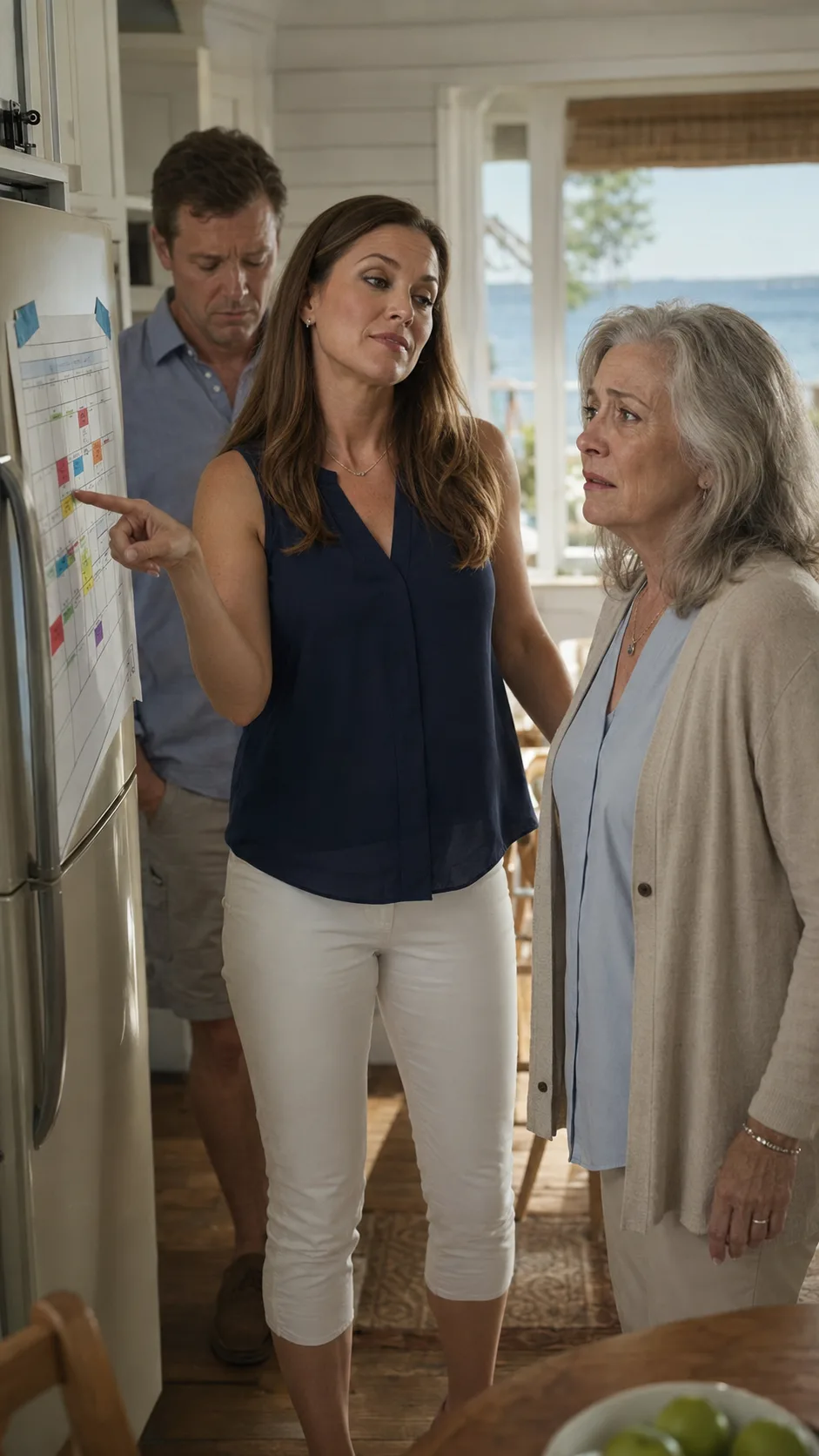
That night, after everyone left, I stood in front of the refrigerator.
Four faint tape marks remained where Ashley’s schedule had been. I cleaned them away with warm water.
Then I took out Daniel’s old black pen and made my own calendar.
July 5 — Coffee on porch.
July 6 — Read by lake.
July 7 — Replace porch fern.
July 8 — Do absolutely nothing.
Under September, I wrote:
Marianne — whenever she pleases.
I attached the page with one small magnet.
The following month, Bradley met me at a diner in Grand Rapids. He looked older when he walked in.
Not dramatically.
Guilt ages people differently than time.
We ordered coffee. He stirred his too long.
Finally, he said, “I let Ashley take over because it was easier than fighting.”
I waited.
“And because part of me liked not having to ask you. I liked acting as though we already had a claim.”
The honesty cost him something. I could see it.
“Thank you for saying that.”
His eyes filled.
“I hate that I made you feel alone.”
“You did make me feel alone.”
“I know.”
He took an envelope from his jacket.
“My key to your Grand Rapids house. You gave it to me for emergencies. I don’t want any key from you until you trust me again.”
I looked at the envelope, then at my son.
That was the first moment I believed he might truly understand.
“Trust is not a porch light,” I told him. “You cannot switch it back on because you apologized. It is more like that old dock your father rebuilt—one board at a time.”
Bradley smiled through tears.
“Dad hated that dock.”
“No. He loved complaining about it. Different thing.”
We laughed.
Not fixed.
But real.
Two weeks later, Ashley sent me a handwritten letter.
She apologized for assuming that access meant ownership. She admitted that people praised her for “organizing everything,” and she had enjoyed their admiration more than she cared about the fact that nothing she offered belonged to her.
Returning the money had humiliated her.
Then she wrote:
I needed to be humiliated. I confused access with ownership.
I read the sentence three times.
I did not forgive her that day.
But I kept the letter.
Sometimes accountability begins as ink before it becomes behavior.
Late August cooled the lake roads. Summer families packed their rafts and porch signs. Restaurants grew quieter. School supplies appeared in the grocery aisles.
Then September came.
My penciled week.
On September eighth, I woke before sunrise and put on Daniel’s navy windbreaker. I carried coffee down to the dock.
Mist hovered over the water. The rebuilt boards stood straight beneath my feet.
For a moment, I could almost see Daniel at the end, hands in his pockets, shoulders bent against the cold.
“You were right,” I whispered.
The lake moved softly against the pilings.
That week was beautiful.
Not leftover beautiful.
Not second-choice beautiful.
September beautiful.
Clear mornings. Empty beaches. Soft light. No guests demanding towels. No crowded restaurants. No one telling me when I was allowed to arrive.
Bradley came near the end of the month.
Alone.
He brought no overnight bag and no expectation—only grocery-store flowers and a bag of cherries long past their season.
“I know they’re not the same,” he said.
I took them anyway.
We sat on the porch and talked about ordinary things. His work. My neighbor’s knee surgery. Furnace filters.
Then he looked toward the lake.
“I miss Dad here.”
“So do I.”
“I think I acted like having access to this place was the same as having him.”
That truth opened something in me.
“You can miss your father without taking from your mother.”
He nodded. “I’m learning.”
Before leaving, he asked permission to walk down to the dock.
I said yes.
He did not ask for a key.
I watched him stand at the end, his shoulders shaped like Daniel’s in the fading sun, and allowed myself to feel grief and love without forcing either one to win.
Ashley has not returned to the cottage.
Maybe one day she will sit at my kitchen table and apologize without defending herself. Maybe one day I will believe her enough to pour coffee and listen.
I am in no hurry.
At seventy-one, I no longer confuse urgency with importance.
The cottage is still imperfect. The porch boards need paint. The screen door complains. Sand enters no matter how often I sweep. November winds shake the windows.
But the roof holds.
The dock stands straight.
And the coffee still tastes better on that porch than anywhere else in the world.
My refrigerator calendar remains mostly blank.
Some people think blank means empty.
I know better.
Blank means open.
Blank means peaceful.
Blank means no one has written my name in pencil beneath everyone else’s plans.
Bradley visits when invited. He brings groceries, repairs what I ask him to repair, and leaves unless I ask him to stay.
He is learning the difference between being welcome and assuming access.
That summer, Ashley thought she had organized my cottage.
All she really did was remind me where Daniel had put the papers.
A home remembers who fought for it.
And so does a woman.
THE END
Chapter complete
You have reached the end of this chapter.
Continue reading
A few more worlds to get lost in after this chapter.




