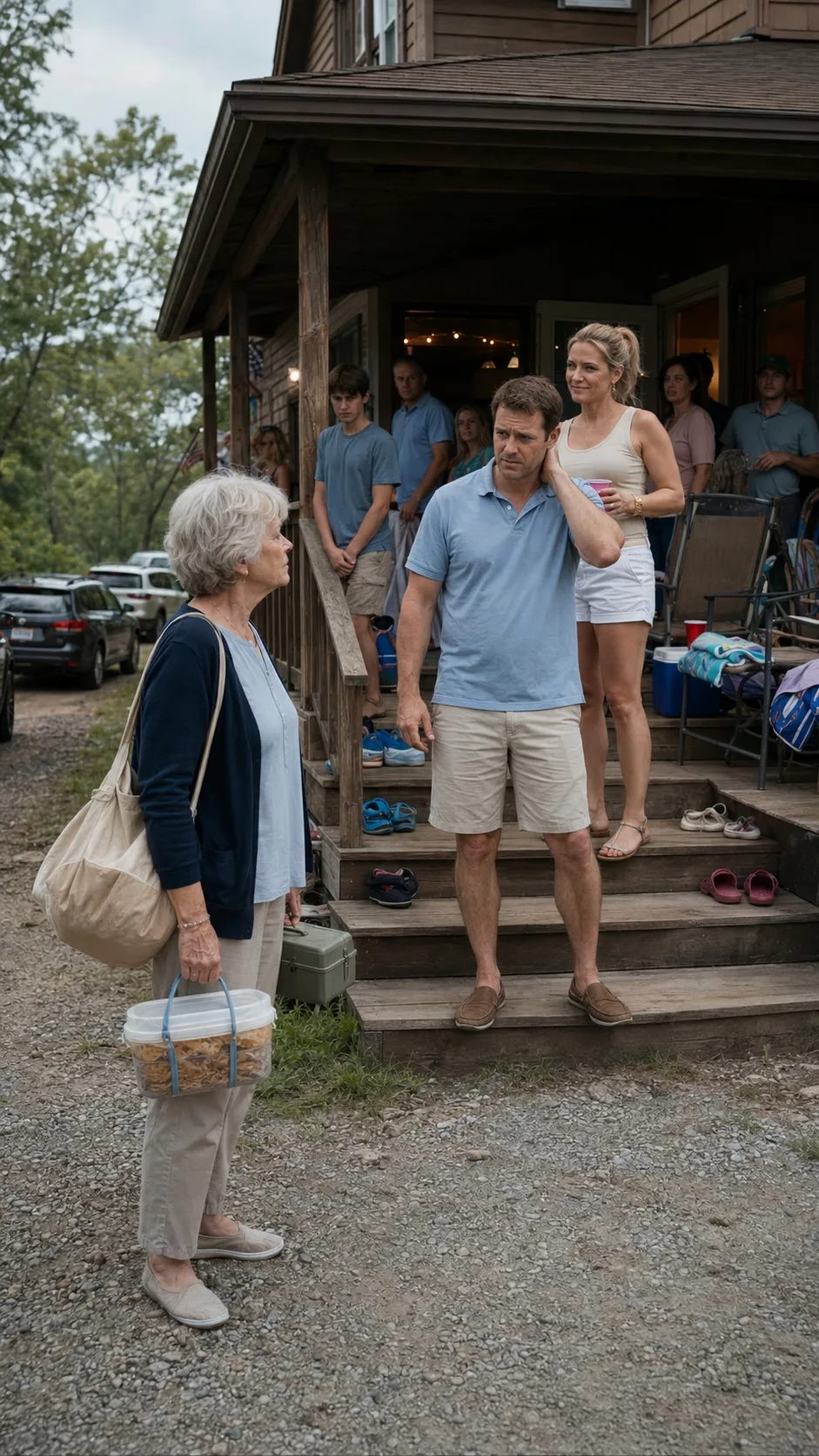
The rest of that weekend did not become comfortable.
Chapter 3
The rest of that weekend did not become comfortable.
Comfortable was no longer the goal.
Truth rarely enters a room gently. It knocks over chairs. It changes where people stand. It makes adults look at the floor and children suddenly seem wiser than anyone expected.
But the weekend became better.
Jessica’s parents stayed at the motel and came back the next day only after asking if they were welcome for dinner. Her mother, Diane, brought potato salad and paused in the doorway.
“Linda,” she said, “where would you like this?”
That question mattered.
Not because of the potato salad.
Because she asked.
Families forget the power of asking. They assume. They arrange. They decide that the quiet person will adjust because she always has before.
Asking puts the truth back in the room.
I pointed to the counter.
“Beside the cobbler is fine.”
Jessica heard the exchange. She said nothing, but I saw her face change.
Good.
Watching is
where some people begin learning.
Eric cleaned the grill without being told. Abby and Mason slept in the loft. Eric and Jessica took the pullout sofa. I slept in the main bedroom beneath the quilt Frank’s mother had made, listening to the old cabin shift in the night breeze.
For the first time in years, I did not feel grateful simply to have a corner of my own place.
I felt present.
On Sunday morning, I woke before everyone else.
The cabin smelled like coffee, lake air, and yesterday’s arguments.
I was pouring coffee into Frank’s old mug when Jessica entered the kitchen.
No makeup.
Hair messy.
No hostess smile.
She stood near the doorway as if unsure whether she still had permission to enter a room she had tried to control.
“Linda,” she said.
I looked at her.
“Yes?”
She took a breath.
“I am sorry for what I
did.”
I waited.
People often stop there because they think the word sorry is a bridge all by itself.
It is not.
It is only the first board.
Jessica seemed to understand that, because she kept going.
“I’m sorry I changed the reunion into something that made me look important. I’m sorry I invited people without asking you. I’m sorry I let you drive here with your bag and tried to send you away from your own cabin. And I’m sorry I used the word comfortable when what I really meant was convenient.”
That was specific.
Ugly enough to be honest.
I handed her a mug.
“Thank you.”
She looked like she wanted a hug.
I did not offer one.
Not because I wanted to punish her.
Because apologies need to stand on their own before we decorate them with forgiveness.
A few minutes later, Eric came into the kitchen
and stopped when he saw us.
He looked like a man walking into a house after a tornado, unsure if the roof was still attached.
I sipped my coffee.
“After breakfast, we are going to write cabin rules.”
He nodded.
No sigh.
No argument.
Progress.
We wrote them at the kitchen table on a yellow legal pad because I no longer trusted group texts with anything important.
Rule one: Linda Dawson owns the cabin, the dock contract, and the pontoon.
Obvious, but apparently necessary.
Rule two: No overnight guests beyond immediate family without my approval.
Rule three: No one changes marina, billing, insurance, dock, or boat information except me.
Rule four: No one operates Maggie Pearl unless listed and cleared by Cedar Bend Marina.
Rule five: No one uses the word “relax” to move me out of decisions, bedrooms, meals, boats, or conversations.
Mason insisted on that rule.
I let him write it.
Rule six: If the reunion becomes too big for the cabin, extra guests get motel rooms. The owner does not.
Eric read the list twice.
His ears turned red.
Jessica looked at the table.
Then she signed.
Eric signed next.
Mason signed as witness, sitting up straighter than I had seen him sit all weekend.
Abby drew a tiny pontoon in the corner and wrote, “Don’t be rude.”
Best clause in the document, in my opinion.
That afternoon, I walked to the marina.
Eric came with me.
Not to drive.
To stand there.
Tom Alvarez looked up from behind the counter.
“Mrs. Dawson.”
“Tom.”
His eyes moved briefly to Eric, then back to me.
“I am keeping Eric off the authorized list for now,” I said. “He can reapply after he completes the safety refresher and after I decide I trust his judgment again.”
Eric flinched slightly.
Tom nodded.
“Fair enough.”
Eric swallowed.
“I’ll take the class.”
Tom handed him the form without ceremony.
Just paper.
That is often how repair begins.
On the walk back, Eric kicked at the gravel like a boy again.
“I always thought the cabin would be mine someday,” he said.
“I know.”
He looked at me.
“Is it?”
I watched the lake shimmer through the trees.
“That depends on the man you become around it.”
He was quiet for a long time.
Then he said, “That’s fair.”
Fair.
Not easy.
Not comfortable.
Fair.
After that summer, I called my attorney.
Yes, I have one.
Women my age should have attorneys, passwords, updated paperwork, and at least one neighbor with a ladder.
I changed the cabin trust.
Not to punish Eric.
To protect what Frank and I had built from anyone’s convenience.
The cabin would not become something my son could sell, borrow against, rent out, or hand over to a wife with matching towels and a talent for rewriting ownership.
It would become part of the Dawson Family Lake Trust.
There would be use rules.
Maintenance contributions.
No sale for ten years after my death unless both my children and a majority of adult grandchildren agreed.
No short-term rentals.
No boat use without training.
A small fund from my savings would cover the first few years of taxes. After that, anyone who wanted to use the cabin would help care for it.
Because a place like that does not stay in a family because people love using it.
It stays because someone loves maintaining it.
I told Eric and my daughter Karen on a video call.
Karen laughed first.
“Mom finally put the cabin in writing,” she said. “We are all doomed.”
Eric did not laugh.
He simply said, “I understand.”
That mattered.
The next July, the reunion happened again.
Smaller.
Better.
Jessica asked before inviting her parents. I said yes. They stayed at a motel by choice and came during the day.
Brad did not return.
No one missed him.
The group text was renamed Dawson Cabin Weekend.
Mason made me admin and said, “Grandma owns the dock and the vibes.”
I pretended not to understand what vibes meant.
Jessica’s first message that year was:
Linda, what would you like us to bring?
I stared at that message for a long time.
Not because it was poetic.
Because it asked.
I replied:
Ice. Paper towels. And no surprises.
She wrote back:
Understood.
The cabin felt like itself again.
Brown siding.
Slamming screen door.
Crooked drawer.
Mismatched rocking chairs.
Frank’s hat back on the peg.
Peach cobbler on the counter.
Mason and I took Maggie Pearl out on Saturday morning.
Just us at first.
He had completed his boating safety course and acted very serious about rules I had learned by surviving other people’s foolishness.
He tied the line himself.
The knot held.
“Grandpa’s knot?” I asked.
He nodded.
“Grandpa’s knot.”
Out on the water, the lake opened wide and bright around us. The engine hummed. A heron lifted from the shoreline. Sunlight scattered across the surface like coins no one could spend.
Mason slowed near a quiet cove.
“Grandma?”
“Yes?”
“I’m glad you didn’t sell it.”
“Me too.”
“Are you going to?”
“Not today.”
He smiled.
“That’s not really an answer.”
“At sixty-nine,” I said, “not today is an excellent answer.”
He laughed.
Then his face turned serious.
“When you’re not here someday, I want to help keep it.”
I looked at his hands on the wheel.
Frank’s hands.
Young.
Capable.
Still learning what care costs.
“Then remember this,” I said. “A family place survives when people stop treating it like a free vacation and start treating it like a promise.”
He nodded.
“I’m learning.”
Good answer.
That afternoon, Eric stood beside me on the porch while the children played near the gravel drive. Jessica was in the kitchen with her mother, asking before moving dishes, which I appreciated more than she knew.
Eric looked toward the dock.
“I’m sorry I didn’t understand what it took.”
“You understood some of it,” I said.
“I ignored the rest because it was easier to think the cabin was just always here.”
That was true enough.
“Your father and I made many things look easy.”
“You made too many things look easy,” he said.
I thought about Frank. The first summer. The leaking roof. The crooked birthday cakes. The children running barefoot down the dock. The years after his death when grief sat with me in every room until coffee and routine made space around it.
“Do you regret it?” Eric asked.
I shook my head.
“No. But I am done pretending easy means free.”
He nodded slowly.
“I can live with that.”
“Good,” I said. “Because you’re cleaning the grill.”
He laughed.
Then he did.
I keep a folder in the small desk drawer by the window now.
Inside are the dock contract, boat registration, insurance renewal, property receipts, the cabin rules, the trust summary, Tom’s note removing Eric from the operator list, and the later certificate proving he completed the safety course.
I do not keep those papers because I want to stay angry.
I keep them because families are excellent editors.
Given enough time, someone would say things got crowded.
Linda overreacted.
Jessica meant well.
Eric was caught in the middle.
No.
My son asked me to sleep at a motel so guests I did not invite could stay in the cabin my husband and I kept alive.
My daughter-in-law tried to turn my ownership into an inconvenience.
My name was useful for bills, contracts, taxes, insurance, and boat registration — but somehow not important enough for a bed.
That happened.
And so did this:
The marina manager came up the drive.
The clipboard opened.
The pontoon stayed docked.
My room stayed mine.
My name is Linda Dawson.
I am sixty-nine years old.
I am a widow, a mother, a grandmother, and the owner of the little brown cabin outside Branson with the slamming screen door and the crooked kitchen drawer.
I am not a guest there.
I am not a scheduling problem.
I am not old enough to be erased or generous enough to be moved out of my own life.
Jessica thought she had solved the problem of too many people and not enough beds.
She forgot that some women come with keys.
She forgot that a dock contract can speak louder than a group text.
She forgot that the woman carrying peach cobbler may also be carrying the insurance papers.
And she forgot that a mother who kept a cabin alive after burying her husband is not easily sent to a motel so strangers can sleep under her roof.
The screen door still slams.
The frosting still leans.
The pontoon still starts if you know how to listen to the motor.
And on summer evenings, when the lake turns gold and Mason ties Frank’s knot without looking down, I sit in the rocking chair by the porch rail and understand something I wish I had learned sooner.
Keeping a place open does not mean letting people push you out of it.
Sometimes love is a light left on.
Sometimes it is a key turned firmly in your own front door.
THE END.
Chapter complete
You have reached the end of this chapter.
Continue reading
A few more worlds to get lost in after this chapter.




