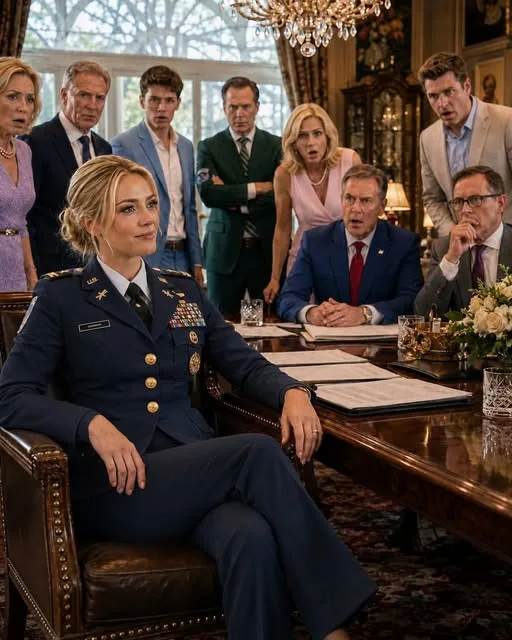
Tyler did not explode.
Chapter 4
Tyler did not explode.
That was how I knew she was telling the truth.
He simply sat there, staring at our mother with the expression of someone watching a locked door open from the wrong side.
“Mom,” he said quietly.
Diane wiped her face.
“You told me it was temporary.”
“Because it was.”
“You brought me the signature page.”
Ray swore under his breath.
Brian stood and moved away from the table.
Victoria remained seated.
She had spent enough years in litigation to know that silence often gathers more evidence than confrontation.
Tyler pointed at me.
“She was never going to help.”
I almost laughed.
“Did you ask?”
“You always judge me.”
“You used my signature.”
“You have no idea what it’s like to build something.”
That sentence finally broke through my restraint.
I leaned forward.
“No idea?”
My voice was still calm, but every person in the room heard the shift.
“I built
a career in an institution where nobody cared who my father was, who my mother was, or what I thought I deserved. I started at the bottom. I moved every few years. I missed holidays. I buried friends. I failed evaluations and trained harder. I earned every promotion in rooms where excuses were worthless.”
Tyler’s face tightened.
“You think your business failing means the world cheated you. Sometimes failure is information.”
He looked away.
“You don’t get to steal my name because you dislike what the information says.”
My mother whispered, “Claire.”
I straightened.
“I’m done.”
Victoria closed the settlement folder.
The meeting ended without anyone signing anything.
That was deliberate.
Pressure had been their weapon.
I refused to make it mine.
Over the next seventy-two hours, the story they had built began collapsing in ordinary, uncinematic ways.
Emails were produced.
Bank records were reviewed.
Independent attorneys entered the picture.
Tyler’s lawyer advised him to cooperate with Meridian Atlantic immediately.
My mother retained separate counsel and signed an affidavit explaining how the beneficiary acknowledgment had reached her.
Ray hired his own lawyer after learning that Tyler had used documents from Ray’s contracting office to assemble portions of the loan packet.
The five attorneys from the original ambush disappeared from the family group chat one by one.
Brian sent Victoria a formal letter stating that his representation had been limited to a potential trust contest and that he had neither prepared nor approved the bank submission.
For once, everybody wanted the record to be precise.
The trust challenge was withdrawn on the fourth day.
The proposed credit facility was canceled.
The false acknowledgment was formally repudiated.
Meridian Atlantic referred the matter to its internal fraud department and preserved its rights, but because the loan had never funded, the financial damage was
contained. What consequences Tyler would face after that were no longer mine to control.
That distinction mattered.
I had spent most of my adult life believing strength meant taking responsibility for every threat in the room.
My father’s final lesson was different.
Sometimes strength is knowing which consequences belong to other people.
Two weeks later, Victoria called me to her office.
My father’s trust had cleared its final administrative review.
No challenge remained.
No emergency petition had been filed.
No one could force me to assign it.
She handed me a smaller envelope we had not seen before.
“This was held by the trustee,” she said. “Your father instructed that it be delivered only after the contest period closed or any challenge was withdrawn.”
I smiled despite myself.
“He really planned everything.”
“Almost everything.”
Inside was a single page.
Claire,
If this reached you, then I hope the noise is over.
Do not spend your life proving that you deserved what I gave you. You already did that before I signed a single document.
Use some of it foolishly.
Use some of it wisely.
Give some away.
Keep enough to make choices for yourself.
And please buy a decent fishing boat. The one you made fun of for twenty years was held together by optimism and marine tape.
I laughed so suddenly that Victoria laughed too.
Then I cried.
Not because of the money.
Because grief had been postponed by conflict.
For weeks, every memory of my father had been attached to affidavits, signatures, phone calls, and threats.
Sitting in that quiet office, I finally got to miss him.
A month later, I drove back to my mother’s house.
This time there were no black sedans in the driveway.
No lawyers.
No paperwork waiting on the table.
Diane opened the door and looked older.
“Are you here about the settlement?”
“No.”
She hesitated.
“Then why are you here?”
I held out a cardboard box.
Inside were copies of photographs from my father’s storage unit. Pictures of me as a child. Pictures of my parents before the divorce. One photograph of my mother laughing beside my father at a county fair, both of them young enough to believe love alone could solve everything.
“These belong to you too,” I said.
Her eyes filled.
“I don’t deserve kindness from you.”
“I’m not doing this because you earned something.”
That sentence surprised both of us.
Maybe that was the difference between generosity and control.
I stepped inside, but I did not stay for dinner.
We talked for twenty minutes.
She apologized without adding the word but.
It was the first real apology I had heard from her in years.
I did not forgive everything in twenty minutes.
I did not pretend trust could be rebuilt because someone cried in a doorway.
I told her that if we were going to have a relationship, money could not be part of it.
No loans.
No investments.
No requests on Tyler’s behalf.
No conversations about what Dad “would have wanted.”
She agreed.
Whether she would keep that promise was up to her.
My job was to keep mine.
Tyler never apologized directly.
Three months later, I received a letter from him through counsel.
It was only four sentences.
He admitted using the signature page.
He said desperation had made him believe repayment would erase what he had done.
He said he was selling his remaining interest in the development company.
And he said he understood if I never wanted to speak to him again.
I did not answer immediately.
Some endings do not need reconciliation.
Some only need the truth.
Six months after my father died, the Parker Veterans Education Foundation awarded its first scholarships.
The no-contest provision had redirected part of what my mother might otherwise have received, and I added a contribution from my own trust.
We funded tuition assistance for veterans transitioning into public service, intelligence analysis, cybersecurity, and emergency management.
At the first award ceremony, Victoria stood near the back of the room.
She nodded toward the stage.
“Your father would have liked this.”
“He would have complained about the catering.”
“That too.”
I smiled.
Afterward, I drove alone to the marina.
A used twenty-two-foot fishing boat waited in the slip.
Nothing extravagant.
Reliable engine.
Clean deck.
No marine tape.
I had named it CLEAR TERMS.
My father would have hated the name.
Which was precisely why I chose it.
I took the boat out just before sunset.
The water turned copper beneath the fading light, and for the first time since the funeral, my phone stayed silent in my pocket.
No family meeting.
No attorney.
No demand.
Just the engine, the wind, and my father’s final letter folded safely inside the cabin.
For years, my mother believed the greatest leverage she had over me was family.
Then she believed it was money.
Then lawyers.
She was wrong every time.
The greatest leverage anyone has over you is the part of yourself that still needs their permission.
My father’s trust gave me financial security.
What he really left me was permission to stop negotiating for my own worth.
That was the inheritance nobody in that dining room knew how to take.
THE END.
Chapter complete
You have reached the end of this chapter.
Continue reading
A few more worlds to get lost in after this chapter.




