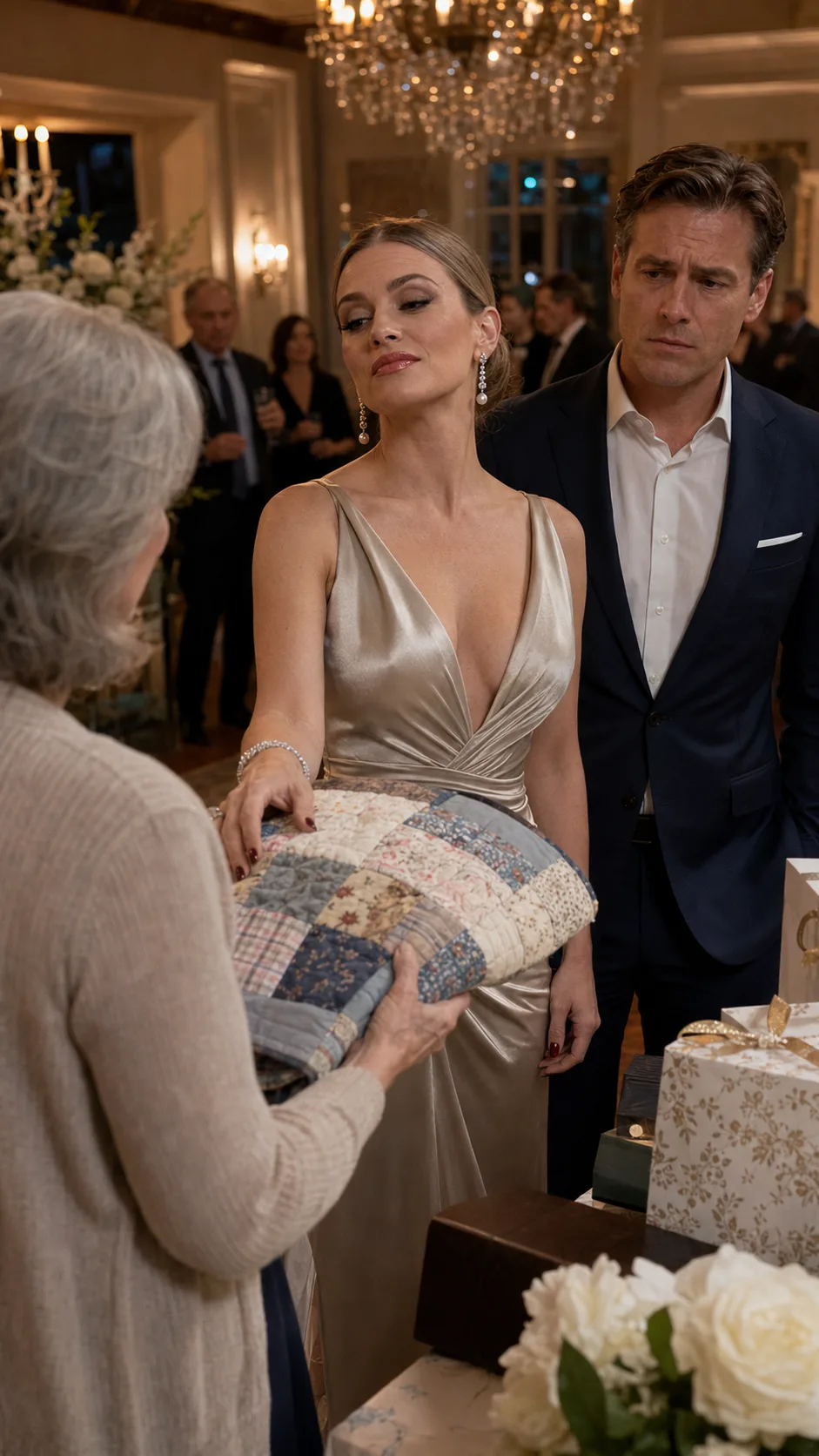
“THAT’S FROM A FLEA MARKET” — MY SON’S FIANCÉE TOSSED MY HANDMADE GIFT ASIDE AT THE PARTY — SO I …
PART 2 — THE VENUE SHE NEVER KNEW I OWNED
That night, I sat at the kitchen table for a long time.
Chapter 2
“THAT’S FROM A FLEA MARKET” — MY SON’S FIANCÉE TOSSED MY HANDMADE GIFT ASIDE AT THE PARTY — SO I …
PART 2 — THE VENUE SHE NEVER KNEW I OWNED
That night, I sat at the kitchen table for a long time.
Not with plans. Not yet.
Just with the particular quiet that comes after you understand something you’d been hoping wasn’t true.
Then I got up, made a pot of Red Rose, and went to the hall closet.
On the top shelf behind the spare blankets and Darren’s old school yearbooks sat a fireproof box I bought at Canadian Tire in 2002.
The combination was his birthday.
Inside, property deeds, investment statements, a folder from my accountant in Westboro, and a sealed envelope I updated every year labeled: For Darren, read when ready.
The current value of the portfolio, including the three Kanata properties and 20 years of compounding investments, was $2.4 million.
It wasn’t Bay Street money, but it was mine, every dollar of it, and it had been earned on 200-thread-count sheets and 5:30 morning drives and Sunday mornings reading the financial pages alone at my kitchen table.
I
put the box back.
I made a decision, not about revenge, about clarity.
The following Monday, I called my accountant, a steady woman named Olive, who had handled my books since 2004 and who had the professional habit of never reacting to anything.
“I’d like to restructure the Kanata properties,” I said. “Transfer them fully under the holding company.”
“JM Holdings?”
“Yes, and I want to review the events property.”
There was a slight pause.
“The Fairvale property?”
“Yes.”
The Fairvale property was a converted heritage farmhouse in Carp, about 40 minutes west of Ottawa, that I’d purchased in 2017 through JM Holdings when the previous owner, a couple who’d run it as a bed and breakfast, listed it for $680,000 and got no takers for eight months.
Everyone said heritage properties were money pits, too expensive to maintain, too rural for reliable bookings.
I’d seen it differently.
I hired
a property manager named Cecil, a methodical man who’d spent 20 years running event venues in the valley.
Within 18 months, the Fairvale had become one of the most in-demand wedding and private event venues in the Ottawa region.
Simone had booked the Fairvale for her wedding.
She’d found it in a magazine spread, Ottawa’s Most Beautiful Wedding Venues, and told Darren it was exactly what she’d always imagined.
Twelve acres, heritage stone exterior, the original timber beam barn converted into a reception hall.
The deposit had been paid to Cecil’s management company, routed through a booking agency.
The name JM Holdings appeared nowhere on the wedding contract.
Simone had no idea the ground she was planning to get married on belonged to her future mother-in-law.
I’d known this for several months and hadn’t said anything.
I wasn’t sure what I was waiting for.
After the engagement party, I understood.
I was waiting for certainty.
Three weeks after the engagement party, I drove out to the Fairvale on a Tuesday morning.
Cecil met me at the gate in his truck.
“Everything all right?” he asked.
“Fine. I want to walk the property.”
We walked the fence line and through the barn.
The reception hall was beautiful. Rough-hewn beams, stone fireplace, wide-plank floors that had been refinished but still showed 100 years of use.
I stood in the center of it for a moment.
“The Hartley-McIntosh booking,” I said. “What’s the date?”
“June 14th. Four months away.”
“I may need to make some changes to that booking.”
Cecil waited. He was good at waiting.
“Nothing yet,” I said. “I’ll let you know.”
I drove back to Ottawa thinking about my son, not about Simone.
About Darren.
I’d raised him to be decent. I believed he was.
But there’s a difference between being a decent person and being a brave one.
Darren was standing beside his fiancée at that engagement party. When she set my quilt on the table and moved on, he’d seen it.
He’d said nothing.
I needed to understand whether that was a moment of weakness or a habit.
I started paying closer attention.
It wasn’t dramatic what I noticed over the next few weeks. It was small.
The way he deferred to her on every plan.
The way he stopped mentioning hockey or his old friends from Nepean or anything from before he’d met her.
The way he called me less.
When I did speak to him, he sounded slightly compressed, like a man editing himself in real time.
One afternoon, he called to ask if I could possibly not come to the wedding in my car.
Simone’s parents had arranged transportation for the family, and it would just be easier if everyone arrived the same way.
I asked what was wrong with my car.
He paused.
“Nothing, Mom. It’s just easier.”
I told him I’d drive myself.
The call ended shortly after.
That evening, I called my brother Harold, who lives in New Brunswick and has known me for 63 years and therefore has no patience for my roundabout way of getting to a point.
“Just say it,” he said.
“I think my son is becoming someone I don’t recognize.”
Harold was quiet for a moment.
“Is it him or is it her?”
“I don’t know yet.”
“Well,” he said, “figure that out before you do anything.”
He was right.
So I did something I had never done before.
I called a friend of mine from the hotel, a retired RCMP officer named Gary who now did private consulting, and I asked him to do a background check on the Hartley family.
Not Simone personally, professionally.
The family finances.
I felt uncomfortable doing it. I want to be honest about that.
It felt like a betrayal of something, though I wasn’t sure what.
But I thought about the way Simone’s mother had introduced me at that party.
She works at the Beaumont.
And about my son’s voice on the phone, compressed and careful.
And I picked up the phone.
What Gary found took about 10 days.
We met at a Second Cup on Bank Street. He handed me a manila folder across the table without drama.
He’d always been economical with words.
The Hartley family finances had a gap in them.
Judge Hartley had retired on a full pension, but three years ago, the family had taken out a significant home equity line of credit against the Rockcliffe Park house.
The HELOC was substantial, nearly $400,000.
The same year, a numbered company registered to Simone appeared in Ontario corporate filings.
The numbered company had received two large transfers from the Hartley family in the same period.
The numbered company was listed as a partial guarantor on a loan that Simone’s law firm was currently reviewing her employment over.
Not publicly, but Gary had a contact.
“What kind of review?” I asked.
“Billing irregularities. Client trust account discrepancies.”
Gary drank his coffee.
“Nothing proven. But the review started eight months ago, and she’s still on desk duty.”
I sat with that.
My son was planning to marry a woman who might be under investigation by her own firm.
“Does he know?” I asked. “About any of it?”
“No way to know that from the outside,” Gary said. “But my read? No. She doesn’t seem like someone who shares that kind of information willingly.”
I drove home slowly.
I thought about what to do with this.
I thought about my brother’s question: Is it him or is it her?
I was beginning to understand it was both, in different ways, for different reasons.
I could call Darren right now. Tell him what I’d found.
But I knew exactly what would happen.
He’d tell Simone. Simone would tell her family.
There would be lawyers involved by the end of the week, and my son would spend the next decade believing his mother had tried to destroy his marriage out of jealousy.
I had to let this play out, but I could control the stage.
I called Cecil.
“The Hartley-McIntosh booking,” I said. “Cancel it. Full refund. Standard terms.”
Another pause.
“The reason I should give?”
“The venue unavailable due to owner requirements. It’s in the contract.”
“It is,” Cecil confirmed. “I’ll process it tomorrow.”
“Thank you.”
I hung up and sat at my kitchen table for a long time.
Three days later, Darren called.
He was upset in a way I hadn’t heard from him since he was a teenager. That particular tightly wound upset that men get when they feel embarrassed and don’t want to say so directly.
“Mom, what did you do? Simone’s venue canceled. The Fairvale? She’s been planning this for a year.”
“I didn’t do anything. The venue sent a cancellation notice saying the owner had a personal scheduling conflict. Venues do that sometimes,” I said.
“Mom.”
“Darren, I think we need to talk.”
“Not about the venue. About other things.”
“What other things?”
“Come for dinner. Saturday. I’ll make tourtière again.”
There was a silence. I could hear him deciding whether to fight or comply.
Eventually, “Fine. Saturday.”
He came alone, which told me something.
I made the tourtière and a butter tart square for dessert because he’d loved them since he was nine.
We sat at the same kitchen table where I’d sat alone on a hundred nights balancing spreadsheets after he’d gone to bed.
I didn’t hand him the folder Gary had given me.
I’m not sure why, exactly.
It didn’t feel like the right move.
Instead, I asked him questions I hadn’t asked in two years.
About his job.
About what he wanted.
About whether he was happy in the way that had nothing to do with the trappings of happy, the house and the car and the wedding venue.
He answered carefully at first, then slowly, less carefully.
“I feel like I’m always catching up,” he said at one point.
He wasn’t looking at me. He was looking at his plate.
“To what?”
“To where she thinks we should be. To what the Hartleys have. To how things are supposed to look.”
I let that sit for a moment.
“How do they look from where I’m sitting?” I asked.
He looked up.
“Like a lot of work,” he said. “Like a lot of performance.”
“And is that what you want?”
He didn’t answer.
But he didn’t say yes.
After dinner, I told him about the Fairvale.
Not Gary’s report, just the Fairvale.
I told him I owned it.
I watched his face go through several things in a short period of time. Confusion first, then something like hurt, then something I couldn’t quite name.
“You own the venue she booked?”
“Yes.”
“Since when?”
“2017.”
“And you never told me.”
“I’ve kept a lot of things to myself. That was probably a mistake.”
He was quiet for a long time.
The kitchen clock ticked. Outside, someone on the street was warming up their car.
February in Ottawa.
“Why are you telling me now?”
“Because I think you deserve to know who you come from before you decide who you’re going to become.”
He left at 10:00.
He didn’t say much on his way out. He hugged me at the door, which he hadn’t done without prompting in about two years, and then he sat in his car in the parking lot for a while before he drove away.
I watched from the window.
I didn’t hear from him for 12 days.
Then Simone’s law firm made its review public.
Not dramatically.
A brief notice on their website about an internal compliance matter. The kind of language that tells you everything by saying nothing.
Three of the firm’s corporate clients moved their files that week.
Gary called me from New Brunswick to tell me he’d seen it.
Darren called me that same evening.
“Mom.”
His voice sounded different. Flatter. Quieter.
“I know,” I said.
“Did you… Did you know about this? The firm thing?”
“I found out some things, yes.”
“How long?”
“Six weeks.”
He was silent for a moment.
“Why didn’t you tell me?”
“Would you have listened?”
Another long silence.
“She told me it was nothing,” he said. “She said someone had it out for her at the firm. She said…”
He stopped.
“I know.”
“She said you were probably behind it. That you’d always hated her.”
“And what do you think?”
“I think,” he said slowly. “I think I need to come over.”
To be continued… Click “PART 3” to read the final part: 👉 PART 3 👈
Chapter complete
You have reached the end of this chapter.
Continue reading
A few more worlds to get lost in after this chapter.




