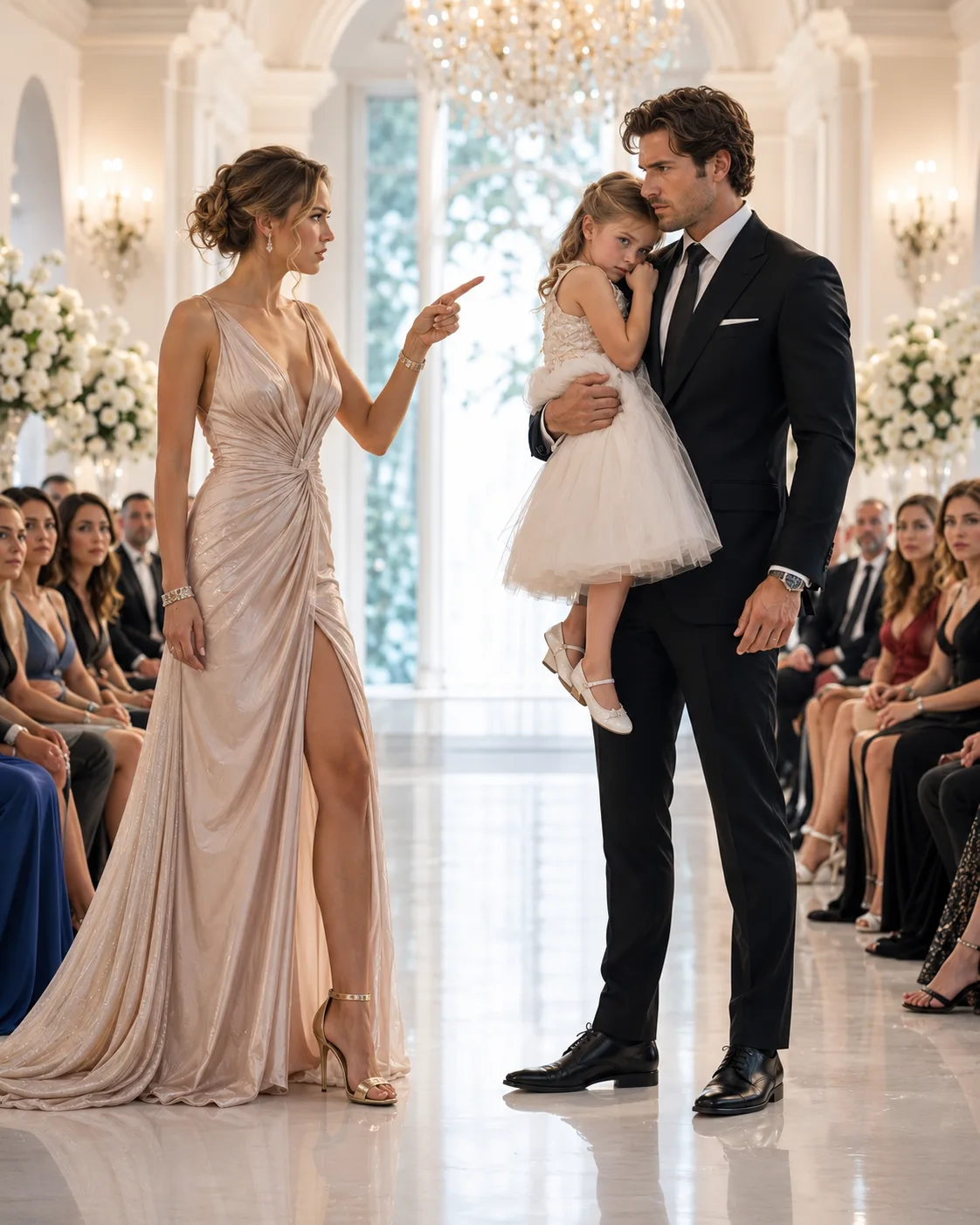
The woman he planned to marry made him choose between her and the little girl in his arms, and his answer destroyed every lie on that runway.
ByHoangAnh1 MrJune 21, 2026
He told her Amara was his daughter.
Chapter 1
ByHoangAnh1 MrJune 21, 2026
He told her Amara was his daughter.
He said the situation with Diana was complicated. He said Amara’s early life had been difficult and that he did not want details repeated among society people who treated private pain like dinner gossip. Celeste did not press him then.
Maybe she should have.
Maybe he should have trusted her.
Maybe everything that happened later began with that quiet omission.
But as Marcus stood on the runway now, with Celeste demanding he choose, he understood something with brutal clarity.
Secrets do not protect love.
They only delay the moment love is tested.
Celeste crossed her arms.
“Well?” she demanded, though her voice had lost some of its confidence. “Are you going to stand there and let everyone watch you humiliate me?”
Marcus looked down at Amara.
Her eyes were open, watching a luggage cart roll in the distance. Her fear had passed quickly, as toddler fear often does when held
by safe arms. She had found something else to wonder at.
Something about that innocence nearly brought Marcus to his knees.
He kissed the top of her head.
Then he looked at Celeste.
“I need to tell you the truth,” he said.
Part 2
Celeste’s face tightened as if truth were an inconvenience she had not scheduled.
“Not here,” she said. “Marcus, not in front of staff.”
“In front of staff is where you told me to choose between my fiancée and my daughter.”
Her cheeks flushed.
Gloria looked down, but Marcus saw her lips press together. Gloria had worked for families with money for almost thirty years. She knew the difference between embarrassment and accountability. She had watched children treated like accessories in houses where the art cost more than most people’s homes. She had stayed with Marcus because he was different.
Because when Amara cried, he put down
the phone.
Because when Amara laughed, he stopped to listen.
Because when Amara ran into a room, Marcus Donovan’s whole face changed before he could hide it.
Celeste glanced toward the pilots, the guards, the jet stairs.
“Fine,” she said. “Say it.”
Marcus adjusted Amara higher on his hip.
“Amara is not Diana’s biological child.”
Celeste blinked.
“What?”
“She was abandoned at Houston Memorial when she was three days old. Diana was her foster mother.”
The runway seemed to tilt beneath Celeste.
She stared at the little girl as if seeing her for the first time. The black dress. The small shoes. The curls pulled into a puff with a satin bow. The serious little eyes. The child she had resented because she thought Amara represented a life Marcus had lived before her, a woman who had claimed a part of him she could never touch.
“She isn’t yours?” Celeste
whispered.
Marcus’s expression hardened.
“She is mine.”
“That is not what I meant.”
“It is exactly what you meant. She is my daughter because I chose to be her father. Because a judge signed the papers. Because I sit with her when she has nightmares. Because I know she likes strawberries and hates bananas. Because she says ‘again’ when I finish a book, even if I have already read it five times. Because when she is sick, she reaches for me. Because when she falls asleep, she trusts me enough to let go.”
His voice broke slightly on the last words, and everyone heard it.
Even Celeste.
“She was left,” Marcus continued. “No mother. No father. No name anyone could trace. Diana gave her love for as long as her body allowed. Then she asked me for help. I started showing up. And somewhere along the way, showing up stopped being something I did and became who I was.”
Celeste swallowed.
“You adopted her.”
“Yes.”
“And you never told me.”
“No.”
The admission landed with its own weight.
Marcus did not soften it.
“I should have,” he said. “I was afraid.”
“You were afraid of me?”
“I was afraid of losing you. I was afraid the truth would be too much. I was afraid you would look at my daughter like a burden.”
Celeste flinched.
Marcus looked at her steadily.
“And then you did.”
For a moment, Celeste Whitmore looked exactly like what she was beneath the money, beauty, polish, and pride.
A woman who had just been handed a mirror.
Her mouth opened, but no defense came out.
The private jet waited behind them, white and enormous. The red carpet moved slightly in the wind. Somewhere beyond the airstrip fence, traffic hummed faintly on a highway, ordinary life continuing while a family either broke or remade itself on concrete under the Texas sky.
Celeste looked at Amara again.
Amara had turned her attention to the buttons on Marcus’s jacket, poking one with careful concentration.
“She doesn’t know,” Celeste said, so softly Marcus almost missed it.
“Know what?”
“That I’ve been awful to her.”
Marcus did not answer quickly.
Children always know more than adults hope they do.
They may not understand sentences, but they understand rooms. They understand shoulders tightening. They understand when smiles stop at the teeth. They understand when a woman kneels to tie their shoe with hands that do the task but offer no tenderness.
“She knows how people make her feel,” Marcus said. “That is enough.”
Celeste’s eyes filled.
She turned her face away, angry at the tears before they fully formed.
“I was jealous,” she said. “Of a three-year-old. God, listen to me.”
Marcus waited.
Celeste pressed her fingers to her lips and stared at the runway as if searching the concrete for a version of herself she could respect.
“My father had four children,” she said slowly. “Three sons and me. He used to tell people I was his princess. He bought me ponies, dresses, trips to Paris, everything. But when I walked into a boardroom, he looked through me. When my brothers failed, he called it learning. When I succeeded, he called it lucky. I spent my whole life fighting for a chair at a table that had my name on it but never felt like mine.”
Marcus’s face shifted, not with forgiveness yet, but with attention.
Celeste laughed once, miserably.
“That is not an excuse. I know it isn’t. But when I saw you with Amara, the way you loved her without making her earn it, the way your whole world stopped when she needed you, I felt this ugly thing inside me. I told myself it was because you had lied. Because Diana still mattered. Because I was protecting our future. But that wasn’t the whole truth.”
She finally looked at him.
“I wanted someone to love me like that.”
The words were small, stripped of every elegant defense.
For the first time since he had known her, Celeste looked poor in the one way money cannot fix.
Marcus’s anger did not disappear. It changed shape. Became sadness. Became recognition. Became the hard knowledge that understanding someone’s wound does not erase the damage they caused with it.
“You deserved that kind of love,” he said. “But Amara is not responsible for the fact you didn’t get it.”
“I know.”
“Do you?”
Celeste nodded, tears sliding down her face now.
“I do now.”
Marcus looked at the ring on her finger.
Four hundred thousand dollars. New York rooftop. Champagne. Ruth Donovan crying over FaceTime for twenty minutes because her son, her lonely boy, had found someone.
He remembered believing that love could be built with enough patience.
He remembered ignoring the coldness because hope is sometimes a very expensive form of denial.
“I was going to give you the ring back three weeks ago,” he said.
Celeste went still.
“After the house,” he added. “After you said she didn’t deserve that room.”
Celeste closed her eyes.
The shame that crossed her face was not pretty, and because it was not pretty, Marcus believed it more than any polished apology she could have offered.
“I heard myself say it,” she whispered. “And I hated myself. But then I doubled down because I didn’t know how to take it back.”
“You could have started with ‘I’m sorry.’”
“I know.”
Amara suddenly lifted her head.
“Daddy,” she said, pointing toward the jet stairs.
The single word moved through Marcus like light.
He kissed her cheek. “Yes, baby. Plane.”
“Big plane.”
“Very big plane.”
Gloria made a soft sound, half laugh and half sob.
Celeste looked at the child’s small hand pointing into the sunset. Something in her face crumpled again, but this time there was no self-pity in it. Only grief for what she had almost become.
“Marcus,” she said. “Are you leaving me here?”
The question was not proud.
It was not a threat.
It was a woman standing barefoot at the edge of consequences, asking whether the door had already closed.
Marcus looked at her for a long time.
“I am getting on that plane with my daughter,” he said. “That was never a question. It never will be.”
Celeste nodded, crying silently.
“If you come,” he continued, “you come differently. Not as a woman tolerating my child until the wedding. Not as someone waiting for me to make Amara smaller so you can feel bigger. You come with honesty. Therapy. Real work. And no guarantees from me.”
Her breath shook.
“And if I can’t?”
“Then you give me the ring, and we end this tonight with as much dignity as we can.”
The wind lifted the edge of her yellow dress.
For once, Celeste did not look like she belonged in a magazine. She looked human. Afraid. Exposed. Still selfish, maybe. Still wounded. But awake.
She pulled the diamond ring from her finger.
Marcus’s heart tightened.
But she did not hand it to him.
She held it in her palm, looked at it, then closed her fingers around it.
“I don’t want this to be my reason for staying,” she said.
She stepped toward him and placed the ring carefully in the breast pocket of his blue suit.
“If I get on that plane,” she said, voice trembling, “it is not because I am engaged to you. It is because I want to become someone who can be trusted near her. If I cannot do that, I do not deserve either of you.”
Marcus stared at her.
It was the first thing she had said all evening that did not sound like performance.
Amara reached for the pocket where the ring had disappeared.
“Sparkle?” she asked.
A broken laugh escaped Celeste.
“Yes,” she whispered. “Sparkle.”
Then, slowly, as if approaching a wild bird, Celeste bent her knees until she was eye level with Amara.
“Hi, Amara,” she said.
The child studied her.
Marcus held his breath.
Celeste did not smile too brightly. Did not force warmth. Did not reach for the child. She simply waited.
Amara looked at Marcus, then at Celeste.
Then she held out one small hand.
It was not forgiveness. Children should never be responsible for forgiving adults before adults have changed. It was not a blessing. It was not a miracle cure for all that had happened.
It was a hand.
Open.
Curious.
Unaware of pride.
Celeste stared at it as if it were the most sacred thing she had ever been offered.
Then she took it gently.
Her face changed completely.
Not beautifully. Not cinematically. Something deeper. Something hard inside her loosened with such force that she had to lower her head and weep into her own shoulder, still holding Amara’s tiny hand as carefully as if it were made of glass.
Marcus looked at Gloria.
Gloria wiped her cheek and said, “Well, Mr. Donovan, we either getting on that plane or raising a family right here on the runway?”
For the first time all evening, Marcus laughed.
It was quiet, tired, and full of pain.
But it was real.
Part 3
Miami did not heal them.
That would have been too easy, and real life rarely gives people transformation without asking for labor in return.
But Miami gave them a beginning.
The villa Marcus rented sat on Biscayne Bay, all white walls, wide windows, pale wood floors, and terraces filled with the smell of salt water and blooming jasmine. It had been meant for romance. Champagne. Sunset dinners. Celeste in silk dresses. Marcus finally resting after the largest deal Lumis Grid had ever closed.
Instead, the first morning began with Amara standing in her crib at 6:12 a.m. announcing, “Strawberries,” with the authority of a judge issuing a sentence.
Marcus opened one eye.
Gloria, from the hallway, called, “Already washing them, baby.”
Celeste appeared in the kitchen twenty minutes later wearing a white robe, no makeup, and the expression of a woman who had slept badly because her conscience had refused to lie down. She found Gloria slicing strawberries into toddler-sized pieces.
“Can I do that?” Celeste asked.
Gloria looked at her for a moment.
Not unkindly.
Not warmly either.
The runway had happened less than twelve hours earlier, and Gloria loved Amara too much to pretend memory was a light switch.
“You know how small?” Gloria asked.
Celeste nodded. “Small enough not to choke. Big enough not to insult her intelligence.”
Gloria almost smiled.
Almost.
She handed over the knife.
Celeste sliced the strawberries with intense care while Amara sat in her high chair, watching like a tiny supervisor. Marcus stood in the doorway, hair still damp from the shower, and said nothing.
Celeste placed the bowl in front of Amara.
Amara picked up one piece, inspected it, then held it toward Celeste.
“For me?” Celeste asked.
Amara nodded.
Celeste took it.
“Thank you.”
Amara smiled.
It was not a grand moment. There was no music swelling, no revelation, no speech. Just a child offering fruit to a woman who had not earned it and a woman receiving it as if it were mercy.
Later that morning, Celeste cried in the guest bathroom with the water running so no one would hear.
Marcus heard anyway.
He did not knock.
Some shame needs privacy before it becomes confession.
That afternoon, they walked along the water. Gloria pushed the stroller, though Amara demanded to get out every seven minutes to investigate rocks, flowers, a sleeping dog, and once, with great seriousness, a discarded napkin. Celeste walked beside Marcus, quiet.
“I called a therapist,” she said.
Marcus looked at her.
“In Dallas,” she added. “Dr. Ellen Park. My college roommate sees her. I have an appointment Tuesday.”
“That is good.”
“I almost didn’t tell you because I wanted you to praise me.”
The honesty surprised him.
“Do you still want me to?”
“Yes,” she said. “But less than I want it to be real.”
He nodded.
“That is a start.”
She looked toward Amara, who was crouching beside Gloria, holding a shell as if she had discovered treasure.
“I don’t know how to love children,” Celeste said.
Marcus slipped his hands into his pockets.
“Most people learn by noticing they are people.”
Celeste took that in.
“She is a person,” she said. “Not a symbol. Not your past. Not Diana. Not proof I will always come second.”
“No.”
“She is just Amara.”
Marcus watched his daughter hold the shell up to the sun.
“She is never just anything,” he said softly. “But yes.”
That night, after Amara fell asleep, Marcus and Celeste sat on the terrace. The bay reflected the city lights. The air was warm and damp. Somewhere below, a boat engine purred through the dark.
Celeste placed the diamond ring on the table between them.
“I don’t want it back yet,” she said.
Marcus looked at the ring but did not touch it.
“I wasn’t offering.”
A faint smile crossed her face, gone almost immediately.
“I know.”
She folded her hands in her lap.
“My father used to make us compete for everything,” she said. “Grades. Attention. Approval. Even grief. When my grandmother died, my brother cried at the funeral, and my father said he was dramatic. I didn’t cry, and he said I was cold. There was no right way to need anything in that house.”
Marcus listened.
The old Marcus, the businessman, might have tried to solve it. The younger Marcus, the abandoned boy, might have tried to rescue her so she would not leave. But Amara had taught him something more difficult than rescue.
Presence.
So he listened.
“I think I looked at the way you love Amara,” Celeste continued, “and I hated her for receiving something I did not know how to ask for. That is ugly. I know that.”
“Yes,” Marcus said.
She nodded, accepting the word.
“But I also need to say this,” she whispered. “I was hurt that you did not trust me with the truth.”
Marcus leaned back.
“I know.”
“You let me build a story in my head. Diana. You. Some hidden biological family I could never compete with. I should have handled my fear better. But you hid the truth because you decided for me who I would be.”
He looked out at the water.
She was right.
It did not erase what she had done. It did not make the runway acceptable. But it was true, and truth deserved room even when it complicated blame.
“I am sorry,” Marcus said.
Celeste turned to him.
He met her eyes.
“I thought I was protecting Amara’s privacy. Some of that was true. But some of it was cowardice. I loved you, and I was afraid the whole truth would make you leave.”
The past tense hung between them again.
This time Celeste did not flinch from it.
“Do you still love me?” she asked.
Marcus was silent so long the answer became clear before he spoke.
“I don’t know what I can trust yet.”
A tear slipped down her face.
She nodded.
“That is fair.”
“It is not punishment.”
“I know.”
“I want you to get better because you deserve to be free of whatever made you think love has to be won by pushing a child aside. But I cannot promise you a wedding because you cried on a terrace.”
“I know that too.”
He believed she did.
When they returned to Dallas, the engagement was quietly paused.
The society blogs noticed within days that Celeste Whitmore was no longer wearing the Donovan diamond. Her mother called six times in one afternoon. Her father sent one text that read, Do not embarrass this family.
Celeste stared at it for a long time.
Then she deleted it.
She started therapy the next morning.
It was not graceful. Healing rarely is. She came out of some sessions furious, some ashamed, some exhausted enough to sit in her car for twenty minutes before driving home. Dr. Park did not let her hide behind intelligence. Marcus did not let her use therapy as a performance. Gloria did not let her near Amara with false sweetness.
And Amara, in the blunt and holy way of children, did not care about Celeste’s progress reports.
She cared whether Celeste would read The Very Busy Spider twice.
She cared whether Celeste remembered that strawberries had to be cut but blueberries did not.
She cared whether Celeste showed up.
So Celeste showed up.
On Saturdays, she came to Marcus’s penthouse for breakfast, not as his fiancée, not as mistress of the house, not as a woman claiming territory, but as a guest who asked where the napkins were and accepted Gloria’s raised eyebrow as part of her education.
She learned to sit on the floor in expensive pants.
She learned toddlers do not respect silk.
She learned Amara liked to place stickers on people’s hands and then applaud her own work.
One morning, Amara pressed a purple star to Celeste’s wrist and said, “Pretty Cece.”
Celeste froze.
Marcus, standing at the coffee machine, turned slowly.
Gloria looked up from the sink.
Amara had already moved on to putting a sticker on her own knee.
Celeste stared at the purple star.
“Cece?” she whispered.
Amara nodded without looking at her. “Cece.”
Celeste covered her mouth.
Marcus looked away, giving her the privacy of not being watched while something sacred entered her life without asking whether she was ready.
Months passed.
Diana’s health improved, then worsened, then steadied. Marcus made sure Amara visited her in Houston whenever Diana was strong enough. Celeste came once, nervous and carrying flowers she almost left in the car.
Diana answered the door thinner than she had been in photos, with a scarf wrapped around her hair and kind eyes that missed nothing.
“You must be Celeste,” she said.
Celeste swallowed. “I am.”
Diana looked at the flowers. “Those for me or your guilt?”
Marcus nearly choked.
Celeste blinked, then laughed. A real laugh. “Both, probably.”
Diana smiled and stepped aside. “Then bring them in. Guilt flowers still brighten a room.”
That afternoon changed something too.
Celeste watched Diana and Amara together. The little girl climbed into Diana’s lap carefully, as if some part of her knew Diana’s body needed gentleness. Diana kissed Amara’s curls and called her “my brave little bird.” There was no competition in it. No threat. Just another form of love holding its rightful place.
On the drive back to Dallas, Celeste said, “She gave Amara to you because she loved her.”
“Yes.”
“I used to think love meant keeping your place.”
Marcus glanced at her.
“What do you think now?”
Celeste watched the highway lights slide across the windshield.
“I think love means making room.”
A year after the runway, Ruth Donovan hosted a small dinner in her backyard in South Dallas.
Not a gala. Not an announcement. Just folding tables under string lights, barbecue from the place Marcus had loved as a boy, peach cobbler in aluminum pans, children running through the grass, and old neighbors telling stories Marcus pretended not to find embarrassing.
Celeste arrived early to help Ruth set out plates.
“You don’t have to do that, baby,” Ruth said.
“I know,” Celeste replied. “I want to.”
Ruth studied her.
Ruth Donovan had spent her life reading faces across hospital laundry carts, church pews, school offices, and grocery lines. She knew when people were performing goodness and when they were practicing it because they had finally realized goodness was not a costume but a discipline.
She handed Celeste a stack of napkins.
“Then put these by the lemonade.”
Celeste smiled. “Yes, ma’am.”
Marcus watched from the porch with Amara on his hip.
“She getting better?” Ruth asked him later, when Celeste was helping a neighbor carry chairs.
Marcus looked toward Celeste.
“She is trying.”
Ruth nodded.
“Trying matters. So does time.”
“I know.”
“And you?”
He turned to his mother.
“You trusting again, or just watching?”
Marcus did not answer immediately.
Ruth touched his arm.
“You were four years old when your daddy left. You learned early that love can walk out a door. But baby, not everybody standing in the doorway is leaving.”
Across the yard, Celeste crouched to help Amara fix a sandal strap. Amara placed one hand on Celeste’s shoulder for balance, completely trusting.
Marcus felt something inside him ache.
Not the ache of fear.
The ache of a scar being asked to stretch.
After dinner, when the sky had gone deep blue and the children were sticky with cobbler, Celeste found Marcus near the magnolia tree Ruth had planted when he bought her the house.
“I have something to ask you,” she said.
He braced himself out of habit.
She saw it and smiled sadly.
“Not that.”
She reached into her purse and took out a small velvet box.
Marcus stared.
Celeste opened it.
Inside was not the diamond ring.
It was a simple silver band, no stone, no performance, engraved inside with three words.
Make room always.
“I bought it for myself,” she said. “Not as an engagement ring. Not as a promise you owe me anything. I bought it because I needed something to remind me of the person I am choosing to become.”
Marcus lifted his eyes to hers.
“I want to ask your permission to keep being in Amara’s life,” Celeste said. “Even if you and I never become what we planned. I know that is a lot. I know I have no right to ask. But I love her. Not perfectly. Not with any claim. But I do.”
Marcus’s throat tightened.
Behind Celeste, Amara ran across the grass holding a bubble wand, laughing as Ruth pretended to be shocked by every bubble floating past her face.
Celeste’s voice lowered.
“And I love you. But I finally understand that loving you cannot mean asking you to choose less of her.”
Marcus looked at the silver ring.
Then at the woman holding it.
The woman on the runway had demanded a choice.
The woman under the magnolia tree was offering one.
Not to him.
To herself.
Six months later, Marcus proposed again.
Not on a rooftop. Not with photographers waiting or champagne chilling in a silver bucket. He did it in the kitchen of his penthouse on a rainy Sunday morning while Amara sat at the counter eating strawberries and Celeste wore one of his old sweatshirts with her hair in a messy knot.
He placed the original diamond ring beside her coffee.
Celeste stared at it.
Amara gasped. “Sparkle!”
Marcus laughed softly. “Yes, baby. Sparkle.”
Celeste looked at him, eyes already filling.
“Are you sure?” she whispered.
“No,” Marcus said.
She blinked.
He took her hand.
“I am not sure in the way I thought I needed to be sure before. I don’t believe love means never being afraid. I don’t believe family means nobody ever hurts anyone. I believe it means telling the truth faster. Repairing what you break. Protecting the most vulnerable person in the room. Choosing to make room even when fear tells you to close the door.”
Celeste cried quietly.
“I can do that,” she said. “I want to spend my life doing that.”
Marcus looked at Amara.
“What do you think, baby?”
Amara held up a strawberry.
“Cece sparkle.”
That settled it.
They were married three months later in Ruth Donovan’s backyard under the magnolia tree.
Celeste’s father refused to attend because the wedding was “too small for the Whitmore name.” Celeste read the text, exhaled, and handed her phone to Ruth, who placed it face down on the kitchen counter and said, “Well, there’s more cobbler for people with manners.”
The ceremony had forty guests, white chairs, a borrowed sound system, and flowers Celeste arranged herself with Gloria’s supervision. Diana came from Houston in a wheelchair, wearing a lavender dress and a smile that made Amara squeal and run straight into her arms.
Gloria cried before the music even started.
Amara served as flower girl with extreme seriousness. She walked slowly down the aisle, dropping petals one by one as if each had legal significance. Halfway through, she stopped, turned back, picked up one petal she felt had landed incorrectly, and moved it three inches to the left.
The guests laughed softly.
Marcus did not.
He was too busy trying not to fall apart.
When Amara reached him, she held up the empty basket.
“All done, Daddy.”
He picked her up.
Celeste reached the front wearing a simple ivory dress and Ruth’s pearl earrings. She looked at Marcus, then at Amara in his arms.
There was a time when she would have seen that child as standing between them.
Now she saw the truth.
Amara was not between them.
She was part of the love that had taught them how to stand there honestly.
The officiant began, but Celeste gently interrupted.
“Before we do this,” she said, “I need to say something.”
Marcus tilted his head.
Celeste turned to the guests, then to Amara.
“A year and a half ago,” she said, voice shaking, “I thought love was something people competed for. I thought being chosen meant someone else had to be rejected. I was wrong. A little girl held out her hand to me when I did not deserve it. A good man told me the truth when I had made it hard for him to trust me with it. And the people in this yard gave me time to become better instead of letting me pretend I already was.”
She looked at Marcus.
“I am not promising to be perfect. I am promising to be honest. I am promising to make room. I am promising that no child in our home will ever have to wonder whether love is running out.”
Ruth covered her mouth.
Diana closed her eyes.
Gloria whispered, “Amen.”
Marcus could not speak for a moment.
Then Amara patted his cheek.
“Daddy sad?”
He laughed through tears.
“No, baby. Daddy’s happy.”
The vows were simple after that.
The kiss was soft.
The applause was loud.
And when the family walked back down the aisle, Marcus carried Amara on one side and held Celeste’s hand on the other, not because love had been easy, but because love had finally become true.
Years later, people would still talk about the runway.
Some told it as scandal. Some as romance. Some as proof that powerful men could be humbled. Some as proof that spoiled women could change. Most of them got parts of it wrong.
Marcus never corrected everyone.
He did not need the world to understand the whole story.
The people who mattered knew.
They knew about a child abandoned in a hospital blanket and chosen into a family.
They knew about a woman who learned that jealousy is often grief wearing armor.
They knew about a man who had to stop hiding the truth to protect himself from losing love.
They knew about a nanny who cried on a runway and later danced harder than anyone at the wedding.
They knew about Ruth Donovan, who had once raised a lonely boy in South Dallas and lived long enough to watch him become the kind of father who broke a generational curse with both arms full.
And Amara?
Amara grew up knowing she had been chosen.
Not as a slogan. Not as a secret whispered only on birthdays. She knew the story in age-appropriate pieces, then fuller ones as she got older. She knew Diana loved her first. She knew Marcus chose her forever. She knew Celeste had once been afraid and then became brave enough to change.
When Amara was seven, she asked Celeste, “Did you love me when I was little?”
Celeste set down the book she was reading and told the truth.
“At first, I didn’t know how,” she said. “And that was my fault, not yours. But I learned. And once I learned, I never stopped.”
Amara considered that.
Then she climbed into Celeste’s lap, far too big for it and still somehow fitting perfectly.
“I’m glad you learned,” she said.
Celeste held her tightly.
“Me too, sweetheart.”
Outside, in the yard of their Highland Park home, the magnolia tree Marcus had chosen for Amara’s room bloomed every spring. Its branches brushed the upstairs window just as he had imagined. The room behind that window had white shelves, too many books, a stuffed giraffe with one missing ear, and a purple sticker still pressed to the inside of Amara’s old jewelry box.
Proof, Celeste liked to think, that some of the smallest hands leave the deepest marks.
Love is not a prize awarded to whoever demands it loudest.
It is not a room with limited chairs.
It is not a spotlight that disappears from one face when it shines on another.
Love is a door.
And the bravest families are the ones who keep opening it.
THE END
Chapter complete
You have reached the end of this chapter.
Continue reading
A few more worlds to get lost in after this chapter.




