PART 2 — THE LIFE BEHIND THE QUIET MAN
I was not born quiet.
Chapter 2
PART 2 — THE LIFE BEHIND THE QUIET MAN
I was not born quiet.
My mother used to say I came into the world hollering and only learned restraint after the Army got tired of hearing my opinions.
I grew up outside Salina, Kansas, in a house with peeling white paint, three brothers, and a father who believed tenderness was something men did by fixing things before anyone asked.
We were not poor in the way people tell stories about poverty.
We had food.
We had work.
We had a roof that leaked only when the rain came sideways.
But there was never extra.
Extra was a word for people who owned lake cabins and bought new tires before the old ones went bald.
I joined the Army because I wanted college money, distance, and a uniform that made a young man feel like his life had edges.
The uniform did that.
Other things came with it.
Things I learned not to carry into
every room.
I served twenty-six years active and reserve combined. Vietnam came first, then years of training younger soldiers, then administrative work I once thought would bore me to death and later understood kept men alive by making sure forms were right before wheels moved.
People hear Colonel and imagine speeches.
I spent more of my life checking rosters, reading maps, making sure supplies arrived, and looking young men in the eye before they did something foolish because no one older had told them fear was not the enemy.
Panic was.
That is a lesson civilians need too.
I received the Bronze Star in a year I still do not discuss much.
Not because I am ashamed.
Because the medal belongs to more than me.
There were men whose names are not pinned to my jacket.
Men whose mothers got folded flags.
Men who made jokes in the worst places
because laughter sometimes keeps the roof from falling.
When people asked what the medal was for, I used to say paperwork.
Ruth would roll her eyes.
“Robert, don’t make light of it.”
“I’m not.”
“You are.”
“I’m making it carryable.”
She understood that.
Ruth understood most things I did not say.
I met her at a USO dance in Kansas City after I came home the first time. She had brown hair, a yellow dress, and no patience for men who confused a uniform with a personality.
I asked her to dance.
She said, “Can you?”
I said, “Ma’am, I can follow orders.”
She smiled.
“Then listen carefully.”
I married her eleven months later.
Best order I ever followed.
We built a life the slow way.
A small house outside Topeka.
Two boys.
A washer that shook the whole utility room if you loaded towels wrong.
A refrigerator covered with
school pictures, appointment cards, and Ruth’s grocery lists written in the neatest handwriting God ever wasted on coupons.
After I left full-time service, I worked at a machine shop.
Precision suited me.
Measurements.
Noise.
Steel.
Men who did not talk too much at six in the morning.
I liked work that made sense.
You cut wrong, the part does not fit.
You measure right, it does.
Family was less tidy.
Our older son, Mark, was Emily’s father.
He was charming as a boy, restless as a teenager, and unreliable as a man in ways that broke Ruth’s heart more quietly than mine.
Emily’s mother, Dana, loved our son once.
Then exhaustion took over.
Their marriage cracked under money problems, anger, pride, and two people who knew how to blame faster than they knew how to heal.
Emily was six when she started spending more nights at our house than theirs.
At first, it was just until things settled.
Then just became years.
That word again.
Just a few nights.
Just until the new job.
Just while they figure things out.
Ruth and I did not fight it.
How could we?
Emily would arrive with a backpack too heavy for her little shoulders, hair half-brushed, eyes too careful for a child.
Ruth would meet her at the door with hot chocolate.
I would pretend I needed help in the garage so Emily could hold the flashlight and tell me everything without thinking she was being questioned.
She asked about the photographs in the hallway.
The one of me in uniform.
The one of Ruth at the county fair.
The one of her father at ten, holding a baseball bat and looking like life had not yet found him complicated.
“What’s this one?” she would ask.
“That’s your grandpa pretending he knew where he was,” Ruth would say.
I would say, “I knew exactly where I was.”
Ruth would look at me over her glasses.
“Eventually.”
Emily loved those stories.
Back then, she asked about my medals.
I gave her the short answers.
“This one is for service.”
“This one is for being places.”
“This one is for coming home.”
She would touch the bronze star pin carefully with one small finger.
“Is this the important one?”
I would say, “They’re all metal.”
Ruth would say, “Robert.”
Then Emily would whisper, “Grandpa is being difficult.”
Yes.
I was.
She grew up in our house more than anyone planned.
I taught her to ride a bike in the church parking lot because the streets near us had too many cracks and too many drivers who believed stop signs were suggestions.
She fell twice.
The second time, she scraped her knee and tried not to cry.
I sat on the curb beside her.
“You can cry and still get back on.”
She looked offended.
“I’m not crying.”
“Then I’m not seeing it.”
She sniffed.
“Good.”
Then she got back on.
Ruth sat through her school plays.
I sat too.
Emily once forgot every line in a Thanksgiving program and smiled so brightly that half the audience forgot she had not spoken. Afterward, I told her, “When in doubt, stand straight and look like you belong.”
That advice served her too well later.
I paid for braces with overtime from the shop.
Emily never knew until years afterward.
She thought Ruth had found a special payment plan.
Ruth had found my extra shifts and made sandwiches for them.
When Emily got into Kansas State, I drove her there in my old Ford with a cooler of sandwiches, apples, bottled water, and two thermoses of coffee because campus food was expensive and restaurants along the highway were for people who had not survived military dining.
Emily rolled her eyes.
“Grandpa, there are restaurants.”
“Yes.”
“And grocery stores.”
“Yes.”
“And I am not going to starve.”
“Good. Then these sandwiches will be emergency preparedness.”
She took them.
Ate three before we reached Manhattan.
On move-in day, I carried boxes up two flights of stairs while boys with better hair and worse lifting technique struggled around us.
Emily hugged Ruth first.
Then me.
Hard.
“You’ll come visit?”
“Of course.”
“Not too much.”
Ruth laughed.
“I’ll handle him.”
On the drive home, Ruth cried quietly.
I kept both hands on the wheel.
Old soldiers are not always good at grief when it first enters the vehicle.
I said, “She’ll be fine.”
Ruth said, “I know.”
I said, “Then why are you crying?”
She looked out the window.
“Because fine is far away.”
Ruth died eight years later.
A stroke.
Quick enough that I did not get to bargain.
Slow enough for me to know what was happening before the doctor said it.
Emily came home from Kansas City, where she was working by then, and sat beside Ruth’s hospital bed with her hand wrapped around her grandmother’s.
After the funeral, Emily stayed with me for four days.
She cooked badly.
Cleaned things I could not find afterward.
Cried in the hallway once because she found Ruth’s handwriting on a grocery list.
Then life pulled her back.
Jobs do that.
Bills do that.
Grief gets scheduled around things that do not care.
For a while, Emily still came often.
Sunday lunches.
Birthdays.
Memorial Day.
She would sit in the hallway looking at old photographs, asking about Ruth, about her father, about the time I accidentally burned toast so badly the smoke alarm made the neighbor call.
Then Tyler entered her life.
Tyler Drake.
Commercial real estate associate at a Kansas City firm.
Handsome.
Tall.
Good teeth.
The confidence of a man who had learned early that rooms opened if he smiled before knocking.
He was polite the first time.
Too polite.
He shook my hand and said, “Mr. Whitaker, pleasure.”
No young man says pleasure to an eighty-one-year-old in his own living room unless he is either well-raised or auditioning.
Tyler was auditioning.
He told stories where he was always the clever one.
He talked about deals.
Networks.
Optics.
Timing.
Emily looked at him like he was a future that had finally arrived wearing a watch expensive enough to prove it.
I tried to like him.
I truly did.
A grandfather should not become suspicious just because a young man laughs too loudly at his own jokes.
But then the jokes turned.
Small at first.
At Thanksgiving, Tyler picked up the rotary phone I kept in the hallway because Ruth had refused to throw it away even after it stopped working.
“Does this connect to the telegraph, Rob?”
People laughed.
I smiled.
A man can absorb a soft joke.
At Christmas, he said, “Careful with Grandpa’s stories. He might start one before dessert and finish by New Year’s.”
Emily said, “Tyler,” but smiled while saying it.
That taught him enough.
At Easter, he moved my cane away from the doorway and said, “Don’t want anyone tripping over history.”
I looked at him then.
Not long.
Long enough.
He looked away first.
That told me he was not as brave as his mouth.
Still, Emily loved him.
Or thought she did.
Sometimes those are the same long enough to sign paperwork.
They married at the courthouse on a Friday morning.
Small ceremony.
No big church.
No aisle.
No Ruth to sit beside me and whisper opinions.
Emily said they wanted something simple, then later announced there would be a banquet downtown so families and friends could celebrate.
Tyler called it a family celebration with networking.
I asked Emily what that meant.
She laughed nervously.
“Tyler’s firm people will be there. It’s good for him.”
“Your marriage is good for his firm?”
“Grandpa.”
One word.
A warning.
I let it go.
Another mistake.
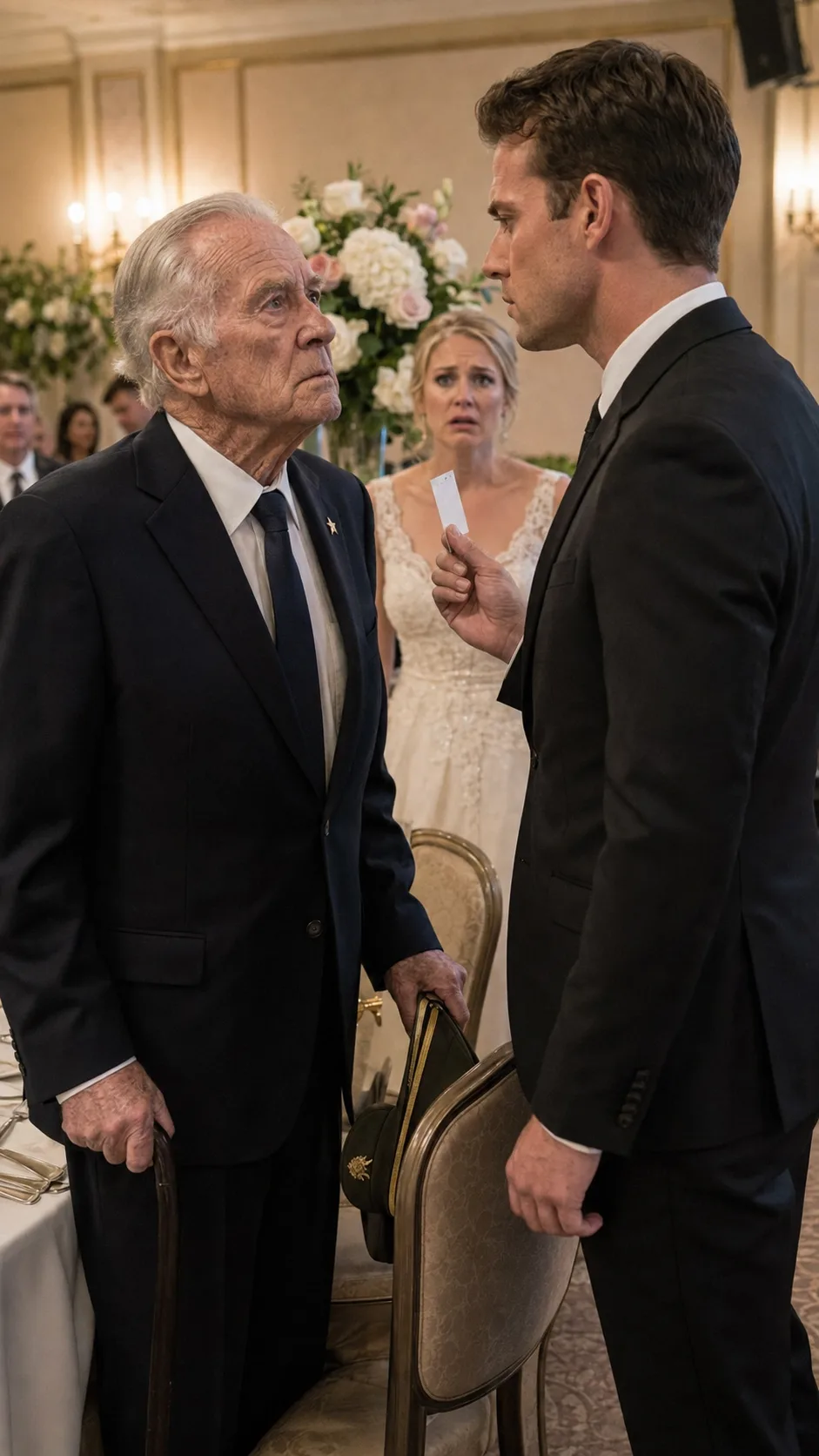
The banquet was at the Rialto Hotel in downtown Topeka, a restored building with marble floors, brass elevator doors, and a ballroom where the chandeliers had more confidence than some of the guests.
I wore my dark suit.
The same one I wore to Ruth’s funeral, though I had changed the tie.
My service cap was folded in my hand because Commander Ellis from the VFW had asked me to bring it.
He had been mysterious about why.
“Just bring it, Bob,” he said.
“Are you planning something?”
“Old soldiers don’t plan. We coordinate.”
“Ray, that is planning.”
“Bring the cap.”
So I did.
I wore the bronze star pin on my lapel because Emily had once asked me to wear it at her wedding someday.
She had been thirteen then, sitting on the hallway floor with Ruth, looking through photo albums.
“Grandpa, if I ever get married, will you wear this?”
“Why?”
“So everyone knows.”
“Knows what?”
“That you’re brave.”
Ruth had cried.
I had pretended not to notice.
Years later, standing in the hotel lobby with the pin on my lapel and my granddaughter pretending not to see me clearly, I wondered if children should be allowed to make promises to people they will later become embarrassed by.
The ballroom smelled of flowers, steak, expensive candles, and whiskey.
Tyler’s friends stood near the bar, laughing too loudly.
His parents were by the stage. His father, Grant Drake, wore a navy suit and a smile that belonged on a billboard. His mother, Celeste, touched Emily’s arm every few minutes as if guiding her through a room she was still learning to own.
Emily looked beautiful.
Cream dress.
Small bouquet.
Hair pinned softly.
A little tired around the eyes.
I wanted Ruth there so badly I could feel my ribs ache.
Near the front, a table held a sign:
Reserved Special Guests.
My name card was there.
Colonel Robert Whitaker.
The word Colonel made me uncomfortable.
I do not use it much anymore.
At the VFW, sometimes.
At the doctor’s office, never.
At family events, it felt like wearing boots in church.
Still, the card was there.
Click the blue “PART 3” below to read the next part:
Chapter complete
You have reached the end of this chapter.
Continue reading
A few more worlds to get lost in after this chapter.




