THE WOMAN HE FIRED AT THE ALTAR
Opening Hook: He Didn’t Say “I Do” — He Said “You’re Fired”
The wedding cost twelve million dollars.
Chapter 1
The wedding cost twelve million dollars.
The betrayal cost more.
By noon, every white rose in Newport had been bought, arranged, chilled, flown, or bribed into blooming for Caleb Whitmore’s wedding.
The ceremony was set on the cliff lawn of the Whitmore estate, where the Atlantic crashed below like an audience hungry for tragedy. Five hundred guests sat beneath silk canopies. Senators, CEOs, fashion editors, old-money widows, and men who had made fortunes destroying other men all waited for the wedding of the year.
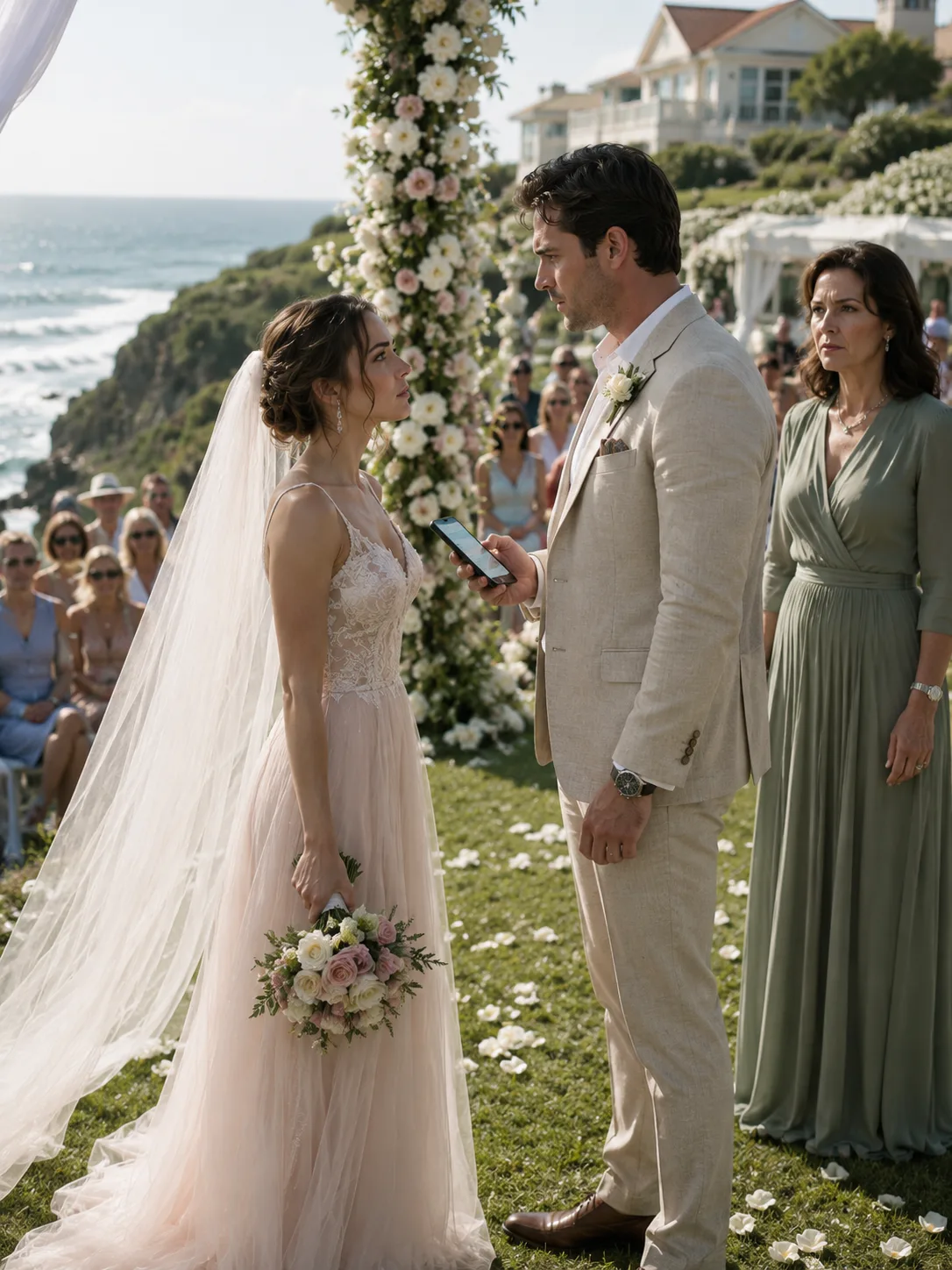
At the end of the aisle stood Caleb Whitmore.
Billionaire.
Hotel heir.
The coldest CEO in New England.
And the only man who had ever made Julia Ashford believe she could be loved without being useful.
Then his mother handed him a phone.
Caleb read the headline.
His face changed.
Not much.
But Julia saw it from the doorway.
She was in her wedding dress, veil falling down her back like mist,
bouquet in her hands, spine straight enough to look carved from marble.
The music had not started yet.
The guests had not risen.
But Caleb looked at her like the ceremony had already become a funeral.
He walked toward her.
Every bridesmaid stepped back.
His jaw was hard.
His eyes were not.
That was the cruelest part.
His eyes looked like he had just lost his entire life.
But his voice, when it came, was winter.
“Julia.”
She smiled faintly, confused.
“What happened?”
He held up the phone.
A news alert glowed on the screen.
WHITMORE FAMILY TRUST EXPOSED: SECRET ACQUISITION FILES REVEAL HOSTILE TAKEOVER SCANDAL
Julia stared at it.
Then at him.
“I don’t understand.”
Caleb’s mouth tightened.
“The files came from my private archive.”
Her face went pale.
“That’s impossible.”
“Only three people had access.”
“Caleb—”
“My mother. Me.” His voice dropped. “And you.”
The lawn went quiet
around them.
Somehow, even the ocean seemed to pause.
Julia’s fingers tightened around the bouquet.
“You think I leaked this?”
“I don’t think,” he said. “I know what the access logs say.”
Her eyes sharpened.
“The access logs?”
“Yes.”
“Since when do you trust logs more than me?”
That hit him.
She saw it.
For one second, Caleb Whitmore almost broke.
Then his mother, Eleanor Whitmore, stepped behind him in pale blue silk and said softly, “Caleb, the guests are waiting.”
Julia looked at Eleanor.
Eleanor’s face was arranged in sorrow.
Perfect sorrow.
Practiced sorrow.
Julia understood then that something had already been decided without her.
Caleb turned back to Julia.
His voice was controlled.
Too controlled.
“This wedding is canceled.”
A gasp moved through the bridal party.
Julia did not cry.
She did not collapse.
She did not beg.
She stood in her wedding dress beneath the bright Newport
sun and looked at the man who had promised her a life.
“Say it clearly,” she said.
His eyes flashed with pain.
“Don’t do this.”
“No. If you’re going to destroy me in front of everyone, have the courage to use complete sentences.”
Caleb swallowed.
Then said:
“Julia Ashford, you are no longer my fiancée.”
Her face did not move.
“And?”
His hand curled into a fist at his side.
“You are terminated from all advisory roles within Whitmore Holdings, effective immediately.”
Behind them, someone whispered, “Oh my God.”
Julia almost laughed.
Not because it was funny.
Because if she didn’t laugh, something in her chest might tear open.
“You fired me at the altar?”
Caleb’s voice broke for half a breath.
Then froze again.
“Yes.”
Julia stepped closer.
Close enough that only he could hear her next words.
“I loved you when you were not watching.”
He flinched.
“I trusted you when it cost me nothing. That was easy.”
Her eyes shone, but no tears fell.
“Today, it would have cost you everything. So now I know what your trust was worth.”
Caleb looked like she had struck him.
Eleanor said softly, “Julia, please don’t make this uglier.”
Julia turned.
The entire bridal room held its breath.
Then she smiled at Eleanor Whitmore.
It was not a bride’s smile.
It was a blade.
“Oh, Eleanor,” she said. “I haven’t even started.”
Julia Ashford had never belonged in rooms like the Whitmore estate.
That was what people said.
Not directly, of course.
Old money rarely insulted directly when implication could do the work.
They said she was “refreshing.”
They said she had “unusual restraint.”
They said Caleb had always liked “women with grit,” which was what wealthy women called poverty when they wanted to sound generous.
Julia heard everything.
She had spent her life listening from corners.
Her mother, Elise, worked as a seamstress for luxury hotels. Her father died before Julia was old enough to remember him clearly. She grew up in rented apartments, back rooms, and staff entrances. By twelve, she could hem silk without leaving a mark. By sixteen, she could identify a designer gown by the stitching inside the sleeve. By twenty-two, she had learned that rich people said “family legacy” when they meant “theft with portraits.”
She met Caleb Whitmore at a hotel reopening in Boston.
Not as a guest.
As a crisis consultant.
Julia had built a quiet career advising heritage brands on archival authenticity, lost provenance, and reputational risk. She was hired by Whitmore Holdings after a restoration scandal threatened one of its historic hotels.
The first time she saw Caleb, he was standing in the ballroom under a chandelier, surrounded by lawyers.
Everyone spoke at once.
Caleb did not.
He listened.
That was what made Julia notice him.
Most powerful men performed listening while waiting to interrupt. Caleb absorbed information like he planned to use every word as evidence.
A lawyer pointed at Julia.
“She’s the provenance consultant.”
Caleb turned.
“Julia Ashford?”
“Yes.”
“You found the missing ownership trail?”
“I found the part your archivists hoped was missing.”
The lawyers went silent.
Caleb’s mouth almost moved.
“Should I be worried?”
“Yes.”
“Good. I prefer honesty before lunch.”
She handed him the file.
“You may lose the hotel’s centennial claim.”
His general counsel groaned.
Caleb ignored him.
“Why?”
“Because the hotel was not founded in 1898. It absorbed a Black-owned inn in 1911, erased the name, and backdated its own legend.”
The room went still.
A board member said, “That’s historically complicated.”
Julia looked at him.
“No. It’s historically inconvenient.”
Caleb studied her.
Then he turned to the lawyers.
“Correct the claim.”
The room erupted.
His counsel said, “Caleb, the marketing—”
“The marketing can survive accuracy.”
The board member objected.
“The centennial campaign is already printed.”
“Print again.”
Julia looked at Caleb then.
Really looked.
A man born into money, choosing discomfort over polish.
That was dangerous.
Hope always was.
After the meeting, Caleb found her in the empty ballroom.
“You enjoyed that,” he said.
“Which part?”
“Watching twelve lawyers lose blood pressure.”
“Yes.”
He smiled.
It changed his face completely.
Julia wished it hadn’t.
He asked her to stay on as an independent advisor. Then as archive consultant. Then as special counsel for legacy acquisitions.
Their working relationship became a private language.
She told him when his family history lied.
He told her when investors were hiding poison behind politeness.
She challenged him in meetings.
He backed her when the room turned cold.
One night, after a sixteen-hour review of a hotel acquisition, she found him barefoot in the Newport estate kitchen eating cereal from a mixing bowl.
“You own twelve hotels,” she said.
He looked up.
“Your point?”
“You can order food.”
“I did. It arrived with garnish.”
“And?”
“I wanted cereal.”
She sat across from him.
“You’re strange when unsupervised.”
“You’re the only person who notices.”
That was the beginning of something softer.
Not immediately love.
First curiosity.
Then trust.
Then late dinners.
Then texts at midnight about archives, hostile takeovers, bad coffee, and whether ghosts preferred wallpaper or chandeliers.
Caleb was difficult.
Cold in public.
Careful in private.
He had been raised by Eleanor Whitmore, a woman who treated emotion as a security breach. His father had died young. His mother took control of the company, the family, and eventually Caleb’s inner weather.
“She taught me never to react in a room,” Caleb once said.
Julia asked, “And outside a room?”
He looked at her.
“I don’t know. I’ve never found one.”
She loved him before either of them said it.
He loved her like a man discovering a language he had not been allowed to learn.
When he proposed, it was not at a gala or on a yacht or in front of cameras.
It was in the archive room of the oldest Whitmore hotel, between dust-covered ledgers and fireproof cabinets.
Julia had been reading a century-old property file when Caleb placed a ring box on top of the page.
She looked at it.
“Is this a hostile acquisition?”
“Merger proposal.”
“Terms?”
“Lifetime partnership. Equal voting rights. Full emotional disclosure, subject to reasonable delay during board meetings.”
She tried not to smile.
“Any hidden liabilities?”
“Several. Mostly maternal.”
“Expected.”
He opened the box.
The ring was not huge.
That surprised her.
A simple old sapphire with two small diamonds.
“It belonged to my grandmother,” he said. “The only Whitmore woman my mother never managed to frighten.”
Julia looked at him.
“Caleb.”
“I know my world is cruel. I know my family is worse. I know people will say you are marrying up.”
His voice softened.
“But I have spent my life above everyone, Julia. It is cold there.”
Her eyes filled.
“I don’t want to be rescued by you.”
“I know.”
“I don’t want to become a Whitmore ornament.”
“I would rather burn the house down.”
“That’s dramatic.”
“I’m improving.”
She laughed.
Then she said yes.
For a while, they almost believed love could survive inheritance.
Eleanor Whitmore hated Julia from the beginning.
Not loudly.
That would have been vulgar.
Eleanor’s hatred wore pearls, thanked the staff, and asked questions that sounded like concern.
“Julia, where did your mother work again?”
“Julia, did you always want to study archives, or was that a practical choice?”
“Julia, do you find Newport overwhelming?”
“Julia, how brave to choose a dress so simple.”
Caleb heard some of it.
Not all.
Julia did not tell him everything.
Partly pride.
Partly strategy.
Mostly because she wanted him to choose without being managed by her pain.
That may have been her first mistake.
Eleanor controlled the wedding like a military campaign disguised as flowers.
Newport estate.
Five hundred guests.
European florists.
Private security.
A cathedral-length veil Julia did not ask for.
A seating chart that placed half the guests according to net worth and the other half according to threat level.
At one planning meeting, Eleanor slid a list across the table.
“These are the approved press angles.”
Julia read.
“Approved bride profile?”
“Yes.”
“This says I was raised by ‘a modest but cultured family.’”
Eleanor smiled.
“It sounds better than rented apartments.”
Caleb looked up sharply.
“Mother.”
Julia touched his wrist under the table.
Not because Eleanor deserved mercy.
Because Julia wanted to answer herself.
She placed the paper back.
“Write the truth.”
Eleanor’s smile thinned.
“The truth is often poorly dressed.”
“Then I’ll wear it.”
Caleb looked at her.
The admiration in his eyes almost made the room warmer.
Eleanor noticed.
Her fingers tapped once against the table.
That was when Julia understood: Eleanor was not merely worried that Julia wanted Caleb’s money.
She was worried Caleb wanted Julia’s truth.
A month before the wedding, Julia found an anomaly in the Whitmore archive.
A file labeled Ashford Meridian Acquisition — Restricted Historical Reference.
Ashford.
Her name.
She opened it because her job required suspicion.
Inside were old corporate documents from forty years earlier, connected to a company called Ashford Meridian Group, once a major hotel and landholding corporation before it collapsed under debt and was absorbed by Whitmore Holdings.
Julia knew little about her father’s family.
Her mother rarely spoke of them.
“Elise Ashford married down and vanished,” one aunt had once said with bitterness. “Or maybe she escaped. Depends who tells the story.”
The file showed something else.
Ashford Meridian had not simply collapsed.
It had been cornered.
Loans called early.
Regulatory complaints triggered.
Board members pressured.
A family trust challenged.
Then Whitmore Holdings acquired majority assets for almost nothing.
Julia read until dawn.
One document made her stop breathing.
A missing heir clause.
The Ashford family trust had named a direct descendant, born to Thomas Ashford and Elise Marlowe Ashford, as lawful claimant if ownership transfers were proven fraudulent.
Julia’s parents.
Her.
She took the file to Caleb.
He read it in silence.
Line by line.
When he finished, his face looked carved.
“Did you know?”
“No.”
“You’re sure?”
Julia stared at him.
“Ask me that again and we won’t make it to the wedding.”
He closed his eyes.
“I’m sorry.”
“Good.”
He stood and paced.
“My grandfather led this acquisition.”
“Yes.”
“My family may have stolen your family’s company.”
“Not may.”
He looked at her.
She did not soften it.
His voice dropped.
“What do you want to do?”
That question saved something in her.
Not What will this cost me?
Not Can we hide it?
What do you want to do?
Julia sat down slowly.
“I want proof.”
“We’ll get it.”
“We?”
His gaze held hers.
“Yes.”
“Even if it damages Whitmore?”
“Especially then.”
She wanted to believe him.
She did believe him.
That was why what happened next hurt so deeply.
They began quietly gathering records.
Caleb gave her access to the private archive.
He contacted outside counsel.
They planned to file an internal board disclosure after the wedding, before any public announcement. Julia insisted on waiting until the documents were complete.
“We do this clean,” she said.
Caleb nodded.
“No one will say you married me to get leverage.”
“They’ll say it anyway.”
“Then they’ll be wrong with less evidence.”
He smiled faintly.
Then, two days before the wedding, the leak happened.
Not the full file.
A curated version.
Whitmore family trust documents.
Hostile acquisition notes.
Enough to create scandal.
Not enough to prove Julia’s claim.
And every digital trace pointed to her login.
On the morning of the wedding, Julia knew something was wrong before she saw Caleb’s face.
The house had changed temperature.
Staff moved too quietly.
Bridesmaids whispered, then stopped when she entered.
Her phone had been taken for “ceremony privacy.”
Eleanor came to the bridal suite at eleven, wearing pale blue silk and the expression of a woman attending an execution she had arranged.
“You look beautiful,” Eleanor said.
Julia looked at her reflection.
The dress was extraordinary.
Ivory satin.
Long sleeves.
A structured bodice.
No glitter.
No lace.
No softness pretending weakness.
“Thank you.”
Eleanor stepped behind her.
“For what it’s worth, I believe Caleb loved you.”
Julia turned.
“Loved?”
Eleanor’s eyes met hers in the mirror.
“Love is often insufficient when weighed against betrayal.”
Julia went still.
“What did you do?”
Eleanor smiled sadly.
“Still so direct.”
The door opened before Julia could answer.
A wedding planner announced it was time.
Julia walked down the corridor holding her bouquet, every instinct screaming.
Then she saw Caleb.
The phone in his hand.
The headline.
His mother beside him.
The guests waiting beyond the doors.
And the man she loved preparing to become what he had always feared.
A Whitmore first.
A man second.
When he accused her, Julia felt something inside her go silent.
Not die.
Clarify.
The strange thing about betrayal is that it does not always feel like fire.
Sometimes it feels like a room finally turning on the lights.
She watched Caleb choose evidence arranged by someone else over the woman standing in front of him.
She watched him hurt himself to hurt her.
She watched him look at her like he wanted to fall apart and then force himself into cruelty because that was the only strength his family had ever taught him.
He canceled the wedding.
He fired her.
At the altar.
The phrase would become famous by dinner.
But in that moment, it was only pain wearing legal language.
Julia faced the doors to the lawn.
The guests had risen now.
They had heard enough to understand scandal had arrived early.
She could have run.
She could have screamed.
She could have thrown the bouquet at his head.
Instead, she stepped into the ceremony space.
Gasps moved through the crowd.
Caleb said her name behind her.
She did not stop.
She walked halfway down the aisle alone, in full wedding dress, without music.
Then she turned to face the guests.
Her voice carried.
“Ladies and gentlemen, the wedding is canceled.”
A wave of shock.
Phones lifted.
Security shifted.
Eleanor’s face tightened.
Julia continued.
“I have been accused by Caleb Whitmore of leaking confidential family files to the press. Since many of you came here for a wedding and have instead been given theater, allow me to at least make the performance accurate.”
Caleb stepped into the aisle.
“Julia.”
She turned toward him.
“No. You made this public when you fired me in silk.”
A few guests inhaled sharply.
Julia looked back at the crowd.
“I did not leak those files.”
Eleanor said, “Julia, this is not the time.”
Julia smiled.
“You keep saying that, Eleanor. I suspect because timing is the only weapon you still trust.”
Eleanor went still.
Caleb looked between them.
Something moved in his face.
Doubt.
Finally.
Too late.
Julia lifted her bouquet slightly.
“I will not plead my innocence at my own wedding. I will not cry for the benefit of people who came dressed for romance and found blood more interesting. And I will not explain loyalty to a man who just proved he requires logs before trust.”
She looked at Caleb then.
His eyes were wet.
He did not let the tears fall.
She hated him for that too.
For turning even grief into discipline.
Julia removed the sapphire ring from her finger.
The crowd went silent.
She walked back down the aisle and stopped before him.
For one second, they were close enough to remember.
Archive dust.
Cereal in the kitchen.
The proposal.
His hand shaking when she said yes.
Then she placed the ring in his palm.
“Keep your family’s jewelry,” she said softly. “I’m done wearing history I haven’t verified.”
He flinched.
She walked past him.
Not fast.
Not broken.
Straight-backed.
Veil trailing behind her like smoke.
The ocean roared below.
And Caleb Whitmore stood at the altar holding the ring of the woman he had lost by obeying the wrong truth.
Caleb did not remember leaving the lawn.
One moment Julia was walking away.
The next, he was in his father’s old study with the door locked, the sapphire ring in his fist, and his mother speaking through the wood.
“Caleb. Open the door.”
He did not.
The news was already spreading.
NEWPORT WEDDING COLLAPSES AFTER BRIDE ACCUSED OF LEAKING FAMILY SECRETS
CALEB WHITMORE FIRES FIANCÉE AT ALTAR
JULIA ASHFORD WALKS OUT WITHOUT TEARS
Without tears.
Everyone seemed obsessed with that.
As if tears would have made her innocence easier to measure.
Caleb opened the access log again.
Julia’s credentials.
2:17 a.m.
Private archive entry.
File export.
Press transfer.
Clear.
Too clear.
Julia would have said that.
Too clear means staged.
His mind supplied her voice before he could stop it.
He heard himself telling her, Only three people had access.
He heard her answer, Since when do you trust logs more than me?
He stood abruptly and went to the archive wing.
His security chief tried to stop him.
Caleb looked at him once.
The man stepped aside.
The archive was below the east wing, climate-controlled and guarded by systems Caleb had paid millions to install.
He pulled the raw access data.
Not the summary.
The source logs.
The first irregularity appeared within ten minutes.
Julia’s credentials were used remotely, but her access key had registered physically inside her bridal suite safe at the same time.
Impossible.
Unless cloned.
He kept digging.
At 2:16 a.m., an administrative override disabled secondary authentication for ninety seconds.
The override came from Eleanor Whitmore’s private account.
Caleb stared at the screen.
No.
His first thought was not logical.
It was a child’s refusal.
No.
Not his mother.
Not this.
Then he saw the export path.
The leak had not gone directly to the press.
It passed through an old family media trust.
Controlled by Eleanor.
The room seemed to narrow.
Caleb’s phone rang.
Eleanor.
He answered.
“Tell me I’m reading this wrong.”
Silence.
Then his mother said, “Come upstairs.”
“No.”
“Caleb.”
“Did you frame her?”
A pause.
Too long.
That pause killed the last obedient part of him.
Eleanor sighed.
“She was never going to be simply your wife.”
“What does that mean?”
“It means Julia Ashford is not who she thinks she is.”
Caleb closed his eyes.
“You knew.”
“Of course I knew.”
“When?”
“Before you proposed.”
His hand tightened around the phone.
“You knew she was the Ashford heir.”
“I knew she was dangerous.”
“She didn’t know.”
“That made her more dangerous. Innocence is persuasive.”
Caleb laughed once.
It did not sound human.
“You leaked our family scandal to stop my wedding?”
“I controlled the damage.”
“You blamed her.”
“I saved you.”
He looked at the screen.
At the forged access.
At the export.
At the arranged betrayal.
“No,” he said. “You saved the theft.”
Eleanor’s voice sharpened.
“Do not be naïve. The Ashford claim could tear Whitmore Holdings apart. The wedding would have given her sympathy, access, legitimacy. You were about to marry the one person who could walk into court and take half our empire with a clean face and a tragic story.”
“She is the rightful heir.”
“She is a seamstress’s daughter with a useful bloodline.”
Caleb went still.
There it was.
The contempt beneath every polished smile.
His voice dropped.
“Do not speak about her like that.”
Eleanor exhaled.
“Oh, Caleb. Even now?”
“Especially now.”
“You think love is nobler because it has been wounded. It isn’t. She will use this.”
“She wanted proof before filing anything.”
“Because she is clever.”
“Because she is honest.”
“Honesty,” Eleanor said, “is what people without assets call strategy.”
Caleb looked at the sapphire ring in his palm.
The ring he had given Julia in the archive.
The ring she returned because his family’s history could no longer touch her skin.
For the first time, he understood something Julia had tried to teach him.
Inheritance is not memory.
It is responsibility for what memory reveals.
“I’m going to correct this,” he said.
Eleanor’s voice turned cold.
“If you do, you will destroy your father’s company.”
Caleb looked around the archive.
At the files.
At the acquisitions.
At the portraits stored as objects.
At the empire built from beautiful rooms and ugly signatures.
“No,” he said.
“I’m going to return what was never ours.”
Julia did not go home.
There were cameras outside her apartment by sunset.
Reporters at the front entrance.
Photographers at the side street.
A news van near the bakery where her mother worked.
So Julia went to the only place no guest at the wedding would think to look for a runaway bride.
The kitchen of a Whitmore hotel.
Not the Newport estate.
The old Boston property where she and Caleb first met.
The night staff knew her.
Not as a scandal.
As the woman who had once sat with the dishwashers at midnight and helped translate a lease notice for a busboy’s mother.
The sous-chef, Marco, opened the service entrance.
He saw the wedding dress.
Then her face.
He said nothing.
He simply stepped aside.
Julia sat in the staff break room with a black coffee and a towel around her shoulders while two pastry assistants pretended not to cry.
Her veil hung over a chair.
Her bouquet lay in the sink.
A dishwasher named Ana looked at the dress and said, “Do you want scissors?”
Julia almost smiled.
“Not yet.”
At 10:40 p.m., Caleb arrived.
Marco blocked him at the kitchen door with a carving knife held casually enough to be terrifying.
“Mr. Whitmore.”
Caleb looked past him.
“Is she here?”
“No.”
Julia, from inside the break room, said, “That was unconvincing, Marco.”
Marco sighed.
“I tried.”
Caleb did not push past him.
That mattered.
Julia hated that it mattered.
She stepped into the kitchen.
She had changed into a hotel staff sweatshirt someone found for her, but the wedding skirt still remained beneath it, absurd and ghostly.
Caleb looked at her like he had been punched.
“Julia.”
“No.”
He stopped.
Good.
She looked at Marco.
“It’s okay.”
Marco hesitated.
Then moved aside, but not far.
Caleb entered the kitchen.
Not the CEO now.
Not the groom.
Just a man standing under fluorescent lights, holding ruin in both hands.
“I know,” he said.
Julia’s expression did not change.
“Know what?”
“My mother leaked the files.”
The kitchen went silent.
Caleb continued.
“She cloned your credentials. She used the media trust. She knew about your claim before we did.”
Julia’s face went pale.
Not with shock.
With confirmation.
“Why?”
He swallowed.
“Because you are the legal Ashford heir. Because my family stole Ashford Meridian. Because marrying me would have given you access and credibility. Because she thought destroying you publicly would make any future claim look like revenge.”
Julia closed her eyes.
For a moment, she swayed.
Ana stepped forward.
Julia raised a hand.
“I’m fine.”
Caleb’s face twisted.
“No, you’re not.”
Her eyes opened.
“You lost the right to say that to me.”
He bowed his head.
“Yes.”
She watched him accept the wound instead of defending against it.
That made this harder.
“You believed her,” Julia said.
“I believed the logs.”
“You believed a system your family controlled.”
“Yes.”
“You believed I would sell your secrets on our wedding day.”
His voice broke.
“Yes.”
She stepped closer.
“Why?”
He could have said panic.
Shock.
Evidence.
Family pressure.
Instead, he said the only answer that mattered.
“Because I was raised to trust betrayal more than love.”
The kitchen was very quiet.
Julia looked away first.
Not because she forgave him.
Because she understood too much.
Caleb reached into his coat and pulled out a folder.
“I brought the proof.”
She did not take it.
“Give it to my lawyer.”
“Yes.”
“And the press.”
“Yes.”
“And the board.”
“Yes.”
“You don’t get to bring me evidence like roses and expect me to soften.”
“I know.”
“Do you?”
He looked at her.
“I did not come to ask you back.”
That stopped her.
He continued.
“I don’t deserve that question. Not tonight. Maybe not ever.”
Her eyes stung.
He looked down.
“I came to tell you I will return the Ashford shares.”
Julia stared at him.
“What?”
“The stolen equity. The holdings that can be traced. The voting bloc still controlled by Whitmore. I will transfer them to you publicly.”
Her voice became cold.
“Publicly?”
“Yes.”
“Because shame requires lighting?”
“Because you were destroyed in front of everyone. The correction should not be private.”
The words landed deep.
Painfully deep.
Julia hated that he had learned the shape of justice so late.
“How much?” she asked.
“Enough to make you controlling shareholder of the revived Ashford Meridian trust.”
The kitchen reacted before Julia did.
Ana gasped.
Marco muttered something in Italian that sounded violent.
Julia remained still.
“And what happens to you?”
Caleb smiled faintly.
No happiness in it.
“The board may remove me. My mother will try. The guests will enjoy dessert with litigation.”
“Caleb.”
He looked at her.
She had not meant to say his name like that.
Softly.
Wounded.
He heard it.
Did not move toward her.
Good.
“I am not doing this to win you back,” he said. “I need you to know that.”
Her voice was barely above a whisper.
“Then why?”
“Because you were right. I wore history I had not verified.”
He held out the folder.
Not to her.
To Marco.
“Her lawyer,” Caleb said. “Not her hands tonight.”
Marco took it.
Julia looked at Caleb for a long time.
Then she said, “You should go.”
He nodded.
At the door, he stopped.
“Julia.”
She closed her eyes.
“Yes?”
“I looked at you today like you were my enemy because I was too weak to look at my mother.”
Her throat tightened.
“That is almost an apology.”
“No,” he said softly. “It’s evidence.”
Then he left.
The guests were still at the estate when Caleb returned.
Of course they were.
Nothing holds old money in place like a scandal with catering.
The ceremony lawn had been cleared, but the reception tent glowed with candles and crystal. Champagne continued to flow. Musicians played softly, because apparently even disaster required ambience.
Eleanor stood near the head table, surrounded by allies.
When Caleb entered, conversations dimmed.
Five hundred people turned toward him.
He walked to the stage.
The same stage where he had planned to toast his bride.
His mother intercepted him halfway.
“What are you doing?”
“What you should have done forty years ago.”
Her face hardened.
“If you think guilt makes you righteous—”
“No. It makes me late.”
He stepped past her.
Eleanor grabbed his arm.
“Caleb, I am warning you.”
He looked down at her hand.
The entire room seemed to watch the gesture.
“Let go.”
She did.
He climbed onto the stage and took the microphone.
The band stopped playing.
A dozen phones lifted.
Caleb looked at the guests.
Every face seemed hungry.
He thought of Julia standing in her wedding dress, asking him to use complete sentences.
So he did.
“Earlier today, I canceled my wedding to Julia Ashford because I accused her of leaking Whitmore family documents to the press.”
A murmur moved through the tent.
Caleb continued.
“I was wrong.”
Silence.
“I had evidence. That evidence was manufactured. The leak was orchestrated by my mother, Eleanor Whitmore, using cloned credentials and a family-controlled media trust.”
The room exploded.
Eleanor’s face went white.
A senator whispered, “Jesus.”
Caleb raised his voice.
“She did this to prevent my marriage because Julia Ashford is the legal heir of Ashford Meridian Group, a company my family wrongfully acquired decades ago through coercive financial tactics, suppressed trust documents, and fraudulent control transfers.”
The guests were no longer whispering.
They were witnessing.
Good.
Caleb looked toward his mother.
“She did not protect me from betrayal. She taught me to commit it.”
Eleanor stepped forward, trembling with rage.
“Caleb, stop.”
He looked back at the crowd.
“I will not ask Julia Ashford to return to this wedding. I will not ask her forgiveness in front of people who watched me humiliate her. I will not turn correction into theater of romance.”
His voice shook.
He let it.
“I will only do what should have been done before I was born.”
He signaled to his general counsel, who had arrived from Boston looking like a man dragged into a hurricane.
The counsel handed him a document.
Caleb held it up.
“These are executed transfer documents assigning the traceable Ashford Meridian equity block currently held by Whitmore Holdings into the restored Ashford Meridian Trust, with Julia Ashford named as lawful beneficiary and controlling shareholder, subject to court confirmation and independent audit.”
A woman in the front row gasped.
His uncle stood.
“You have no authority to unilaterally—”
Caleb cut him off.
“I have emergency authority over disputed legacy assets under the Whitmore Restitution Clause approved by this board in 2016 to avoid federal review after the Marlowe Hotel scandal.”
The uncle sat down.
Julia would have loved that.
The thought nearly broke him.
Caleb looked at the crowd again.
“These shares are not a gift. They are not settlement bait. They are not a groom’s apology wrapped in equity. They are stolen property being returned to its legal heir.”
His mother’s face crumpled for one second.
Then hardened into something colder than grief.
“You would choose her over your family?”
Caleb looked at her.
“No,” he said.
“I am choosing truth over inheritance.”
Then he signed the final page.
Not as a proposal.
Not as a performance of love.
As restitution.
The pen scratched across the page.
The sound was small.
The consequences were not.
When he finished, he placed the signed documents on the table where the wedding cake should have been.
Then he removed the sapphire ring from his pocket.
For a moment, everyone seemed to think he would make a speech about love.
He did not.
He placed the ring beside the documents.
“My family’s jewelry belongs to my family,” he said.
Then, after a pause:
“Her company belongs to her.”
Julia watched the speech from the hotel kitchen.
Marco had found a livestream.
Ana cried openly.
The dishwasher staff gathered around a propped-up phone beside a tray of cooling bread.
When Caleb said, These shares are not a gift, Julia covered her mouth.
When he signed, she sat down.
When he placed the ring beside the documents, she finally cried.
Quietly.
Angrily.
Not because she forgave him.
Because a piece of history had shifted.
Because her father’s name, her mother’s silence, her family’s lost company, her own strange life of not belonging — all of it suddenly had a legal shape.
And because Caleb had learned, too late, not to make love the price of justice.
Ana put a hand on her shoulder.
“Do you want to go to him?”
Julia wiped her face.
“No.”
“Are you sure?”
“No.”
That made Ana smile sadly.
“But I’m not going.”
And she didn’t.
Not that night.
Not the next morning.
Not when reporters asked for statements.
Not when Caleb resigned temporarily from Whitmore Holdings pending investigation.
Not when Eleanor Whitmore released a statement calling her son “emotionally compromised.”
Julia’s lawyer released one clean sentence:
Ms. Ashford will allow the documents to speak before she does.
Privately, Julia got to work.
She met auditors.
Trust attorneys.
Corporate historians.
Forensic accountants.
She sat in rooms where men underestimated her until she opened her mouth.
She learned the full scale of what the Whitmores had taken.
Hotels.
Land.
Brands.
Licensing rights.
Family trusts.
Archives.
Names.
So many names.
Three weeks after the wedding, Caleb requested one meeting.
Through her lawyer.
Good.
Julia agreed.
Not at the estate.
Not at a Whitmore hotel.
At a public garden overlooking the harbor, where no one owned the horizon.
Caleb arrived alone.
No suit jacket.
No tie.
He looked thinner.
Older.
Less certain.
Julia wore a gray coat and no jewelry.
He noticed.
Did not comment.
Smart.
They stood facing the water.
For a while, neither spoke.
Then Caleb said, “The court accepted the emergency transfer pending final review.”
“I know.”
“Of course you do.”
She almost smiled.
Almost.
He continued.
“The board removed my mother from all governance committees.”
“Good.”
“They’re deciding whether to remove me.”
“What do you want?”
He looked at the water.
“I don’t know.”
That was new.
Caleb Whitmore had always known, or performed knowing well enough to fool rooms.
Now the uncertainty sat bare between them.
Julia said, “Good.”
He looked at her.
She shrugged.
“Certainty failed you.”
His face twisted.
“Yes.”
He took a breath.
“I am sorry.”
She did not answer.
He continued.
“I am sorry for believing you betrayed me. I am sorry for humiliating you. I am sorry for firing you in the language of corporate cowardice when I should have been asking questions.”
Her eyes stayed on the water.
“I am sorry I made you stand alone in a dress I asked you to wear.”
That one hurt.
She closed her eyes briefly.
He went on.
“I am sorry that the first time I publicly chose truth over my mother was after I had already used her lie to wound you.”
Julia opened her eyes.
“That is the first complete apology.”
His breath caught.
“Not forgiveness,” she added.
“I know.”
“Not an invitation.”
“I know.”
“Not hope.”
He looked at her.
This time, she did not soften it.
“I know,” he said.
They stood in silence.
Then Julia asked, “Did you love me?”
He looked wounded.
“Yes.”
“Then why was it so easy to doubt me?”
He answered slowly.
“Because loving you was mine. Doubting you was inherited.”
That sentence stayed with her longer than she wanted.
She nodded once.
“You should fix that before you love anyone again.”
He looked down.
“Yes.”
She turned to leave.
Caleb did not stop her.
That mattered too.
At the path, she paused.
“Caleb.”
He looked up.
“Thank you for returning the shares.”
His expression broke.
“You should never have had to thank me for that.”
“I know.”
Then she walked away.
One year later, Ashford Meridian reopened its headquarters in Boston.
Not in a glass tower.
Not in a stolen hotel.
In a restored brick building that had once belonged to Julia’s great-grandfather before Whitmore Holdings absorbed it into a shell company and forgot the plaque in the basement.
Julia had the plaque cleaned but not replaced.
It still showed scratches.
She liked that.
The company did not return as a vanity project.
It returned as a historical trust, hospitality group, and restitution-focused investment firm dedicated to recovering erased ownership histories in legacy hotels and land assets.
The press loved calling Julia “the bride who got the company.”
She hated that.
“I didn’t get it,” she told one interviewer. “It was returned.”
They asked about Caleb constantly.
She answered rarely.
Caleb, to his credit, never commented on her.
He spent the year dismantling Eleanor’s control structures, testifying in civil hearings, and converting several Whitmore-held disputed properties into independently governed restitution trusts.
The board did not fully remove him.
Not because they forgave him.
Because he knew where too many bodies were buried.
Julia respected that.
Reluctantly.
Their paths crossed at legal proceedings and industry events.
At first, they spoke through attorneys.
Then directly.
Then, eventually, carefully.
The chemistry did not die.
That annoyed her.
It changed.
Became quieter.
Sharper.
Less innocent.
Once, during a hearing break, Caleb handed her a coffee exactly the way she liked it.
She stared at him.
“You remembered.”
“I remember many things too late.”
“That was almost charming. Don’t make it a habit.”
He smiled faintly.
“I’ll try to remain disappointing.”
“Better.”
Another time, she found him alone in an archive room after testifying about Eleanor’s forged records.
He was staring at an old photograph of his grandfather shaking hands with hers.
“You okay?” she asked before she could stop herself.
He looked up.
“No.”
“Good.”
He almost laughed.
“I deserved that.”
“You did.”
He looked back at the photograph.
“I grew up thinking this man built everything.”
Julia stood beside him.
“He built some things.”
“He stole others.”
“Yes.”
“How do you live with a name that carries both?”
She looked at him.
“You stop pretending inheritance is identity. Then you decide what your name does next.”
He absorbed that.
“You always make truth sound like labor.”
“It is.”
“Will it ever feel clean?”
“No.”
He nodded.
“Fair.”
The night of Ashford Meridian’s reopening, Julia gave a speech in the restored lobby.
Her mother sat in the front row, crying quietly.
Former employees’ descendants attended.
Historians.
Auditors.
Community leaders.
No Whitmore family members had been invited.
Except one.
Caleb stood at the back, by the door.
Julia had not placed him there.
He had chosen it.
Good.
She spoke of ownership, memory, theft, restoration, and the danger of calling silence peace.
She did not mention the wedding.
She did not mention Eleanor.
She did not mention Caleb.
But near the end, she said:
“Restitution is not romance. It is not generosity. It is not the beautiful guilt of powerful people. Restitution is the return of what should never have been taken, and it asks nothing in exchange except that truth remain named.”
Caleb lowered his head.
Afterward, he approached her only when the crowd thinned.
“Congratulations,” he said.
“Thank you.”
“You were extraordinary.”
“I know.”
He smiled.
The old smile.
The one from the archive.
It hurt less now.
Not because the wound was gone.
Because it had scarred honestly.
He handed her an envelope.
She did not take it.
“What is that?”
“Not shares. Not documents. Not apology.”
“Then?”
“A letter.”
She raised an eyebrow.
“Dangerous category.”
“I wrote it six months ago. Rewrote it badly several times. This is the least terrible version.”
“What does it say?”
“That I love you. That I am not asking you to return. That I am trying to become a man who would not have failed you at the altar.”
Julia’s chest tightened.
“Caleb.”
“You don’t have to read it.”
He placed it on the table beside her untouched champagne glass.
“Your choice.”
That mattered most.
Then he stepped back.
No dramatic exit.
No lingering plea.
No performance.
Julia watched him leave.
She did not open the letter that night.
But she did not throw it away.
People still remembered the Newport wedding.
They remembered the canceled vows.
The bride who did not cry.
The groom who fired her at the altar.
The mother who leaked a scandal to stop a marriage.
The shares signed over where cake should have been cut.
The story became legend because people love betrayal when it wears couture.
But Julia knew the truth was not as clean as the headlines.
Caleb had loved her and failed her.
Eleanor had protected theft and called it motherhood.
Julia had been humiliated and still walked out with her spine straight.
The company had been returned, but no document could return the version of herself who had walked toward the aisle believing love would choose her before evidence was convenient.
That woman was gone.
Julia did not mourn her every day.
Only sometimes.
Years passed.
Ashford Meridian grew.
Whitmore Holdings shrank, restructured, and survived without Eleanor, who spent her remaining public life insisting history had become “unfairly emotional.”
Caleb never fully regained his old power.
He gained something better.
A conscience with consequences.
He and Julia did not marry quickly.
That would have been too neat.
They rebuilt something without calling it repair at first.
Coffee after hearings.
Conversations in archives.
Arguments over restitution frameworks.
One long winter walk where Julia finally said, “I read the letter.”
Caleb stopped walking.
“And?”
“It was not terrible.”
His eyes closed briefly.
“That is the highest praise I’ve received all year.”
“You used one metaphor too many.”
“I suspected.”
“And you did not ask me to forgive you.”
“No.”
“Why?”
He looked at her.
“Because forgiveness that has to be requested in every room becomes another performance.”
She studied him.
“You’ve been learning.”
“Slowly.”
“Painfully?”
“Yes.”
“Good.”
He laughed softly.
Then grew serious.
“I still love you.”
“I know.”
“I still don’t expect anything from that.”
“I know.”
She looked out at the harbor.
Then said, “I still love you too.”
He did not move.
Did not reach for her.
Did not ruin the moment by trying to possess it.
Julia appreciated that.
Finally, she took his hand.
Not as the bride he abandoned.
Not as the heir he restored.
Not as the woman he had to spend his life repaying.
As herself.
Years after the wedding that never happened, they returned once to the Newport estate.
Not for a ceremony.
For an auction.
The Whitmore family was selling parts of the property to fund restitution settlements.
The cliff lawn was empty.
No silk canopy.
No white roses.
No guests waiting to watch a woman break.
Julia stood where the aisle had been.
Caleb stood beside her.
After a long silence, he said, “This is where I lost you.”
Julia looked at the ocean.
“No.”
He turned.
She met his eyes.
“This is where I learned not to lose myself.”
His face softened with pain and gratitude.
“Yes,” he said. “That’s more accurate.”
She smiled faintly.
“Always verify history.”
He laughed.
The Atlantic crashed below them, loud and indifferent.
Once, in that place, Caleb Whitmore had chosen a lie and called it duty.
Once, Julia Ashford had stood in a wedding dress and refused to collapse for an audience.
Once, a stolen company began its journey back to the hands history had tried to erase.
The altar was not where their love ended.
It was where the performance ended.
And only after the guests left, the shares returned, the lies named, and the inheritance stripped of its romance could anything true begin.
Caleb did not win Julia back by begging.
He did not rescue her.
He did not buy forgiveness with stock certificates.
He simply returned what was hers.
And in doing so, he finally became a man who understood that love without justice is just another beautiful theft.
Chapter complete
You have reached the end of this chapter.
Continue reading
A few more worlds to get lost in after this chapter.




