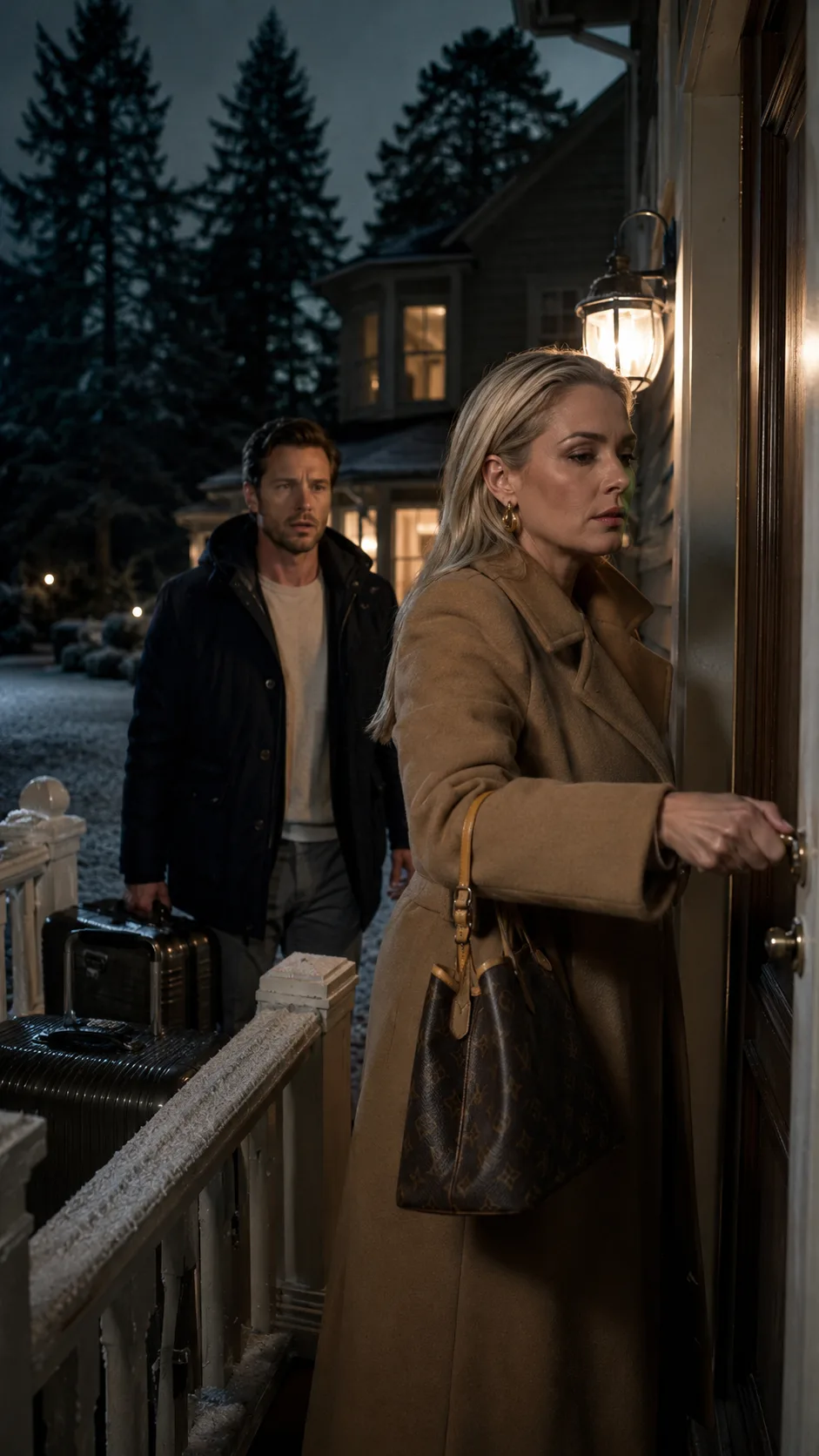
“Your house?” Brenda repeated.
Chapter 3
“Your house?” Brenda repeated.
The words came out sharp, but Clara heard the crack underneath them.
Julian heard it too.
He stepped forward, lowering his voice as if softness could undo four days of arrogance.
“Mom, just take the chain off. We’re tired. We can talk inside.”
“No,” Clara said.
One word.
No anger. No trembling. No apology.
That made Brenda angrier than shouting ever could have.
“You locked your own family out in winter,” Brenda snapped. “Do you realize how cruel that is?”
Clara looked at her daughter-in-law’s smooth resort makeup, the gold earrings, the expensive handbag hanging from her arm.
Then she looked at Julian, still holding luggage like a boy caught stealing cookies.
“Cruel,” Clara repeated. “Is that what we call it now?”
Julian’s eyes dropped.
Brenda folded her arms. “We needed a break. You are always around. Always watching. Always making us feel guilty.”
“I live here,” Clara said.
Brenda
scoffed. “So do we.”
Clara nodded once.
“For now.”
Silence fell hard.
Julian lifted his head. “What does that mean?”
“It means you may use the patio entrance tonight. The connecting door to your apartment is open from the outside. Everything you need to know is on your kitchen counter.”
“Mom—”
“Good night, Julian.”
Clara closed the door before either of them could answer.
The new deadbolt clicked.
For a moment, the house became perfectly still.
Then Brenda exploded.
Clara heard her outside, shouting about lawyers, police, insanity, and “elderly paranoia.” Julian’s voice murmured something weaker, something pleading. A minute later, their footsteps stormed around the side of the house toward the patio stairs.
Clara returned to the living room.
She did not turn the television back on.
She simply sat with her tea and listened.
Above her, the apartment door opened.
A suitcase fell.
Brenda’s heels crossed the floor
fast.
Then came the sound Clara had been waiting for.
Paper being snatched from a counter.
A long silence.
Then Brenda screamed.
“What is this?”
Clara smiled into her tea.
Julian’s voice came next, muffled but panicked.
“Brenda, lower your voice.”
“No! She wants fifteen hundred dollars a month? For this place? And where is my basement key?”
Clara heard drawers slamming. Cabinet doors. Footsteps. More paper.
Then Julian shouted, “There’s only one front key.”
That was when Brenda truly lost control.
Only one key meant Brenda no longer moved freely through Clara’s home. Only one key meant Julian had to choose whether to hand his wife access or keep it himself. Only one key meant control had shifted quietly, legally, and completely.
At 8:47 p.m., Clara’s phone rang.
Julian.
She watched it ring.
Once.
Twice.
Five times.
Then she declined the call and switched the phone to silent.
Seconds
later, someone pounded on the interior connecting door.
“Mom!” Julian called. “Open up. We need to talk.”
Clara walked to the door but did not unlock it.
“We will talk tomorrow at five,” she said through the wood.
“This is ridiculous,” Julian said. “You can’t just demand rent.”
“I can,” Clara replied. “And I did.”
Brenda’s voice cut in from behind him.
“We have rights, Clara.”
Clara leaned closer to the door.
“You have privileges I allowed. Do not confuse the two.”
The pounding stopped.
For the first time in months, Brenda had no instant answer.
The next day passed in icy silence.
Julian left early for work. Brenda stayed upstairs, probably too proud to come down and too trapped to go anywhere without negotiating for the one key.
At exactly five o’clock, Clara set three glasses of water on her dining table.
Not tea.
Tea was for guests.
At 5:01, Julian knocked.
Clara opened the door.
Julian looked exhausted, his face gray with stress. Brenda stood beside him in a fitted black sweater, arms crossed tightly, her chin raised in a performance of confidence.
“Sit,” Clara said.
Julian obeyed.
Brenda remained standing.
“This is extortion,” Brenda said. “You’re using money to control us.”
Clara folded her hands on the table.
“No. I’m using ownership to protect myself.”
Julian winced.
“Mom, Brenda was upset when she sent that text. She didn’t mean—”
“She meant every word,” Clara said. “And you allowed it.”
His face flushed.
Brenda rolled her eyes. “Oh, please. It was one text.”
“One text on Christmas Eve,” Clara said. “After months of you treating me like a problem to manage inside my own home.”
Brenda’s nostrils flared. “We’re family.”
“Family doesn’t remove a widow’s photos from her hallway.”
Julian looked up sharply.
Clara turned to him.
“Yes, Julian. I noticed. I noticed the laundry schedule. The backyard rules. The comments about cottages. The way your wife spoke over me at dinner. And most of all, I noticed how silent you became whenever she did it.”
His eyes filled with shame, but shame was not enough anymore.
Brenda leaned over the table.
“And if we refuse?”
Clara reached into the folder beside her and placed a business card in the center of the table.
Marianne Hale, Real Estate Agent.
Julian stared at it as if it were a weapon.
“If you refuse,” Clara said, “I list the house.”
Julian stood so quickly his chair scraped the floor.
“You can’t sell Dad’s house.”
Clara’s face softened for one second.
Then it hardened again.
“Your father left me security, not a prison. This house was meant to protect my old age, not subsidize your comfort.”
Brenda’s face went pale.
Clara continued.
“The market is strong. Marianne believes I could sell quickly. I can buy a downtown condo, travel, and live peacefully without hearing someone call me a burden through my own ceiling.”
Julian sat back down slowly.
For once, Brenda did not look at him with command.
She looked at him with fear.
Because Clara was not threatening drama.
She was offering math.
Rent was cheaper than moving.
Respect was cheaper than losing the house.
And silence, Julian finally understood, had become very expensive.
“You have until tomorrow at six,” Clara said. “Signed rental agreement. First month paid. Or the realtor walks through this house Saturday morning.”
Brenda grabbed her purse. “Come on, Julian.”
Julian did not move immediately.
He looked at his mother.
For a second, Clara saw the little boy from the crayon drawing.
“Mom,” he whispered, “I’m sorry.”
Clara did not melt.
She had spent too many years mistaking small apologies for real change.
“Then prove it on paper,” she said.
By 5:43 the next evening, the signed agreement was in Clara’s mailbox.
By 5:49, the first rent payment arrived in her private bank account.
No note.
No apology from Brenda.
But Clara did not need one.
On New Year’s Eve, Clara cooked salmon in her clean kitchen and poured herself a glass of white wine. Upstairs, no doors slammed. No one shouted. No one used the laundry room outside the posted hours.
When Julian passed her in the hallway that afternoon, he said, “Hi, Mom,” quietly.
Clara nodded.
It was not healing.
Not yet.
But it was order.
At midnight, fireworks lit up the dark Portland sky. Clara stood by the living room window, watching colors bloom over the frozen pines.
Her phone was silent.
Her house was peaceful.
Her name was still on the deed.
She raised her glass to her reflection and smiled.
For the first time in years, Clara did not feel like a guest in someone else’s life.
She was home.
And from now on, everyone else would have to knock.
THE END
Chapter complete
You have reached the end of this chapter.
Continue reading
A few more worlds to get lost in after this chapter.




