Mr. Coffee machine and an old Motown station played softly on the radio sitting in the windowsill over the sink.
This time, there was nothing.
Just the echo of her laugh in my memory and the scuff of my slippers on the tile.
They asked me to feed their dog, drive their kids, clean their house. I smiled and waved goodbye from the driveway of the property where I’d lived since before my son was born, in front of the garage apartment where I’d been relegated for nearly three years.
Standing there, watching their BMW glide past the rusted rural mailbox with our name still stenciled on it—HENDERSON—I made a decision.
I didn’t yell. I didn’t argue. I’m a history teacher. I know how wars are won in this country, from Lexington to Selma—not with flailing anger, but with strategy and timing.
If you’re reading this on your phone somewhere in America—maybe on your lunch break in a Walmart parking lot, maybe in the break room of a hospital, maybe in a quiet kitchen after everybody else has gone to bed—listen closely. This story matters more than you think.
Let me tell you how a history teacher taught his attorney son the most important lesson of his life.
But first, I need to back up and show you how I ended up in that garage.
My wife, Eleanor, died of cancer on January fifteenth, 2022. Fluorescent hospital lights, the smell of antiseptic and stale coffee, machines humming like distant traffic. We’d been married forty-four years. We met in the seventies at an anti-war protest near the National Mall, two broke college kids eating street pretzels and arguing about Watergate and the Pentagon Papers. She had wild dark hair, big brown eyes, and a battered copy of Steinbeck tucked under her arm.
She’s the one who convinced me to become a teacher instead of going to law school.
“Larry,” she told me back then, sitting on the stone steps near the Lincoln Memorial, “you don’t want to bill hours. You want to change kids’ lives. That’s your thing.”
She was right.
Six months after she died, I retired. I couldn’t stand in front of a whiteboard and talk about the Battle of Antietam while every room in our five-bedroom farmhouse screamed her absence. Her coffee mug still on the counter. Her gardening clogs by the back door. Her scarf hanging from the chair at the head of the table.
The house sits on eight acres outside Leesburg—gently rolling Virginia pasture, the kind real estate agents photograph at sunset and call “equestrian paradise” in their listings. There’s an oak tree in the back that’s older than the interstate. On summer evenings you can hear the distant hum of traffic on Route 15 and the closer sound of frogs in the drainage ditch.
I inherited it from my parents in 1995. My father, Howard, worked at a small bank in town. My mother, June, was a nurse at Loudoun Hospital. They bought that farm when the county was still mostly fields and feed stores, before the outlet malls, before the data centers with their blank, humming faces.
We raised our son, Garrett, there. I taught him to ride a bike in the cracked driveway. Built him a treehouse in the oak out back, hammering nails late into humid summer evenings while fireflies stitched light through the tall grass.
We were a regular American family. House, yard, station wagon, later a minivan. PTA meetings, Friday night football games, church potlucks.
Two months after Eleanor died, Garrett called.
He’s a corporate attorney now, a partner-track associate at a big D.C. firm with a glass-walled office overlooking K Street and the Potomac. Whitfield & Associates. His suits cost more than my first car. He makes two-hundred-eighty-five thousand dollars a year before bonuses. His LinkedIn reads like a brochure: top law school, prestigious clerkship, awards I can’t pronounce.
“Dad,” he said, “you can’t stay in that house alone. It’s too much for you.”
I was sixty-three. I’d been mowing those eight acres for twenty-nine years.
“Natalie and I have been talking,” he continued.
Natalie, his wife, is a pharmaceutical sales executive, a regional VP for a big company whose name you’d recognize from TV commercials that end with a list of side effects. She lives on airplanes and hotel reward points, knows every decent airport bar between Dulles and O’Hare. She makes three-hundred-twenty-thousand a year.
“We’ll move in, help you,” he said. “The twins need more space anyway.”
Sophie and Ethan, my grandkids, were eight at the time—bright, funny, perpetually sticky with peanut butter and school glue. Sophie loves books. Ethan loves asking questions.
I’d do anything for them.
“Where would I go?” I asked.
“The garage apartment,” Garrett said, like it was the most reasonable thing in the world. “We converted it last year, remember? Four hundred fifty square feet. Separate entrance. You’ll have privacy.”
Privacy.
That’s what he called it.
What he meant was out of sight.
I moved into that garage apartment in March of 2022. I told myself it was temporary. That I was helping. That this is what family does in small-town America—kids come home, everyone piles into the old house, grandpa gets the in-law suite. You make it work.
It wasn’t temporary.
The master bedroom—where Eleanor and I slept for twenty-seven years, where she took her last breath with her hand in mine—became Garrett and Natalie’s home office. Dual monitors, ring light, their degrees framed on the wall where our wedding photos used to hang.
Her garden view, the one she tended every morning, became the background for Natalie’s Instagram posts.
I got a four-hundred-fifty-square-foot space above the garage, with one small window facing the driveway and the road. From there, I could see their cars: his eighty-nine-thousand-dollar BMW, black and polished, with a personalized plate that read KKEESQ—attorney esquire. Her SUV with the dealership sticker still shining on the bumper.
My 2015 Honda Civic looked like it had wandered into the wrong neighborhood.
But I told myself, “Family comes first. Eleanor would want this. You’re helping.”
I repeated it like a prayer.
Then the chores started.
Every morning at six, my phone buzzed on the little thrift-store nightstand I’d dragged up from the basement.
Text from Natalie.
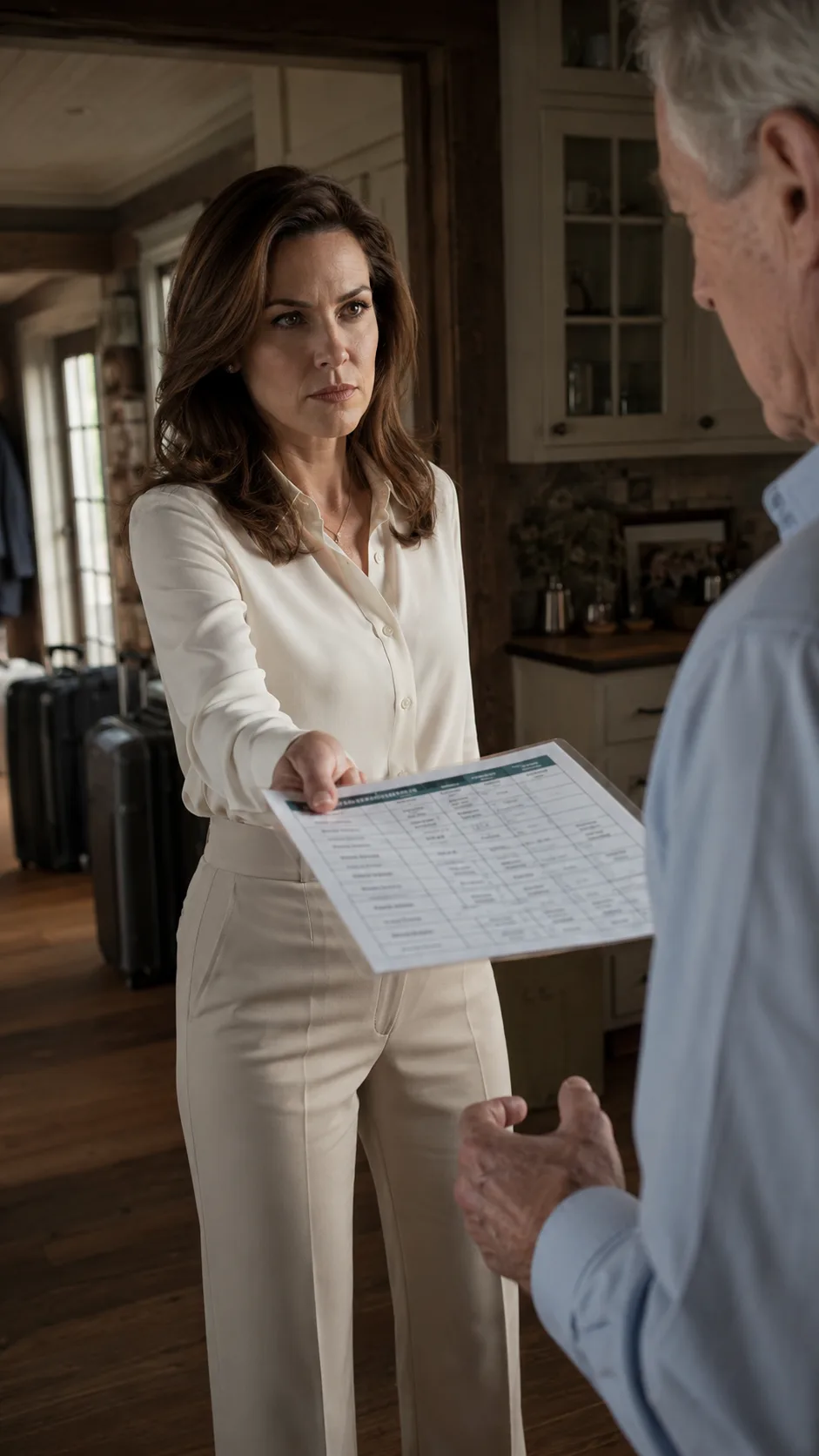
A color-coded schedule.
Six-thirty: make the twins’ lunches—whole-grain bread, organic turkey, no peanuts, cut the crusts.
Seven: walk the dog—half an hour around the property, no matter the weather.
Seven-forty-five: drive Sophie and Ethan to school. They go to a private academy on the edge of town where the parking lot is full of Audis and Teslas and the American flag out front is perfectly lit at night.
Three-fifteen: pick them up.
Four o’clock: help with homework.
Five: start dinner—preferably “something healthy but kid-friendly.”
Weekends were worse. Yard work across eight acres. House maintenance. Babysitting while they went to cocktail parties in D.C., wine tastings at Virginia vineyards, “networking events” at country clubs with strict dress codes.
“Can you stay in the garage tonight, Larry?” Natalie would ask. Not Dad. Not Mr. H.
“Larry.”
“We’re hosting colleagues. It’s a professional thing.”
I was the help in my own house.
Every month I paid the property taxes: thirteen-thousand-six-hundred dollars a year, divided by twelve—eleven-hundred-thirty-three dollars monthly. I paid the utilities, around four-hundred-fifty dollars a month. Insurance, twenty-two-hundred a year. When the roof needed repairs, I paid. When the old furnace finally died in the middle of a January cold snap and we could see our breath in the kitchen, I paid.
Garrett and Natalie paid zero.
No rent. No utilities. No groceries.
Most of the food in their stainless-steel refrigerator came from Costco runs I made in my Civic, wheeling the cart under fluorescent lights while couples half my age argued over brands.
Later, with help, I did the math.
Professional child care, five days a week, forty-eight weeks a year—that’s two-hundred-forty days. The going rate in Loudoun County hovers around one-hundred-thirty-one dollars per day.
Thirty-one-thousand-five-hundred dollars in child care value per year.
Add property costs, and I was contributing roughly fifty-five thousand dollars annually while living over the garage.
I told myself I was helping.
Really, I was being used.
Then came my birthday.
Before I tell you what happened that morning, you need to understand what I stood to lose if I kept pretending nothing was wrong.
Money first.
If this pattern continued—and Garrett had made it clear he expected it to—I’d be spending fifty-five thousand dollars a year indefinitely. I was sixty-six. I could easily live another twenty years.
Over a million dollars.
A lifetime of savings, slow and steady from a teacher’s salary and Eleanor’s careful planning, bleeding away into someone else’s lifestyle.
But it wasn’t just the money.
I’d been hearing things for months. Conversations that stopped when I entered rooms. Garrett’s voice behind the office door, lowered but not low enough.
“Estate planning… property transfer… appropriate care facility…”
I know that language. I spent four decades teaching kids to read between the lines of documents, from the Declaration of Independence to Supreme Court rulings.
I knew what “appropriate care facility” meant.
Assisted living.
Once I was in a “facility,” the house—worth one-million-one-hundred-twenty-five-thousand dollars according to the last county assessment—would become theirs outright. They were positioning me as unable to manage alone. Never mind that I’d managed just fine for sixty-six years. Never mind that I still climbed ladders, shoveled snow, mowed fields.
But money wasn’t my real fear.
Sophie and Ethan were.
Every morning, those kids burst through the garage door.
“Grandpa Larry!” Sophie’s voice.
Ethan’s backpack hitting the floor like a dropped anchor.
They were the only pieces of Eleanor I had left in this world. Her laugh lived in Sophie’s giggle. Her curiosity burned in Ethan’s questions.
After homework, we had our own ritual. I’d teach them history through Eleanor’s stories: how she met me at a protest in ’76, how she convinced me to choose a classroom instead of a courtroom, how she believed one committed teacher could change the entire trajectory of a life.
“Grandma sounds cool,” Sophie said once, swinging her legs under the table.
“She was the coolest,” I told her.
If I spoke up, if I set boundaries, I knew I might lose them. Garrett would cut off access, weaponize my grandchildren. As a lawyer, he understood leverage better than most.
But there was something I feared more than losing them.
Eleanor’s last words to me in the hospital.
It was January fourteenth, two-twenty-two in the morning. The monitors glowed green and blue. Snow fell outside the narrow window, turning the hospital parking lot into a soft white blur. The nurse’s shoes squeaked in the hallway. Her breaths were shallow and thin.
She squeezed my hand with surprising strength.
“Larry,” she whispered. “Don’t let them forget what matters.”
I thought she meant the twins—remember her stories, remember her face—but when I looked at her, her eyes weren’t on them.
They were on me.
“Show Garrett,” she said, forcing the words out, “that character beats credentials.”
She knew. Somehow, dying, she knew what was coming.
I’d spent thirty-eight years teaching teenagers to stand up to bullies, to know their worth, to set boundaries. I’d stood in front of thousands of kids in bleachers and desks and told them to never let anyone make them feel small.
I got letters.
“Mr. H, you changed my life.”
“You’re the reason I went to college.”
“You taught me I mattered.”
And there I was, hiding in a garage, taking orders via color-coded text, letting my son’s wife call me Larry like I was the handyman.
What was I teaching Sophie and Ethan?
That dignity doesn’t matter?
That you let people use you if you love them?
That teachers—that I—were worth less than attorneys and executives and regional VPs?
I realized I’d rather lose temporary comfort than permanent self-respect.
That was what I stood to lose.
Not a house.
Not money.
My soul.
The thing Eleanor loved about me. The thing I’d spent four decades trying to plant in other people’s children.
And on September twenty-second, 2024, I decided no more.