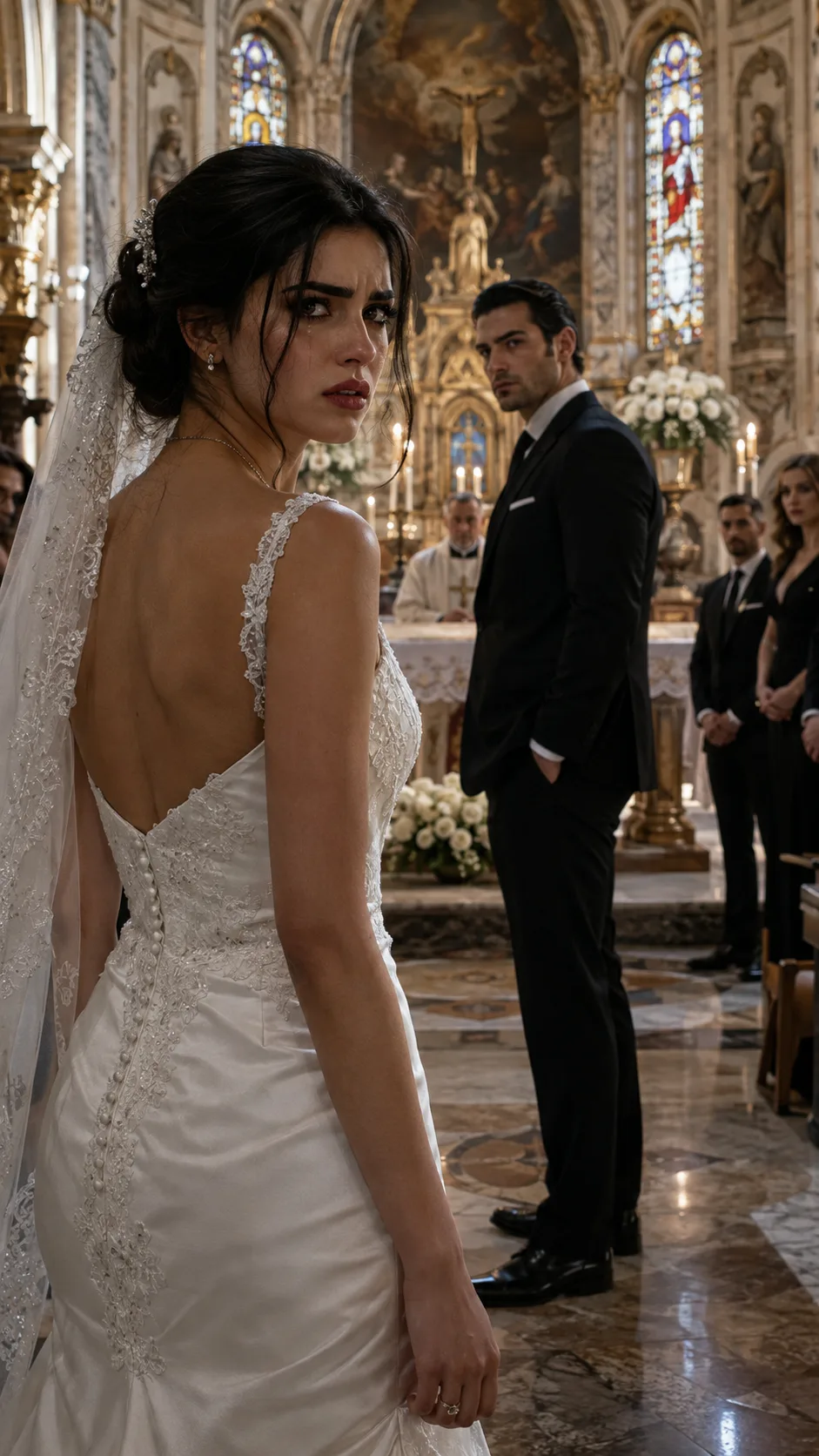
On Their Wedding Night, the Sicilian Mafia Boss Learned His Bride Had Never Been Touched
PART 2 — The Bride Enters the Santoro World
It was the 1st time in years I had seen Arthur Shaw lose control.
Chapter 2
On Their Wedding Night, the Sicilian Mafia Boss Learned His Bride Had Never Been Touched
PART 2 — The Bride Enters the Santoro World
It was the 1st time in years I had seen Arthur Shaw lose control.
The coffee cup trembled. The envelope slid across the wood.
The silence afterward carried more force than the blow.
“You’ll understand one day,” he said. “You won’t understand today, but one day you will.”
“What kind of father says that to his daughter?”
“A father who has no options left.”
“What kind of option requires locking me inside a marriage with a criminal?”
He became silent.
He pinched the bridge of his nose, the gesture he made when a migraine was beginning. For the 1st time, I noticed his age concentrated in his face.
Perhaps it had always been there and I had never stopped long enough to see it.
There was gray beneath his eyes. His hands looked too old for someone who continued climbing onto stages and standing behind podiums.
“If you refuse, I’ll have to disinherit you.”
The sentence was flat. It contained none of the careful,
paternal warmth he usually reserved for me.
His eyes trembled as he finished, as though the hardness were only a shell around something worse that he could not yet reveal.
The air in the office seemed thinner. I placed my hand against the chair to prevent the sensation that I might drift away.
“You’re threatening me.”
“I’m protecting you.”
“It doesn’t look like protection.”
“I know.”
We remained silent while the clock continued ticking. A car passed outside and sounded its horn.
The rest of the city had not stopped for me.
The envelope was sealed with red wax stamped with a raised S.
“Dad.”
“Yes?”
“Look at me.”
He raised his eyes. They were red.
I had seen Arthur Shaw cry only twice: at my mother’s funeral and on the night he lost his 1st election.
This would have been the 3rd time.
“I love you,” he said.
“Believe
me, I used to.”
I stood, took my bag, and left without looking back. Had I looked, I might have returned, embraced him, and forgiven him before I understood what I was forgiving.
My body had not yet decided whether it would yield or break.
The driver remained silent during the journey home. Palermo moved past the fogged window.
I did not cry.
I stared at my reflection in the glass: hair tied up, black shirt, and the eyes of a woman who had left home expecting to sit an examination and was returning with a wedding scheduled for Saturday.
My reflection seemed already to know what would happen. It looked as though it had been waiting for me to reach that window so it could tell me.
When I returned to the apartment building, Stella was sitting on the stairs outside my floor. She held 2 cups of iced
coffee and wore sunglasses despite the absence of windows in the hallway.
“You look like you’ve seen a ghost,” she said, offering me 1 of the cups. “My intuition never fails.”
“Stella.”
She lowered the cup.
“Talk to me.”
“I’m getting married on Saturday.”
She remained silent for 2 complete seconds.
Stella Ki did not remain silent for 2 seconds. She thought aloud, filled every pause, and treated silence as a defect to be repaired.
Those 2 seconds were the most frightening part of the morning.
“To whom?”
“Niko Santoro.”
She removed her sunglasses. Her eyes widened slowly.
“The Santoro family?”
“Yes.”
“The family from the hills?”
“Yes.”
“The one people say—”
“That one.”
She inhaled, placed both coffees on the floor, and embraced me on the stairs without asking anything else.
That was Stella. She did not waste time asking questions when the answer was already visible on someone’s face.
“Do you want to run?” she whispered. “We can run. I have a cousin in Catania.”
I laughed against her shoulder. It was a wet sound.
“I wish I could.”
“Why can’t you?”
“He’ll disinherit me.”
She drew back and searched my face.
“With all due respect, forget the inheritance.”
“It isn’t the inheritance. It’s him. I can’t leave my father alone.”
I remembered how Arthur had looked inside the office.
“He looked old today,” I said. “He looked afraid.”
Stella did not try to correct or solve anything. She took my hand, squeezed it, and remained beside me.
Sitting on the stairs with the 2 coffees growing warm between us while the morning continued outside as though nothing had changed, I cried for the 1st time that day.
The days between Thursday and Saturday passed without leaving a clear mark.
I did not return to the university. I ignored every call that did not come from my father or Stella.
A wedding dress arrived inside an ivory-colored box, sewn to measurements no one had asked me to provide. The fabric was heavy satin, with discreet lace around the neckline. It was beautiful in a way that had nothing to do with me.
Someone knew the dimensions of my body better than I wanted to consider.
In the silence of those 2 days, I made myself a promise.
Whatever the man looked like, whatever his age or size, he would not see me cry. I would enter the church with my back straight and leave with it straight. Whatever followed would become my problem, but during the ceremony I would remain Eveina Shaw.
Eveina Shaw would not cry in front of the people who had purchased her.
Saturday began beneath a clear sky.
I hated that.
The makeup artist worked without conversation. So did the hairstylist. Stella entered the room twice, held my hand twice, and left without speaking twice.
The dress was heavier than it appeared. A short train dragged across the cold floor.
I descended the staircase carefully. My father waited at the bottom in a tuxedo, wearing an expression I could not interpret.
“You look beautiful.”
“I know.”
He swallowed and extended his arm.
“Shall we?”
“Yes.”
I placed my hand on his arm.
“If I discover that you lied to me today, I will not forgive you.”
“I know.”
The escort waited outside.
There were black cars with dark windows and men in black suits standing along the pavement with the posture of people who never completely relaxed.
I entered the center car.
As we crossed Palermo, I watched the city the way I had 2 days earlier. This time, I counted churches instead of trees.
There seemed to be more churches than trees in Palermo. At that moment, it felt like a deliberate joke.
The church appeared around a bend, built from pale stone with a broad staircase. A crowd had gathered behind velvet ropes.
I had not considered crowds or photographers. I had considered nothing beyond the altar.
The car stopped. My father stepped out and offered me his hand.
It was the 1st time I had touched him since Thursday.
He was trembling.
We climbed the steps and crossed the cold stone vestibule, where the smells of candles and old flowers combined into the particular perfume of a ceremony.
The organ began.
I entered.
The nave was long, white, and gold, filled with people I did not know. I looked ahead because there was nowhere else to look.
At the end of the aisle, beyond stone, flowers, and stained-glass light, I saw the man I was going to marry.
I had imagined someone old: a man with a heavy stomach, a curved back, and spotted hands.
I had hoped for an old man because an old man could be survived. You waited, tended to him, inherited, and continued living.
An old man was a calculation, a number that could be solved.
The man at the altar was not old.
He was in his early 30s, tall, with broad shoulders beneath a black suit that looked as though he had been born wearing it. His dark hair was combed back. His jaw was straight, and his hands were clasped calmly in front of him.
The calm did not appear natural.
It appeared cultivated.
Even at a distance, I could see that his eyes were the color of ice melting inside whiskey: cold, beautiful, and apparently empty.
He looked at me once.
It was a quick assessment from head to foot. Then he returned his attention to the altar.
It was not the look of a groom or of a man who wanted the woman approaching him. It was the look of someone confirming that a delivery had arrived at the correct address.
Once the address had been confirmed, the information was filed away.
The air left my lungs.
It was not his appearance that frightened me. It was his coldness.
An old man could have been survived.
The man at the altar looked capable of destroying me without noticing he had done it.
My father gave me away.
The priest spoke first in Latin, then in Italian, and then in a language I no longer heard. My thoughts had drifted somewhere between my apartment staircase and my father’s office, searching for the point at which my life had changed direction without warning.
Someone asked whether I accepted.
I said yes because the air in my lungs seemed to answer for me.
Niko accepted as well. His voice was deep and low, and there was no hesitation in it.
He did not speak my name tenderly. He did not look at me during the vows.
The kiss came at the end.
His closed lips touched mine for 2 seconds, as cold as the stone beneath us.
I closed my eyes instinctively. When I opened them, he had already stepped away.
The church erupted in applause.
I smiled because brides smiled.
He did not.
He offered his arm, and I placed my hand over it. We walked through the nave without exchanging a word.
Outside, the sunlight struck the staircase with a violence it had not possessed earlier.
I saw his guards for the 1st time. They were different from my father’s men. They were quieter and more alert, their attention continually moving across the crowd.
It was not protocol.
It was instinct.
They opened a path to an armored car.
Niko held the door and waited for me to enter 1st. It was the only act of kindness he offered that day.
He sat on the other side of the car.
The door closed with a heavy, final sound. The driver started the engine, and Palermo began passing the windows as it always did: the same markets, stone streets, and people who neither knew nor needed to know what had occurred inside the church.
Niko did not speak or look at me.
He removed his phone, read a message, and returned it to his pocket.
I watched him from the corner of my eye. His jaw was sharply defined. One hand rested loosely on his knee.
The wedding ring remained inside his other palm, apparently forgotten, as though he had also forgotten that I existed.
I dug my fingernails into my hand to stop myself from trembling.
Inside my mind, I repeated the promise no one in the car could hear.
This man will not see me cry.
It was the 1st promise I broke before that night ended.
The Santoro estate appeared at the end of a road that seemed constructed solely to reach it.
There was a high wall, a wrought-iron gate, and 2 men in black suits inside the gatehouse. The car entered without stopping.
Gravel cracked beneath the tires with a dry, final sound, like a vault being sealed.
Beyond a hedge of fuchsia bougainvillea, the Palermo sea opened toward the horizon like a blue blade beneath the orange light of late afternoon.
It was beautiful.
I hated that as well.
The reception took place in the main hall. Long tables were covered with immaculate white linen. Crystal chandeliers threw fragments of light across marble walls. The wine cost more than my 1st university semester.
I greeted names I did not retain and smiled at faces whose smiles did not reach their eyes. I ate half of whatever was placed before me and drank from every glass I was offered.
I kept my back straight.
I discovered that looking composed was easier when the body was occupied with chewing.
Niko moved through the hall like a host who had repeated the scene many times. He shook the hands of elderly men, kissed the cheeks of elderly women, and laughed when someone whispered a joke.
He laughed with his mouth but not his eyes.
I noticed and retained it as evidence of something I could not yet identify.
At one point, he crossed the room toward me. He stopped at my side and placed a hand against my waist.
The touch was brief and professional, like a manager repositioning something in a display.
The warmth of his fingers passed through the dress. I chose not to register it.
“Are you tired?”
“No.”
“We’ll leave in an hour.”
“That’s fine.”
He held my eyes for 2 seconds, the longest direct exchange we had shared all day.
Then he walked away.
The drive from the reception building to the residential part of the estate was short. The mansion stood nearer the sea, concealed beyond an avenue of cypress trees aligned like tall, dark sentinels.
Don Vittorio waited at the entrance with his hands folded behind his back.
He was tall and thin, with white hair combed precisely into place and the posture of a man who had never lowered his head to anyone.
He kissed my hand with the courtesy of another century.
“Welcome to our home, Signora Santoro.”
The new surname struck my chest like a stone.
I smiled, thanked him, and crossed the threshold.
The entrance hall was cold.
Everything inside seemed cold: the gray marble floor, the yellowish light that warmed nothing, and the members of staff positioned in corners like statues.
The house smelled of wax and old stone.
A large, stocky man stepped forward. He had the expression of someone preparing to tell a joke no one had requested.
“Gennaro Russo, Signora. The boss’s driver. From now on, I’ll be yours as well. I should warn you that I drive well, speak little, and laugh only when something is worth it.”
Despite myself, I laughed.
It was the 1st amusing thing I had heard all day.
“Understood, Gennaro.”
“You’ll adapt quickly. The only thing worse than my silence in this house is the boss’s.”
He gave me a slight wink.
Behind him stood a thinner, more elegant man in an impeccable gray suit. He extended his hand with the exact gesture of someone who had measured the appropriate distance for every handshake he had ever performed.
“Tommaso Ferri, consigliere to the family and a lawyer by training. Should you require advice, come to me. Part of my occupation is not being surprised by anything.”
“Am I meant to find that reassuring?”
“You are meant to find it useful.”
I smiled again.
I had already understood that Tommaso Ferri would be more dangerous than Gennaro.
Niko appeared behind me without making a sound.
I had not heard him cross the marble. A man of his size should have made noise. It was a natural law, and he appeared determined to violate that as well.
“I’ll show you the east wing.”
We climbed the stairs.
The corridor was wide and dark, illuminated by iron sconces that produced insufficient, theatrical light, as though the house preferred to preserve shadows in its corners.
Portraits of dead people watched us from both walls.
I did not look back at any of them.
Niko stopped before a pair of doors.
“This is the main bedroom.”
He opened them.
“Yours?” I asked.
I looked inside.
The room was large, with an enormous bed covered in cream linen. Half-open shutters revealed a balcony, a narrowing rectangle of evening sky, and the smell of salt from the sea.
My suitcases had been opened on a trunk in the corner. My shoes were arranged in pairs, and my clothes had already been hung inside the wardrobe.
Someone had entered before me, touched my belongings, folded my clothes, and selected the order of my dresses.
A controlled wave of anger moved through me.
“And you?”
Niko indicated another door approximately 3 meters along the corridor.
“We have separate rooms,” I said.
“Yes.”
“I thought it would be better.”
“For you or for me?”
He turned.
It was the 1st time since the altar that he had truly looked at me.
At close range, the expression was worse than it had been from the other end of the church. It was not coldness but absence. He was looking at me while the rest of him remained elsewhere, occupied by urgent matters and problems I could not understand.
“For you, Signora.”
“Don’t call me Signora.”
“What should I call you?”
“My name.”
He hesitated for half a second.
I noticed every part of it.
“Good night, Eveina.”
He closed the door without noise.
I remained in the center of the room, still trapped inside the heavy dress. The shoes pressed against my ankles, and the pins securing my hair hurt the back of my head.
Beyond the partially open shutters, the sea continued striking the shore as though nothing important had occurred.
I removed the dress alone.
It took time. The fastenings were small and treacherous, created for another person’s hands.
When the fabric finally dropped in a circle around my feet, I felt 10 pounds lighter and 10 years older.
My phone rang.
It was Stella.
“Are you still in 1 piece?”
“I think so.”
“What is the house like?”
“Beautiful. Freezing.”
“And him?”
“He sleeps in the room next door.”
“What?”
“We have separate rooms.”
Stella remained silent.
I sat on the edge of the bed, looking at the weak yellow lamp on the bedside table. Its light made everything appear older.
“Is that better or worse than if he had insisted?” she asked.
“I don’t know. I think it’s worse.”
“Why?”
I remembered how quickly he had closed the door. He had not hesitated, looked at me with curiosity, or needed time to make the decision.
Separate rooms had seemed obvious, as though I were a contractual detail that did not require discussion.
“Because it means he doesn’t want me enough even to pretend.”
Stella was quiet for a moment. Then she spoke with the voice she used when she needed to be both hard and unexpectedly gentle.
“Eveina, listen to me. You were not made to be wanted just enough. You were made to be wanted too much. When that man realizes it, he’s going to choke. Give him time.”
“Thank you.”
“Always.”
I ended the call, switched off the light, and lay facing the wall separating my room from his.
I heard nothing from the other side.
There were no footsteps, voices, or movements of furniture.
Perhaps he had gone to sleep immediately, like someone completing a task before moving to the next.
It troubled me more than it should have.
The following days compressed into one another.
Breakfast was served at 8:00 a.m. in a smaller dining room. I ate alone beside a newspaper left on the table as though someone had risen moments before I entered.
Lunch came at 1:00 p.m. I was alone again, surrounded by the staff’s polite and suffocating silence.
Dinner was served at 8:00 in the large dining room. Niko sat at the other end of the long oak table, reading the newspaper between each mouthful. Light from the chandelier created shadows along the angle of his jaw.
On Monday night, I tested him.
“How was your day?”
He turned a page without looking up.
“Ordinary.”
Then he continued reading as though I had said nothing deserving more than a single word.
I resisted the impulse to throw my water in his face, finished my meal without speaking, and returned to my room.
I learned quickly.
I asked nothing at the dinners that followed.
My attendance at the university was temporarily suspended.
Temporarily was the exact word Tommaso used on Tuesday when he explained, with a carefully controlled smile, that the boss preferred I remain on the estate until certain arrangements had been completed.
I asked what arrangements he meant.
He said it concerned my security.
I asked what I needed protection from.
He smiled, changed the subject with the ease of someone who had practiced since childhood, and ended the discussion before it had properly begun.
Gennaro became the only source of light in those gray days.
He appeared in the gardens whenever I went outside to breathe the mixture of salt and rosemary carried from the sea. He pretended to inspect the car with immense seriousness and made quiet observations.
“The sea is beautiful today, Signora.”
“Yes.”
“More beautiful than the boss in the morning.”
I would laugh.
They were small, nearly breathless laughs, but they were the only ones that belonged inside those days.
Late on Wednesday afternoon, I was descending the marble staircase to retrieve a book from the library when I heard a sound in the east wing.
It was not loud.
It was wrong.
A man was speaking in a harsh, controlled voice, more threatening than a shout. Beneath it, almost swallowed by the corridor’s silence, a woman apologized for something I could not understand.
“I told you not to touch that paper.”
“Sir, I was only cleaning.”
“I said not to touch it. Are you deaf?”
I descended the remaining steps, turned the corner, and found a simple, repellent scene.
One of Niko’s men stood before a member of the domestic staff, a small woman approximately 50 years old with a cloth clenched in her hand.
I recognized the man’s dark overcoat but not his face.
He had taken hold of her wrist. He was not yet using his full strength. The calculated restraint was crueler because it announced what he could do whenever he chose.
The woman trembled.
He looked down at her as though she were nothing.
I did not stop to think.
“Release her.”
He turned his head slowly.
His eyes recognized me. He hesitated for an entire second.
Then the hesitation disappeared.
He did not release her.
I learned later that his name was Bruno.
“Return to your room, Signora.”
“I told you to release her.”
“You don’t give orders here.”
“The Signora is the Signora here.”
The sentence came out more firmly than I had expected. I had not prepared it, but once spoken, it remained in the corridor where none of us could retract it.
He stared at me.
I did not blink.
The woman caught between us closed her eyes as though she expected the worst and had long ago grown accustomed to expecting it.
“Let her go,” I repeated.
Bruno released her slowly, maintaining eye contact with me. He wanted it understood that he was releasing her because he chose to do so, not because I had ordered it.
“You’ll regret this, Signora.”
His voice was quiet and precise.
“Perhaps. But you’ll regret it 1st.”
That was when I heard a footstep behind me.
Only 1.
It was heavy and deliberate, carrying the weight of someone who did not need to announce his presence because the corridor changed when he entered it.
I turned.
Niko stood at the far end of the hallway in a white shirt with the sleeves folded to his elbows and his tie loosened.
His hands were empty.
He had been there long enough to hear everything. He had remained silent long enough not to interrupt either of the final statements.
His attention was fixed on Bruno.
For once, Niko’s eyes were not absent.
They were entirely present.
The coldness in them was different. It was the cold of something about to cut rather than something already dead.
“Bruno.”
Niko spoke almost politely.
Bruno lost color before Niko said anything else.
“Boss, I—”
“Leave.”
“Boss—”
“Leave.”
Bruno walked away without looking back. His footsteps faded along the corridor and down the stairs.
The staff member continued trembling, her shoulders curved inward.
I gently took the cloth from her hands, folded it, and placed it on a marble table.
“Go to the kitchen and ask for tea. I’ll come down in 10 minutes to make sure you’re all right.”
She nodded twice, her eyes wet, and hurried away through the service staircase.
When she disappeared, only Niko and I remained.
Click the blue “PART 3” below to read the next part: 👉 PART 3 👈
Chapter complete
You have reached the end of this chapter.
Continue reading
A few more worlds to get lost in after this chapter.




