For several seconds, I could hear only the soft clink of dishes from the hotel kitchen.
Chapter 3
For several seconds, I could hear only the soft clink of dishes from the hotel kitchen.
“What papers?” I asked, though I already knew.
Ethan wiped his face.
“The agreement from when we bought the Greenwich house. The bank transfers. Dad’s letter. And the drawing I made when I was five.”
Years earlier, Ethan and Vanessa had been short of the down payment on their home. I gave them one hundred eighty thousand dollars from my personal savings.
Vanessa called it an early inheritance.
My attorney called it dangerous.
At his insistence, Ethan signed a notarized agreement. My contribution remained secured against the property, and if I ever lost my own home, I had the legal right to live with them without rent or labor until I recovered.
I carried those papers into their house and placed them in the bottom drawer of the room beside the kitchen.
When I left, the folder stayed behind.
“I called a lawyer,” Ethan said. “He told me you could
demand repayment with interest. If we couldn’t pay, you could force us to sell.”
“I know.”
His head lifted. “Then why didn’t you?”
“Because I never wanted your house. I wanted my son.”
He looked as if I had struck him.
“The drawing was there too,” he whispered. “You were sitting at your sewing machine in a blue dress. I wrote, ‘When I grow up, I’ll buy Mommy a big house so she never works again.’”
“I remember.”
“And Dad’s letter.”
Robert had written it before he died, addressed to Ethan.
Take care of your mother. She will tell you she can carry everything alone. Do not let her.
Ethan’s voice broke.
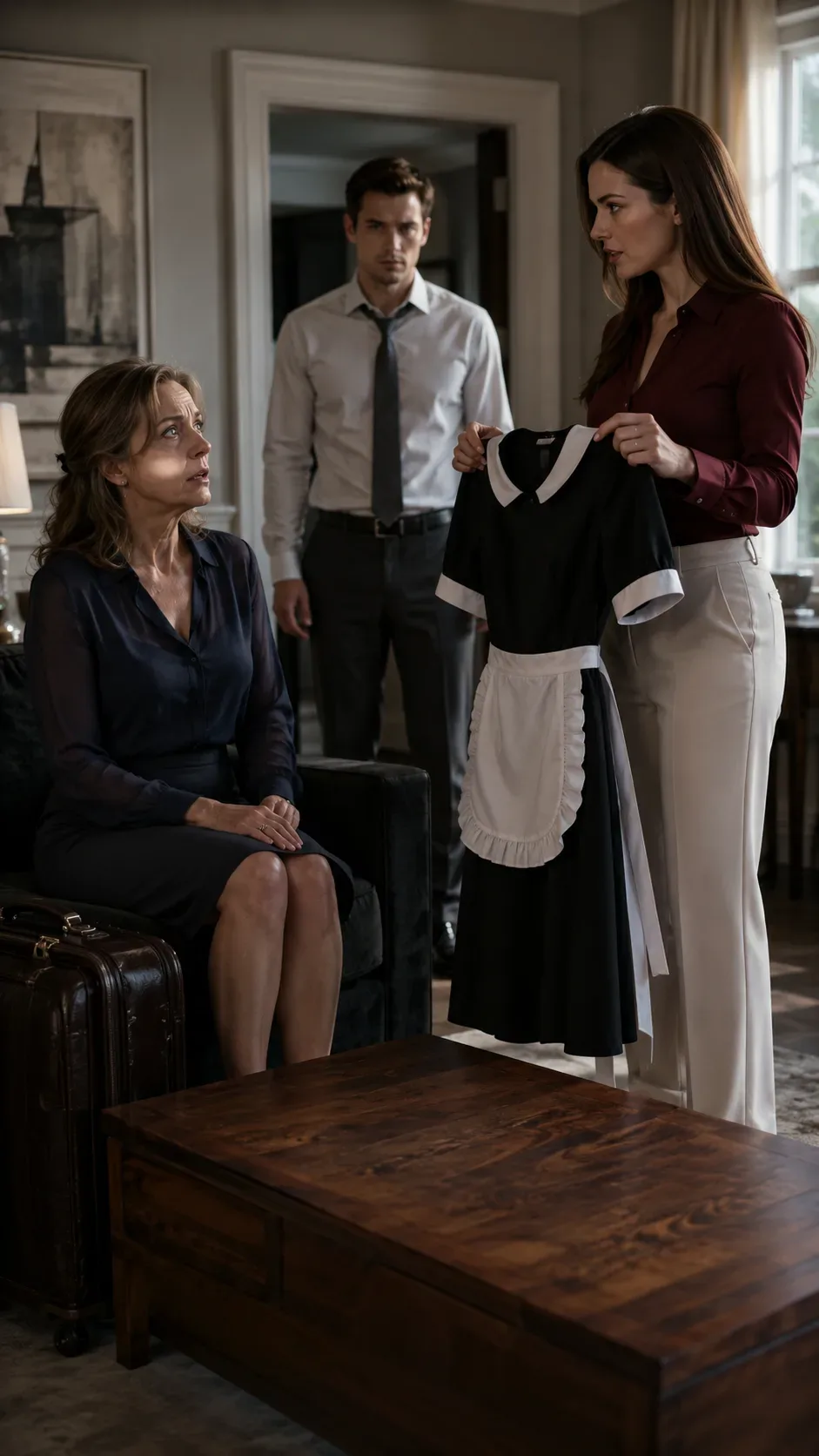
“After I read it, I went downstairs. The uniform was still on the coffee table.”
I said nothing.
“Vanessa told me to throw the papers away. She said you would never make a claim because you needed us.”
“Did you believe her?”
“For three days.”
That answer hurt, but at least it was honest.
“Then I tried to find you,” he continued. “Aunt Lucy said you had left. I checked hospitals, shelters, and bus stations.”
“But you still didn’t apologize.”
“I kept thinking I could fix it without admitting what I had become.”
“What had you become?”
“A man Dad would have been ashamed of.”
Ethan placed a thick envelope on the table.
“The documents are inside. I signed a new acknowledgment. Your claim is protected. If you want your share, I’ll sell the house.”
For a moment, I imagined Vanessa learning that the woman she ordered into a maid’s uniform could force the sale of the floor beneath her heels.
Once, that thought might have pleased me.
Now it only made me tired.
“I don’t want the house.”
“Mom—”
“Vanessa humiliated me because she could. I will
not become her simply because I can do the same.”
“What do you want from me?”
“Accountability. Not tears. Change.”
He nodded.
“I’m in therapy. Vanessa and I have filed for separation. She refused to continue counseling after the therapist confronted her about the uniform.”
“And the baby?”
“She’ll be born in two months. I want you in her life, but I know I haven’t earned the right to ask.”
“No,” I said. “You haven’t.”
He accepted that without protest.
That was the first sign that my son might still exist somewhere inside him.
I kept the legal claim active as protection, not revenge. Ethan began repaying the original contribution in monthly installments. Every payment went into a fund for women rebuilding after family abandonment or financial abuse.
Second Thread continued to grow.
We moved into a larger workshop with tall windows and space for twenty sewing stations. Patricia became operations manager. Gabriella joined our advisory board and rejected every title I offered.
“I’m the woman who gave you a broken machine,” she said. “That is enough.”
Lucy came to work for us after separating from Robert. On her first day, she stood beside me in the workshop and cried.
“I should have defended you.”
“You gave me a couch when I had nowhere else.”
“For only three days.”
“Sometimes three days keep a person alive.”
Two months after the award ceremony, Ethan called from the hospital.
“Elena is here.”
“Is she healthy?”
“Perfect. Vanessa asked if you would come.”
I almost refused.
Then I remembered that a child should not inherit the punishment meant for her parents.
Vanessa looked smaller in the hospital bed. Her hair was tied back. Her face held no makeup and no contempt.
Ethan placed Elena in my arms. She was warm, impossibly light, and completely innocent.
“Martha,” Vanessa said, “I owe you an apology.”
I waited.
“What I did was cruel. I knew about the money you gave us, but I didn’t know about the agreement. When Ethan found it, my first thought was that you could take the house.”
“That was your first thought?”
“Yes. Not where you were sleeping. Not what we had done. The house.”
Her honesty surprised me.
“I hated how much our life depended on your sacrifices,” she continued. “Instead of being grateful, I felt powerless. When you lost everything, I saw a chance to make you feel small.”
“You succeeded.”
Tears filled her eyes.
“I am sorry.”
An apology does not erase a bus-station floor or the moment your child chooses comfort over you. But a sincere apology can become the first step toward something different.
“I accept that you are sorry,” I said. “Forgiveness will take longer.”
“I understand.”
Over the next year, Ethan kept every promise that could be measured. He attended therapy, made the repayments, and visited without demanding that I pretend nothing had happened.
Vanessa and Ethan finalized their divorce but learned to parent Elena without using her as a weapon. Vanessa moved into a smaller apartment and began therapy. We never became friends, but slowly, we became respectful.
A television network produced a documentary about Second Thread. After it aired, messages arrived from women across the country.
A widow in Ohio enrolled in nursing school at sixty-one.
A mother in Arizona left a home where her adult children treated her like unpaid labor.
A woman in Georgia sent me a photograph of a secondhand sewing machine and wrote, “I bought this because of you.”
Two years after Vanessa placed that box on my bed, Second Thread employed twenty women.
Each woman carried a history.
None was treated as a burden.
One morning, Ethan arrived at the workshop with a storage box.
“I found this while moving.”
Inside was the maid’s uniform.
The black fabric was still stiff. The white apron remained perfectly folded.
For one instant, I was back in that windowless room, powerless and afraid.
Then Elena ran across the workshop and wrapped both arms around my knees.
“Grandma!”
The memory released me.
I took the uniform home and placed it in a cedar box beside my mother’s ring, my first award, Robert’s letter, and Ethan’s childhood drawing.
Not every painful object deserves to be destroyed.
Some should remain as evidence.
Today, Elena is three. This morning, we had breakfast with Ethan and Vanessa. We are not a perfect family. We are something more honest—a family that has faced the harm it caused and chosen not to hide from it.
Elena climbed into my lap.
“Grandma, tell me a story about when you were brave.”
“What kind of brave?”
“The biggest brave.”
I looked at Ethan. He did not look away.
“Once, there was a woman who lost everything she thought made her important.”
“Was she scared?”
“Very.”
“What did she do?”
“She remembered that a house is not a home if you must surrender your dignity to stay inside it. So she walked away.”
“Where did she go?”
“She built a new home with her own hands.”
“Did she live happily ever after?”
I kissed her forehead.
“Yes. But first she learned that you can lose money, work, property, and even people you trusted. If you refuse to lose yourself, you still possess everything you need to begin again.”
The maid’s uniform remains in my closet.
It no longer reminds me of shame.
It reminds me of the moment I stopped waiting for other people to recognize my worth.
I am not the woman Vanessa tried to reduce to a servant.
I am not the mother Ethan failed to defend.
I am not the businesswoman who went bankrupt.
I am the woman who walked into the night with three suitcases and rebuilt a life no one could take from her.
I am what I chose to become afterward.
And I chose to rise.
THE END
Chapter complete
You have reached the end of this chapter.
Continue reading
A few more worlds to get lost in after this chapter.




