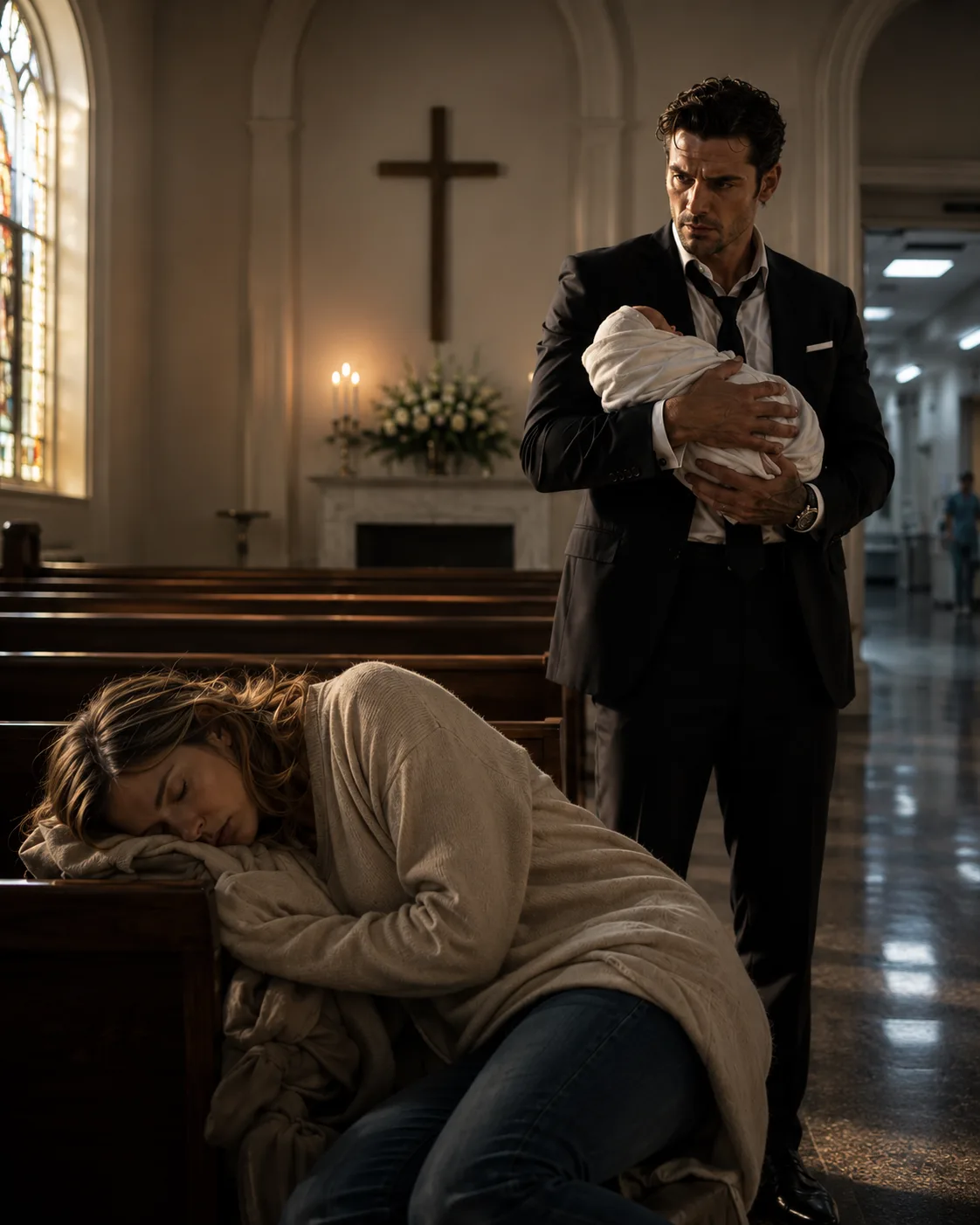
The mafia boss found me sleeping in the hospital chapel and the secret he carried beside me changed both our lives
Steam curled from the lid.
Chapter 1
Steam curled from the lid.
Elena stopped.
Her pulse lifted.
She looked around the room.
No one.
Slowly, she stepped closer. Written across the side of the cup in black marker were two simple words.
For Elena.
Her breath caught.
The coffee was warm. Fresh.
She crossed to the doorway and looked into the hall. At the far end, elevator doors closed with a quiet metallic sigh.
Nobody else was there.
Elena returned to the pew and sat. The chapel seemed less empty now. She held the cup in both hands, letting the warmth sink into her palms.
She should have ignored it.
She should have thrown it away.
Instead, despite herself, she smiled.
Across the street from St. Gabriel, a black sedan waited beneath rain-dark trees.
Inside, Sebastian Morelli watched the chapel window glow softly against the night.
He never saw her smile clearly.
But he saw her sit down.
He saw her hands
wrap around the coffee.
And for the first time in six months, something inside his chest loosened.
He started the engine and disappeared into the sleeping city.
Three nights later, Elena found him in the cafeteria.
It was nearly five in the morning. Fog drifted outside the windows, softening the parking garage into gray shadows. The cafeteria was almost empty except for a janitor, a sleeping resident, and a man seated near the glass with a ceramic mug in one hand and an old photograph in the other.
Sebastian looked up before she reached him.
“You again,” Elena said.
“You sound disappointed.”
“I sound suspicious.”
The corner of his mouth moved. Not quite a smile, but close enough to count.
Elena sat across from him before she could talk herself out of it.
For a moment, neither spoke. Rain slid down the window behind him. The silence between them felt
strange, not awkward, not empty. Almost familiar.
She nodded toward the photograph near his hand. “Family?”
Something changed in his face.
Not pain exactly.
Something older.
He turned the photograph facedown on the table. “Something like that.”
“I’m sorry,” she said immediately. “I shouldn’t have asked.”
“Most people stop asking questions once they realize they might get real answers.”
Elena looked down at her coffee. “Occupational hazard. Medical people ask questions for a living.”
“Do they listen?”
“Almost never.”
That earned a real smile. Small. Brief. Gone quickly.
But real.
“You never told me your name,” she said.
He studied her for a second. “Sebastian.”
“For now?”
“For now.”
“That sounds suspiciously dramatic.”
“Maybe I’m suspiciously dramatic.”
Elena laughed softly before she could stop herself.
The sound surprised both of them.
Overhead, the speakers crackled with a transport request. The hospital reminded them it was still hungry for their attention.
Sebastian stood and put on his coat. “You should go home.”
“That is rich coming from a man sitting in a hospital cafeteria before sunrise.”
“I’m not the one falling asleep in chapels.”
She opened her mouth, then closed it.
“Fair point.”
He pulled a napkin from the dispenser, wrote something on it, and slid it across the table.
A phone number.
Just ten digits.
Elena stared at it. “What is this?”
“A favor.”
“I didn’t ask for one.”
“No.” Sebastian picked up his coat. “But one day you might.”
Before she could answer, he walked away.
Only after he vanished through the cafeteria doors did Elena notice the photograph still lying on the table.
She should not have looked.
But she did.
A young woman stood beside a lake beneath bright summer sunlight. Blonde hair. Gentle eyes. A smile that struck Elena with a force she did not understand.
The woman in the photograph looked almost exactly like her.
And for the first time, Elena wondered whether meeting Sebastian Morelli had been an accident at all.
Part 2
Some questions do not knock. They move into your mind and start opening doors.
For the rest of that morning, Elena carried the image of the photograph through every hallway of St. Gabriel. She saw it while adjusting oxygen tubing. She saw it while charting vitals. She saw it in the elevator doors when her reflection stared back at her with the same blonde hair and tired eyes.
The woman in the picture was not Elena.
But she could have been.
A cousin. A sister. A ghost wearing a familiar face.
By the time her shift ended, rain had returned to Manhattan. Elena walked toward the employee parking garage with her jacket pulled tight around her body.
She found Sebastian beside a black sedan on the fourth level, looking out toward the skyline through the open concrete wall.
He turned before she spoke.
“You forgot something,” Elena said.
“The photograph.”
A shadow crossed his face.
Not surprise.
Resignation.
“Yes,” he said quietly. “I suppose I did.”
“Who is she?”
He looked back at the rain-soft city.
“Someone important.”
“Family?”
“Not mine.”
That answer tightened the knot inside her chest.
“She looked familiar,” Elena said.
His jaw flexed.
“Did she?”
“Enough that it made me uncomfortable.”
For several seconds, the only sound was rain tapping against the metal railings.
Then Elena noticed the manila folder on the passenger seat of his car. A corner of paper had slipped loose. Another photograph was attached to a document inside.
The same woman.
Older image. Formal. Damaged at the edge.
Sebastian quietly closed the passenger door.
The folder disappeared.
Elena looked at him. “What are you looking for?”
He did not answer.
Instead, he reached into his coat pocket and touched a folded paper there, almost unconsciously, as if making sure it had not vanished.
“What is that?” she asked.
“Nothing important.”
Elena knew immediately he was lying.
Not because of his voice.
Because his eyes changed when he said it.
Before the week ended, she would learn the name written on that folded paper.
Rose.
The name came to her in the hospital archives.
St. Gabriel’s archive corridor was one of the few places in the building that still held silence. It ran beneath the east wing, lined with locked rooms full of old records, outdated files, and histories no one wanted until they suddenly needed them.
Elena had gone there near midnight to drink coffee away from ringing phones.
Instead, she heard voices around the corner.
One belonged to Martha Jensen, the archive supervisor, a woman who had worked at St. Gabriel for more than thirty years and treated paperwork like it had feelings.
The other belonged to Sebastian.
“I checked the records you requested,” Martha said softly. “Most were transferred years ago.”
“And the rest?” Sebastian asked.
“Incomplete.”
Papers rustled. A drawer opened.
“You’ve been looking for this for a long time, haven’t you?” Martha asked.
A pause.
“Yes.”
The word carried so much weight Elena forgot to breathe.
“Sometimes old records stay buried for a reason,” Martha said.
“Sometimes they stay buried because someone wanted them gone.”
Another pause.
Then Martha’s voice dropped.
“The only name that appears consistently is Rose.”
Elena’s pulse stumbled.
Rose.
The same name from the folded paper.
The same woman from the photograph.
Elena took a step back.
Her shoe brushed the floor.
The conversation stopped instantly.
Sebastian appeared around the corner.
Their eyes met.
For a moment, neither spoke.
Elena lifted her coffee cup slightly. “I was looking for a quiet place.”
Sebastian glanced at the cup. “And did you find one?”
Despite herself, she exhaled.
Martha appeared behind him holding a folder to her chest. Her eyes moved between them, sharp with recognition, then she excused herself and disappeared through an archive door.
Elena folded her arms.
“You spend a surprising amount of time in hospitals for someone who doesn’t work in one.”
“And you spend a surprising amount of time asking questions.”
“Occupational hazard.”
He almost smiled.
They walked together down the corridor. The hospital was quieter at that hour, but never quiet enough. Carts rolled somewhere above them. An elevator chimed in the distance.
Finally, Elena asked, “Who is Rose?”
Sebastian stopped walking for half a second.
When he looked at her, grief stood behind his eyes, controlled but unmistakable.
“Someone important.”
“That is not an answer.”
“It is the truth.”
She wanted to push harder. She wanted to demand every secret he carried and lay them out under the fluorescent lights until they made sense.
Instead, she saw the pain in his face and stopped herself.
The next week, Sebastian vanished.
The first night, Elena told herself she did not care.
The second night, she noticed herself glancing toward the chapel doors.
By the fourth night, the empty pew beneath the stained glass window felt like an accusation.
She hated that his absence mattered.
She barely knew him. They had shared coffee, silence, and a handful of conversations full of missing pieces. Yet the hospital felt different without him, as if some quiet part of the night had been removed.
One evening, she stepped into the chapel carrying coffee and found Father Michael arranging prayer cards near the altar.
“Looking for someone?” he asked.
“No.”
He smiled gently. “Of course not.”
Elena groaned. “Is it that obvious?”
“Only to people who spend their lives watching lonely people.”
That answer stayed with her.
Three nights later, her shift ended before midnight for the first time in weeks. Instead of driving straight home, Elena walked through Riverside Park along the Hudson. Rain had stopped an hour earlier. The air smelled clean, almost honest.
Near a small memorial garden, she saw the black sedan.
Her heart moved before her mind could stop it.
Sebastian stood near the river, facing the water. Fresh white lilies rested beneath a stone marker. A glass lantern flickered at its base.
He turned when she approached.
“Elena.”
“You vanished,” she said.
His mouth softened. “That sounds almost like concern.”
“Do not get used to it.”
A faint smile appeared, then faded.
Elena looked toward the flowers. “Someone important?”
“Yes.”
She did not ask more.
For once, the silence told her enough.
Then she noticed the name carved into the lower corner of the memorial stone.
Liam Morelli.
Sebastian followed her gaze and looked away.
“Your brother?” Elena asked quietly.
He nodded once.
The simple answer opened something in her. She understood loss. Not his exact loss, but the shape of it. The way it entered a life and rearranged every room.
“I’m sorry,” she said.
“Most people say that when there is nothing else to say.”
“Maybe because there isn’t.”
He looked at her then, really looked, and something in his expression softened.
They stood by the river until the air turned colder.
As they walked back toward the parking lot, Elena said, “One of these days I’m going to find out why you worry so much about a stranger.”
Sebastian stopped.
The reaction was small, but unmistakable.
For a second, she thought he would finally tell her everything.
Instead, he opened his car door.
“Good night, Elena.”
He drove away, leaving the sentence unfinished.
The answer arrived three nights later from the archive office.
Martha Jensen appeared in the respiratory department shortly after midnight carrying a stack of files and looking personally betrayed by technology.
“Please tell me you know how to operate this scanner,” Martha said. “The computer and I are no longer speaking.”
Elena laughed and followed her downstairs.
The archive office smelled like dust, paper, and old decisions. Martha muttered at the scanner while Elena sorted folders on a desk.
One thin folder slipped from the stack and fell open.
A photograph slid halfway out.
Blonde hair. Gentle eyes. That familiar face.
Elena went still.
Slowly, she pulled the image free.
Attached beneath it was a patient identification form dated eight years earlier.
The name printed across the top seemed to drain the air from the room.
Rose Bennett.
Elena stared until the letters blurred.
Rose Bennett.
Her sister.
“Elena?” Martha said.
Elena’s hands trembled. “Why is my sister’s picture in a hospital archive?”
Martha’s face lost color. “Oh, dear.”
The room suddenly felt too bright.
Rose had been dead for eight years.
A car accident, they had said. Internal injuries, they had said. Too much damage, too fast, too late.
Elena had been twenty-three then, old enough to understand paperwork and young enough to believe grief should come with clearer instructions. She had buried her sister. Packed away her clothes. Kept a voicemail she still could not delete. Learned to survive the empty chair at Thanksgiving.
She thought there were no more surprises left inside Rose’s death.
She was wrong.
Martha sat slowly. “I didn’t realize you were related.”
“Neither did I,” Elena said, her voice hollow. “Why is this here?”
“Most of the records were transferred years ago. This folder remained behind. It was incomplete.”
“Incomplete how?”
Martha opened another drawer and removed a thin file. “Several sections were missing. Some were redacted. I never knew why.”
Elena took the folder.
The pages were old, yellowed at the edges. Medical terms, administrative notes, dates, signatures. Her eyes moved faster, searching for sense.
Then she found a faded handwritten note attached near the back.
Next of kin notification pending.
Her stomach dropped.
“What does this mean?”
Martha looked away.
“What does it mean?” Elena repeated.
“I don’t know.”
“That is not good enough.”
“I know.”
Elena closed the folder with shaking hands.
Every moment with Sebastian rearranged itself in her mind. The chapel. The coffee. The photograph. Rose. Liam.
None of it had been accidental.
Her phone vibrated.
Unknown number.
Three words appeared on the screen.
We need to talk.
Twenty minutes later, Elena stepped onto the rooftop observation deck above St. Gabriel. The rain had stopped, leaving the city polished and cold beneath a restless sky.
Sebastian stood near the railing.
He did not turn when she opened the door.
“You knew,” Elena said.
He closed his eyes briefly.
“Yes.”
The word landed harder than she expected.
“How long?”
“Since before we met.”
She looked away toward Manhattan. The skyline blurred. She was angry, but not only angry. Hurt, confused, afraid to know more.
“Why didn’t you tell me?”
“Because I didn’t know how.”
“That is not an answer.”
“It is the only honest one I have.”
Elena turned back to him. “Tell me about Rose.”
Sebastian’s hands tightened on the railing.
“I cannot explain Rose without telling you about Liam.”
The two names connected in the air between them.
Rose.
Liam.
The hospital seemed impossibly quiet from the rooftop, even with the city roaring below.
Sebastian stared into the distance.
“Liam was my younger brother,” he said. “Six years younger. Smarter than me. Kinder than me. He talked to strangers like they were already friends. Coffee shop cashiers, taxi drivers, people in line at the grocery store. It drove me insane.”
A faint smile appeared and vanished.
Elena listened without interrupting.
“Years ago, Liam got sick. Very sick. There was a point when nobody knew if he would survive. Everything depended on finding a donor.”
Elena felt the file folder in her memory like a weight.
“Did they find one?” she asked.
Sebastian nodded.
“Yes.”
The wind moved between them.
“Liam got a second chance. For years, I thought it was a miracle.”
“Maybe it was,” Elena whispered.
Sebastian gave a quiet laugh with no humor in it. “Miracles usually feel cleaner than this.”
He reached into his coat and handed her a folded photocopy.
Elena opened it carefully.
At the bottom of the page sat a signature she knew from old birthday cards and Christmas tags.
Rose Bennett.
Above it, most of the form had been blacked out.
But one sentence remained visible.
Donor authorization approved.
For a moment, Elena could not hear the wind. Could not hear the traffic. Could not feel the cold.
“My sister was a donor,” she said.
Sebastian nodded slowly.
“When Liam was running out of time, the hospital called. A match had been found.” His voice lowered. “He survived because someone he never met chose to help a stranger.”
Tears gathered before Elena could stop them.
Rose had never told her.
Not once.
But that sounded like Rose. Quiet kindness. Private courage. Love offered without needing applause.
“Liam knew?” Elena asked.
“Not her name. Confidentiality protected that. But he knew someone had saved him.” Sebastian’s face softened. “Every birthday, he raised a glass and thanked his invisible hero.”
The tears fell then.
Elena did not wipe them away.
Sebastian did not offer empty comfort.
He simply stood beside her in silence.
Sometimes presence was the only mercy grief allowed.
After several minutes, Elena whispered, “If Liam survived, why do you visit his memorial?”
Sebastian’s face changed.
The answer came before the words.
“Because six months ago,” he said quietly, “I lost him anyway.”
Part 3
The cruelty of hope is that it can still end.
Elena stood beside Sebastian beneath the hospital rooftop lights, holding a document that had rewritten eight years of grief. Rose had not only died. She had given. She had left behind more than absence. She had left behind time.
Time for Liam Morelli to wake up in a hospital room and see another birthday.
Time for him to laugh.
Time for him to make plans.
Time for him to become a man his brother still could not speak of without breaking somewhere inside.
Sebastian leaned against the railing, eyes fixed on Manhattan.
“Liam was twenty-eight,” he said. “He had lists for everything. Restaurants he wanted to try. Cities he wanted to see. He once spent three months planning a road trip and never took it because he kept changing the route.”
Elena smiled through tears.
“He believed every day mattered,” Sebastian continued. “Not because he feared losing time. Because he appreciated having it.”
The words settled between them.
Rose had given Liam years.
And still, loss had come.
“What happened?” Elena asked.
Sebastian swallowed. “A relapse. Complications. Doctors did everything they could.” His mouth tightened. “I did what I always do. I called people. Threatened people. Paid for specialists. Moved money, moved machines, moved the world as far as it would move.”
He looked at her then.
“But death does not take orders.”
Elena’s chest ached.
After Rose died, people told her to find closure. To be grateful for the years she had with her sister. To move forward. They meant well. They always meant well. But grief did not become lighter because someone dressed it in wisdom.
It stayed.
It changed shape.
It learned your schedule.
It waited for quiet rooms.
Sebastian looked away. “When Liam died, people told me to be grateful for the extra years.”
“And were you?”
His laugh was broken. “Grief does not care about gratitude.”
“No,” Elena said softly. “It doesn’t.”
For the first time, Sebastian looked like a man who had finally been understood.
Not forgiven. Not healed.
Understood.
“I found Liam’s journals after the funeral,” he said. “He still wrote about the donor. Even years later.”
Elena pressed a hand to her mouth.
“He called her his invisible hero,” Sebastian said. “I started looking because I thought if I could find her family, I could tell them what she had done. I thought maybe that would honor him. Maybe it would honor her.”
“And then you found me.”
“I found your name first. Then I saw you at the hospital. I should have walked away.”
“Why didn’t you?”
He held her gaze.
“Because one night I walked into a chapel and found you asleep on a pew, and you looked exactly like someone who had been carrying pain alone for too long.”
Elena looked down.
“Then the coffee,” she said.
“I wanted to do one decent thing without making it complicated.”
“You failed.”
A small smile touched his mouth. “Clearly.”
The rooftop door opened behind them, then closed again. Somewhere below, a new ambulance arrived, siren fading as doors opened and lives changed.
Elena handed the document back to him.
“You should have told me sooner.”
“I know.”
“You scared me.”
“I know.”
“You made me feel like my sister was a secret you had more right to than I did.”
That hit him. She saw it.
Sebastian straightened. “I never had more right. I was afraid if I came to you with only fragments, I would reopen a wound for nothing.”
“It was already open,” Elena said. “You just didn’t know where to look.”
He nodded once, accepting it.
No excuses.
That mattered.
For the next several days, Elena barely slept, but this time it was not only exhaustion that kept her awake. She pulled old boxes from her apartment closet. Rose’s college yearbook. Volunteer pins. A faded St. Gabriel badge from one summer. Photos of Rose smiling in places Elena had forgotten she had ever been.
Rose had volunteered at St. Gabriel during college.
Pediatric wing.
Elena sat on her bedroom floor surrounded by memories and realized her sister’s life had been larger than the story grief had allowed her to remember.
Not just the accident.
Not just the funeral.
Not just the empty places after.
Rose had lived. Helped. Laughed. Chosen. Given.
And somewhere, perhaps, she had crossed paths with a sick young man named Liam who loved talking to strangers.
On Friday before dawn, Elena returned to the chapel.
Sebastian was already there.
This time, she sat beside him.
Neither spoke at first. The silence felt different now, no longer full of suspicion. It was still heavy, but honest.
Elena handed him a photograph.
Rose stood in front of St. Gabriel eight years earlier, wearing a volunteer badge and holding two paper cups of coffee. Beside her, slightly blurred, stood a young man in a hospital hoodie, thin but smiling, one hand raised as if caught mid-joke.
Sebastian went completely still.
His fingers tightened around the photo.
“Elena,” he whispered.
“Is that Liam?”
Sebastian did not answer immediately.
His eyes shone beneath the chapel lights.
“Yes.”
The word broke in the middle.
Elena looked back at the photo. Rose was laughing. Liam was smiling at her like he had just said something ridiculous and was proud of it.
“They knew each other,” Elena said.
Sebastian covered his mouth with one hand, fighting for composure.
For months, he had searched through formal records, redacted files, legal fragments, and old signatures.
But the answer had been sitting in Elena’s closet, tucked inside a shoebox labeled Rose college stuff.
“I don’t know how well,” Elena said gently. “I don’t know what they meant to each other. But they met.”
Sebastian looked at the stained glass window as if trying not to fall apart in front of her.
“Liam used to say,” he began, then stopped.
“What?”
“He used to say there was a girl at the hospital who talked to him like he was not dying.”
Elena closed her eyes.
That sounded like Rose too.
The chapel seemed to breathe around them.
After a long silence, Sebastian said, “I spent six months looking for the person who saved my brother’s life.”
“And?”
He looked at her.
“I think I found the person who reminded him why he wanted to live.”
Elena cried then, but it did not feel like breaking. It felt like something locked inside her had finally opened.
Sebastian stayed beside her.
No hand on her shoulder without permission. No command. No promise that everything would be fine.
Just there.
The most powerful man half of New York feared sat quietly beside an exhausted respiratory therapist in a hospital chapel, holding a photograph of two people they had both loved and lost.
For once, he did not look like a mafia boss.
He looked like a brother.
Weeks passed.
The story did not heal them all at once. Real healing never did. It arrived in small, almost embarrassing ways.
Elena stopped taking every extra shift offered to her.
At first, she told herself it was practical. Her body needed rest. Her supervisor had been warning her for months. Her friends had stopped believing her when she promised to call back.
But the truth was simpler.
She wanted to live a life Rose would recognize.
Sebastian changed too, though not in ways the newspapers would have understood. He still wore tailored black coats. Men still lowered their voices when he entered private rooms. His phone still rang with problems most people never saw.
But he came to the chapel every Friday morning.
No guards inside.
No business.
Just coffee.
Sometimes he and Elena talked about Rose and Liam. Sometimes they talked about ordinary things. Bad hospital cafeteria muffins. The Knicks. Elena’s neighbor who vacuumed at midnight. Sebastian’s inability to assemble a bookshelf because, according to Elena, “you can intimidate men but not Swedish furniture.”
He laughed more often.
She slept more often.
Neither of them called it love at first.
They were too careful for that.
Too aware that grief can disguise itself as need.
But months have a way of telling the truth.
By early summer, Manhattan had turned bright and restless. Trees around St. Gabriel were full again. Morning sunlight warmed the chapel windows instead of rain.
Elena stepped into the hospital one Friday carrying two coffees and a folder tucked under her arm.
Sebastian waited near the elevators.
“You’re late,” he said.
“I brought coffee.”
“You’re forgiven.”
They walked to the chapel together.
It looked the same as it had that first night. Wooden pews. Colored glass. Quiet corners where broken people could sit without explaining themselves.
But Elena did not feel like the same woman who had fallen asleep there alone.
She sat in the third pew.
Sebastian sat beside her.
For a while, they said nothing. The hospital hummed around them. Distant footsteps. A cart wheel squeaking in the hall. The ordinary music of lives continuing.
Finally, Elena opened the folder.
Inside was a printed proposal for a new patient support program at St. Gabriel.
The Rose and Liam Foundation.
Sebastian looked at the name for a long time.
Elena spoke softly. “For transplant families. Donor families too. Counseling, hotel vouchers, emergency meal cards, transportation. Things people need when their whole life becomes waiting.”
Sebastian read the first page.
“You wrote this?”
“I started it. Martha helped. Father Michael knows a donor counselor who wants in. My supervisor said the hospital board will listen if we have funding.”
Sebastian looked up. “Funding.”
“Yes,” Elena said, trying not to smile. “That is the part where you pretend to think about it.”
“I am deeply considering it.”
“For how long?”
“Three seconds.”
“That seems emotionally responsible.”
“I’ve grown.”
Elena laughed.
Then Sebastian’s expression turned serious.
“They would have liked this,” he said.
“Rose would have pretended it was too much attention.”
“Liam would have made a speech.”
“A long one?”
“Unbearably long.”
Their laughter softened into silence.
Sebastian reached into his coat pocket.
Elena noticed the movement.
“What are you doing?”
“Something suspiciously dramatic.”
“That is never good.”
He removed a small velvet box and placed it on the pew between them.
Elena stared at it.
For a second, the world stopped making sound.
Then she looked at him. “Sebastian.”
“I know,” he said. “This is not the cleanest place to ask. It is not a restaurant. There are no roses. No music. No men hiding behind columns with violins.”
“There better not be.”
“There are not.”
Her hand trembled slightly.
He did not open the box yet.
Instead, he looked toward the altar, then back at her.
“For a long time, I thought loving someone meant waiting for the day I would lose them. So I kept people at a distance. I called it control. It was fear.”
Elena’s eyes filled.
“Then I found you asleep in this chapel,” he continued. “And somehow, without trying, you made silence feel less lonely. You made grief feel survivable. You made staying feel possible.”
He opened the box.
The ring inside was simple, elegant, and nothing like the kind of thing a man like Sebastian Morelli could have bought if he wanted to impress the world.
Which meant he had chosen it to impress only her.
“I cannot promise you an easy life,” he said. “I cannot promise I will always know the right thing to say. Most of the time, I won’t.”
“That is true.”
His mouth curved.
“But I can promise I will tell you the truth. I can promise I will show up. I can promise that whatever comes, I will sit beside you in it.”
Elena covered her mouth, laughing and crying at once.
“You practiced that.”
“Only fourteen times.”
“That is fewer than I expected.”
“I edited heavily.”
She looked at the ring, then at the man beside her. The feared man. The grieving brother. The stranger who had once moved her coffee cup so it would not fall. The man who had carried her sister’s secret not perfectly, but carefully. The man who had learned that power could not save everyone, but presence could still save something.
“Yes,” Elena whispered.
Sebastian blinked once, like the answer had stunned him despite asking the question.
“Yes?”
“Yes.”
He slipped the ring onto her finger with hands that were not quite steady.
Then Elena leaned into him, and he held her carefully, as if the moment were made of glass.
Outside the chapel doors, the hospital kept moving.
Patients woke. Families waited. Nurses hurried. Elevators opened and closed.
Life continued, as it always did.
But inside the chapel, beneath stained glass and morning light, two people who had been brought together by loss chose something grief had not managed to destroy.
They chose love.
They chose memory.
They chose to stay.
Months earlier, Elena Bennett had fallen asleep in that chapel believing no one would notice if she disappeared into her own exhaustion.
Sebastian Morelli had sat behind her believing silence was the only prayer he had left.
Neither of them had known that Rose and Liam had already written the first line of their story years before, in hospital hallways, in hidden kindness, in a decision to give life where death had tried to end it.
Now Elena rested her head against Sebastian’s shoulder.
His hand closed gently around hers.
And for the first time in a very long time, the chapel did not feel like a place where broken people came to be alone.
It felt like a place where they came to begin again.
THE END
Chapter complete
You have reached the end of this chapter.
Continue reading
A few more worlds to get lost in after this chapter.




