For the next ten days, I behaved as though nothing had changed.
Chapter 2
For the next ten days, I behaved as though nothing had changed.
I made coffee before sunrise. I cooked Tobias’s favorite chicken on Thursday. I folded towels and returned Felicity’s dry cleaning to the hall closet. She seemed almost cheerful, perhaps relieved after releasing years of resentment into her sister’s ear.
She had no idea I was preparing to leave.
While Felicity attended Pilates and Tobias worked, I packed two suitcases. I took my medication, my mother’s pearls, a framed photograph of my late husband, and the financial files Felicity had never bothered to examine.
On the kitchen island, I left a note.
Tobias, I’m staying with a friend for a while. I love you. Mom.
I checked into a Hartford hotel. My attorney, Wendell Avery, met me in a private conference room with the trust documents spread across a polished table.
First, I arranged to move back into the Westport home I had never sold.
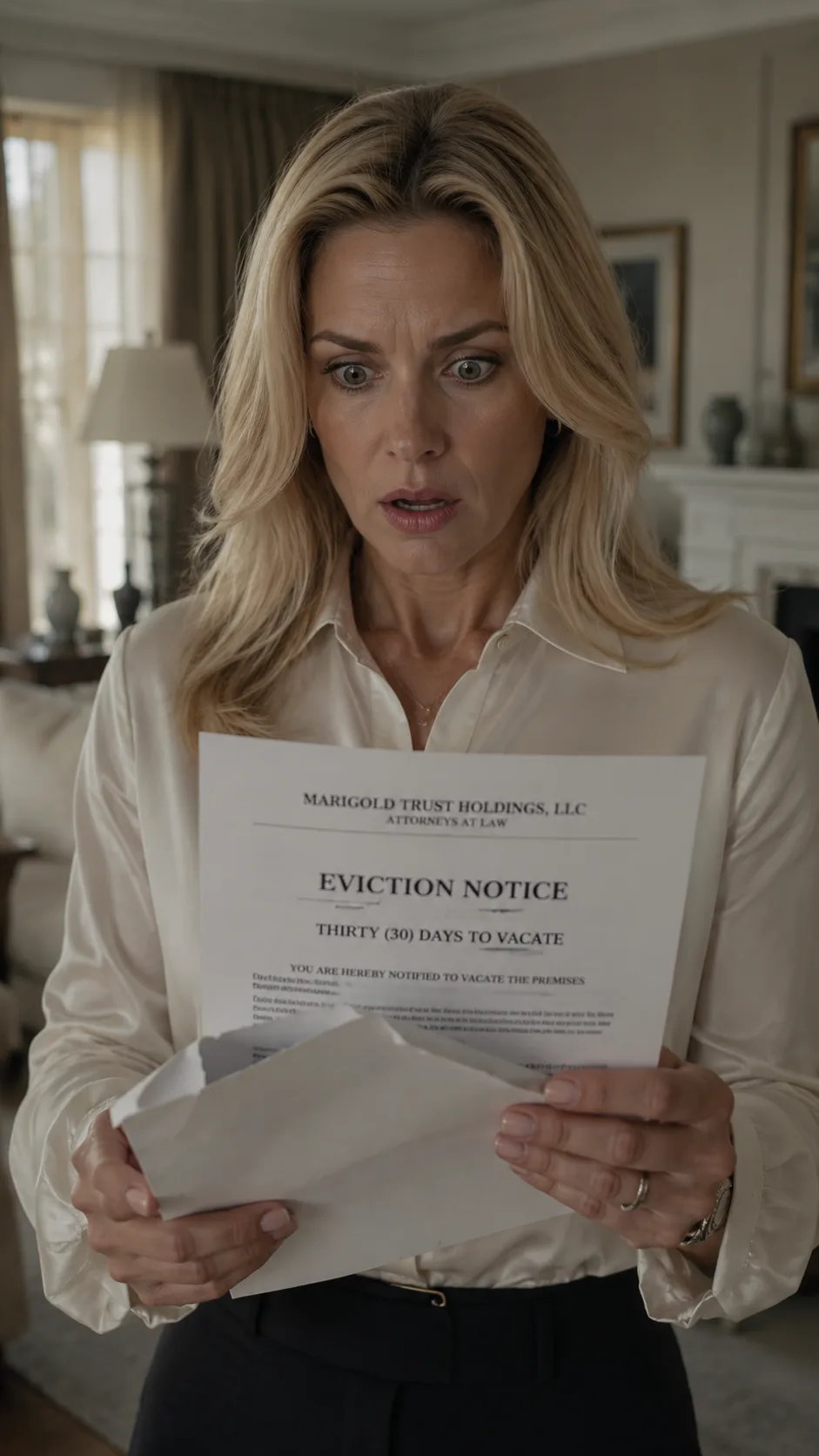
Second, Wendell prepared formal notice that
the occupants of 14 Birwood Lane had thirty days to vacate.
Third, I authorized the release of every payment Tobias had made over eleven years.
Three hundred twelve thousand dollars.
The money had always been his. I had only been protecting it.
The notice arrived the next morning.
At 11:47, Tobias called.
“Mom, there’s a lawyer at the door. This letter says you own our house.”
“I do.”
His breathing changed. “That’s impossible.”
“I bought it before your wedding. The deed is held by Marigold Trust Holdings. I am the sole trustee.”
“Why didn’t you tell me?”
“Because I wanted you to have security without making money the center of our relationship.”
Then I explained the investment account. I told him his payments had never gone toward a bank loan. I told him the full balance had been transferred that morning.
He was silent for several seconds.
“You gave me
over three hundred thousand dollars,” he whispered, “and you’re evicting me?”
“I am taking back my property,” I said. “Those are two different things.”
His voice cracked. “Why?”
I closed my eyes and told him about the mudroom.
I repeated every word Felicity had said: barnacle, facility, burden, old beggar, throw her out.
When I finished, my son was crying.
“I should have seen it,” he said.
“Yes,” I answered softly. “You should have.”
He begged me to reconsider. He promised to confront her. He said he could fix everything.
But this was not punishment delivered in anger. It was a boundary built after three years of humiliation.
“I will not spend my remaining years paying for the privilege of being disrespected,” I told him. “You have enough money to begin again. But I will never return to that guest room.”
That evening, Tobias came to the hotel alone. He
looked older than he had that morning.
He held my hands across the restaurant table and asked whether I hated his wife.
“No,” I said. “But I refuse to remain at her mercy.”
“I’m leaving her tonight.”
“No. Go home. Ask what she said. Listen to whether she is sorry for hurting me or only frightened of losing the house. Then decide when your blood is cool.”
At 1:14 the next morning, Felicity called.
She did not apologize.
She accused me of manipulating Tobias, hiding my wealth, destroying her marriage, and waiting years for an opportunity to humiliate her.
I let her speak until her fury exhausted itself.
Then I asked one question.
“If you had known I was wealthy, would you have called me an old beggar?”
The silence lasted long enough to answer.
“Good night, Felicity.”
I hung up.
A week later, Tobias met me at the Westport house carrying a duffel bag. He had asked Felicity for a separation.
“She didn’t deny what she said,” he told me at the kitchen table. “She said you deserved it because you had deceived us.”
His face tightened.
“Then she said I was weak. She said I would never have given her the life she wanted without you.”
Some words cannot be unheard.
Tobias stayed with me while he considered divorce. I did not celebrate. Watching your child’s marriage collapse is not victory, even when the collapse reveals the truth.
Three weeks later, rain darkened my front porch, and Felicity appeared at the door.
Her hair was tied back. Her face was bare. She wore sweatpants beneath a raincoat, and for the first time since meeting her, she looked less polished than human.
“May I come in?” she asked.
I almost said no.
Instead, I stepped aside.
She sat on my couch without removing her coat.
“What I said was monstrous,” she began. “I don’t expect forgiveness.”
“It was monstrous.”
She nodded, accepting the blow.
Then the woman who had judged every cardigan and every old shoe told me the truth.
Her father had measured love in money. Her mother had taught her that being pitied was worse than being cruel. Her sister’s mansion had become a scoreboard she could never stop watching. Two years of infertility had turned the empty guest room into a daily accusation.
“When I looked at you,” she whispered, “I saw myself becoming old, dependent, and unwanted. I hated you because I was terrified of becoming you.”
It was ugly.
It was also honest.
I reached across the table and held her cold hand.
“I do not forgive you yet,” I said. “But I understand you.”
When Tobias returned, he found us sitting together over untouched tea.
Felicity stood.
“I came to apologize to your mother.”
He looked at me.
I nodded once.
They walked onto the porch to speak beneath the rain. Through the window, I watched them face one another without touching.
For the first time, neither of them had a house, a secret, or a performance to hide behind.
Only the truth remained.
To be continued… Click “PART 3” to read the final part : 👉 PART 3 👈
Chapter complete
You have reached the end of this chapter.
Continue reading
A few more worlds to get lost in after this chapter.




