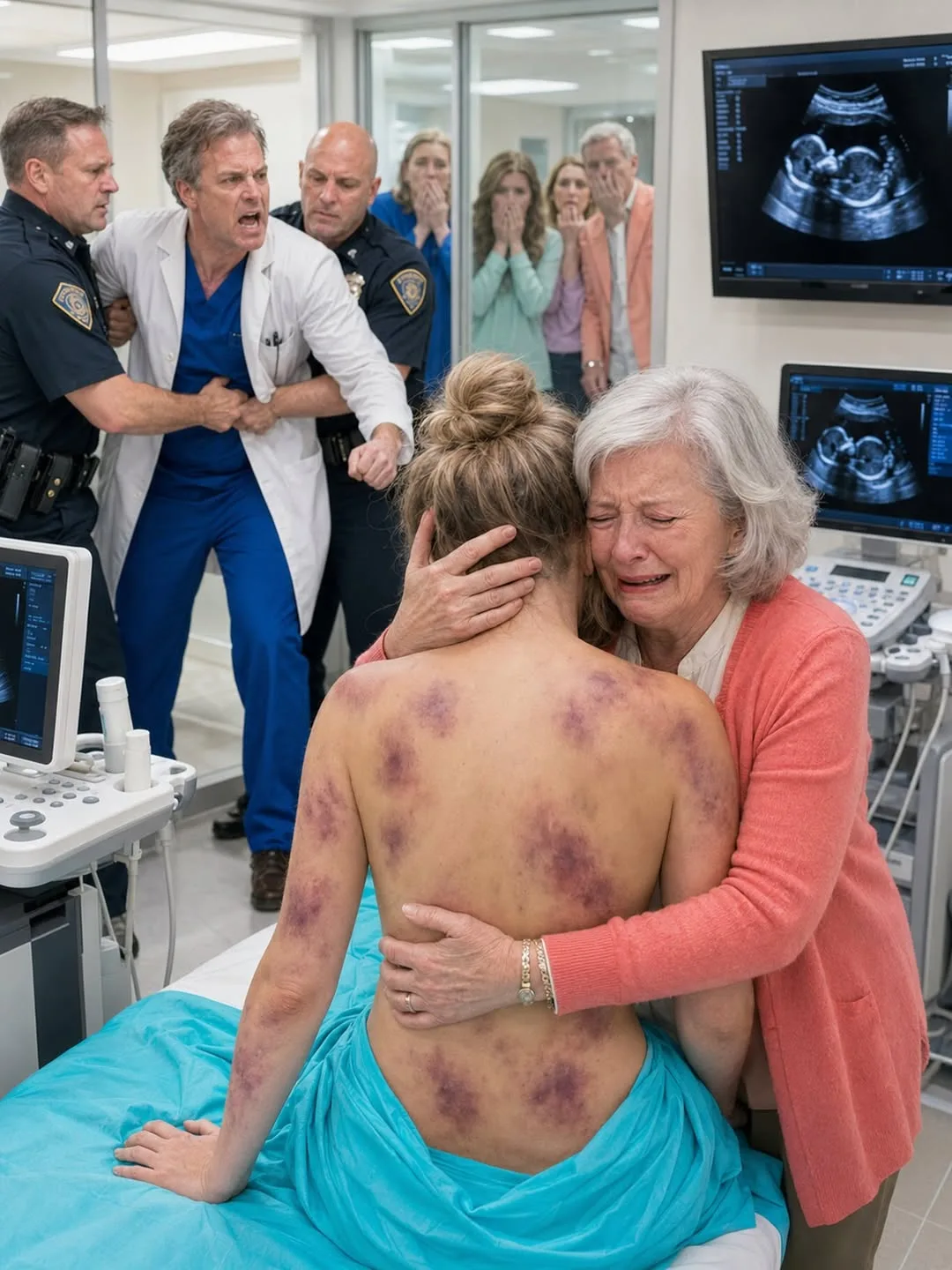
The man carrying my dead husband’s briefcase was someone I had not seen in seventeen years.
Chapter 2
The man carrying my dead husband’s briefcase was someone I had not seen in seventeen years.
For one terrible second, I forgot about the police officers.
Forgot Ernest.
Forgot the ultrasound monitor, the hospital room, even Taylor’s trembling hand wrapped around mine.
I simply stared.
“Arthur?”
Arthur Vance stopped just inside the doorway.
He had aged badly.
His once-black hair was almost completely silver now, and deep lines carved downward from the corners of his mouth. But the eyes were the same—sharp, pale, calculating.
My husband’s former attorney.
The man who had handled nearly every private acquisition Theodore and I had ever made.
The man who vanished six months after my husband’s funeral.
And in his right hand was Theodore’s old leather briefcase.
The one I had buried empty.
My blood turned cold.
Ernest watched my face carefully.
That was what he had been waiting for.
Not the police.
Not my reaction to the accusation.
This.
Recognition.
“Hello, Margaret,” Arthur said.
His voice sounded almost gentle.
I glanced at Ernest.
“You brought him here.”
Ernest gave a small shrug.
“I invited someone who understands what you really are.”
Taylor looked from one man to the other.
“Mom?”
I squeezed her hand.
“Don’t move.”
One of the police officers cleared his throat.
“Mrs. Hale, we need you to come with us.”
I didn’t look at him.
“Am I under arrest?”
“Not at this time.”
“Then I’m not going anywhere until my daughter’s examination is complete.”
The officer’s expression hardened.
“We have allegations involving financial coercion, interference with hospital operations, and attempted extortion against Dr. Waldron.”
“That happened twelve minutes ago.”
“Yes.”
“So remarkably efficient.”
The officer said nothing.
I finally looked directly at him.
“Who signed the complaint?”
His eyes flickered.
Just once.
Toward Ernest.
That was all I needed.
I smiled.
Not because anything was funny.
Because Ernest had made his second mistake.
His first was
hurting my daughter.
His second was moving too quickly.
People who prepare perfect traps often forget that perfection itself can become evidence.
I turned back toward Taylor.
She looked terrified.
Not confused.
Terrified.
And suddenly I understood something.
This wasn’t the first time Ernest had prepared for me.
“Taylor,” I said quietly, “how long has he known about my companies?”
Her lips parted.
No answer came.
Ernest stepped forward.
“She doesn’t need to answer you.”
“I wasn’t speaking to you.”
“You’re upsetting her.”
Taylor flinched again.
There it was.
That tiny physical surrender.
I had spent less than an hour inside the truth of my daughter’s marriage, but I already recognized the language Ernest had taught her.
Fear had grammar.
Abusers created entire dictionaries from pauses, glances, footsteps, doors closing.
And my daughter was fluent.
I stood between them.
“She is not leaving this room with you.”
Ernest’s smile disappeared.
“You don’t decide that.”
“No,” I said. “She does.”
Every eye turned toward Taylor.
That frightened her more than anything.
Her breathing quickened.
“Mom…”
I crouched beside the examination table.
“Look at me.”
She did.
Barely.
“You don’t have to protect me.”
Her chin trembled.
“You don’t understand.”
“Then explain.”
“He has files.”
“What files?”
“On everybody.”
Ernest’s expression changed.
A fractional tightening of the jaw.
Taylor saw it.
She immediately stopped.
“Keep talking,” I said.
Ernest took another step forward.
“Margaret—”
I raised one finger.
He stopped.
Perhaps it was instinct.
Perhaps memory.
Men like Ernest spent their lives believing power was the ability to make people obey.
They never realized true power was learning precisely when someone expected you to obey—and refusing.
Taylor began crying silently.
“He records people,” she whispered. “Patients. Board members. Doctors. Politicians. Everyone who comes through the private wing.”
The room changed.
Even the officers became still.
Ernest laughed.
It was too fast.
Too artificial.
“She’s heavily medicated.”
“I’m not medicated,” Taylor said.
His eyes snapped toward her.
I saw the threat instantly.
So did she.
Her face went white.
Then something extraordinary happened.
Taylor looked down at the bruises visible beneath the edge of her hospital gown.
And when she looked back up, she didn’t lower her eyes.
“I’m not medicated,” she repeated.
Ernest stared at her.
The ultrasound monitor continued its soft electronic hum beside us.
Arthur Vance shifted his grip on the briefcase.
That movement caught my attention.
“Theodore’s case,” I said.
Arthur looked at it.
“Yes.”
“Open it.”
Ernest stepped in.
“That won’t be necessary.”
I smiled faintly.
“Now I definitely want it opened.”
Arthur hesitated.
Interesting.
I had known Arthur for twenty-seven years.
He hated hesitation.
He considered uncertainty a disease suffered by people who had failed to prepare.
Yet now he hesitated.
“Open it,” I repeated.
Arthur placed the briefcase on the counter.
The brass locks clicked.
Inside were documents.
Old ones.
Contracts.
Trust certificates.
Acquisition records.
Photographs.
And on top of everything else sat a small black tape recorder.
Taylor whispered, “What is that?”
Arthur answered.
“Your father’s last insurance policy.”
I felt my heart strike hard against my ribs.
“My husband died of an aneurysm.”
Arthur looked at me.
“No, Margaret.”
The room became very quiet.
Ernest smiled.
Arthur continued.
“Theodore discovered irregularities inside Saint Luke’s medical-property acquisitions several months before his death.”
I stared at him.
“That’s impossible.”
“He suspected someone was redirecting funds through shell companies.”
“My husband would have told me.”
“He intended to.”
“Then why didn’t he?”
Arthur glanced at Ernest.
Because of that glance, I knew the answer before he spoke.
“The night before Theodore died,” Arthur said, “he met Ernest Waldron.”
Taylor sucked in a breath.
I turned slowly.
Ernest did not deny it.
I remembered that night.
I remembered Theodore coming home late.
The smell of rain on his coat.
His silence.
I had asked whether something was wrong.
He kissed my forehead and told me he was tired.
The next morning, he collapsed in our kitchen.
Dead before the ambulance arrived.
For seventeen years I had accepted the explanation given to me.
Sudden cerebral aneurysm.
Tragic.
Unpreventable.
Final.
“Why?” I asked Arthur.
He took a slow breath.
“Because Theodore had discovered that Waldron Medical Management wasn’t created by Ernest.”
Ernest’s face darkened.
Arthur removed a document from the briefcase.
“He inherited the infrastructure.”
“From whom?”
Arthur looked at me.
“Your husband.”
The words didn’t make sense.
I almost laughed.
“Theodore hated hospital administration.”
“He hated public administration.”
Arthur turned the document toward me.
My husband’s signature was at the bottom.
Beside another name.
A name I recognized.
Dr. Samuel Waldron.
Ernest’s father.
My throat tightened.
Arthur continued.
“Thirty years ago, Theodore and Samuel Waldron created a private investment network using medical real estate, charitable foundations, and surgical-equipment companies. On paper it was legitimate.”
“And off paper?”
Arthur said nothing.
I understood.
Money moved easiest through institutions people trusted.
Hospitals.
Charities.
Foundations.
Places where questioning financial structures felt almost impolite.
“You’re lying,” I said.
Arthur’s eyes softened.
“I wish I were.”
Ernest leaned against the wall.
Now his confidence made sense.
He had not simply researched me.
He had inherited information about me.
About Theodore.
About everything.
“You thought you owned the ground beneath my hospital,” he said.
I looked at him.
He smiled.
“My family helped buy that ground.”
“Then why are the property companies in my trust?”
“Because Theodore betrayed my father.”
Arthur interrupted.
“That isn’t what happened.”
Ernest’s head snapped toward him.
Arthur continued anyway.
“Samuel Waldron began stealing.”
Ernest laughed bitterly.
“My father took what belonged to him.”
“He diverted patient-investment funds.”
“He was protecting his family.”
“He was laundering money.”
The police officers exchanged glances.
This conversation had moved far beyond whatever complaint had brought them here.
Ernest pushed himself away from the wall.
“Careful, Arthur.”
Arthur’s hands began shaking.
That was when I noticed something strange.
The sleeves of his jacket.
Too long.
Intentionally long.
He saw me looking.
Then he slowly pulled one sleeve back.
Bruises circled his wrist.
Old.
New.
Layered.
Taylor stared.
I understood.
“You didn’t come willingly.”
Arthur gave a tiny shake of his head.
Ernest moved.
Fast.
But one of the officers stepped between them.
“Doctor, stay where you are.”
Ernest stopped.
His face changed.
For the first time, the charming surgeon disappeared completely.
What remained underneath was not rage.
Rage would have been human.
This was calculation.
He looked around the room, measuring exits, witnesses, risks.
Then the hospital lights went out.
Taylor screamed.
The ultrasound monitor died.
Emergency lights flickered on one second later, bathing the room in red.
Somewhere beyond the walls, alarms began sounding.
Not fire alarms.
Security alarms.
Then came the metallic thud of automatic doors locking.
Arthur whispered, “He started it.”
I turned toward him.
“Started what?”
“The lockdown.”
Ernest smiled in the red light.
“You wanted to take my hospital away from me, Margaret?”
His voice was calm again.
“Now nobody leaves it.”
One of the officers reached for his radio.
Static.
The second tried the door.
Locked.
Taylor began breathing too quickly.
I went to her immediately.
“Look at me.”
“My baby—”
“Your baby is fine.”
“I can’t hear her heartbeat.”
“The machine lost power. That is all.”
She clutched my arm.
Another sound came through the hallway.
Running footsteps.
Then shouting.
Then silence.
Ernest looked toward the door.
Whatever was happening outside, he expected it.
Arthur leaned close to me.
“The private wing has an independent security network.”
“I know.”
“No. You know the system Theodore installed seventeen years ago. Ernest replaced it.”
“With what?”
Arthur lowered his voice.
“A closed medical command system. Cameras, locks, medication access, operating-room schedules, patient charts.”
I stared at him.
“You’re saying he can alter medical records remotely?”
Arthur looked toward Taylor.
“Among other things.”
Taylor’s face crumpled.
“My C-section is tomorrow.”
Ernest’s smile returned.
I felt the final piece click into place.
The threat had never been merely verbal.
He really could arrange it.
A changed medication order.
A false allergy.
An altered blood type.
A delayed response.
Something subtle enough to become tragedy instead of murder.
I walked toward him.
The officer raised a hand.
“Ma’am.”
I ignored him.
Ernest watched me approach.
“You should have stayed in your garden,” he said.
“You should have stayed away from my daughter.”
“You think she’s innocent?”
Taylor froze.
I stopped.
Ernest looked past me toward her.
“Tell her.”
Taylor’s lips trembled.
“Don’t.”
“Tell your mother what you did.”
“Ernest.”
“Tell her why Theodore’s records suddenly became interesting to me.”
I turned toward Taylor.
She looked sick.
“What is he talking about?”
Taylor shook her head.
“I didn’t know what it was.”
“What?”
“About eight months ago, I found a storage key in Dad’s old desk.”
I stared at her.
“You went through his desk?”
“I was looking for baby pictures.”
“Taylor.”
“I found a key taped under the bottom drawer. There was a number on it.”
Arthur closed his eyes.
“You found the archive.”
Taylor nodded.
“I didn’t know.”
My voice became very quiet.
“What archive?”
Arthur answered.
“Theodore kept records outside the family estate. Everything he learned about the Waldron network.”
Taylor continued through tears.
“I told Ernest.”
Of course she did.
He was her husband.
At the time, she still believed husbands were people you could trust.
“He asked me to take him there,” she whispered. “I thought he was helping me understand Dad’s business.”
“And what did you find?”
Her eyes shifted toward Ernest.
“He already knew.”
My stomach tightened.
“He had been looking for that archive for years.”
Ernest smiled.
“I married into a very useful family.”
Taylor flinched as if slapped.
I wanted to destroy him in that moment.
Not financially.
Not legally.
Completely.
But anger was expensive.
I had learned that long ago.
Spend it too quickly and you became poor.
So I saved mine.
“Why didn’t you destroy the archive?” I asked Ernest.
His expression told me I had asked the right question.
Arthur answered.
“He couldn’t.”
“Why?”
“Theodore encrypted the financial accounts.”
I looked at Arthur.
“What accounts?”
He said nothing.
I grabbed his arm.
“What accounts?”
“Margaret…”
“Tell me.”
Arthur looked almost ashamed.
“An emergency reserve.”
“How much?”
“Originally?”
“Yes.”
“Approximately eighty million.”
Ernest laughed softly.
Taylor stared.
“Eighty million dollars?”
Arthur shook his head.
“That was seventeen years ago.”
My mouth went dry.
“How much now?”
“Depending on the investments…”
He paused.
“Just under two billion.”
Even Ernest stopped smiling.
That surprised me.
He didn’t know the exact amount.
Good.
Arthur continued.
“The money was never meant for personal use. Theodore created it to dismantle the Waldron network if Samuel ever compromised the hospitals.”
Taylor whispered, “Then Mom can use it.”
“No,” Arthur said.
“Why not?”
“Because Margaret isn’t the beneficiary.”
I looked at him.
“Who is?”
Arthur turned toward Taylor.
She stared back.
“No.”
Arthur’s expression broke.
“Theodore named his first grandchild.”
The room seemed to tilt.
Taylor pressed both hands over her stomach.
“My baby?”
Arthur nodded.
“Your daughter.”
Ernest’s gaze dropped instantly toward Taylor’s belly.
And suddenly every bruise made even more horrifying sense.
Taylor saw it too.
Her mouth opened.
Nothing came out.
“You weren’t trying to stop her from leaving,” I said.
Ernest looked at me.
“You were trying to make sure the baby stayed under your control.”
He didn’t answer.
He didn’t need to.
Taylor began sobbing.
“I thought…”
She couldn’t finish.
I walked back to her and placed both hands around her face.
“Listen carefully.”
Her frightened eyes met mine.
“You are getting out of this hospital.”
“Mom—”
“So is your daughter.”
A pounding suddenly struck the door.
Three times.
Everyone froze.
Then a voice came through the intercom.
“Dr. Waldron?”
Ernest smiled.
“Finally.”
The officer drew his weapon.
“Who is outside?”
No answer.
Then the electronic lock clicked.
The door opened.
Four hospital security officers stood outside.
Behind them was a man in a charcoal suit.
I recognized him immediately.
Gerald Pike.
Chairman of Saint Luke General’s governing board.
The same board I had supposedly forced into terminating Ernest’s leases.
Gerald looked at me apologetically.
“Margaret.”
I understood before he continued.
“The board vote has been reversed.”
My stomach dropped.
“What?”
Gerald would not meet my eyes.
“Your emergency resolution has been declared invalid.”
“By whom?”
“Federal receivers.”
Ernest stepped past the police officer.
Nobody stopped him now.
He buttoned his coat calmly.
“My attorneys filed before you arrived this morning.”
I looked at him.
“You expected me.”
“Yes.”
“You expected me to discover the bruises.”
His smile widened slightly.
“Yes.”
Taylor stared at him.
Real horror flooded her face.
The bruises.
The appointment.
My presence.
The financial move.
The police.
All of it.
A sequence.
A carefully constructed chain reaction.
“You hit her knowing she would call me,” I said.
Ernest tilted his head.
“I knew eventually you would see what I wanted you to see.”
My hands went cold.
He had not lost control.
He had created evidence designed to trigger me.
Not because the abuse was fake.
That would have been easier to understand.
No.
He had hurt my daughter and calculated my response.
The cruelty was real.
The trap was simply built around it.
“You wanted me to activate the trust assets,” I said.
Arthur looked suddenly alarmed.
Ernest smiled.
“Exactly.”
Arthur turned toward me.
“Margaret, what authorization did you use?”
“The emergency director clause.”
His face went white.
“Oh God.”
“What?”
“That clause requires reauthentication of Theodore’s dormant holding network.”
The meaning hit me.
“My contingency order woke the accounts.”
Ernest looked almost pleased.
“For seventeen years, I knew the reserve existed. I knew where it was distributed. I knew the shell institutions. What I didn’t have was the active authorization chain.”
I stared at him.
“You used me to unlock it.”
“You used yourself.”
Taylor whispered, “Then he can take the money?”
Arthur shook his head quickly.
“No. Not directly.”
Ernest looked annoyed.
Arthur continued.
“The final beneficiary authentication still requires Theodore’s heir protocol.”
Taylor held her stomach again.
“But my daughter isn’t born.”
“That is the problem.”
A silence fell.
Then I understood.
Theodore had named his first grandchild.
Not first living grandchild.
Not first adult grandchild.
The trust had been waiting.
For a birth certificate.
For identity.
For legal existence.
Taylor was thirty-eight weeks pregnant.
And Ernest controlled the hospital where she would deliver.
I looked at him.
His expression confirmed everything.
“You need the baby born here.”
He said nothing.
“You need control of the documentation.”
Still nothing.
Arthur stepped closer to Taylor.
“If he registers himself as sole medical guardian during an emergency—”
“I am her father,” Ernest said.
The words were almost bored.
Taylor screamed at him.
“You’re never touching her!”
The sound seemed to surprise even her.
Ernest’s face became blank.
For the first time since I had known my daughter, I watched her fear transform into rage.
She ripped the pulse monitor from her finger.
“You threatened to kill me.”
Ernest stared.
“You kicked me while I was carrying her.”
“Taylor.”
“You told me I was crazy.”
“Enough.”
“You made me apologize after you hurt me.”
“Enough.”
“You said nobody would believe me.”
He moved toward her.
The police officer blocked him.
“Doctor.”
Ernest stopped.
Taylor was shaking violently now, but she kept going.
“You told me my mother would choose your reputation over me.”
That one cut deepest.
Taylor looked at me.
Tears spilled down her face.
“I believed him.”
I touched her cheek.
“You don’t anymore.”
She shook her head.
“No.”
And that was when the first real crack appeared in Ernest Waldron.
Not financial loss.
Not police scrutiny.
Not exposure.
Taylor’s refusal.
He could tolerate enemies.
What he could not tolerate was disobedience.
His jaw tightened.
“You’re confused.”
“No.”
“You’re frightened.”
“Yes.”
He seemed satisfied.
Then Taylor finished.
“But I’m frightened of what I’ll become if I stay.”
Ernest’s face emptied.
The hospital alarm suddenly changed pitch.
Arthur looked toward the ceiling.
“What is that?”
Gerald Pike checked his phone.
“No signal.”
A nurse appeared behind security.
“Dr. Waldron, we have a problem downstairs.”
“What problem?”
“The records system is restoring old backups.”
Ernest froze.
I did too.
Arthur looked at me.
“You didn’t do that?”
“No.”
The nurse continued.
“Patient archives. Financial ledgers. Internal surgical reviews. Everything from the last fifteen years is appearing on network terminals.”
Ernest shoved past security.
“Shut down the servers.”
“We tried.”
“Disconnect them.”
“We did.”
“Then how are they restoring?”
The nurse swallowed.
“They aren’t restoring from our servers.”
Arthur’s head turned slowly toward the briefcase.
I followed his gaze.
The little black tape recorder.
Except it wasn’t a tape recorder.
Not really.
I remembered Theodore buying it during our twenty-fifth anniversary trip.
He had joked about distrusting smartphones.
I had mocked him.
Arthur opened the battery compartment.
Inside was a tiny transmitter.
Old technology modified with something newer.
A green light blinked.
Arthur whispered, “Theodore.”
I stared.
“He planned this?”
Arthur looked stunned.
“No.”
The speaker on the device crackled.
Then my dead husband’s voice filled the room.
“Margaret.”
My knees nearly gave way.
Taylor covered her mouth.
Even Ernest turned pale.
The recording continued.
“If you are hearing this, then someone has activated the emergency director clause.”
I couldn’t breathe.
Theodore’s voice.
Seventeen years.
Seventeen years without it.
Now he was speaking as if standing beside me.
“That means one of two things has happened. Either Samuel Waldron has destroyed everything we built…”
A pause.
“…or his son has become worse than he was.”
Ernest lunged for the device.
Arthur snatched it away.
The police stepped in.
Theodore continued.
“The reserve will become visible upon activation. That is intentional.”
Ernest stopped struggling.
I stared at the blinking light.
Intentional.
My husband had known.
“The account is bait,” Theodore said.
Arthur’s mouth fell open.
Ernest looked as though someone had struck him.
“The actual reserve was moved before my death.”
Ernest whispered, “No.”
Theodore’s recorded voice continued.
“The two-billion-dollar network contains marked funds connected to every hidden partner, shell recipient, bribed official, fraudulent medical contractor, and compromised administrator who ever participated in Samuel Waldron’s system.”
Gerald Pike slowly backed toward the door.
I noticed.
So did the police.
One officer turned.
“Mr. Pike.”
Gerald ran.
He made it three steps.
Security caught him.
Theodore kept speaking.
“Anyone attempting to access those funds will identify themselves.”
Ernest’s face had lost all color.
Phones began vibrating throughout the corridor.
Dozens of them.
Doctors.
Administrators.
Security officers.
Alerts appearing everywhere.
Arthur looked at his screen.
His eyes widened.
“What?” I asked.
He turned it toward me.
A news notification.
Federal warrants were being executed simultaneously at multiple medical companies.
Bank accounts frozen.
Executives detained.
Regulatory agencies entering three hospitals.
Ernest whispered, “Impossible.”
Theodore’s voice answered from seventeen years ago.
“Samuel believed institutions protect powerful men.”
A pause.
“He was wrong.”
Ernest stared at the device as if it were a ghost.
Then Theodore said something I had never expected.
“Margaret, if you activated this protocol, I owe you an apology.”
My eyes burned.
“Because I lied to you.”
I stopped breathing.
“About what?” I whispered.
The recording couldn’t answer.
But it continued.
“I did not die because my work failed.”
Arthur looked away.
Ernest’s eyes sharpened.
Taylor squeezed my hand.
Theodore’s voice lowered.
“I died because someone inside our family discovered what I was preparing.”
The room became absolutely still.
Inside our family.
Not Samuel Waldron.
Not Ernest.
Family.
I looked at Arthur.
He shook his head.
“I don’t know.”
Theodore continued.
“If Margaret is alive when this message plays, do not trust the person who brings her this briefcase.”
Every head turned.
Toward Arthur.
He stopped breathing.
Then slowly looked down at the briefcase in his hands.
“No,” he whispered.
Theodore’s voice continued.
“Arthur Vance has been dead since 2012.”
Nobody moved.
Arthur’s face drained of color.
Taylor gripped my arm.
I stared at the man I had known for nearly three decades.
The man who knew my husband’s contracts.
The man carrying Theodore’s briefcase.
The man with Arthur’s face.
He took one step backward.
The police officer raised his weapon.
“Hands where I can see them.”
The man smiled.
And suddenly the nervous old attorney disappeared.
His shoulders straightened.
His voice changed.
Not dramatically.
Just enough.
“Your husband always did enjoy theatrics.”
I felt ice crawl through my veins.
“Who are you?”
Before he could answer, Taylor screamed.
A sharp cry of pain.
Her body folded forward.
I rushed to her.
“What is it?”
Her eyes went wide.
“Mom.”
Water spread across the examination sheet.
The nurse pushed through everyone.
“She’s in labor.”
“No,” Taylor gasped. “No, no, no.”
The nurse checked her quickly.
Then looked up.
“We need obstetrics now.”
Ernest stepped forward.
“I’ll deliver her.”
Taylor screamed, “Don’t touch me!”
The police blocked him.
The false Arthur laughed softly.
Every person in the room turned toward him.
He looked directly at Taylor’s stomach.
Then at Ernest.
“You really thought the child was Theodore’s beneficiary?”
Ernest stopped.
I stared at him.
“What are you talking about?”
The man smiled.
“Theodore changed the trust eleven days before he died.”
My heartbeat thundered.
“To whom?”
The hospital lights flickered back on.
Every monitor in the room came alive at once.
Taylor’s medical chart appeared automatically on the large wall display.
At first I saw ordinary prenatal information.
Blood pressure.
Gestational age.
Fetal measurements.
Then one line appeared in red.
A genetic screening notation.
PATERNITY DISCREPANCY FLAG.
Ernest stared at the screen.
Taylor stopped crying.
Her face became utterly blank.
I slowly turned toward her.
“Taylor?”
She looked at Ernest.
Then at me.
And whispered:
“He isn’t the baby’s father.”
Ernest’s face changed.
Completely.
“What did you say?”
Taylor grabbed my hand as another contraction seized her.
“He isn’t her father.”
The false Arthur began laughing.
Not loudly.
Almost fondly.
Ernest lunged toward Taylor.
The officers tackled him before he reached the bed.
He fought like an animal.
“You lying—”
“Get him out!” I shouted.
They dragged him backward.
Taylor screamed through another contraction.
The nurse called for a stretcher.
And beneath the chaos, beneath Ernest’s curses and the alarms and rushing feet, Theodore’s recording played one final sentence.
A sentence nobody seemed to hear except me.
“The heir is not my grandchild, Margaret.”
I froze.
Theodore’s voice crackled.
“The heir is yours.”
The recording ended.
I stared at the silent device.
Mine?
That made no sense.
Then the false Arthur leaned close enough for only me to hear.
“You still don’t remember the hospital in Zurich, do you?”
My blood stopped.
Zurich.
Thirty-nine years ago.
Three missing days.
A car accident.
A private clinic.
Theodore telling me afterward that I had lost the pregnancy.
I stared at the stranger wearing Arthur Vance’s face.
He smiled.
And from his pocket, he removed an old photograph.
A newborn baby.
Wrapped in a hospital blanket.
On the back, in Theodore’s handwriting, were six words.
MARGARET’S DAUGHTER — DO NOT TELL HER.
The hallway seemed to collapse around me.
Taylor was being rushed toward obstetrics.
Ernest was shouting that the baby belonged to him.
Federal agents were flooding into the building.
And I stood completely still, holding proof that somewhere in the world, I had another daughter.
A daughter I had been told died before she was born.
The stranger leaned toward my ear.
“She’s been looking for you, Margaret.”
I turned to him.
“Who is she?”
His smile vanished.
He looked toward the doors where Taylor had disappeared.
Then he whispered:
“You’ve already met her.”
Click the blue “PART 3” below to read the next part: 👉 PART 3 👈
Chapter complete
You have reached the end of this chapter.
Continue reading
A few more worlds to get lost in after this chapter.




