THE WOMAN WHO REFUSED THE FAMILY NAME
Opening Hook — She Would Not Sign Away Her Name
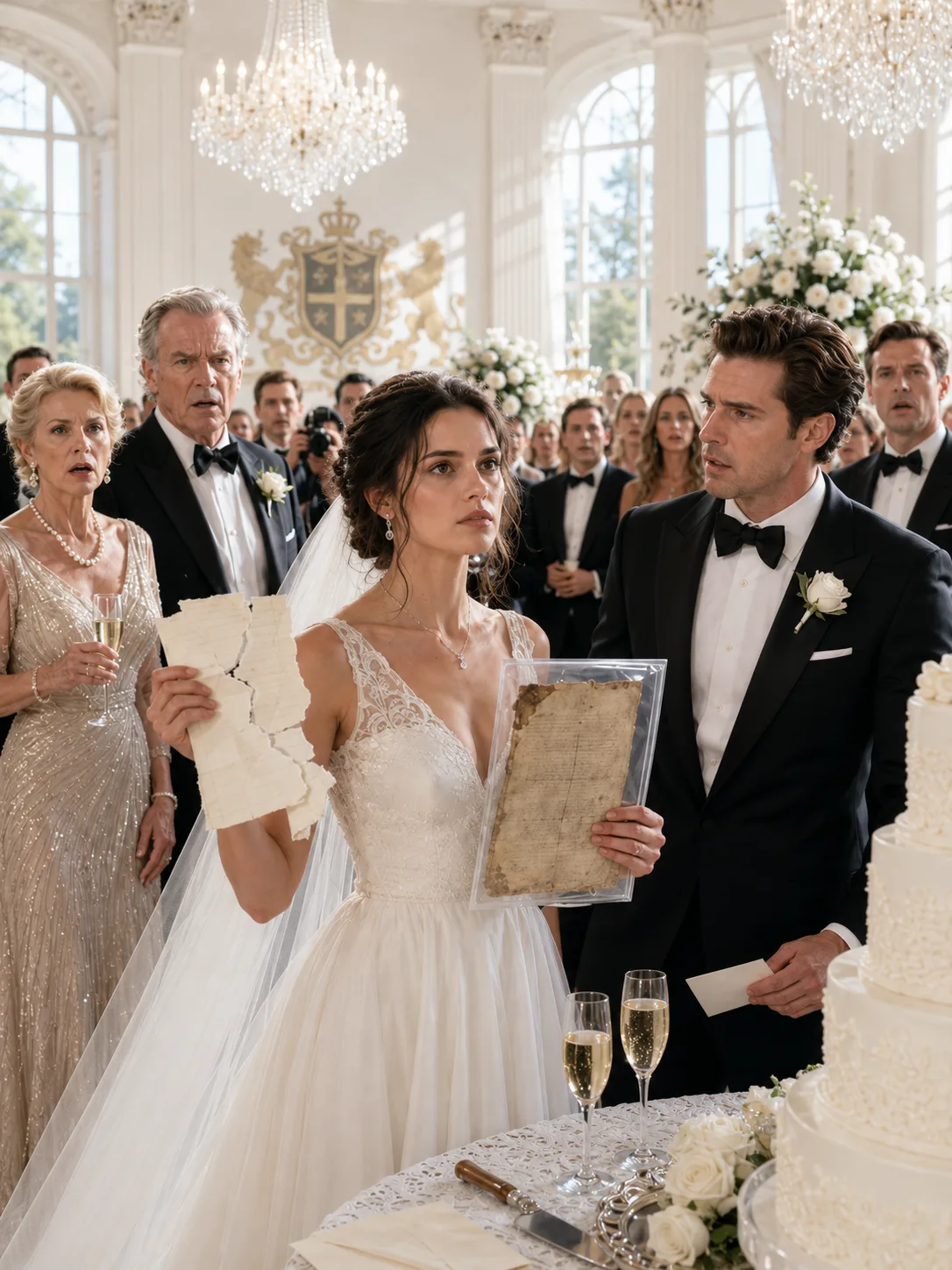
They placed the name-change documents beside her wedding cake.
Chapter 1
They placed the name-change documents beside her wedding cake.
Not in a lawyer’s office.
Not in private.
Not even after the honeymoon.
At the reception.
Between the champagne tower and the silver knife.
A folder of cream-colored legal papers lay on the lace tablecloth, waiting for her signature like a second set of vows.
Application for Legal Change of Surname.
From: Mara Vale.
To: Mara Whitestone.
Everyone smiled as if this were romantic.
Mara did not pick up the pen.
Across the ballroom, two hundred guests watched beneath chandeliers dripping with crystal and money. Reporters from society magazines hovered near the floral arch. The orchestra had paused. The cake had not been cut. The bride had not yet danced.
And the Whitestone family had decided the most important part of the wedding was not love.
It was absorption.
Her new husband, Adrian Whitestone, stood beside her in his black tuxedo, jaw tight, eyes fixed on the folder as if
it had appeared there like a snake.
His mother, Victoria Whitestone, lifted a glass of champagne.
“Now, darling,” she said warmly, “it is only a formality.”
Mara looked at her.
“Then it can wait.”
The room shifted.
Small movements.
Fans lifted.
Glasses paused.
A cousin stopped whispering.
Victoria’s smile remained perfect.
“It is tradition.”
Mara’s fingers rested lightly on the table.
“Tradition usually survives waiting.”
A few guests laughed nervously.
Adrian’s hand moved toward hers under the table, but before he could touch her, his father spoke.
Charles Whitestone, chairman emeritus of Whitestone Capital, leaned back in his chair with the weary patience of a king forced to explain gravity.
“Mara, our family name is not a casual matter.”
“No name is.”
His eyes narrowed.
“You are being given something few people in this world are invited to carry.”
There it was.
Given.
As if her own name were a
poor dress to be replaced by couture.
Mara Vale had been many things before she became Adrian’s wife: courthouse archivist, historical researcher, daughter of a fired schoolteacher, granddaughter of a woman who cleaned train stations, owner of three good dresses and one stubborn refusal to bow before old money.
Now the Whitestones wanted her to become grateful ink.
Victoria laughed softly.
“You must understand, dear. Whitestone is not merely a surname. It is a legacy.”
Mara looked around the ballroom.
The family crest projected in gold on the wall.
A white stone tower beneath a black hawk.
The logo appeared on napkins, menus, wine bottles, charity brochures, investment reports, museum plaques, university halls, and the entrance to the very estate where they were married.
For one hundred years, the Whitestone name had meant power.
Banks.
Railroads.
Shipping.
Real estate.
Philanthropy.
Political access.
A dynasty.
And now, according to everyone in
the room, Mara should be honored to disappear into it.
Adrian leaned toward her.
“We don’t have to do this now.”
Victoria’s eyes flashed.
“Adrian.”
He straightened.
“No,” he said quietly. “We don’t.”
The room went colder.
His older brother, Nathaniel, smiled from the end of the table.
“Careful, Adrian. The bride may think you’re ashamed of your own name.”
Mara looked at Nathaniel.
“I’m sure your name is proud enough for all of you.”
A soft gasp.
Adrian almost smiled.
Victoria did not.
She pushed the pen closer to Mara.
“Every Whitestone wife has taken the name.”
“Then I’m glad to introduce variety.”
Charles set down his glass.
“You are now part of this family.”
“I married Adrian.”
“You married into us.”
“No,” Mara said. “I married him. The rest of you were present.”
The silence became sharp.
A society reporter near the floral arch lowered her notebook, eyes wide.
Victoria’s voice dropped.
“Do not embarrass us on your wedding day.”
Mara finally picked up the folder.
For one second, the room relaxed.
Then she opened it, removed the signature page, and tore it cleanly in half.
The sound carried through the ballroom.
Adrian turned to her, stunned.
Victoria went white.
Charles stood.
Nathaniel laughed once, disbelieving.
Mara placed the torn papers back on the cake table.
“I will not change my name.”
Victoria’s mask cracked.
“You should be grateful we allowed you to carry ours.”
Mara looked at her.
That was the mistake.
Not the pressure.
Not the papers.
Not the public humiliation.
That sentence.
Allowed.
Mara reached into the small beaded purse hanging from her wrist and removed an old folded document sealed inside a clear archival sleeve.
Adrian’s eyes dropped to it.
He knew that sleeve.
He had seen her use them for fragile records in courthouse basements.
“Mara,” he whispered. “What is that?”
She looked at his family.
“The reason I will never be grateful for a stolen name.”
Charles’s face changed.
Not much.
But enough.
Victoria saw it and went still.
Mara unfolded the document carefully.
It was a baptismal certificate from 1899.
The ink had faded.
The paper was brittle.
But the name was clear.
Elias Vale.
Beside it, in a later legal notation:
Alias: Elias Whitestone.
Murmurs stirred.
Mara raised her voice.
“Before your family became Whitestone, before the tower crest, before the bank, before the foundation, before one hundred years of pretending nobility, your name was Vale.”
Charles whispered, “That is a lie.”
Mara looked at him.
“No. The lie is what your grandfather built after betraying mine.”
The ballroom fell silent.
Mara continued.
“The Whitestone fortune began when Elias Vale stole partnership deeds, changed his surname, and testified against his own brother Samuel Vale to hide a railway bond fraud. Samuel went to prison. Elias became Elias Whitestone. My family carried the name you buried.”
Adrian stared at her.
“My God.”
Victoria’s face hardened.
“You have no proof.”
Mara smiled sadly.
“I’m an archivist. Proof is what I bring to weddings when people try to erase me.”
Then Adrian did something no one expected.
He picked up the pen.
Not to sign her name-change papers.
Those were torn.
He took a blank card from the table, wrote slowly, and held it up.
Adrian Vale.
His mother staggered back as if he had struck her.
Charles shouted, “You will not!”
Adrian looked at Mara.
Then at the crest glowing behind his family.
“I married the only honest name in this room.”
By midnight, the Whitestone brand would begin losing the one thing it had controlled for a century.
Its name.
Mara Vale learned early that names could be stolen without anyone touching your body.
Her grandmother taught her that.
Nora Vale had hands cracked from cleaning chemicals, a back curved from decades of work, and a voice that became sharp whenever anyone mispronounced their surname.
“Vale,” she would say. “Not Vail. Not Veil. Vale.”
When Mara was eight, she asked why it mattered.
Her grandmother stopped chopping onions.
“Because when poor people lose a name, rich people call it history.”
Mara did not understand then.
She understood later.
The Vale family story lived in fragments.
An ancestor named Samuel.
A brother who betrayed him.
A court case no one could find.
A fortune that should have been shared.
A surname that became a warning.
Samuel Vale, her grandmother said, had been a railway engineer and partner in an early investment syndicate during America’s industrial expansion. His brother Elias handled papers. Elias was charming. Elias knew bankers. Elias spoke like a man people trusted because he wore good boots.
Then came fraud.
Forged railway bonds.
Missing land options.
A fire in a records room.
Samuel was accused.
Elias testified.
Samuel went to prison.
Elias disappeared from public records for five years.
Then the Whitestone name appeared.
New money.
Clean origins.
A white tower crest.
A story about a family “rising from stone and steel.”
Nora Vale spat whenever she heard it.
“They rose from our grave.”
Mara became an archivist because family legends annoyed her.
Not because she disbelieved them.
Because she wanted proof.
She studied history, records management, legal archives, land deeds, and paleography. She learned to read old handwriting, water-damaged documents, marginal notes, court ledgers, and the polite language of fraud.
She worked in county archives, then private collections, then litigation research.
She became the woman lawyers called when a hundred-year-old deed suddenly mattered.
She was good.
Quietly good.
Good enough to know the Vale story was more than bitterness.
But not good enough, at first, to prove it fully.
Then Adrian Whitestone walked into the archive.
Not as a billionaire.
Not at first.
He came wearing jeans, a charcoal coat, and the expression of a man trying not to be recognized by anyone with internet access.
Mara was cataloging railroad compensation claims from 1902 when he approached the desk.
“I’m looking for old Whitestone family land records.”
She did not look up.
“Congratulations.”
He blinked.
“Sorry?”
“Most people are looking for records. You found a building full of them.”
A small smile appeared.
“I deserved that.”
“Yes.”
He gave his name.
Mara looked up then.
Adrian Whitestone.
Youngest son of Charles and Victoria Whitestone.
CEO of Whitestone Urban Development.
The “ethical Whitestone,” according to profiles.
Which, in Mara’s experience, often meant he donated politely while inheriting aggressively.
“What land records?” she asked.
“A parcel outside Albany. My family foundation wants to restore an old railway worker settlement.”
“Restore or rebrand?”
His smile faded.
“Restore, I hope.”
“Hope is not a documentation method.”
“No. That’s why I’m here.”
She liked that answer despite herself.
For three hours, they worked through ledgers.
Adrian was different from the Whitestones she had researched from newspaper clippings and foundation brochures. He listened. Took notes. Asked when he did not understand. Did not pretend expertise.
When she corrected him, he thanked her.
That was unusual.
When she found evidence that the worker settlement had been seized from immigrant laborers through unpaid tax manipulation, he looked genuinely disturbed.
“That isn’t in our foundation packet,” he said.
“I’m shocked.”
“Do you always do that?”
“What?”
“Say devastating things with no volume.”
“It saves energy.”
He laughed.
Mara tried not to.
Failed.
He returned the next week.
Then the next.
At first, strictly for research.
Then coffee.
Then dinner at a diner because Mara refused to let him take her somewhere that used edible flowers.
Adrian learned quickly that Mara was not impressed by his name.
That was one of the things he loved first.
She challenged every comfortable story he carried.
His family’s philanthropy.
His company’s development language.
His belief that he could reform a dynasty from inside without being changed by it.
“You think wealth is a tool,” Mara told him once.
“It can be.”
“So can a knife. That doesn’t make it dinner.”
He looked at her for a long moment.
Then said, “You make me feel stupid.”
“I doubt that.”
“No. In the useful way.”
She should have run.
Instead, she fell in love.
Not with the Whitestone name.
Never that.
With Adrian.
The man who sat on archive floors reading century-old tax books because she told him the footnotes mattered.
The man who brought her soup when she worked late.
The man who admitted his family frightened him more than hostile investors.
The man who asked, one rainy evening, “Do you think a name can be repaired?”
Mara answered, “Only if the person carrying it stops using it as a shield.”
He nodded.
“I’m trying.”
She believed him.
That was love’s first danger.
It believes effort before proof is complete.
The Whitestones did not reject Mara immediately.
That would have been too honest.
Victoria Whitestone invited her to dinner at the family estate two months after she and Adrian began appearing in public together.
Whitestone House stood above the Hudson River, all pale stone, black iron balconies, manicured lawns, and windows tall enough to make ordinary people feel temporary.
The family crest was carved above the entrance.
A white tower beneath a black hawk.
The same crest Mara had seen stamped on charitable grants, bank buildings, private schools, hospital wings, and boardroom doors.
Adrian squeezed her hand before they entered.
“They’re a lot,” he said.
“Your house has heraldry. I guessed.”
He smiled nervously.
“I’m serious.”
“So am I.”
Victoria greeted them in the foyer.
She was elegant, silver-haired, and beautiful in the way old money women become beautiful when no one has ever interrupted their sleep over rent.
“Mara Vale,” she said. “The archivist.”
“The mother,” Mara replied.
Adrian coughed.
Victoria smiled.
Not warmly.
“Adrian told us you have been helping with foundation research.”
“Yes.”
“How charming. I do admire people who preserve the past.”
“Only the parts that survive the powerful.”
Victoria’s smile paused.
Dinner was long.
Charles Whitestone asked about her family in the tone of a man asking about weather damage.
Nathaniel, Adrian’s older brother, asked whether archive work paid “enough to be interesting.”
His wife, Beatrice, complimented Mara’s dress by saying it was “brave to wear something understated here.”
Adrian defended her every time.
But Mara noticed something.
He defended her like a man swatting arrows.
Not like a man questioning why his family owned a bow.
After dinner, Victoria found Mara alone in the gallery.
Portraits lined the walls.
Generations of Whitestones, each posed beside symbols of industry: rail lines, towers, ships, banks.
Victoria stood beside her.
“You must understand, Mara, this family is not simply wealthy. We are institutional.”
“That sounds like something requiring regulation.”
Victoria laughed softly.
“Adrian enjoys sharp women. He always has.”
Mara turned.
“Does he?”
“But marriage is different.”
“I haven’t proposed to him, so perhaps tell him.”
Victoria’s eyes cooled.
“If things continue, there will be expectations.”
“Whose?”
“The family’s.”
“Families have many expectations. Some should be disappointed for their health.”
Victoria studied her.
“The Whitestone name has survived scandals, wars, depressions, and political shifts. It survives because every person who enters this family understands that the name comes first.”
Mara looked at the portraits.
“What happens to the people?”
“They are remembered through the name.”
“No,” Mara said. “They are replaced by it.”
That was the night Victoria decided Mara was dangerous.
Charles decided later, after Mara uncovered the Albany settlement records and advised Adrian not to let the foundation restore anything without restitution to descendant families.
Nathaniel decided immediately because Mara did not laugh at his jokes.
The family began applying pressure.
Soft pressure first.
Invitations designed to expose class difference.
Articles praising Adrian’s need for a “proper partner.”
Old girlfriends appearing at charity events.
Society columnists calling Mara “refreshingly unpolished.”
Then harder pressure.
A foundation contract withdrawn from Mara’s consulting firm.
A landlord suddenly raising concerns about her archive boxes.
Anonymous messages asking whether she knew what happened to women who tried to climb stone walls.
Adrian found out and confronted his family.
They denied everything.
Of course.
Mara expected that.
What she did not expect was Adrian proposing.
Not because she doubted he loved her.
Because she doubted he understood war.
He asked in the basement archive where they first met.
No ring at first.
Just a folder.
She opened it.
Inside was a restitution plan for the Albany settlement, with funding transferred out of Adrian’s personal holdings before the family could block it.
“I listened,” he said.
Mara stared at the documents.
“You did.”
“I want to build a life where listening is not an event.”
Her eyes burned.
Then he showed her the ring.
Small.
Antique.
No Whitestone crest.
“My grandmother’s?” she asked suspiciously.
“A jeweler in Queens.”
“Good.”
“Marry me?”
She looked at him.
The man.
Not the name.
“Yes.”
He smiled like sunrise.
Neither of them noticed the archive camera in the corner.
Three hours later, Victoria Whitestone knew.
The engagement lasted six months.
It felt longer.
The Whitestone family behaved like a country preparing annexation.
Victoria insisted on hosting the wedding.
Mara refused.
Victoria insisted the ceremony occur at Whitestone House.
Mara refused.
Victoria insisted on guest list approval.
Mara said, “You may approve your guests. I will invite mine.”
Victoria asked how many.
Mara said, “The living ones or the ancestors?”
Adrian laughed.
Victoria did not.
Eventually, a compromise emerged, which meant the Whitestones won the venue but lost several symbols.
The wedding would be at Whitestone House because the estate chapel had “historical significance,” though Mara privately suspected its real significance was photography.
The ceremony would not include the family crest.
The vows would not mention legacy.
Mara would walk herself down the aisle.
Her grandmother Nora, too ill to attend, sent a letter instead.
Adrian read it first.
Then cried.
Mara found him in the kitchen holding the paper.
“What did she say?”
He handed it to her.
Nora’s handwriting was shaky but fierce.
Mara,
Do not let them make gratitude out of surrender. If you take his hand, take it as yourself. If his people ask for your name, ask what they did with theirs.
Love him. Do not vanish for him.
Your grandmother,
Nora Vale.
Mara folded the letter carefully.
“She always did enjoy sounding like scripture.”
Adrian wiped his eyes.
“She’s right.”
“Yes.”
“I won’t let them take your name.”
Mara looked at him.
“Don’t make promises about what they can’t do. Make promises about what you will do.”
He nodded.
“I will stand with you.”
That promise would be tested beside the cake.
Before that, the family made one final attempt privately.
Two weeks before the wedding, Charles invited Mara to his study.
Adrian was delayed by a board call.
Convenient.
Mara entered and found Charles, Victoria, Nathaniel, and a family attorney waiting.
A folder lay on the desk.
Name-change papers.
Prenuptial amendment.
Media statement draft.
Mara looked at the folder.
“How festive.”
Charles said, “This will save unpleasantness later.”
“I enjoy unpleasantness when it introduces itself honestly.”
Victoria sighed.
“Mara, you are marrying into a public family. Public coherence matters.”
“My surname disrupts coherence?”
Nathaniel smiled.
“It confuses the story.”
Mara turned to him.
“Maybe the story is weak.”
The attorney cleared his throat.
“The Whitestone name is a protected commercial identity across multiple trusts, licensing structures, philanthropic arms, and brand holdings. Spousal use of the family surname ensures alignment in public, legal, and charitable contexts.”
Mara stared.
“You made marriage sound like trademark compliance.”
Charles leaned forward.
“Because at this level, it is.”
There it was.
The clean truth.
Mara almost appreciated it.
Victoria softened her voice.
“You will have access to extraordinary resources. The name opens doors. It protects. It elevates.”
Mara smiled.
“From what?”
“From being no one.”
The words hung in the room.
Mara felt her grandmother behind her somehow.
Every corrected pronunciation.
Every story of Samuel.
Every warning.
She stood.
“I was someone before Adrian.”
“Of course,” Victoria said, too quickly.
“No. Not of course. That is the thing none of you believe.”
Charles’s face hardened.
“If you refuse the name, people will question your commitment.”
“To Adrian?”
“To this family.”
“Good,” Mara said. “I want them to.”
She left.
That night, she told Adrian everything.
He was furious.
Not performatively.
Quietly.
Dangerously.
“I’ll cancel the wedding,” he said.
“No.”
“Mara—”
“No. I’m not surrendering the day because they tried to steal it early.”
“What do you want?”
She thought.
“Truth.”
“About what?”
She looked at the old archival boxes in the corner of her apartment.
For months, she had been working secretly on the Vale-Whitestone records. The proof was almost complete.
Baptismal certificates.
Railway bonds.
Court transcripts.
Newspaper notices.
Prison registers.
Land transfers.
A name-change petition.
A false testimony.
A founding bank charter.
All tying Elias Vale to Elias Whitestone.
All proving the Whitestone name began not as legacy but camouflage.
“Everything,” she said.
Adrian stared at the boxes.
“You found it.”
“Yes.”
“Why didn’t you tell me?”
“Because I needed to know whether you would stand with my name before learning yours was built on it.”
He flinched.
Then nodded.
“That’s fair.”
“Is it?”
“It hurts. That doesn’t make it unfair.”
She loved him more for that.
But love did not erase fear.
The wedding came.
The ceremony was beautiful.
Adrian cried during the vows.
Mara did not cry until he promised:
“I do not ask you to become mine by losing anything that made you yourself.”
Victoria’s face remained still.
After the kiss, guests applauded.
For one hour, Mara believed they might survive the day without war.
Then the name-change folder appeared beside the cake.
After Mara tore the papers, the reception became less a wedding than a trial with flowers.
Charles demanded the document.
Mara handed it to Adrian instead.
He read the baptismal certificate slowly.
Then the legal notation.
Elias Vale.
Alias Elias Whitestone.
His face went pale.
“Mara.”
“I’m sorry,” she said softly.
“For what?”
“For the timing.”
He looked at the torn name-change papers.
Then at his parents.
“No. The timing is excellent.”
Victoria snapped, “Adrian.”
He did not look at her.
Mara opened the archival folder.
She had prepared copies for exactly this possibility, though part of her had hoped she would never need them.
Hope was not a documentation method.
She placed the first page on the table.
“The public Whitestone story begins in 1904 with Elias Whitestone founding Whitestone Trust & Rail Finance after supposedly arriving from nowhere with a modest investment and extraordinary discipline.”
Nathaniel laughed.
“Are we doing a lecture?”
Mara looked at him.
“Yes. Try to keep up.”
A few guests made shocked sounds.
Adrian stood beside her.
Not behind.
Beside.
Mara continued.
“Before 1904, Elias Whitestone does not exist in census, church, immigration, tax, military, commercial, or court records. But Elias Vale does.”
She placed another page.
“Elias Vale and Samuel Vale were brothers. Partners in a railway bond syndicate connected to land acquisitions outside Albany. Samuel managed engineering and worker settlements. Elias managed investor papers.”
Another page.
“In 1901, forged bonds were discovered. Samuel was accused of creating fraudulent instruments and misappropriating settlement funds. The records room containing partnership documents burned before trial.”
Charles said, “Old rumors.”
Mara looked at him.
“Old evidence.”
She placed a court transcript.
“Elias testified against Samuel. He claimed Samuel acted alone. Samuel was convicted. He died in prison eight years later.”
Her voice tightened.
“My ancestor.”
The ballroom was silent now.
Even the reporters had stopped pretending discretion.
Mara placed the next document.
“Six months after Samuel’s conviction, Elias petitioned for a surname change in a rural county under sealed religious grounds. He became Elias Whitestone.”
Victoria whispered, “This is absurd.”
Mara placed the final document.
“A bank charter draft in Elias’s hand shows original capitalization from land options owned by both Vale brothers. Those options became the foundation of Whitestone Trust.”
Adrian picked up the copy.
His fingers shook.
“My family fortune began with stolen partnership assets.”
Mara nodded.
“And a stolen name.”
Charles stepped forward.
“Enough. This is a wedding, not a revenge performance.”
Mara looked at him.
“You put the papers beside the cake.”
A nervous laugh rose from the back tables.
Charles turned red.
Victoria’s voice became icy.
“Even if this were true, it has no bearing on today.”
Mara looked at the crest glowing on the wall.
“It has every bearing. You told me I should be grateful to carry Whitestone. But Whitestone was created to escape Vale.”
Nathaniel stood.
“You little—”
Adrian moved before he finished.
Not dramatically.
Just one step.
Between Nathaniel and Mara.
“Finish that sentence,” Adrian said softly, “and it will be the last thing you say at my wedding.”
Nathaniel stopped.
For the first time, Mara saw fear flicker across his face.
Adrian turned to his parents.
“You knew.”
Charles said nothing.
Victoria looked away.
That answer was enough.
Adrian laughed once.
Hollow.
“You knew.”
Charles finally spoke.
“It is family history. Every dynasty has unpleasant origins.”
“No,” Adrian said. “You don’t get to call betrayal an origin.”
Victoria stepped toward him.
“Adrian, think carefully. This name carries every asset, every trust, every voting structure, every licensing agreement—”
“I know.”
“Then you know what happens if you challenge it.”
He looked at Mara.
Then at the torn papers.
Then at the crest.
“I’m not challenging it.”
Victoria exhaled.
For one second, she thought she had won.
Then Adrian picked up the pen and wrote:
Adrian Vale.
He held the card high enough for the nearest camera to capture.
“I’m leaving it.”
Names are not only emotional.
In families like the Whitestones, names are legal machinery.
The Whitestone name was not merely a surname. It was a commercial identity owned, licensed, protected, and leveraged across dozens of entities.
Whitestone Capital.
Whitestone Foundation.
Whitestone House.
Whitestone Urban Development.
The Whitestone Prize.
Whitestone Fellowships.
Whitestone Medical Wing.
Whitestone Trust.
For a century, the family had built power around a story:
Stone from nothing.
Strength from purity.
Legacy from name.
But stories become fragile when their central symbol is exposed as fraud.
Adrian understood this faster than anyone expected because, unlike his brother, he had actually read the family trust documents.
There was a morality clause in the Whitestone Legacy Trust.
An old one.
Inserted after a 1930s scandal to preserve public confidence.
If the family name became materially associated with proven fraud, betrayal, or misrepresentation affecting the founding legacy, the trust’s commercial licensing authority could be challenged by any direct beneficiary acting to preserve reputational value.
It was meant to stop outsiders from tarnishing the name.
It did not anticipate a bride with archival proof that the name itself was the tarnish.
By morning, the wedding footage was everywhere.
Mara tearing the papers.
Victoria saying she should be grateful.
The baptismal certificate.
Adrian holding the card.
Adrian Vale.
The internet chose sides before breakfast.
Society pages called it vulgar.
Historians called it fascinating.
Legal analysts called it complicated.
Descendants of the Albany railway settlement families called Mara within hours.
By noon, Adrian filed formal petitions to change his legal surname to Vale.
Not hyphenated.
Not private.
Vale.
He also filed a challenge to the Whitestone Legacy Trust’s exclusive control over the family brand, arguing that continued use of the Whitestone name as a symbol of moral legacy constituted consumer and donor misrepresentation in light of authenticated records.
Charles called him.
Adrian put it on speaker because Mara asked.
“Withdraw this,” Charles said.
“No.”
“You are destroying a century of work.”
“I am ending a century of theft.”
“You think that woman loves you? She married you to humiliate us.”
Mara raised an eyebrow.
Adrian looked at her and said into the phone, “That woman is my wife. Her name is Mara Vale. Practice saying it.”
Charles hung up.
Victoria tried a different route.
She appeared at Mara’s apartment two days later.
Alone.
No pearls.
No lawyers.
That made her more dangerous, not less.
Mara opened the door but did not invite her in.
Victoria looked exhausted.
“Mara.”
“Mrs. Whitestone.”
“My son is making a mistake.”
“Your son is making a choice.”
“A choice you encouraged.”
“Yes.”
Victoria’s eyes flashed.
At least she did not pretend otherwise.
“Do you understand what will happen if the trust challenge succeeds?”
“Yes.”
“Licensing agreements collapse. Foundation branding freezes. Donor commitments halt. Board seats tied to family name provisions become uncertain. A century of influence destabilized.”
Mara smiled faintly.
“You should consider archive work. You summarize well.”
“This is not a joke.”
“No. It is accountability.”
Victoria stepped closer.
“Do you want money?”
Mara almost laughed.
“There it is.”
“Name it.”
“My name?”
Victoria’s mouth tightened.
“You think that is clever.”
“I think it is accurate.”
“You will ruin him.”
Mara’s expression changed.
“No. You trained him to believe leaving your lie would ruin him. That is different.”
Victoria’s face hardened.
“The Vale name died powerless.”
Mara leaned in.
“No. It survived poor. You mistake the two because your family stole the difference.”
For the first time, Victoria had no answer.
Mara closed the door.
Her hands shook afterward.
Adrian found her sitting on the kitchen floor.
“She came?”
“Yes.”
“Did she threaten you?”
“She offered money.”
“Of course.”
He sat beside her.
“What did you say?”
“That my name was already taken.”
He looked at her for a long moment.
Then kissed her hand.
“May I sit here?”
“You already are.”
“I mean in the life after the explosion.”
She looked at him.
He was scared.
Good.
Not of her.
Of what came next.
“Yes,” she said. “But no pretending this is romantic every day. Some days it will be legal bills and your relatives calling me a curse.”
“I know.”
“Some days you’ll miss being unquestioned.”
He was silent.
Honest silence.
Then:
“Yes.”
She nodded.
“On those days, tell me before resentment learns better grammar.”
He smiled faintly.
“I love you.”
“I know.”
“Very confident.”
“I kept my name. Confidence was implied.”
The legal name change hearing was public because Adrian wanted it public.
His lawyers advised discretion.
He refused.
“Discretion is how this family turned fraud into tradition,” he said.
Mara sat beside him in court.
No wedding gown now.
No flowers.
Just a black suit, old documents, and the grandmother’s letter folded in her pocket.
The judge reviewed the petition.
“Mr. Whitestone, you understand the legal consequences of changing your name?”
“Yes, Your Honor.”
“You are not doing this under coercion?”
Adrian looked briefly at Mara.
“No.”
“Are you changing your name for marital reasons?”
“Yes,” he said. “But not in the conventional sense.”
The judge removed her glasses.
“Elaborate.”
Adrian stood.
“My wife was asked publicly to surrender her surname as a condition of acceptance into my family. We later established that her surname is the original surname my family abandoned after a founding act of fraud against her ancestor.”
The judge stared.
Court reporters leaned forward.
Adrian continued.
“I am taking the Vale name because it is honest. Because my wife should not be required to disappear into a name created to erase her family. And because the legacy I want to build cannot begin with asking the truth to change its surname.”
The courtroom was silent.
The judge looked at Mara.
“Mrs. Vale?”
Mara stood.
“Yes?”
“Do you consent to your husband taking your surname?”
Mara almost laughed.
The question felt strange in a world where women were expected to answer it silently in reverse.
“I do.”
The judge nodded.
“Petition granted.”
Adrian Whitestone became Adrian Vale at 10:42 a.m.
The moment appeared on every news site by noon.
The market reaction was immediate.
Whitestone Capital stock dipped.
Donors paused foundation pledges.
Museums requested documentation before continuing name partnerships.
Universities opened reviews of Whitestone-endowed chairs.
The Albany descendant families filed claims.
The family trust challenge moved forward.
Nathaniel gave an interview calling Adrian “emotionally captured.”
Adrian responded with one sentence:
I was born captured. I married the person who showed me the lock.
Mara told him it was dramatic.
He said, “But accurate.”
She said, “Annoyingly.”
The phrase went viral.
So did the wedding footage.
A young historian posted a thread comparing the Whitestone founding myth to the Vale court records. It gained millions of views.
A labor rights group highlighted Samuel Vale’s worker settlement plans and asked how many communities lost land when Elias Whitestone rewrote the records.
A nonprofit created a map of institutions bearing the Whitestone name.
One by one, those institutions began calling.
Not Charles.
Not Victoria.
Adrian.
The son who had left the name.
The man now legally positioned to challenge its use.
The Whitestone brand had been powerful because it seemed permanent.
Mara had spent her life in archives.
She knew permanence was often just neglect with better framing.
Nora Vale lived long enough to see Adrian take the name.
Barely.
She was eighty-nine, stubborn, and dying in a small bedroom filled with plants, pill bottles, and photographs of people the world had never considered important.
Mara and Adrian visited three days after the hearing.
Nora sat upright against pillows, oxygen tube beneath her nose, eyes bright.
“So,” she said to Adrian, “you’re a Vale now.”
Adrian bowed his head slightly.
“If you’ll have me.”
Nora snorted.
“Names aren’t guest rooms.”
Mara smiled.
Adrian looked nervous.
Good.
Nora studied him.
“Do you know what it means?”
“To tell the truth about what my family did.”
“That’s the easy part.”
Adrian blinked.
“It is?”
“For you, yes. You have cameras. Lawyers. Money. Truth likes arriving in limousines when rich men finally invite it.”
Mara coughed to hide a laugh.
Adrian accepted the hit.
“What is the hard part?”
Nora leaned forward.
“To carry a name without trying to own its suffering.”
The room quieted.
She continued.
“You don’t get to become noble because you admitted your people were thieves. You don’t get to make Samuel Vale a costume. You don’t get to love my granddaughter by turning her name into your redemption.”
Adrian’s eyes lowered.
“No, ma’am.”
Nora looked at Mara.
“He learns?”
“Sometimes.”
“Good enough to start.”
She reached toward a small box on the bedside table.
Mara opened it.
Inside was a pocket watch.
Old.
Scratched.
Broken.
“It was Samuel’s,” Nora said. “Or so my mother swore. Could be a lie. Poor families keep relics too. We’re just honest that memory sometimes borrows proof.”
Mara lifted it carefully.
On the back, faintly scratched:
S.V.
Nora looked at Adrian.
“You don’t get this.”
Adrian nodded.
“Of course.”
“You get a copy of the story.”
He smiled.
“That is better.”
Nora’s eyes softened.
Maybe slightly.
“Maybe you’ll do.”
She died two weeks later.
At the funeral, Adrian stood beside Mara but did not speak unless asked.
No speech.
No public gesture.
No press.
When a reporter appeared outside the church, Adrian personally asked him to leave and then stood there until he did.
Mara noticed.
So did her family.
After the burial, Mara placed one copy of the wedding name-change papers, torn in half, into her grandmother’s keepsake box.
Not as a trophy.
As evidence.
Nora Vale had been right.
Do not let them make gratitude out of surrender.
Six months after the wedding, Whitestone House lost its crest.
Not literally at first.
Legally.
The court ruled that the Whitestone Legacy Trust could no longer claim exclusive moral licensing authority over the founding brand without disclosure of the authenticated Vale records. Institutions using the Whitestone name in connection with historical philanthropy had to include revised provenance statements.
That sounds dry.
It was devastating.
Museums replaced plaques.
Universities renamed fellowships.
The hospital wing became the Vale-Whitestone Accountability Center after a donor revolt.
The family foundation split.
Adrian directed his portion into a restitution trust for the descendants of Samuel Vale’s worker settlements and communities harmed by early railway land fraud.
Charles called it extortion.
Mara called it accounting with a pulse.
Victoria retreated from society for exactly forty-two days, then returned wearing black and giving interviews about “complex legacies.”
Mara did not watch them.
Nathaniel tried to seize control of remaining assets by arguing Adrian had damaged the family brand.
The court disagreed.
Brand value had not been damaged by Adrian’s name change, the judge wrote.
It had been damaged by the suppressed truth.
Mara framed that line.
Adrian said framing court opinions was strange.
Mara said, “You have ancestors on walls.”
He said, “Fair.”
They did not move into Whitestone House.
Adrian refused.
Mara refused faster.
Instead, they bought a smaller house near the archive where they met.
Still nicer than anything Mara had lived in.
Not obscene.
No crest.
No gates.
A blue front door because Mara liked blue and Adrian had learned not to turn every design choice into symbolism.
Though, privately, the blue door did feel like a promise.
Their mailbox read:
M. Vale & A. Vale.
The first time Adrian saw it, he stared too long.
Mara found him outside.
“Are you crying at the mailbox?”
“No.”
“You are.”
“It has my name.”
“It has our electric bill too.”
“I can be moved by multiple things.”
She smiled.
Their marriage was not easy.
Public righteousness did not cancel private difficulty.
Adrian mourned parts of the family he lost.
Mara resented that sometimes.
Then felt guilty.
Then resented the guilt.
He struggled with sudden exile from rooms that had once opened instantly.
She struggled with being treated as a symbol by people who did not know her favorite soup, her insomnia, her hatred of voicemail.
They fought.
About money.
About press.
About whether Adrian was moving too fast with restitution because he needed to feel clean.
About whether Mara was avoiding joy because vigilance had become habit.
Once, during a terrible argument, Adrian said, “I gave up my name.”
Mara went silent.
He knew immediately.
“Mara—”
“No. Finish it.”
His face went pale.
“I didn’t mean—”
“You did.”
He sat down.
For a long moment, neither moved.
Then he said, slowly, “I gave up access. I gave up protection. I gave up a lie that benefited me. I did not give up my name as a gift to you. I returned to a truth I should have been taught before I could speak.”
Mara’s anger broke, not vanished, but changed.
“Better,” she said.
“I’m sorry.”
“Good.”
“I’ll keep learning the difference.”
“You’ll need to.”
“I know.”
That was marriage too.
Not the absence of wrong sentences.
The willingness to correct them before they became architecture.
People later told the story as if Mara Vale refused a billionaire’s family name because she was proud.
That was true.
But incomplete.
She refused because names are not accessories.
They are records.
They carry betrayals, migrations, jokes, debts, recipes, court cases, bad handwriting, prison registers, love letters, and the stubborn proof that someone existed before power renamed the world.
The Whitestones had believed their name was a crown.
Mara knew it was a mask.
Adrian taking the Vale name did not fix history.
Samuel Vale did not walk out of prison.
The stolen land did not return untouched.
Nora did not get back the years she spent correcting people who thought her name was too small to matter.
But something shifted.
The lie stopped being comfortable.
That matters.
At the restored Albany settlement site, a new archive opened two years later.
Not named after Adrian.
Not named after Charles.
Not even named only after Samuel.
It was called The Vale Records House.
Inside were scanned court transcripts, railway maps, oral histories from descendant families, records of workers whose names had been misspelled or omitted, and a permanent exhibit titled:
When a Family Changes Its Name: Fraud, Memory, and Power.
At the entrance, two documents sat side by side.
Elias Vale’s surname change petition.
And Adrian Whitestone’s legal name change to Adrian Vale.
The plaque beneath them read:
One man changed his name to escape the truth.
One changed his name to return to it.
Mara cried when she saw it.
Then complained that the display lighting was too warm for archival preservation.
Adrian laughed.
By then, he laughed more easily.
At the opening, reporters asked Mara whether she felt vindicated.
She thought of the cake table.
The pen.
Victoria’s smile.
The torn paper.
Her grandmother’s warning.
“I feel responsible,” she said.
“For what?”
“For making sure this does not become a story about one brave wife and one redeemed husband. It is a story about records. Records kept by poor families, ignored by institutions, and waiting for someone to stop calling them rumors.”
Adrian stood in the back, listening.
Proud.
Not possessive.
Later, a young woman approached Mara with tears in her eyes.
“My fiancé’s family wants me to change my name,” she said.
Mara smiled gently.
“Do you want to?”
“I don’t know.”
“Then wait until you do.”
“They say I should be honored.”
Mara looked across the room at Adrian, who was speaking with descendants of the worker settlement families, not leading the conversation, just listening.
“Honor that requires erasure is not honor,” Mara said. “It is appetite.”
The young woman nodded as if something inside her had been given permission to stand.
Years passed.
The Whitestone name did not disappear.
Names rarely do.
But it changed.
Every time it appeared now, the disclosure followed.
Founded by Elias Whitestone, formerly Elias Vale, after contested partnership assets tied to Samuel Vale.
Dry language.
Devastating language.
The kind archives love because it looks calm while rearranging power.
Mara kept her name.
Adrian kept it too.
Sometimes strangers assumed Vale was his family name and asked if he was related to “the old Vales.”
He would smile and say, “By marriage, by history, and by correction.”
Mara said that was too long.
He said truth often was.
Their children, when they eventually had them, carried the Vale name without grandeur. At bedtime, Mara told them stories of Nora, Samuel, archives, railways, and a wedding cake beside a folder no one should have brought.
Adrian told them, “Your mother saved our name.”
Mara corrected him every time.
“No. I refused to lose it.”
The children learned the difference.
On their tenth anniversary, Adrian took Mara back to the courthouse archive where they met.
No gala.
No cameras.
No family crest.
Just dust, ledgers, and the same leaking ceiling pipe that had never been properly fixed.
Mara looked up.
“This building is a preservation hazard.”
“You say that every time.”
“Because it remains true.”
He handed her a small box.
She eyed it suspiciously.
“If that is a diamond shaped like a surname, I’m leaving.”
“It is not.”
Inside was a library card.
For him.
Issued under:
Adrian Vale.
Mara stared.
“You got an archive access card as an anniversary gift?”
“You once said romance is knowing which records matter.”
“I said that during a grant application.”
“I listened.”
She laughed.
Then kissed him between the old land books and the tax ledgers.
Outside, the world still loved powerful names.
It probably always would.
But inside that archive, among records that had waited a century to speak, Mara Vale held her husband’s hand and knew this much:
She had not married into a name.
She had brought one home.
Chapter complete
You have reached the end of this chapter.
Continue reading
A few more worlds to get lost in after this chapter.




