PART 4 — THE HOUSE SHE FINALLY ESCAPED
It was Rosa, wrapped in a thick shawl, holding two steaming mugs of coffee.
Chapter 4
PART 4 — THE HOUSE SHE FINALLY ESCAPED
It was Rosa, wrapped in a thick shawl, holding two steaming mugs of coffee.
“I thought I might find you down here, Mrs. Ava,” Rosa said, handing her a mug with a gentle smile.
“You shouldn’t be out here in the damp air without proper shoes.”
Ava laughed, a clear, ringing sound that echoed softly against the cliffs.
“I spent too many months trapped in shoes I couldn’t use, Rosa. I want to feel everything now.”
Rosa nodded, her eyes shining with a mixture of respect and deep affection.
“You have earned the right to feel the earth beneath your feet, my dear. More than anyone I know.”
They stood together in silence, sipping their coffee, watching the fog slowly lift as the sun rose higher.
The orange rays broke through the mist, turning the gray water into a shimmering field of gold.
Ava looked back at the house, seeing Daniel standing on the deck, looking down at them with a look of pure
devotion.
He waved, and Ava waved back, her heart swelling with a warmth that completely drove out the morning chill.
She knew that the scars on her body and mind would take time to fully fade.
There were still moments when a sudden loud noise would make her flinch, or a shadow would look like a threat.
But looking at Daniel, and looking at the vast, open ocean before her, she knew she had all the time in the world.
She began the walk back up the beach, her stride stronger and more confident with every passing step.
Later that afternoon, a large delivery truck wound its way up the gravel driveway of the coastal estate.
It was the final shipment of their belongings from Connecticut—only the items they had specifically chosen to keep.
Most of the furniture from the old mansion had been sold or donated, too heavily burdened
with dark memories to bring along.
Daniel and Ava stood in the driveway as the movers began unloading the boxes.
Rosa stood nearby, checking items off a master list with meticulous care.
Among the boxes were Ava’s favorite books, her collection of vintage vinyl records, and easel with various art supplies.
“Where would you like the art supplies, ma’am?” one of the movers asked, carrying a heavy wooden crate.
“In the northern corner of the living room, please,” Ava replied, her eyes lighting up with excitement.
“The light there is perfect throughout the entire afternoon.”
Daniel wrapped an arm around her shoulders, pulling her close against his side.
“Are you finally going to start painting again?” he asked, a soft, encouraging tone in his voice.
“I think I am,” she said, looking up at him. “For a long time, I couldn’t see any colors. Everything was gray.”
“But now, every
time I look out at the ocean, I see a thousand different shades of blue and green.”
“I want to capture that. I want to put it on canvas so I never forget what freedom looks like.”
Daniel kissed the top of her head, his heart aching with a familiar, tender pride.
As they unpacked the boxes together inside the house, Daniel came across a small, locked leather briefcase.
It was the case containing the copies of the legal documents, the evidence that had finally brought his mother down.
He stared at it for a long moment, the dark energy of the past threatening to seep into the room.
Ava noticed his stillness and walked over, placing her hand gently over his on the handle of the case.
“We don’t need to keep that in the open, Daniel,” she said softly, understanding his unspoken thoughts.
“It served its purpose. It gave us our lives back. Now, it belongs in the dark.”
Daniel nodded, exhaling a breath he didn’t realize he had been holding.
He carried the briefcase downstairs to a small storage room in the basement, locking it away out of sight.
When he came back upstairs, the heavy feeling was gone, replaced by the warmth of their new home.
Rosa had already set up the record player, and the smooth, soulful voice of an old jazz singer filled the room.
Ava was standing by her easel, arranging her brushes, her face illuminated by the bright afternoon sun.
The house was no longer just a beautiful structure of glass and wood; it was becoming a home.
It was a sanctuary built on the foundation of survival, love, and the beautiful promise of a new beginning.
They had all survived the wreckage of the past, and together, they were building something beautiful from the pieces.
Dinner was a lively affair, filled with light conversation and plans for the upcoming week.
They talked about exploring the local coastal town, buying plants for the wrap-around deck, and perhaps getting a dog.
Simple, ordinary things that ordinary people took for granted, but to them, these plans felt like absolute luxury.
After dinner, Daniel and Ava walked down to the edge of the water, holding hands as the tide crept in.
The water was cold against their skin, a sharp, shocking reminder that they were alive, awake, and completely free.
They stood there for a long time, watching the moon rise over the infinite expanse of the sea.
Ava had learned to read Margaret’s smile the way sailors read the sky before a storm — too calm, too still, a warning dressed as peace.
“Drink this, sweetheart,” Margaret said, holding the small plastic cup an inch from Ava’s lips. “The doctor says it will help with the pain.”
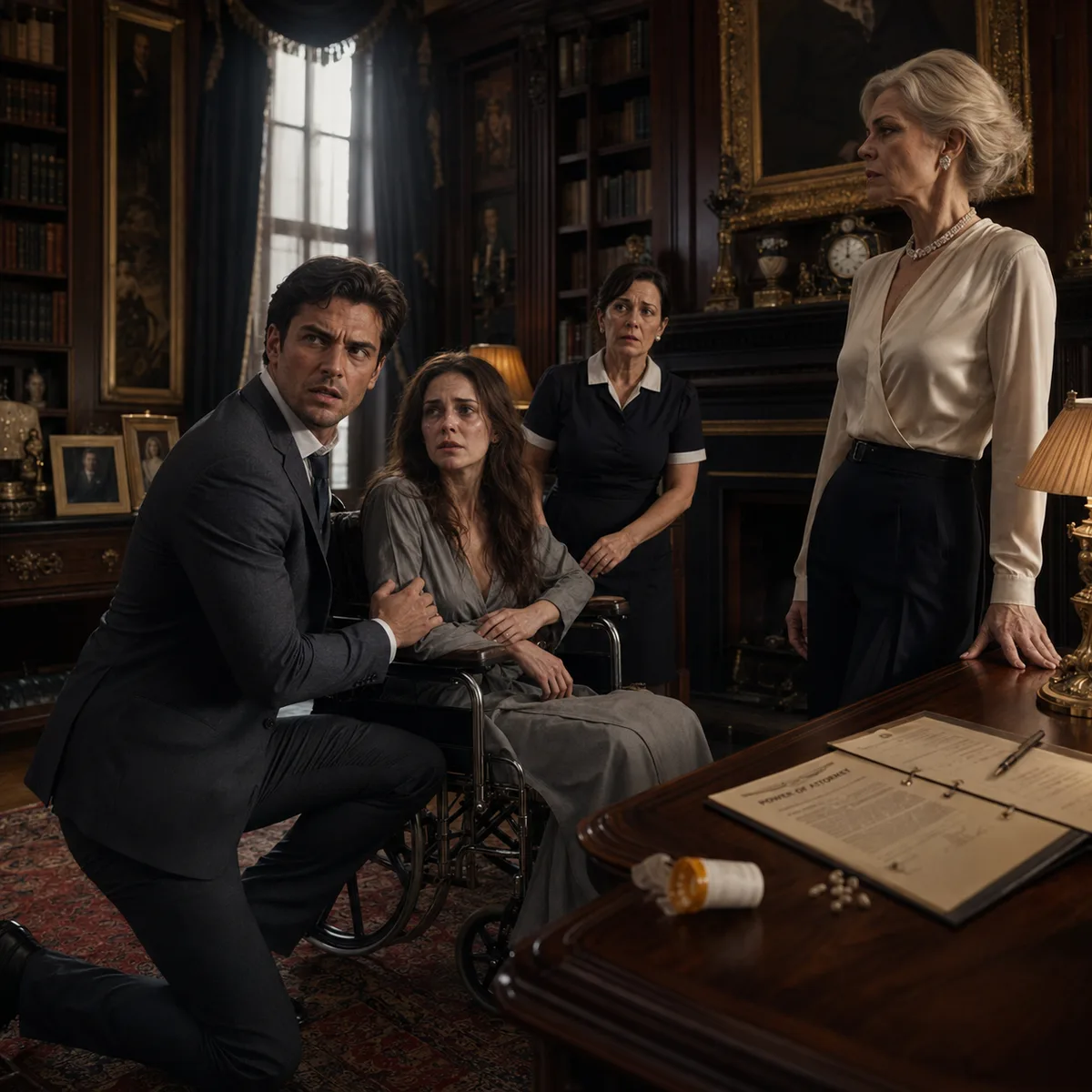
Ava’s fingers gripped the arms of the wheelchair. Three weeks since the accident. Three weeks of therapy sessions that never seemed to end, of doors that locked from the outside, of a mother-in-law who had moved into the guest room and never left. Three weeks of a folder that sat on the study desk like a loaded gun — trust documents, power of attorney, a signature line still empty, still waiting.
“I don’t need it,” Ava said. Her voice came out thinner than she wanted.
“You need to rest. You need to let me take care of things.” Margaret’s hand didn’t waver. “Daniel trusts me. You should too.”
That was the lie underneath every kindness Margaret offered — Daniel trusts me — as if love were a document that could be transferred, signed over, notarized. Ava had begun to suspect the truth was uglier: Daniel didn’t know. Daniel was three states away at a conference Margaret herself had insisted he attend. You’ve been under so much stress, dear, go, we’ll manage here.
The cup pressed closer. Ava turned her face away, and that was when the study door creaked open, and Rosa — the housekeeper who came twice a week, who Ava had begun to watch for the way a drowning woman watches for a rope — stepped inside carrying a stack of folded towels.
Rosa saw the cup. She saw Ava’s eyes, wide and pleading above the rim of it. And she understood, in the space of a single held breath, exactly what she was looking at.
“She didn’t sign anything,” Rosa said quietly, setting the towels down. “Did she?”
Margaret’s hand trembled — just slightly, just enough.
“This isn’t your concern.”
“It is now.”
And before Margaret could stop her, Rosa crossed the room and knocked the cup from her hand.
The cup hit the tile and rolled, spilling its pale liquid in a thin river toward the desk — toward the folder, toward the signature line still blank and gleaming under the lamp.
For one second, nobody moved.
Then Margaret’s face did something Ava had never seen it do. The gentle concern folded inward and what emerged from underneath was sharp, furious, entirely unfamiliar — the face of someone who had planned every hour of every day for three weeks and had just watched it come apart on the floor.
“You stupid girl,” Margaret hissed, and the words weren’t for Ava. She turned on Rosa with a speed that startled them both, seizing her wrist. “You have no idea what you’ve done.”
“Let go of me—”
Margaret didn’t. She dragged Rosa two steps toward the study door, her grip white-knuckled, and when Rosa twisted away, Margaret’s free hand cracked across her face.
The sound of it seemed to hang in the room longer than it should have.
Ava’s whole body went cold. This was the woman who brought her tea in bed. This was the woman who called her sweetheart through a locked door. And here she was, mask gone, dragging a terrified housekeeper by the wrist like she was disposing of evidence.
“Stop!” Ava’s voice cracked. She grabbed the wheels of her chair and pushed forward with everything her weakened arms had left, desperate to put her body between Margaret and Rosa, desperate to stop whatever came next.
She never made it.
The front left wheel caught on the corner of the rug. The chair lurched, tipped, and Ava felt the horrible, slow-motion certainty of falling before her shoulder hit the floor beside the desk — beside the folder, beside the papers still, still unsigned.
Pain exploded up her arm. Somewhere above her, Rosa was shouting her name. And somewhere behind that, Margaret had gone utterly silent, the way people go silent when they realize a line has been crossed that cannot be uncrossed.
That silence lasted exactly as long as it took for the front door to open.
He’d left the conference in the middle of the second session. He couldn’t have said why, not exactly — only that something had felt wrong all morning, a static hum under his skin that no amount of reasoning could quiet. He’d told himself it was nothing. He’d boarded the earlier flight anyway.
Now he stood in the doorway of his own study, keys still in his hand, and the wrongness he’d felt all morning arranged itself into a scene he would never be able to unsee.
His wife on the floor, one arm bent beneath her, her wheelchair on its side.
Rosa pressed against the wall, a red mark blooming across her cheek, tears cutting clean lines through it.
A folder open on the desk. His mother’s handwriting on the cover. Legal letterhead. A line at the bottom of the top page, waiting for a signature that hadn’t come.
And his mother, standing in the middle of it all, her hand still raised, her breath still ragged from a fight nobody had told him was happening.
For a moment nobody spoke. The house held its breath along with them.
“Mom.” His voice didn’t sound like his own. “What did you do to my wife?”
Margaret’s hand dropped to her side. Something flickered across her face — the ghost of an excuse forming and dying before it could reach her mouth. “Daniel, it isn’t what it looks like. I was trying to help her. She’s been so confused since the accident, she doesn’t understand what’s best for her, I only wanted—”
“She’s on the floor.” His eyes moved from Ava to the folder to Rosa’s bruised cheek and back to his mother, and each thing he catalogued seemed to pull something tighter in his chest. “You hit her.” He nodded toward Rosa. “You hit someone in my house.”
“She attacked me first, she knocked—”
“Stop.” He said it quietly, but it cut through the room more effectively than shouting would have. He crossed to Ava, dropping to his knees beside her, and for a moment the folder, the bruise, his mother — all of it receded, and there was only his wife’s face, pale and frightened, looking up at him like she wasn’t sure yet whether the danger had actually passed.
“I’m here,” he said. “I’m here now.”
Ava’s fingers found his sleeve and held on.
Behind them, Margaret had begun to gather the papers off the desk with shaking hands, as though she could still, somehow, make this into something that had never happened.
It took him longer than it should have to look away from Ava’s face, but when he finally did, it was to watch his mother sliding the folder off the desk, pulling it against her chest like something she could still protect.
“Put it down,” Daniel said.
“Daniel, please, you don’t understand the whole situation, there are things about the estate that—”
“Put. It. Down.”
She did, finally, though her hands lingered on it a moment too long before she let go.
He picked it up himself. The top page was exactly what he’d feared from the doorway — a power of attorney, drafted by a lawyer he didn’t recognize, granting Margaret full authority over Ava’s medical decisions and financial assets. Beneath it, a second document: a trust restructuring, his mother named as sole trustee, his wife’s name reduced to a beneficiary who could be managed rather than consulted.
The signature line at the bottom of both was empty.
“You were going to make her sign this,” he said. It wasn’t a question. “While I was gone. While she couldn’t refuse you.”
“I was protecting this family,” Margaret said, and for the first time her voice cracked — not with guilt, Daniel realized, but with the particular outrage of someone who genuinely believed her own justification. “Someone has to think clearly when everyone else is falling apart. You were never going to see what she really is, what she’s turned you into—”
“What I am,” Ava said from the floor, her voice shaking but clear, “is your son’s wife. Not a signature you get to collect.”
Rosa knelt beside her now too, helping her sit up against the side of the desk, and Daniel watched the two women — his wife and the housekeeper who had, in the space of one impossible morning, refused to let a lie become permanent — and felt something in him go very still and very cold.
“You drugged her,” he said to his mother. “Or you were about to.”
“It was a mild sedative, nothing that would—”
“I don’t care what it was.” He set the folder down on the desk, deliberately, the way a man sets down something he no longer intends to pick back up. “I care that you planned this. That you sent me away on purpose. That you hurt someone in my house because she got in your way.”
Margaret opened her mouth. No excuse came out of it this time.
“Get your things,” Daniel said. “You’re not staying here tonight.”
The police took a statement from Rosa first, then from Ava, while a paramedic checked Ava’s shoulder and pronounced it bruised but not broken. Margaret sat in the kitchen under the quiet, unblinking attention of an officer, her earlier fury gone slack into something smaller and more frightened, though whether she was frightened of consequences or simply of being seen clearly for the first time in years, Daniel couldn’t say. He found, standing in his own hallway with his wife’s blood pressure cuff still looped over a chair and his mother’s coat still hanging by the door, that he didn’t much care to find out.
Later, after the house had emptied of uniforms and unfamiliar voices, Daniel sat on the floor beside Ava’s bed, his hand wrapped around hers.
“I should have known,” he said. “I should have asked more questions before I left.”
“You couldn’t have known she’d go this far.”
“I knew she never liked you. I told myself that was just… mothers.” He shook his head. “I didn’t want to see the rest of it.”
Ava was quiet for a moment, turning his hand over in hers, tracing the lines of his knuckles like she was memorizing something she’d almost lost. “Rosa saw it,” she said finally. “Before either of us would let ourselves.”
They both looked toward the doorway, where Rosa stood now with a mug of tea she’d insisted on making despite everyone telling her to sit down, despite the ice pack still pressed to her own cheek.
“I wasn’t going to watch someone get railroaded in her own house,” Rosa said simply, setting the mug on the nightstand. “Not on my week off, not ever.”
Daniel laughed — a short, startled sound, the first real one in what felt like a year. “You’re getting a raise,” he said. “And whatever kind of thank-you actually covers this.”
“I’ll take the raise,” Rosa said. “Keep the rest.”
Outside, the last of the afternoon light slid gold across the study floor, across the space where a wheelchair had tipped and a folder had spilled its papers and a signature line had waited, and gone on waiting, for a name that would never, now, be written there.
Some doors, once you see clearly what’s behind them, you don’t open again. Daniel understood, watching his wife breathe easier against the pillows, that this was the first day of learning which doors those were — and which ones, finally, he meant to keep open for good.
— END —
THE END.
Chapter complete
You have reached the end of this chapter.
Continue reading
A few more worlds to get lost in after this chapter.




