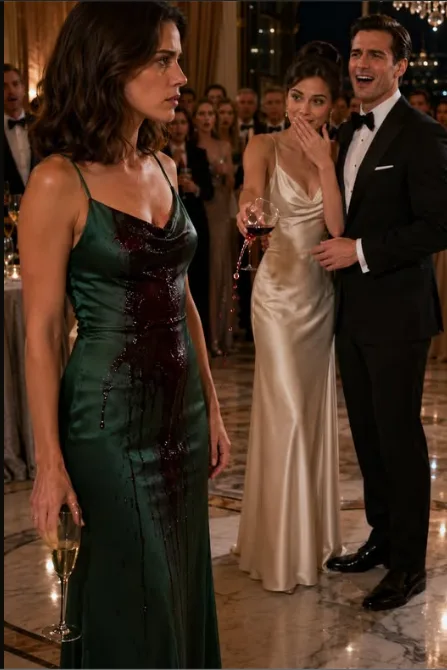
His Ex Spilled Wine on Me at His Birthday Party—So I Walked Away
The chandeliers in the ballroom glittered like a constellation of frozen tears, each crystal catching the hollow laughter and clinking glasses of the city’s elite.
Chapter 1
His Ex Spilled Wine on Me at His Birthday Party—So I Walked Away
The chandeliers in the ballroom glittered like a constellation of frozen tears, each crystal catching the hollow laughter and clinking glasses of the city’s elite.
I stood at the edge of the room, a silent figure in a sea of silk and superficiality, my simple emerald gown feeling less like eveningwear than armor.
It was Alexander’s 30th birthday. I was his wife of 2 years, but that night I felt more like a ghost at the feast than the hostess. My fingers tightened around the stem of my champagne flute as I watched him across the room.
Alexander held court with his arm slung possessively around the slender waist of Isabella Rossi, his first love. She was the one who had gotten away, the one who had supposedly left to pursue a ballet career in Milan, leaving Alexander heartbroken in her wake. That was the story, polished and repeated until everyone accepted it as fact.
Now she was back, dressed in ivory satin, her laughter bright and delicate enough to command the air around her.
She and Alexander had been inseparable all evening. The man who barely found 5 minutes to speak to me over dinner was hanging on Isabella’s every word. His gaze was soft. His smiles were genuine.
The whispers had begun hours earlier, moving through the crowd like venom.
Is that Isabella?
I heard he never got over her.
Poor Clara. She looks so plain next to her.
I was not plain. I was real. I had built a life with him, or thought I had. I had endured his mercurial moods, his criticisms disguised as advice, and the slow erosion of my confidence. I had traded my dream of art restoration to manage his social calendar and become the perfect corporate wife, all for the hope of a future shared between us.
Watching him with Isabella, I saw that future crumble into dust.
“Darling, you’re looking a bit peaky.”
Alexander’s voice
cut through my thoughts. He had detached himself from Isabella and now stood before me, his expression arranged into polite concern. It did not reach his cold gray eyes.
“Is the party not to your liking?” he asked. “You’ve been hiding in this corner all night.”
“I’m fine, Alexander,” I said. My voice was steady despite the tremor inside me. “Just observing.”
“Observing?” He gave a short, humorless laugh. “You sound like a scientist studying a particularly dull species. Mingle. Smile. For God’s sake, Clara, try to look like you belong here.”
The words landed with a familiar sting.
You don’t belong here.
He had never said it quite so directly, but the sentiment had been woven through our marriage from the beginning. I was the scholarship girl from nowhere, the project he had taken on. He had polished me, dressed me, displayed me, but he had never truly accepted
what I was before him.
Before I could respond, Isabella glided toward us and linked her arm with Alexander’s.
“There you are, Alex,” she said. “I was just telling everyone about our disastrous trip to Lake Como. Do you remember when you capsized the sailboat?”
Alexander’s face transformed. Warmth moved through it.
“How could I forget?” he said. “You screamed so loudly you scared the fish for miles.”
They laughed together, enclosed in a private, intimate world that excluded me completely.
Isabella’s cognac-colored eyes flicked toward me. In them, I saw no pity. Only triumph.
“Oh, Clara,” she purred. “I hope you don’t mind me stealing your husband for a few stories. We have so much history to catch up on.”
“By all means,” I said, my smile feeling like a crack through porcelain. “History is meant to be remembered.”
Her smile tightened. She did not like my composure. She wanted tears, a scene, some proof of her victory.
The evening continued. The toast was made, a glowing tribute to Alexander’s success, charisma, and future. I was mentioned only as a footnote: his lovely wife, Clara. The title felt less like an introduction than a brand.
When the orchestra began a waltz, Alexander led Isabella to the floor. They moved with instinctive, practiced grace, their bodies perfectly in sync. To the room, they looked like a fairy tale. I stood in the shadows like the woman written out of it.
It happened during a lull in the music, as I made my way toward the terrace for a breath of clean air.
Isabella, laughing and seemingly flustered, stumbled into me. Her full glass of red wine tilted with deliberate precision.
The cold shock was immediate. A dark stain spread across the bodice of my emerald gown and dripped down the silk like a grotesque bleeding flower.
Gasps rippled through the guests nearby. The music faltered.
I stood frozen as the wine seeped through to my skin. Its chill contrasted sharply with the humiliation burning through me.
Isabella pressed a hand to her mouth, her eyes wide with false innocence.
“Oh my goodness. Clara, I’m so, so sorry. It was an accident. This clumsy old dress.”
Every eye turned to Alexander. He walked over with a frown creasing his handsome brow.
This was the moment when a husband should have defended his wife. He should have shielded me from the pity and mockery. He should have made clear that I was the woman he cherished.
He looked at my ruined dress. He looked at Isabella’s carefully constructed expression of remorse.
Then he laughed.
It was not a loud laugh. It was a soft, dismissive chuckle, and it cut more deeply than any shout.
“Oh, for heaven’s sake, Clara,” he said, his voice dripping with condescension. “Don’t look so horrified. It’s just a dress. Isabella said it was an accident. It’s not a big deal.”
Not a big deal.
The words were the final blow. In that instant, every compromise, every swallowed opinion, every lonely night, every piece of myself I had traded for his conditional affection hardened into resolve.
The humiliation did not vanish. It changed form. It became fuel.
The wine stain was no longer a mark of shame. It was a standard.
I did not cry. I did not flinch.
I looked directly at Alexander, my gaze steady and clear. Something flickered in his eyes. It was not regret, but unease. He had expected me to react.
“You’re right, Alexander,” I said calmly, my voice carrying through the sudden hush. “It’s not a big deal at all. It’s just a dress. And it’s just wine.”
Then I turned to Isabella, whose mask of innocence was beginning to strain.
“No harm done,” I said flatly. “These things happen.”
I turned and walked away.
I did not rush. I did not hide the stain. I moved through the parting crowd with my head high, the ruined gown my armor and the cooling wine my war paint.
I walked out of the ballroom, out of the life I had known, and into the cold, clean night.
The party, Alexander, and Isabella were already part of the past. The future was a dark, blank canvas.
I was ready to paint it with vengeance.
The silence in our penthouse was absolute. It was different from the lonely quiet I had grown used to. This silence had purpose. It carried the echo of my shattered illusions.
I stood in the vast minimalist living room with the city lights spread below like fallen stars and felt only a chilling clarity.
I had taken off the wine-stained gown and dropped it into the incinerator chute like a body, a symbolic burial. Underneath it, I was simply Clara. Not Alexander Vance’s wife. Not his Clara.
I poured a glass of water with steady hands and walked to the floor-to-ceiling window. The party replayed in my mind, not as pain, but as evidence.
Exhibit A: Alexander’s dismissive laughter.
Exhibit B: Isabella’s triumphant smirk.
Exhibit C: my own years of silent complicity.
How had I allowed it?
I traced the path backward, past the glittering parties and expensive vacations, to the beginning. Alexander had been a force of nature. Alexander Vance, brilliant and ruthless CEO, had chosen me, a quiet art history graduate working in a museum gallery. He had called me a refreshing mystery. He had swept me off my feet, and in the process, I had let go of everything that anchored me.
He criticized my friends.
“They’re not ambitious enough, Clara.”
He questioned my career.
“Dusting off old paintings? Is that all you want from life?”
Piece by piece, he isolated me until my world shrank to the limits of his approval. I had let him do it because I mistook control for passion and cruelty for strength.
Not a big deal.
The phrase became a mantra of liberation.
If my public humiliation was not a big deal, then neither was his multi-million-dollar merger. Neither was his reputation. Neither was the foundation of his empire, built as much on perception as profit.
A plan formed in my mind. Not hot or reckless, but cold and meticulous.
Revenge would not be a scream in the dark. It would be a quiet dismantling. I would not take a hammer to his life. I would remove the keystone and let the structure collapse beneath its own weight.
First, I needed resources.
My personal accounts were monitored. My spending was scrutinized. But Alexander, in his arrogance, had forgotten one thing he had given me as a wedding present: a safety net. It was a portfolio of stocks and a small independent art gallery called the Verdant Canvas, which he had bought to keep me occupied.
He viewed it as a hobby. A trinket.
I had made it profitable using the knowledge he dismissed. It was in my name, and he had never bothered to examine the books.
I opened my laptop and began typing. I transferred my personal savings, a significant amount accumulated quietly from the gallery’s profits, into a new encrypted account.
Then I accessed the security system archives. The penthouse was wired with cameras and audio recorders because of Alexander’s paranoia about corporate espionage. I downloaded every piece of data from the previous 6 months.
Then I made a call.
The phone rang twice before a sleepy, familiar voice answered.
“Clara, do you know what time it is?”
“Maya,” I said firmly. “I need your help.”
Maya had been my best friend since university, the one Alexander had called a bad influence because she encouraged me to have opinions. We had drifted, but the bond remained. It had been forged before I lost myself.
30 minutes later, she was at my door, her curly hair a wild halo and her eyes wide with concern.
She looked at my calm face, the set of my jaw.
“What happened? Alexander’s assistant called and said you left the party abruptly. Are you okay?”
I handed her a tablet. It showed the clip I had synced from the ballroom security system, taken from a discreet camera near the terrace doors.
She watched Isabella stumble. She saw the wine strike me. She saw me freeze. She heard Alexander’s laugh and his words clearly.
It’s not a big deal.
Maya’s face changed from confusion to fury.
“That pretentious, soulless bastard,” she said. Then she looked at me. “What are you going to do?”
“I’m going to burn it all down,” I said quietly. “And I need a lawyer. The best, most ruthless divorce lawyer in the city. Someone who isn’t afraid of Alexander Vance.”
Maya grinned, fierce and feral.
“I know just the person. Eleanor Sharpe. She eats men like Alexander for breakfast and uses their bones to pick her teeth. I’ll call her first thing.”
“No,” I said. “Call her now. And I need one more thing.”
“Anything.”
“I need you to find out everything you can about Isabella Rossi’s time in Milan. Everything. Debts, failed auditions, scandals, lovers. I want to know what she’s running from.”
Maya’s eyes gleamed with understanding.
“Consider it done.”
While Maya worked, I went into the walk-in closet, which was larger than my first apartment. I ignored the racks of designer clothes Alexander had chosen for me. In the back, behind a false panel I had discovered years earlier, was a small locked chest.
Inside were the remnants of my former life: my sketchbooks, my grandmother’s locket, and 1 priceless item.
A signed first-edition copy of The Tale of Genji from the 17th century.
It was my secret and my treasure, appraised at more than $2 million. Alexander knew nothing about it.
It was my true safety net.
The front door clicked open. Alexander’s heavy footsteps echoed through the marble foyer.
He appeared in the bedroom doorway with his tuxedo jacket slung over his shoulder and his tie loosened. He looked tired and annoyed.
“There you are,” he said. “What the hell was that, Clara? Walking out of your own party? You made a scene.”
I turned to face him, leaning against the closet doorframe. I did not speak. I only looked at him, my expression neutral, my eyes empty of the fear and pleading he expected.
My silence unsettled him.
“Well?” he demanded. “Do you have anything to say for yourself? Isabella was terribly upset. She felt awful about the dress.”
“Did she?” I asked softly.
“Of course she did. It was an accident. You’re being overly sensitive, as usual.” He stepped closer, his gaze moving over me. “You need to learn to let these things go. In our world, perception is everything. You looked weak.”
“Perception is everything,” I repeated slowly.
The words hung in the air.
“You’re absolutely right, Alexander.”
He seemed confused by my agreement.
“So you understand? Good. We’ll put this behind us. I’ll have my secretary order you a new dress tomorrow. A dozen new dresses.”
He moved as if to touch my arm, a familiar gesture of dismissal. I took a small step back, just enough for his hand to fall uselessly to his side.
His eyes narrowed.
“What is wrong with you?”
“Nothing,” I said, a faint cold smile touching my lips. “For the first time in a very long time, absolutely nothing is wrong.”
I turned and walked into the en suite bathroom, locking the door behind me.
I heard him mutter something about dramatics before his footsteps retreated down the hall.
In the mirror, the woman staring back at me was not the broken wife he had expected. Her eyes were clear. Her jaw was set.
The awakening was complete.
The game had begun.
Alexander Vance, master of the board, had just lost his queen without realizing she was no longer his to command.
Part 2
The next week became a study in clandestine precision. I turned into a ghost inside my own home, moving through its opulent rooms with a purpose hidden beneath subdued normalcy.
To Alexander, I was the chastened wife quietly nursing her wounds. He was too consumed by Isabella, who had begun visiting him openly at his office, to notice the subtle change in the atmosphere.
My first official meeting with Eleanor Sharpe took place in a nondescript back room of the Verdant Canvas. She was in her late 50s, with a severe silver bob and eyes that missed nothing.
“Mrs. Vance,” she began, her voice like gravel wrapped in velvet.
“Clara,” I corrected. “I haven’t felt like Mrs. Vance for a long time.”
She gave a curt nod. “Clara. Maya gave me the broad strokes. You want a divorce, and you want it to be impactful.”
“I don’t just want a divorce, Eleanor. I want justice. I want him to feel a fraction of the humiliation and powerlessness he has made me feel for years. I want his public image, the thing he cherishes more than any human being, shattered.”
Eleanor steepled her fingers.
“Financially, we can hit him hard. The ‘not a big deal’ incident is emotionally potent, but not legally significant. We need leverage. Do you have any? Evidence of abuse? Infidelity?”
I slid a flash drive across the table.
“Audio recordings. From our home. Hours of him systematically tearing me down, criticizing my intelligence, my family, my worth. Psychological abuse.”
Then I opened a file on my laptop.
“As for infidelity, this is Isabella Rossi. He has been emotionally entangled with her for our entire marriage, and I believe it has recently become physical. But I have something more concrete.”
I showed Eleanor the financial records Maya had unearthed.
“Alexander has been funneling large sums of money through several shell companies into an offshore account. He thinks it is untraceable. It is for a hostile takeover bid he is planning for Ethelred Industries. It is highly illegal. Insider trading, tax evasion, the works.”
Eleanor’s eyes widened almost imperceptibly.
This was no longer only a divorce.
This was corporate warfare.
“How did you get this?” she asked.
“He left his secondary laptop unlocked one night. He was drunk, celebrating with Isabella over a video call. His arrogance is his greatest weakness.”
I had not merely downloaded the files. I had planted a worm that would give me continued remote access. I was now his silent, unseen business partner.
“This is explosive,” Eleanor said. “But if we use this in the divorce, it will trigger a SEC investigation. It will destroy his company and could cost thousands of people their jobs.”
I met her gaze without flinching.
“That is a consequence of his actions, not mine. He built his empire on sand. I am merely the tide.”
We spent the next 2 hours building the strategy. The divorce filing would be a calculated shock, served at a pivotal moment. We would use evidence of abuse and infidelity to secure an immediate restraining order and freeze his assets, preventing him from moving the illicit funds. The illegal financial data would be our nuclear option, deployed only if he fought back.
As I left the gallery, my phone buzzed.
It was Maya.
“I’ve got the dirt on our ballerina,” she said, her voice bright with excitement. “It’s better than we thought. Her career in Milan didn’t just stall. It ended in scandal. She was having an affair with the director of the company, a married man. His wife found out and made sure Isabella was blacklisted from every major ballet company in Europe. She’s also drowning in debt from a lavish lifestyle she couldn’t afford. She didn’t come back for love, Clara. She came back because Alexander is her last desperate meal ticket.”
A cold smile touched my lips.
Perfect.
Isabella’s desperation made her predictable. She needed Alexander’s money and status to survive. Destroying him would destroy her by proxy.
That evening, I played my part perfectly. I served Alexander his favorite single malt scotch while he brooded by the fireplace.
“Isabella is feeling very unwelcome,” he said, not looking at me.
“Oh?” I asked lightly. “By whom?”
“By you, Clara. Your coldness is palpable. She thinks you hate her.”
“I don’t hate her, Alexander,” I said, arranging flowers in a vase. “I feel sorry for her.”
He snorted. “Sorry for her? Why? She’s brilliant, talented, beautiful.”
“She’s a parasite,” I said calmly. “And she has chosen a host that is already dying. It is a poor survival strategy.”
Alexander turned to me, confusion and anger crossing his face.
“What the hell is that supposed to mean? What is wrong with you lately? You’re speaking in riddles.”
I looked at him and held his gaze.
“I’m seeing things clearly for the first time. You taught me that, Alexander. Perception is everything. And I’m finally perceiving the truth.”
He stood, his imposing frame rising over me. Once, that gesture would have frightened me. Now it looked pathetic.
“I don’t know what game you’re playing, Clara. But I suggest you stop. You won’t like the consequences.”
“I’m not playing a game,” I said, my voice dropping to a whisper. “I’m building a new reality. And you, my dear husband, are no longer the architect.”
I left him standing there, the first genuine seeds of doubt and fear taking root in his mind.
The pawn had stepped off the board.
Now she was redesigning the game.
The following month was a masterclass in psychological warfare.
I became a phantom limb in Alexander’s life, a presence he could feel but not see, an irritation he could not locate. I attended the necessary social functions with quiet grace, smiling without warmth. I was polite to Isabella, with the cool distance that angered her far more than open hostility would have.
My real work happened in the shadows.
Through the backdoor access I had planted in Alexander’s systems, I began a careful and deliberate sabotage. I found a junior analyst at Ethelred Industries, a bright young woman named Sarah whom Alexander had once belittled in front of the entire board. An anonymous tip sent from an encrypted server guided her toward the discrepancies in the shell company finances.
Sarah was hungry for justice and career advancement. She took the bait and began a quiet internal investigation.
I also used the gallery as my command center. I curated a new exhibition titled Facade, featuring artists who explored deception, hidden truths, and the collapse of empires. The centerpiece was a brutalist sculpture made of mirrored glass and rusted iron. I named it Not a Big Deal.
Alexander did not notice.
The first crack in his armor appeared during a charity gala for the city’s art museum, an event I had helped organize for years. Isabella clung to Alexander’s arm, dressed in a gown suspiciously similar to the one I had worn the night of the wine incident. She was enthusiastically playing the part of the future Mrs. Vance.
I stood across the room speaking with David Chen, a tech billionaire and one of Alexander’s most bitter rivals. David was handsome, sharp, and had always treated me with the respect Alexander never did. He was not a pawn in my game. He was a potential ally, a king on another part of the board.
“I have to say, Clara, the Facade exhibition is brilliant,” David said, his eyes appreciative. “It’s the most talked-about show in the city. It has a bite to it that I’ve never seen from you before.”
“I suppose I found my teeth,” I said with a genuine smile.
Out of the corner of my eye, I saw Alexander watching us, his expression dark. The sight of me confident and captivating in my own right, speaking easily with a man he considered an enemy, was a direct challenge to his ego.
Later, near the champagne fountain, Alexander appeared beside me.
“What do you think you’re doing with David Chen?” he asked in a low growl.
I took a slow sip of champagne.
“Having a conversation, Alexander. It’s a common social activity.”
“He’s using you to get to me.”
I turned to him, widening my eyes with mock innocence.
“Why would he need to use me to get to you? I’m just your wife. Decoration. Not a big deal, remember?”
The words struck their mark. A muscle twitched in his jaw.
He was trapped by his own cruelty.
“You will stay away from him,” he said, his voice low and venomous.
“Or what?” I asked softly. “What will you do, Alexander? Pour wine on me again? Laugh?”
The audacity of the response left him speechless. I saw something in his eyes: the realization that he no longer controlled me. It was quickly replaced by rage.
The unraveling accelerated.
The next day, Sarah’s internal investigation at Ethelred Industries reached critical mass. Whispers of financial irregularities appeared on the business news networks. Alexander’s company stock began a slow, sickening slide.
He came home that night like a caged animal and threw his briefcase against the wall.
“Someone is sabotaging me,” he roared. “There’s a leak. I will find who it is and destroy them.”
I sat on the sofa, calmly reading a book on strategic game theory. I looked up over the rim of my glasses.
“That sounds stressful. Perhaps you should have been more careful with your secrets.”
He stared at me. The pieces began assembling in his mind: my changed behavior, my cryptic comments, my new confidence.
The color drained from his face.
“It’s you,” he breathed. “You.”
I did not confirm or deny it. I simply returned to my book with a small, unreadable smile.
The silence was my confession.
He stumbled backward, gripping the doorframe for support. Alexander Vance, invincible in his own mind, had been brought to his knees not by a corporate rival, but by the woman he had treated as irrelevant.
The architect of his downfall was the foundation he had taken for granted.
The game was no longer his.
The queen was attacking.
The king was in check.
The storm broke on a Monday morning.
While Alexander sat in an emergency board meeting, desperately trying to plug the leaks in his sinking company, a process server arrived at his office. He was handed a thick envelope containing divorce papers filed by Eleanor Sharpe.
They were brutal. They cited years of psychological abuse, infidelity with Isabella Rossi, and included a selection of the most damning audio clips. The demand for alimony was astronomical, enough to damage him deeply even if his company survived.
But that was only the opening strike.
At the same time, a judge, presented with evidence of abuse, granted an immediate temporary restraining order forcing Alexander to vacate the penthouse and freezing a significant portion of his personal and business assets.
I was at the Verdant Canvas when it happened. Maya was with me, monitoring the newsfeeds on her tablet.
We watched as the business channels erupted.
Vance Corporation under investigation.
CEO Alexander Vance served with divorce papers.
Allegations of abuse.
His personal life and professional life were imploding in perfect synchronization.
My phone began ringing constantly. Unknown numbers. His lawyers. His mother.
I ignored them all.
An hour later, the front door of the gallery burst open.
Alexander stood there with his hair disheveled and his tie askew. His eyes were wild with fury and panic. He had been publicly unmasked, and the humiliation was almost physical.
“You,” he snarled, storming toward me. “You vicious, conniving—what have you done?”
Maya moved as if to step between us, but I placed a hand on her arm.
I stood still, calm and immovable.
“I held up a mirror, Alexander. You just don’t like the reflection.”
“You’ve ruined me. My company. My reputation. Everything I built.”
“No,” I said clearly. “You built your empire on a foundation of arrogance and cruelty. I merely gave it the slightest push. It is collapsing under the weight of its own corruption.”
He lunged forward, one hand raised as if to strike me.
Then he froze.
His eyes locked on mine. He saw no fear there. Only icy resolve and an unshakable strength.
The balance of power had changed forever. He was the supplicant now. I was the judge.
“You will withdraw the papers,” he demanded, his voice cracking. “You will call off your lawyer. You will tell them it was all a lie.”
I laughed once, sharply and without humor.
“Or what? It’s not a big deal, remember?”
His own words became the final blow. He physically flinched, stepping back as if I had struck him.
The reality of his position closed around him. The prenuptial agreement he had forced me to sign was void because of infidelity and abuse. He faced financial obliteration. And I still held the evidence of his illegal financial activity, a sword I could drop at any moment.
“Clara, please,” he said, his voice breaking. “Please. We can talk about this. I’m sorry. I’m so sorry about the party, about Isabella, about everything.”
“Your apologies are as worthless as your promises,” I said. “Get out of my gallery.”
At that moment, Isabella rushed in, her face streaked with tears. She must have heard the news.
“Alex. What is happening? My credit cards have been declined. The hotel evicted me.”
Then she saw me, and her despair turned venomous.
“You. This is your fault, you jealous hag.”
I looked at her with pure contempt.
“Your meal ticket has been canceled, Isabella. I suggest you find another patron. Though I hear the ballet companies in Europe are still not hiring.”
The color drained from her face. She knew then that I knew everything.
Alexander turned on her, directing his frustration toward the nearest target.
“This is your fault too. If you hadn’t been so desperate, if you hadn’t poured that wine—”
They began arguing, their voices rising into a desperate cacophony of blame.
It was an ugly spectacle. The golden couple revealed as gilded fools.
I watched them for a moment, these two architects of my pain drowning in the consequences of their own actions. I felt no pity. No satisfaction, either. Only a cold, clean emptiness.
The revenge was complete, but it was not sweet.
It was necessary.
I turned to Maya.
“Security, please. Escort these guests off the premises.”
As the guards led the sobbing, arguing pair away, I turned my back on them and walked toward my office.
The chapter of Alexander and Isabella was closed. The reckoning was over.
It was time to build something new, something entirely and powerfully my own.
Part 3
The silence after Alexander and Isabella were removed from my gallery was profound. It was not the empty silence of the penthouse. It was fertile and promising, the kind of quiet that follows a cleansing storm.
Maya let out a long, low whistle.
“Holy hell, Clara. I have never seen anything like that in my entire life. You were glacial.”
I leaned against my desk. My hands trembled slightly now that the adrenaline was fading, but not from fear or weakness. It was the residual force of a battle hard won.
“It had to be done.”
“Done?” Maya said. “You nuked him from orbit.”
She came over and hugged me tightly.
“I’m so proud of you.”
The next few days were controlled chaos. The media devoured the story: the fall of a titan, the wife’s revenge, the scarlet letter and the red wine. My name was everywhere, but I was no longer being portrayed as the pitied wife. I had become a cunning wronged woman who had orchestrated a brilliant takedown.
The audio clips, strategically leaked by Eleanor to a friendly journalist, turned public opinion fiercely in my favor. Alexander was vilified as a modern monster consumed by the same public that had once admired him.
I moved out of the penthouse and into a sleek modern apartment purchased through a trust whose title could not be traced to me. It was filled with light and with art I had chosen myself: vibrant, bold, and alive.
The first night I slept there, I slept more deeply and peacefully than I had in years.
The legal proceedings continued, but they were largely a formality. Alexander’s assets were frozen. His reputation was ruined. He had no leverage. His board of directors, terrified of the SEC investigation that would follow the full release of his financial crimes, forced him to step down as CEO. The company he had built from the ground up was now being dismantled without him.
He tried to contact me.
He sent dozens of emails, shifting from pleading to furious to despairing. I deleted them unread. He called from unknown numbers. I blocked them. He was a ghost from a past life, and I had no interest in séances.
My focus was the future.
With the initial divorce settlement funds, a massive upfront payment secured by Eleanor, I bought the Verdant Canvas outright and rebranded it.
It became Veridian, a contemporary art space dedicated to fierce, underrepresented female artists.
Our inaugural show, Reclaimed, sold out.
It was at the opening of Reclaimed that I saw David Chen again. He moved through the crowd and found me near a stunning, angry painting of Medusa.
“Clara,” he said, smiling genuinely. “This is incredible. The space, the art, you.”
“Thank you, David. I’m finally curating my own life.”
“It’s a masterpiece.”
He hesitated.
“I know this is probably terrible timing, and you have a million things going on, but when the dust settles, I would very much like to take you to dinner. No business. No games. Just dinner.”
I looked at him, at his intelligent eyes and easy smile. He was not a weapon in my arsenal or a pawn on my board. He was simply a man who saw me for who I was, not for my relation to someone else.
I smiled back, a real smile that warmed me from within.
“I’d like that, David. I’d like that very much.”
It was a glimpse of possibility. A potential for something gentle and real. It was not a priority, but it was a promise. After the winter of my marriage, spring could come.
Meanwhile, Alexander’s world continued to shrink. He was living in a corporate apartment. His friends had deserted him. The SEC had officially opened an investigation. He faced the real possibility of financial ruin and criminal charges.
The man who once believed himself above consequences was being buried by them.
And I, Clara, was no longer only his ex-wife.
I was the founder of Veridian.
I was a survivor.
I was a force.
The revenge was complete, but my story was just beginning. I was stronger than ever, not in spite of the pain, but because I had used it as fuel to forge a version of myself that could not be broken.
A month passed after the opening of Reclaimed. Veridian was an established success, and my life settled into a rhythm of purposeful, joyful work. I had dinner with David twice a week. Our conversations were easy and stimulating, free from manipulation’s shadow. I was rediscovering the person I had been before Alexander, and I liked her even more now.
I had built a fortress of peace around myself.
For the first time, the ghosts of my past seemed truly vanquished.
That was why the frantic knocking on my apartment door one rainy Tuesday evening felt so jarring.
I was not expecting anyone. Maya had a key. David would have texted.
I walked to the door and looked through the peephole.
My breath caught.
Standing in the dim hallway of my secure private building were Alexander and Isabella.
They were far from the glittering couple at the birthday party. Alexander looked haggard, his expensive coat soaked through, his face gaunt and shadowed with a week’s worth of stubble. His once-arrogant gray eyes were red-rimmed and desperate.
Isabella stood slightly behind him, shivering in a thin jacket, her makeup smeared by rain and tears. Misery had stripped away her beauty.
A cold, detached curiosity passed through me.
What could they possibly want? What words remained to them that had not already been made meaningless?
The knocking came again, more desperate.
“Clara, please,” Alexander said. “We know you’re in there. Please, we need to talk to you.”
His voice was ragged, emptied of its former power.
I considered not answering. I could have called security and had them removed. They were nothing to me.
But a part of me, the part that had documented every moment of my own pain, wanted to witness this final act. I wanted to see the complete dissolution of the world that had once crushed me.
I unlocked the door and opened it, but left the security chain in place.
I looked at them through the narrow gap, my expression impassive.
The sight of me, healthy and calm and in control, seemed to damage them further.
“Clara,” Alexander choked out, pressing his hands against the doorframe as if he needed it to remain upright. “Thank God. Please. Please let us in. We need to talk.”
“Anything you have to say can be said through a door,” I replied evenly.
“Clara, I’m begging you,” he sobbed. It was ugly and raw. “You have to call off the SEC investigation. You have to tell them you fabricated the data. They’re going to indict me. I could go to prison.”
Isabella pushed forward, her face wet with tears.
“It’s all my fault. I’m sorry. I’m so sorry for the wine, for everything. I was stupid and jealous. Please, Clara, have mercy. His lawyers say only you can stop it now.”
I looked from one to the other, this duet of despair.
They had been reduced to begging at the door of the woman they had treated as insignificant.
“Let me understand,” I said quietly. “You are not here because you are sorry for the years of psychological torture, Alexander. You are not here because you regret systematically destroying my sense of self. And you”—I turned my gaze to Isabella—“are not sorry for your cruelty. You are both here because you are facing consequences. You are sorry you were caught. You are sorry your actions finally produced a pain you cannot ignore.”
Alexander flinched as if struck.
“No, that’s not true. I’m sorry. I was a fool, a blind, arrogant fool. I didn’t appreciate you. I didn’t see your strength, your intelligence. I see it now. God, I see it now, and it’s killing me.”
His words poured out quickly, but they were empty. They were the currency of a bankrupt man.
“You see it now because it is being used against you,” I said. “There is a difference.”
“I love you, Clara,” he cried, slumping against the door. “I never stopped loving you. Isabella was a mistake, a ghost from the past. It’s you. It was always you.”
The audacity of the lie was breathtaking.
Isabella gasped and turned on him.
“Alex, how can you say that? You told me you loved me. You said she was cold and boring—”
“Shut up,” he roared at her before turning his desperate eyes back to me. “She means nothing. Nothing. Please, Clara, my love, my wife, give me another chance. I’ll do anything. I’ll go to therapy. I’ll give you everything. Just please don’t let them take my freedom.”
The performance was pathetic. It was the ultimate reveal of his true nature: a narcissist willing to sacrifice anyone, even the woman he had called his first love, to save himself.
I looked at the 2 people who had once held so much power over my happiness and my pain.
Now they were only noise.
“There is no another chance, Alexander,” I said. My voice was final. “There is no going back. The man I married was a carefully constructed illusion, and the real you is a coward standing in the rain begging for a pardon you do not deserve.”
I looked at Isabella.
“And you attached your star to a black hole. It will consume you, and there is nothing I can or will do to stop it.”
I began to close the door.
“No!” Alexander screamed, thrusting his hand out to stop it. “Clara, please. Don’t do this.”
I met his wild, terrified gaze through the narrowing space.
“Goodbye, Alexander.”
I closed the door and engaged the deadbolt with a firm, final click.
For a moment, I stood there listening to their broken weeping, their pleading, and their mutual recriminations as they collapsed outside my door.
It was the sound of a chapter ending.
Then I turned and walked away.
I poured myself a glass of wine, a rich red burgundy, and went to the window. The city glittered through the rain.
I felt the last shadow of my old life lift and dissolve into the night air.
I was free.
Truly, completely, and powerfully free.
My future was a blank canvas, waiting for me to paint my masterpiece.
The crying and pleading outside my door lasted for what felt like an hour before fading into the hum of the city night, replaced by retreating footsteps and the slam of a car door.
The silence that returned was sweeter than before. It was earned and absolute.
I finished my wine. It tasted robust and satisfying, a world away from the cheap champagne of Alexander’s world.
The next morning, I woke with the sun and felt profound peace settled deep in my bones. The specters of the past had made their final, desperate appearance and had been dismissed.
It was over.
I met Eleanor for lunch at a sunlit café. She slid a thick document across the table.
“It’s done,” she said, smiling with satisfaction. “He signed everything. The divorce is final. The settlement is even more favorable than we hoped. He gave up everything to try to secure your silence on the financial crimes. A futile effort, of course, since the SEC investigation is now entirely out of your hands. But it shows his level of desperation.”
I did not open the folder. The details were no longer the point. The victory was not in the money. It was in the restoration of my autonomy.
“Thank you, Eleanor. For everything.”
“The pleasure was mine, Clara. You were my most formidable client.”
As we ate, my phone buzzed.
It was a text from David.
Thinking of you. Hope you have a brilliant day.
A simple, warm message. It asked for nothing. It was a world away from Alexander’s demanding, transactional communication.
A few weeks later, news broke that Alexander Vance had been formally indicted on multiple counts of securities fraud, tax evasion, and insider trading. His fall was complete and public. The financial titan was now a defendant.
According to Maya’s sources, Isabella fled the city. Her name was permanently linked to Alexander’s scandal, her own prospects reduced to ash.
When I read the headlines, I felt nothing. No pleasure. No pity. It was simply the logical conclusion of a story whose ending had been written the moment Alexander chose cruelty over kindness and arrogance over humility.
My own life was blooming.
Veridian was nominated for a prestigious cultural award. I was invited to sit on the boards of 2 major arts foundations. My opinion was valued and sought.
I was no longer Alexander Vance’s ex-wife.
I was Clara, the force behind Veridian.
Months after the divorce, David and I walked through a sculpture garden with our fingers loosely intertwined. It was easy and comfortable.
“I have to confess something,” he said, stopping beside a towering bronze figure.
“Oh?” I asked, smiling.
“When everything was happening with Alexander, I was in awe of you. The strength it took. The precision. It was terrifying and magnificent to watch.”
“It wasn’t about strength at first,” I admitted. “It was about survival. The strength came later.”
“I know,” he said softly. “That is what I’m in awe of. You did not just survive. You rebuilt yourself into a queen. And I—”
He paused, his gaze honest and direct.
“I would very much like to be the king who stands beside you. Not to rule you, but to marvel at your kingdom.”
My heart, which I had thought fortified against such softness, moved with cautious hope.
This was not a man who wanted to possess me or control me. He wanted partnership.
“I think I’d like that too, David,” I said.
It was the beginning of a different kind of love, not built on fairy tales or infatuation, but on mutual respect, shared strength, and the hard-won wisdom of past pain.
One evening, I worked late at Veridian, preparing for a new exhibition. The space was quiet, filled only with the potential of blank walls.
I stood in the center of the main gallery, my kingdom.
I thought of the woman I had been 1 year earlier, cowed and silent in a wine-stained dress. I thought of the revenge I had plotted with such precision, the cold execution of it, and the final sight of my tormentors broken at my door.
In the aftermath, people asked whether I thought I had gone too far.
My answer was always the same.
I gave him a reflection of the world he created for me. If he could not bear to look at it, that was his failure, not my cruelty.
Revenge had not made me weak. It had not made me bitter. It had been the fire that tempered my spirit, forging a strength I had never known I possessed.
I was not merely stronger than I had been with Alexander.
I was stronger than I had ever been in my life.
I was the architect of my own existence now.
The canvas was mine. The paints were mine to choose. Every brushstroke belonged to me.
The masterpiece was no longer revenge.
It was reclamation.
And it was more beautiful than I had ever imagined.
Chapter complete
You have reached the end of this chapter.
Continue reading
A few more worlds to get lost in after this chapter.




