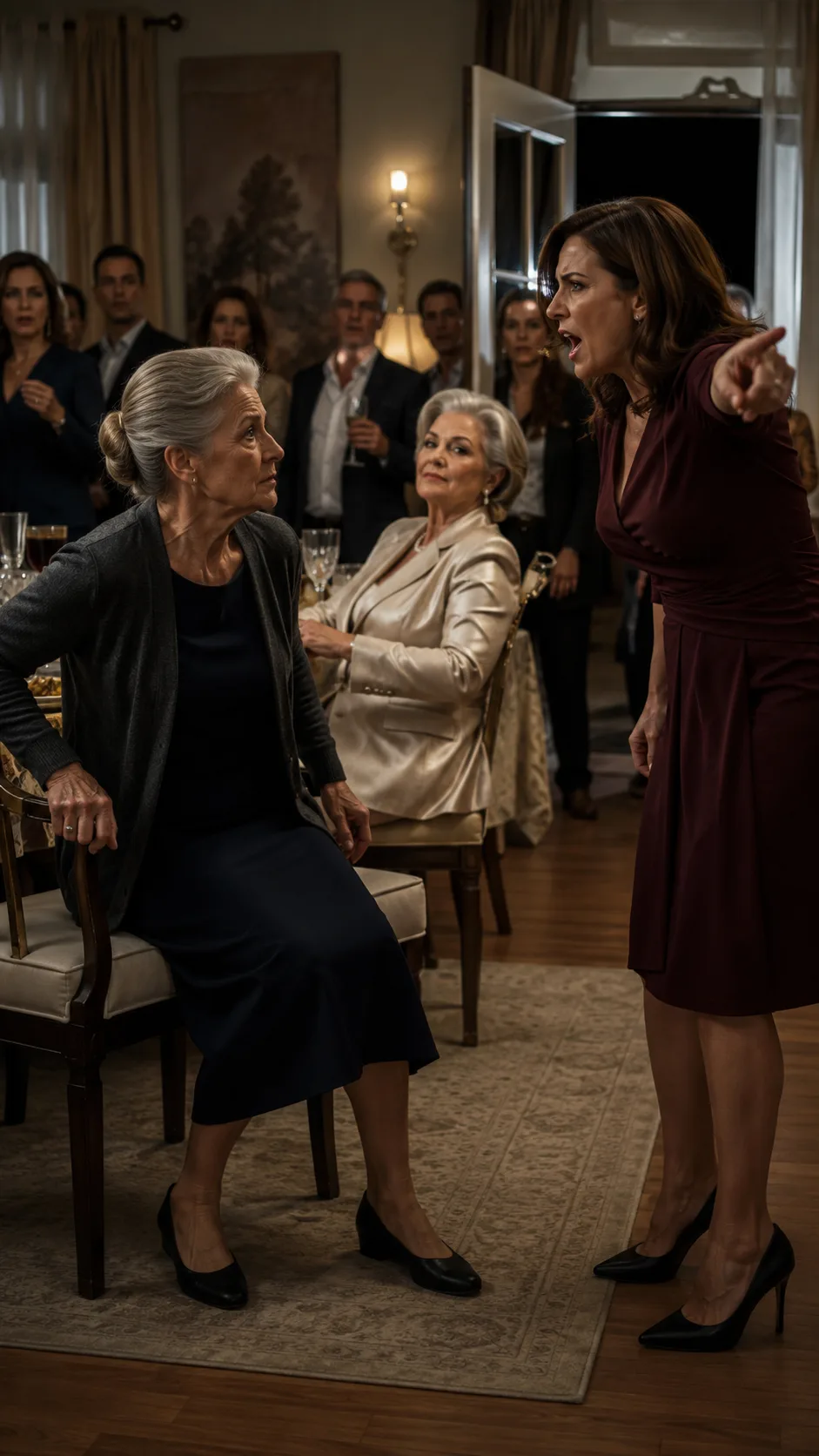
The front door swung open, and six officers entered.
Chapter 3
The front door swung open, and six officers entered.
Daniel tried to move toward the kitchen, but two detectives intercepted him. The confident man who had once looked through me suddenly began shouting about lawyers, warrants, and misunderstandings.
Vilma did not shout.
She stood still while an officer fastened handcuffs around her wrists. Her eyes remained fixed on me.
“You did this,” she said.
“No,” I answered. “You did.”
Rebecca watched them lead her husband and mother-in-law through the room. Guests stepped aside. Phones appeared. The perfect family became a public scandal before the police cars left the driveway.
Then Rebecca turned on me.
“How could you? You searched my husband’s office and handed my life to the police!”
“I handed them evidence.”
“You destroyed my family!”
“Your family was already being destroyed. You just couldn’t see it.”
She slapped the papers from the table. Photographs and bank records scattered across the floor.
For one terrible moment, she looked
at me with hatred.
I wanted to embrace her, but she stepped back.
“Leave,” she whispered.
So I left.
I returned to my small apartment and sat beside the window until sunrise. I had saved my daughter from possible prison, yet I had never felt farther from her.
Five days passed without a call.
On the sixth evening, my phone rang.
“Mom,” Rebecca said, her voice broken. “Please come back.”
When I arrived, the mansion felt hollow. Social services had taken the children out for the evening. Rebecca sat on the sofa in sweatpants, her eyes swollen.
“The police told me everything,” she said. “Daniel used my name on properties and accounts. Vilma kept me ignorant so I could be their perfect innocent wife.”
“I’m sorry.”
“Are you? You were right, but you still betrayed me.”
“Yes. I betrayed your trust to protect your life.”
She flinched.
“If I had
simply told you, would you have believed me?”
Rebecca looked down.
“No.”
“You would have told Daniel.”
“Yes.”
“And Vilma would have destroyed the evidence and made sure you never spoke to me again.”
Tears slid down her face.
“I let her turn me against you,” she said. “She said you embarrassed us. She said the children needed people who could help their future. I chose comfort over my own mother.”
“You were manipulated.”
“I was also cruel.”
That was the first honest sentence she had spoken about us in years.
I moved beside her. This time, when I reached for her hand, she did not pull away.
The house was seized three weeks later. The furniture, jewelry, cars, and accounts were connected to illegal money. Rebecca and the children arrived at my apartment carrying only clothes, photographs, and Sophia’s drawings.
My home had one bedroom and a narrow living
room. Mateo slept on a folding bed. Sophia slept beside Rebecca. I took the sofa.
The first weeks were hard. Mateo barely spoke. Sophia woke crying for her father. Rebecca found work at a coffee shop, returning each afternoon with swollen feet.
One night, she said, “I lost everything.”
I shook my head.
“You lost things. Now you can recover yourself.”
Slowly, the children began healing. I cooked their favorite meals, helped with homework, and attended every school event. Sophia followed me around the kitchen, asking me to teach her to bake and sew. Mateo eventually asked me to watch his soccer practice.
For the first time, I was not the grandmother hidden in the back of a photograph.
I was family again.
Six months later, the trial began.
Daniel entered the courtroom in an orange jumpsuit. Vilma still held her chin high, but chains circled her wrists and ankles. Their attorneys tried to blame employees, accountants, and even Rebecca.
Then my daughter took the stand.
She told the jury how Vilma had isolated her from me, controlled her social life, and kept her ignorant of Daniel’s businesses. The defense attorney leaned toward her.
“You expect this court to believe you enjoyed that wealth for years without asking questions?”
Rebecca looked directly at him.
“I was weak and blind,” she said. “But when my mother discovered the truth, she risked losing me to save me. That is more courage than anyone here has shown me.”
The jury found Daniel and Vilma guilty. Daniel received eighteen years. Vilma received twenty-five.
Outside the courthouse, Rebecca took my hand.
“It’s over,” she said.
“No. The lie is over. Your real life is beginning.”
Over the next year, she built that life carefully. She found an administrative job and rented a modest apartment near mine. The children settled into a public school. Mateo joined a soccer team. Sophia displayed her drawings at the community library.
Every Sunday, they came to my home for lunch.
One afternoon, Rebecca and I sat on a park bench while the children played nearby.
“Forgive me,” she said. “For the birthdays, Christmas, Mother’s Day—all the times I made you feel ashamed to exist.”
“I forgave you when you chose the truth.”
She rested her head on my shoulder.
“I lost the mansion, the money, and the life everyone envied,” she whispered. “But I finally feel free.”
I watched my grandchildren laugh beneath the afternoon sun.
For years, I believed being erased meant I had lost my family. In truth, love had been waiting beneath the lies, wounded but alive.
I had not exposed Vilma for revenge. I had done it because a mother’s love is not always gentle. Sometimes it enters a locked room, photographs the truth, and accepts being hated until the people it loves are safe.
That night, alone in my apartment, I remembered the woman who once waited beside a silent phone for an invitation that never came.
She no longer existed.
I was Alma Rodriguez—mother, grandmother, survivor—and no one would ever seat me in the shadows again.
THE END
Chapter complete
You have reached the end of this chapter.
Continue reading
A few more worlds to get lost in after this chapter.




