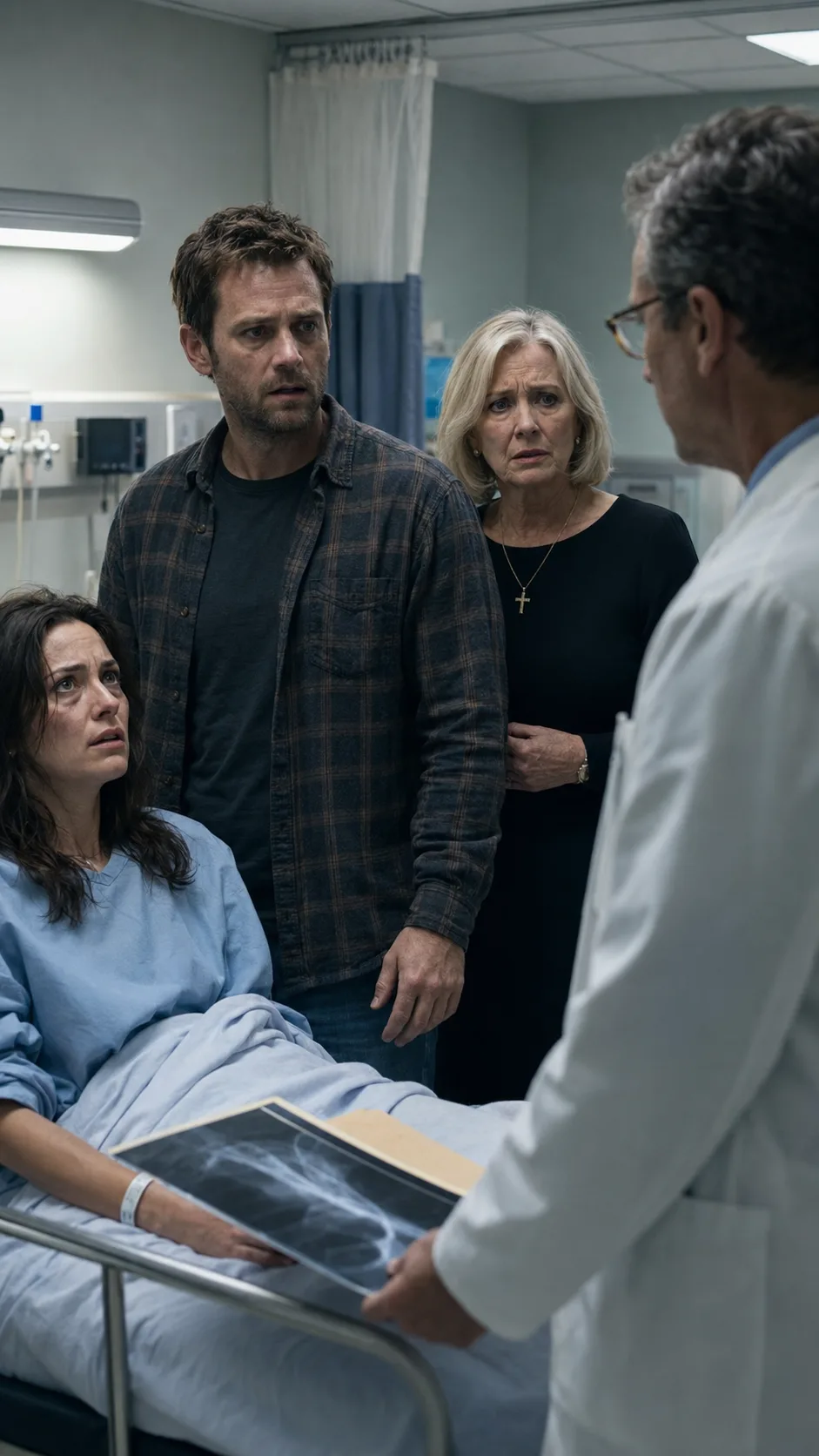
The pain in my ribs no longer mattered.
Chapter 3
The pain in my ribs no longer mattered.
All I could see was Lily in a taxi with Margaret—the woman who had watched Ethan hurt me and poisoned my body.
“I have to find her,” I cried.
Karen held me upright while a nurse rushed in.
“The sheriff’s department is already at the terminal,” Karen said. “The taxi company gave them the route. They know which entrance she used.”
But every minute felt like another chance for Margaret to disappear.
I imagined Lily sitting silently beside her, trying not to cry. My daughter became quiet when frightened, as though silence could make dangerous adults forget she existed.
A deputy kept his radio near the doorway. Static filled the room.
Then a voice came through.
“Female located near Gate Twelve. Child is with her.”
I stopped breathing.
Then another voice followed.
“Suspect is resisting. Child appears unharmed.”
My knees gave way, and Karen eased me back onto the bed.
At the terminal, Margaret stood in line for a bus to Oklahoma with Lily’s backpack and two cash-purchased tickets.
When deputies approached, Margaret wrapped both hands around Lily’s arm and shouted that she was the child’s grandmother and had every right to take her.
Lily did not shout.
She did not fight.
She only asked, “Is my mama alive?”
The police separated them.
Margaret began screaming that I was unstable, sinful, and unfit to raise children.
When an officer asked Lily whether she wanted to go with her grandmother, my daughter clutched her backpack and whispered, “No. I want my mom.”
They brought her to the hospital shortly before dawn.
The moment she appeared in the doorway, I opened my arms.
Lily ran to me, carefully avoiding my injuries.
“Mama,” she whispered, touching my cheek, “Grandma said you were going away forever.”
“I’m not going anywhere,” I told her.
“Do
we have to go back home?”
I looked at Karen.
Then at the deputy.
Then at my little girl.
“No,” I said. “We are never going back there.”
The emergency protective order was granted that morning.
Ethan was prohibited from contacting me or the girls. Margaret was charged in connection with Lily’s abduction while investigators examined the evidence surrounding my earlier pregnancy.
Ethan arrived at the hospital before the paperwork was complete.
He came through the lobby shouting my name, demanding that I stop “performing” for the police. Security blocked him near the elevators, but he shoved an officer and tried to force his way past.
He blamed me even as they placed him in handcuffs.
“You did this!” he shouted. “You destroyed this family!”
The X-rays had told the truth.
The photographs had told the truth.
Mrs. Jenkins had told the truth.
And eventually, Lily did too.
A child
specialist interviewed her. Lily explained that her father hit me while Margaret prayed loudly to drown out the noise.
She described how she and Ava hid beneath the kitchen table.
She remembered Margaret telling them, “Good girls never repeat what happens inside their home.”
Then investigators searched Margaret’s house.
Inside a locked cabinet, they found dried herbs, unlabeled bottles, handwritten recipes, and a calendar documenting my menstrual cycles. There were notes beside dates when I had visited her house, notes about symptoms, and records of every pregnancy test she had secretly purchased.
They also found a black notebook.
One entry was dated two years earlier.
The handwriting was Margaret’s.
“It was a boy. But the timing was wrong. Ethan is not ready to inherit, and Elena is becoming too confident. Better this way. She will believe her body failed again.”
When the prosecutor showed me the page, I felt no immediate anger.
Some pain is too large for tears.
It turns the body to stone.
The notebook revealed that Margaret had feared a son would strengthen my position in the family and weaken her control over Ethan.
She wanted him desperate for a male heir because desperation kept him obedient. As long as I remained “the wife who failed,” Margaret could direct his resentment toward me.
She had taken my unborn child not because he was unwanted, but because she wanted power more than she wanted a grandson.
Ethan learned the full truth during a recorded police interview.
For the first time, he looked genuinely shaken.
“My mother said Elena was sick,” he insisted. “She told me the drink would end a false pregnancy.”
The detective placed a copy of the notebook in front of him.
Ethan read the entry twice.
Then he lowered his head.
But even then, he did not ask whether I had survived the poisoning.
He did not ask what I had suffered.
He asked only one question.
“So it really was a boy?”
That question ended whatever remained of my marriage.
Not the beatings.
Not the lies.
Not even the threats.
It was the realization that, after everything, he still mourned an heir more than he mourned the woman he had nearly killed.
The criminal case took months.
Ethan’s attorney argued that I was exaggerating years of marital conflict. But the medical evidence showed fractures at different stages of healing. Neighbors admitted hearing repeated violence. Photographs recovered from my old phone showed bruises I had hidden beneath makeup and long sleeves.
Mrs. Jenkins testified that she had seen Ethan drag me across the patio.
Lily’s recorded statement was admitted through the child-protection process.
Margaret’s attorney claimed the notebook contained religious reflections rather than admissions. The laboratory report, the bottles from her cabinet, and the note ordering the clinic not to speak with me made that argument impossible to believe.
In court, Margaret wore black and held the same gold cross she had clutched through every act of cruelty.
When the judge asked whether she understood the charges, she looked directly at me.
“You should have been grateful,” she said. “I kept this family together.”
I stood slowly.
“No,” I replied. “You kept us afraid.”
Ethan accepted a plea agreement that included prison time for aggravated assault, intimidation, and violating the protective order.
Margaret faced separate consequences for kidnapping Lily, administering dangerous substances, evidence tampering, and her role in the unlawful termination.
Neither of them apologized.
They were sorry only that the truth had survived them.
After I left the hospital, Karen helped me and the girls enter a protected shelter.
The shelter room was small, with two beds and one narrow dresser.
But the door locked from the inside.
Karen helped me apply for work at a local library and arranged counseling for all three of us.
The first time Lily spoke during a session, she asked whether loving her father meant she had betrayed me.
I told her children are allowed to love someone and still tell the truth about what that person did.
Ava listened from my lap, then whispered that she wanted a house where nobody prayed while somebody else was crying.
The first night, Ava asked whether Daddy had a key.
When I told her no, she slept without waking for the first time in months.
Healing did not arrive like a miracle.
It came in pieces.
A full meal without nausea.
A shower without listening for footsteps.
Lily laughing loudly and then realizing no one would punish her for making noise.
Some nights, I missed our old kitchen and hated myself for it. But familiar walls can feel comforting even when they form a cage.
My pregnancy continued under close medical care.
Ethan’s family spread rumors that the baby was not his. Margaret sent letters from jail quoting scripture and demanding forgiveness. I returned every envelope unopened.
Months later, I went into labor during a summer thunderstorm.
Karen stayed with the girls while a nurse held my hand.
When the doctor lifted my baby into the light, he smiled.
“It’s a girl.”
For one heartbeat, the old shame tried to return.
Then the baby cried.
Strong.
Angry.
Alive.
I held her against my chest and understood that no child enters the world owing anyone a gender, a legacy, or a family name.
I named her Hope.
When Lily and Ava visited, they climbed carefully onto the bed.
Lily counted us with her finger.
“One, two, three, four,” she said.
Then she smiled at the drawing she had made months earlier.
“Now we’re four flowers, Mama.”
She was right.
Four flowers.
Bruised by storms.
Nearly uprooted.
Still alive.
I lost years to fear. I lost blood, safety, and a son I never had the chance to hold.
But my daughters did not lose their mother.
They learned that home is not the place where everyone stays silent to protect the person causing the pain.
Home is where the frightened are believed.
Where doors lock against cruelty.
Where daughters are never called failures.
And where a woman can finally say the words that saved all four of us:
“It wasn’t an accident.”
THE END
Chapter complete
You have reached the end of this chapter.
Continue reading
A few more worlds to get lost in after this chapter.




