PART 2 — THE PEN BESIDE MY EMPTY PLATE
A week before the dinner, Michael called me instead of texting.
Chapter 2
PART 2 — THE PEN BESIDE MY EMPTY PLATE
A week before the dinner, Michael called me instead of texting.
That alone made me sit down.
His voice was soft, almost boyish.
“We’ve been distant, Mom,” he said.
I closed my eyes.
The sound of him calling me Mom that way pulled me backward twenty-five years.
Back to scraped knees.
Back to lunch boxes.
Back to bedtime prayers said under a blanket with thunder outside.
“Marlene and I want to fix things,” he said.
I held the phone tighter.
“Let us take you to dinner.”
I should have known.
But hope is most dangerous when it wears the face of your child.
At sixty-four, I still had the foolish heart of a mother.
So I said yes.
On the night of the dinner, I took my pearl-gray dress from the back of my closet.
It was old but still elegant, the fabric soft and forgiving.
I pinned my silver hair carefully.
I added a little powder under my eyes.
I
wore the small pearl earrings Michael gave me when he was sixteen after saving three months of grocery-store wages.
I looked in the mirror and whispered, “Maybe tonight.”
Maybe tonight he would remember me.
Maybe tonight we would begin again.
Maybe tonight I would stop feeling like a locked room in my own son’s life.
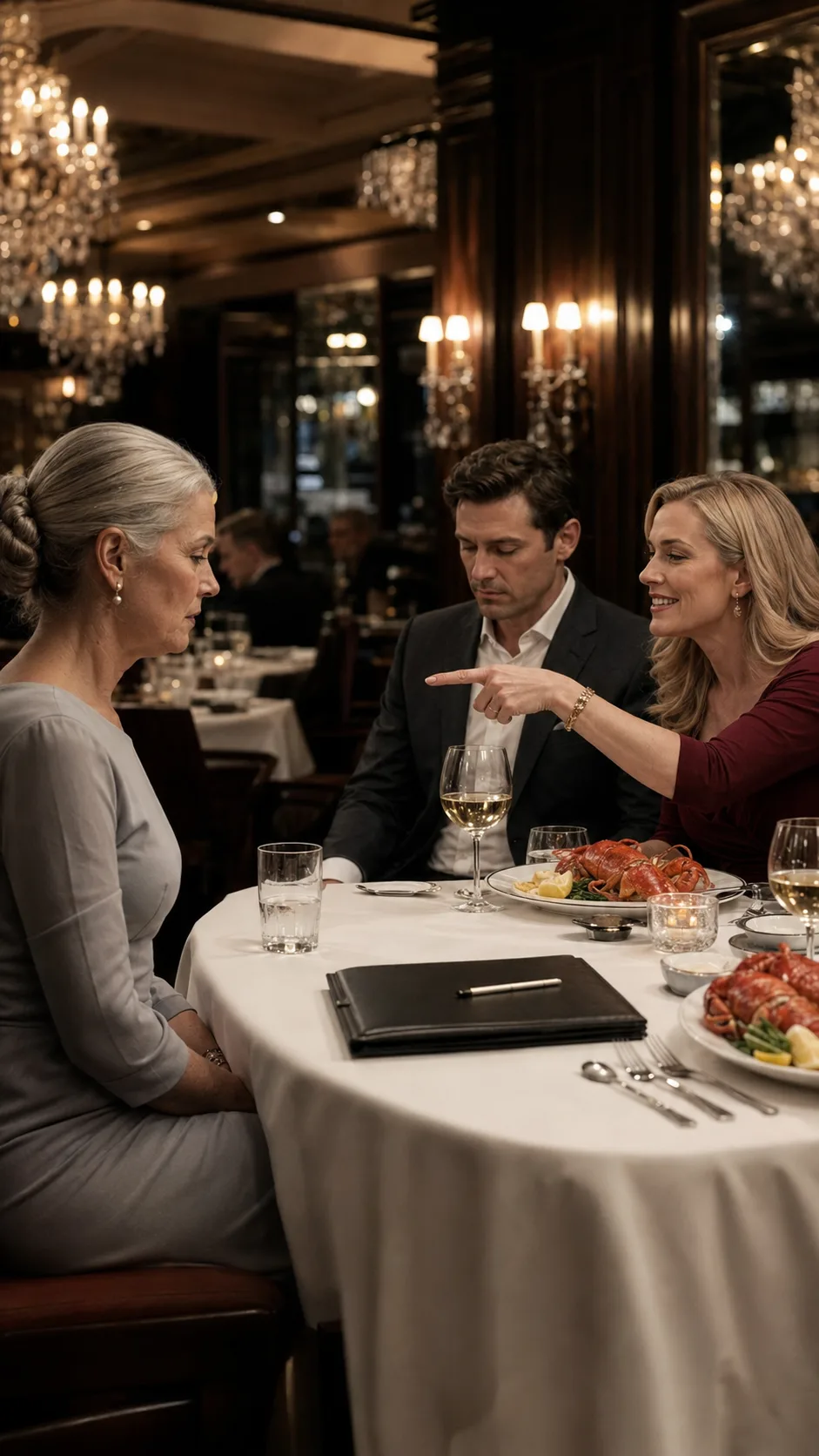
When I arrived at the restaurant, they were already seated.
Michael.
Marlene.
Gregory.
Celeste.
Four polished people at a table set for five.
Marlene looked at her gold watch.
“You’re late, Helen.”
Helen.
Never Mom.
Never family.
Just Helen.
The restaurant was breathtaking.
High ceilings rose like a cathedral.
Crystal chandeliers poured light over white tablecloths and polished silver.
A pianist played something soft near the entrance.
Leather menus lay unopened beside folded napkins shaped like lilies.
It was the kind of place where prices were not printed clearly because the people who belonged there
were not supposed to care.
I stood beside the chair the waiter pulled out for me and tried not to look impressed.
But my heart was doing something strange.
A memory had opened inside me.
The scent of browned butter.
The shine of dark wood.
The faint sound of pans striking metal behind a swinging kitchen door.
I had been in this building before.
Not as a guest.
Not under chandeliers.
Not with pearls at my ears.
But long ago, before it became what it was now.
Back when it was a failing little seaside restaurant called The Blue Lantern, with cracked tiles, three booths, and a kitchen that flooded every time it rained.
I had worked there one winter.
I had been thirty-seven.
Michael had needed braces.
The owner, an old Frenchman named Antoine Bellerose, paid in cash and soup because cash alone was never enough.
I washed dishes
there after my day job.
Sometimes I helped prep vegetables.
Sometimes I mopped the dining room at midnight while Antoine cursed at the pipes.
And sometimes, when no one was watching, I fed a skinny teenager who slept behind the bakery across the alley.
His name was Daniel.
He was seventeen, proud, hungry, and too afraid of the police to ask for help.
I gave him bread, chowder, and coffee.
I never called him homeless.
I called him young.
Antoine saw me feeding him one night and pretended not to notice.
The next week, he hired Daniel to peel potatoes.
Two years later, Daniel could make sauces that made grown men close their eyes.
Years after that, I heard Antoine had died.
The Blue Lantern had closed.
I assumed everything from that part of my life had vanished.
But the building had not vanished.
It had become Maison d’Or.
The golden house.
The restaurant Marlene had chosen to remind me I did not belong.
As I sat down, I looked toward the kitchen doors.
For one foolish second, I wondered if Daniel had ever made it.
Then Marlene snapped her fingers at the waiter.
“Five lobster thermidors,” she said.
Her voice was bright and careless.
“Large ones.”
Then she smiled.
“And your best white wine.”
Michael glanced at me.
Something passed across his face.
Not guilt.
Calculation.
“Four,” he corrected quietly.
Marlene followed his eyes to me.
Then she laughed, soft and sugary.
“Oh, right.”
She turned back to the waiter.
“Four lobsters.”
Her next words were dressed in sweetness and sharpened with a blade.
“We don’t give out extra food.”
The waiter’s face changed.
He looked at me, horrified.
Michael leaned in.
“Mom already ate before she came, right?”
It was not a question.
It was an order.
A command to help them humiliate me politely.
I nodded.
“Of course.”
The waiter swallowed.
“Water, madam?”
Before I could answer, Marlene said, “That will be fine.”
And so the water came.
A single glass placed before me like proof of my removal.
Their dinner began.
Marlene cracked lobster shells slowly, almost theatrically.
Celeste praised the wine.
Gregory discussed markets, property, and how younger people needed discipline.
Michael stared mostly at his plate.
Every now and then, he glanced at me, not with apology, but with irritation, as if my quietness were ruining the pleasure of my own punishment.
Celeste leaned toward me after her second glass.
“These must be difficult times for people your age, Helen.”
I looked at her.
She dabbed butter from the corner of her mouth.
“No steady income.”
She smiled.
“Not enough savings.”
Marlene’s lips curled.
“Such a shame your generation never learned to plan properly.”
Something inside me almost laughed.
I thought of the envelopes I used to keep in a coffee can.
Rent.
Electric.
Food.
Michael.
I thought of selling my wedding ring after Henry left because Michael needed dental work.
I thought of skipping meals and telling him I had eaten at work.
I thought of mending the same coat for six winters so he could have a school trip.
But I said nothing.
Then Gregory leaned back and studied me like a contract he wanted to close.
“Actually, Helen,” he said, “this dinner is a good opportunity.”
Marlene’s eyes sharpened.
Michael put down his fork.
I knew then this was not just humiliation.
It was a meeting.
Gregory slid a slim folder across the table.
The leather was black.
The paper inside was cream.
Expensive paper for an ugly purpose.
“Michael mentioned your house,” Gregory said.
My fingers tightened in my lap.
My house was small, old, and paid off.
It sat on a corner lot in a neighborhood developers had suddenly started calling historic.
For thirty-two years, it had been shelter.
Now it was valuable.
“It is too much for a woman alone,” Celeste said gently.
Marlene added, “And it would be selfish to hold onto it when Michael and I could use the equity properly.”
I looked at my son.
His mouth tightened.
“Mom, listen before you get emotional.”
Before you get emotional.
The oldest trick in the world.
Make a wound, then accuse the bleeding person of making a mess.
Gregory tapped the folder.
“We have arranged a very generous private transfer agreement.”
My voice came out calm.
“Transfer to whom?”
Marlene smiled.
“To Michael, naturally.”
Michael finally met my eyes.
“It would still be in the family.”
I stared at him.
“And where would I live?”
Marlene gave a little shrug.
“There are communities.”
Celeste leaned in.
“Very nice ones.”
Gregory nodded.
“Assisted living can be dignified when approached early.”
The water beside my hand trembled, though I had not touched it.
Michael spoke softer now, which made it worse.
“Mom, don’t make this hard.”
I remembered him at five years old, crying into my skirt after Henry left.
I remembered him at twelve, asleep at the kitchen table beside a science project I had stayed up building with him.
I remembered him at twenty-one, calling me because he was scared he had chosen the wrong life.
And now here he was, sitting over lobster I was not allowed to eat, asking me to sign away the only home I had left.
Marlene pushed a pen toward me.
“We thought doing this in public would help everyone stay calm.”
There it was.
The real reason for the chandeliers.
The witnesses.
The humiliation.
They wanted me small.
Hungry.
Embarrassed.
Publicly cornered.
They wanted me to sign so the pain would end.
I reached for the pen.
Michael exhaled, relieved.
Marlene’s smile widened.
Gregory looked satisfied.
I turned the pen slowly in my fingers.
Then I set it down.
“No.”
The word was small.
The silence after it was enormous.
Marlene’s face went pale with anger.
“Excuse me?”
I looked at her.
“No.”
Michael’s jaw tightened.
“Mom.”
I took a sip of water.
It tasted like nothing.
“You invited me to dinner to starve me, shame me, and pressure me into signing away my house.”
Marlene gave a sharp laugh.
“Don’t be dramatic.”
“I am not dramatic,” I said.
“I am accurate.”
Gregory leaned forward, his polite mask slipping.
“Helen, you need to understand your position.”
The kitchen doors opened before I could answer.
A tall chef in a white uniform stepped out.
The dining room did not stop entirely, but something shifted.
Servers moved aside.
The manager straightened.
The chef walked through the restaurant with the quiet authority of a man who did not need to raise his voice.
His hair was dark with silver at the temples.
His face was older, fuller, stronger.
But I knew his eyes.
For one breath, I was back in a rainy alley behind The Blue Lantern, holding a bowl of chowder out to a starving boy who refused to cry.
Daniel stopped beside my chair.
He bowed his head.
“Mrs. Helen,” he said, “we need you in the office.”
Marlene’s smile vanished.
Michael looked up so quickly his wine glass rocked.
Gregory frowned.
Celeste whispered, “Mrs. Helen?”
The chef ignored them.
He looked only at me.
“Please,” he said softly.
I stood.
Marlene reached out.
“She’s in the middle of a family dinner.”
Daniel turned his head toward her.
His expression was calm, but his eyes were cold.
“No, madam.”
He looked at the untouched water glass.
“She is in the middle of an insult.”
A hush spread around the nearby tables.
Marlene’s cheeks flushed.
Michael pushed back his chair.
“Who are you to speak to my wife that way?”
Daniel looked at him.
For a moment, there was something almost like pity in his face.
“I am the owner of this restaurant.”
The words struck the table like thunder wrapped in silk.
Marlene opened her mouth, then closed it.
Gregory’s expression changed from irritation to calculation.
Celeste lowered her wine glass.
Michael stared at Daniel, then at me, then back at Daniel.
“You know my mother?”
Daniel’s jaw tightened.
“Your mother fed me when no one else would look at me.”
I felt heat rise behind my eyes.
He continued, his voice steady.
“Your mother gave me work when I had no address.”
The dining room seemed to fade.
“Your mother convinced Antoine Bellerose to keep me in that kitchen when I burned the soup, dropped plates, and stole bread because I was still afraid hunger might come back.”
He looked down at me.
“Everything I became began with her kindness.”
Marlene gave a nervous laugh.
“That’s touching, but we’re paying guests.”
Daniel’s eyes did not move.
“Not anymore.”
A manager appeared beside him.
Daniel said, “Clear the table.”
Marlene gasped.
“You cannot be serious.”
Gregory stood halfway.
“I know people on the licensing board.”
Daniel smiled slightly.
“Then you should know better than to harass an elderly woman in a dining room full of cameras.”
The word cameras landed like a stone.
Marlene froze.
Michael’s face drained.
I looked up at Daniel.
He gave me the smallest nod.
Then he led me toward the back hallway.
The restaurant watched us pass.
I felt every eye on my pearl-gray dress, my old shoes, my silver hair, and my empty stomach.
But for the first time that night, I did not feel small.
I felt carried by every invisible version of myself that had survived.
The back hallway smelled of garlic, butter, lemon, and heat.
The kitchen was alive with motion.
Cooks moved like dancers.
Flames rose.
Pans hissed.
But when Daniel guided me through, every person stopped.
One by one, they nodded.
“Mrs. Helen.”
“Good evening, Mrs. Helen.”
“Welcome back, Mrs. Helen.”
I pressed my hand to my mouth.
“Daniel,” I whispered, “what is happening?”
He opened the office door.
Inside sat two people.
One was a woman in a navy suit with silver-rimmed glasses and a legal pad open before her.
The other was a thin man with white hair and trembling hands folded over a cane.
For a second, I did not recognize him.
Then he lifted his face.
My breath left me.
“Antoine?”
The old man smiled.
“Hélène.”
No one had called me that in decades.
I stepped into the room as if walking into a dream that had waited thirty years to happen.
Antoine Bellerose was not dead.
He was old, fragile, and very much alive.
The woman in the navy suit stood.
“Mrs. Helen Whitaker, my name is Ruth Mercer.”
She gestured to the chair.
“I am Mr. Bellerose’s attorney.”
I turned to Daniel.
“I don’t understand.”
Daniel closed the door.
The noise of the kitchen softened.
Antoine reached for my hand.
His skin felt like parchment.
“I owed you a debt,” he said.
I shook my head.
“No.”
“Yes,” he said.
His accent was thinner now, but still there.
“You saved that boy.”
He nodded toward Daniel.
“And you saved me too.”
I frowned.
He smiled sadly.
“When The Blue Lantern was dying, you worked nights for less than I should have paid.”
I remembered.
Of course I remembered.
I had been too desperate to complain.
Antoine continued.
“You brought customers because you treated them like family.”
His eyes shone.
“You fed Daniel from food I was too proud to give away.”
Daniel looked down.
Antoine squeezed my hand.
“I sold the building later.”
I nodded slowly.
“I heard it closed.”
“It did,” he said.
Then he looked at Daniel.
“But Daniel bought it back.”
Daniel’s voice was quiet.
“With help.”
Attorney Ruth Mercer turned a folder toward me.
The same kind of folder Gregory had pushed across the table.
Black leather.
Cream paper.
But this one did not feel like a weapon.
It felt like a door.
“Mrs. Whitaker,” Ruth said, “Mr. Bellerose created a private trust twenty-seven years ago.”
My eyes moved over the papers, but the words blurred.
“What trust?”
Ruth spoke gently.
“A beneficiary trust.”
Antoine smiled.
“For you.”
Click the blue “PART 3” below to read the next part:
Chapter complete
You have reached the end of this chapter.
Continue reading
A few more worlds to get lost in after this chapter.




