PART 2 — The Proof Hidden in Emily’s Phone
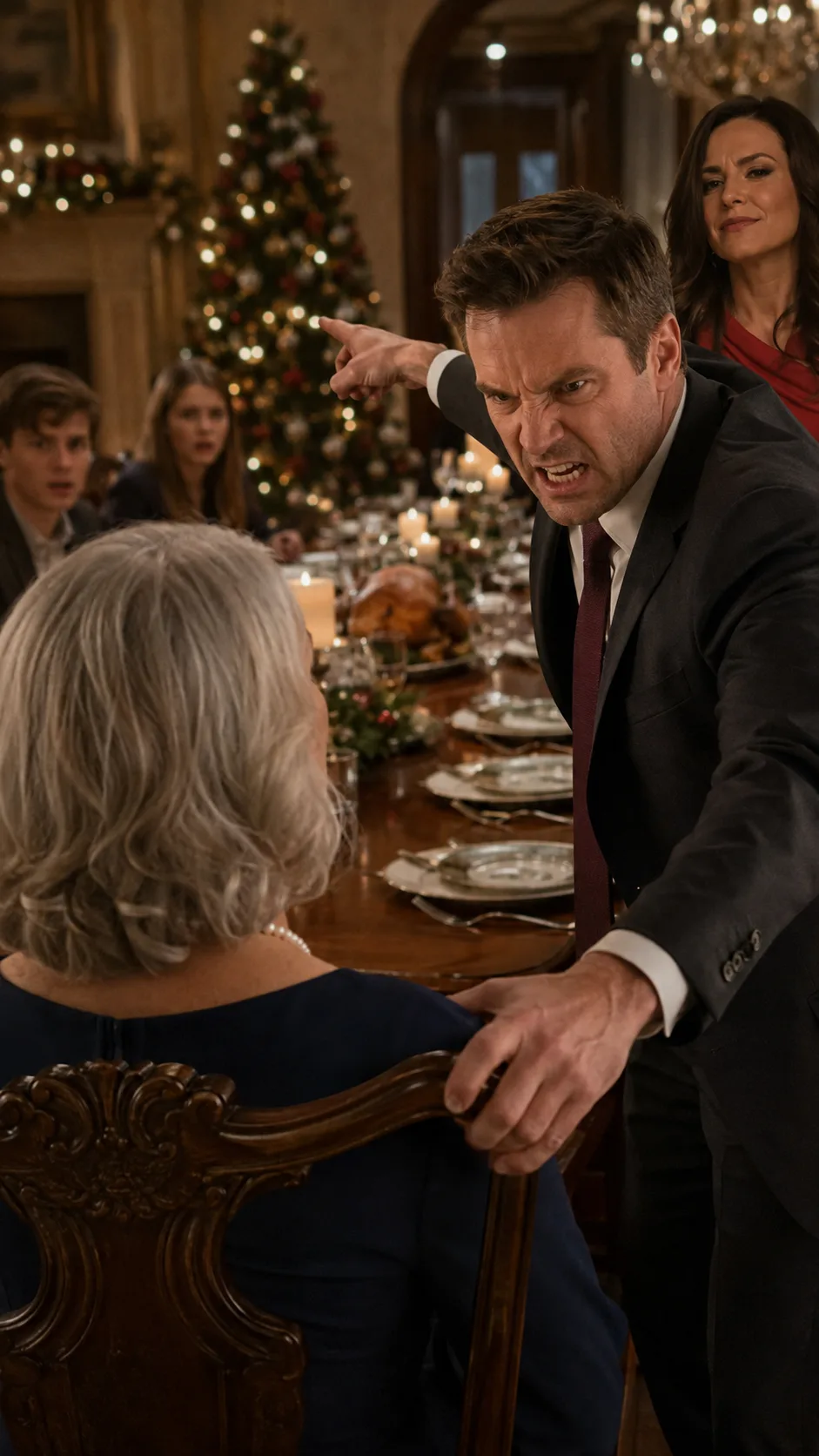
I saw Emily’s wide, horrified eyes from across the table.
Chapter 2
PART 2 — The Proof Hidden in Emily’s Phone
I saw Emily’s wide, horrified eyes from across the table.
I saw Jacob’s mouth open in a silent scream. I saw Monica’s lips curl into a faint triumphant smirk.
Then impact.
My hip struck the marble floor with a sickening thud. The sharp, blinding pain was immediate. But the emotional shock was worse.
My wine glass, which I’d still been holding, flew from my hand and shattered against the floor, the sound as sharp and violent as a gunshot.
A deathly silence fell over the room.
It was broken by my grandson.
“Grandma!”
Jacob screamed, jumping up from his chair to run to me.
But my eyes were locked on a small blinking red light in the corner of the room.
Emily, my beautiful, sensitive Emily, had been holding her new phone, intending to capture a video of our family’s happy Christmas dinner. Her hand was shaking, but the lens was pointed directly at the scene.
It had recorded everything.
My son’s cruel words, his violent push, my humiliating fall, the broken glass spreading like tears around me.
I saw it all reflected in her phone’s dark screen: the face of a heartbroken old woman on the floor, the victorious smiles of my daughter-in-law and her mother, and the face of the son I no longer recognized, standing over me without a shred of remorse.
The war had begun, and they had just handed me my first and most powerful weapon.
A betrayal of that magnitude doesn’t happen in a single explosive moment. It’s a cancer that grows in the dark, fed by whispers and secret resentments.
Looking back, I can see the signs were all there, like faint cracks in a foundation. I just didn’t want to see them.
The week before Christmas, while my heart was full of nothing but love for my family, the plot against me
was already in motion.
I remember that week so clearly. The Dallas air was crisp and cool, a welcome break from the usual Texas heat. The city was aglow with festive lights, and I felt a genuine sense of peace.
Frank had been gone for two years, and the holidays were still tinged with sadness. But my grandchildren, Emily and Jacob, were a powerful antidote to grief. Their excitement was contagious.
I spent an entire afternoon at Neiman Marcus, searching for the perfect gifts.
For Emily, I found a beautiful first edition copy of her favorite classic novel, bound in dark green leather. She had my husband’s love for books, a quiet intelligence that saw the world with an artist’s sensitivity. I knew she would treasure it.
For Jacob, it was easier. He was all boy, full of energy and a love for the outdoors. I bought him the new
mountain bike he’d been circling in catalogs for months, a gleaming machine of chrome and black.
I pictured his face on Christmas morning and smiled to myself in the middle of the bustling store.
I was so wrapped up in my joyful preparations, so blissfully unaware. I imagined them all at the ranch, opening their presents, the fire roaring, our family safe and happy in the home Frank and I had built.
I saw David, my son, smiling as he watched his children. In my mind, he was still the boy who used to run to me with scraped knees, the young man who had looked at me with such pride at his college graduation.
I was living in a past that I now realize no longer existed.
While I was choosing wrapping paper, my son was sitting in a dark, expensive restaurant downtown, selling his birthright for a bowl of soup.
I can picture the scene now as if I were a fly on the wall. The restaurant would have been one of Monica’s choices, all sharp angles, gleaming chrome, and hushed, self-important tones. It was the kind of place where deals were made, a cold and sterile environment for a cold and sterile conversation.
The three of them were there: David, my son, Monica, his ambitious wife, and Helen, her mother, the serpent in our garden.
They would have ordered a bottle of wine that cost more than most people’s weekly groceries. Helen would have guided the conversation as she always did, with the practiced skill of a master puppeteer.
She never raised her voice. She never appeared angry. She simply planted seeds of poison with a gentle, concerned smile.
“David, darling,” I can hear her saying, her voice smooth as silk. “You know how much I admire your mother. Margaret is one of the strongest women I’ve ever known.”
She would have paused, letting the compliment land, disarming him.
“But…” she would continue, her tone shifting to one of deep, feigned concern, “the world of construction, of business… it isn’t the same one she and Frank conquered. It’s faster now, more ruthless. Her ideas, while well-intentioned, are outdated.”
David would have shifted uncomfortably in his seat. A part of him, the boy I raised, would have wanted to defend me.
“Mother knows what she’s doing. She helped Dad build Ellison Construction from the ground up.”
That’s when Monica would have jumped in, playing her part perfectly.
“Of course she did, honey,” she’d say, placing her hand on his. “No one is denying that. But that was then. This is now. We just had a board meeting where she tried to earmark a million dollars for a new local arts program.”
“A million? We have competitors trying to undercut us on the Bridgeport contract, and she wants to fund a ballet.”
Helen would have nodded gravely.
“It’s not about the money, David. It’s about focus. Your mother still sees the company as a family project, a way to do good in the community. That’s lovely, but it’s a liability in this day and age. You see the bigger picture. You have your father’s head for business, but you’re being held back.”
She knew exactly which buttons to push.
His entire life, David had struggled under the weight of his father’s legacy. Frank was a giant of a man, not just in stature, but in character and accomplishment. David, who was not as driven and not as brilliant, had always felt like he was living in his father’s shadow.
Helen’s words were designed to hit him where it hurt the most: his insecurity, his desperate need to prove that he was his own man.
“She needs to understand that her time of running things is over,” Helen would have said, her voice dropping to a conspiratorial whisper. “It’s your time now. You have to be strong, David. Not for you, but for your own family, for Monica, for your children’s future.”
“She’s right,” Monica would chime in, her eyes hard. “We need to have complete control, David. Full authority to make the tough decisions without having to run them by her for approval. It’s time we took what is rightfully ours.”
The hesitation, I imagine, in my son’s eyes is the most painful part. There must have been a moment, a flicker of a second, where his love and loyalty to me fought against the poison they were pouring into his ears.
But it wasn’t a fair fight.
On one side was his mother, who he saw as a relic of the past. On the other were these two women stroking his ego, promising him the power and respect he craved.
He looked at Helen’s serene, smiling face. He looked at his wife’s determined, hungry expression.
They were offering him a crown.
All he had to do was betray his own mother.
I can see him picking up his wine glass, his knuckles white as he gripped the stem. He stared into the deep red liquid for a long moment. Then he took a slow drink, placed the glass back on the table with a soft click, and gave a single sharp nod.
A silent agreement had been forged in the dim light of that soulless restaurant.
The ambush was set, and I, miles away, was happily paying for a bicycle, completely oblivious to the fact that my own son had just agreed to push me out of my home, my company, and my life.
A few days before the Christmas Eve storm broke, there was a quiet dinner, a false peace.
It was just the four of us, myself, David, and the children. Monica was conveniently away at a spa weekend with her mother, a trip I now see was likely a final strategy session.
At the time, I was just relieved to have my son and grandchildren to myself. I thought it was an opportunity to connect, to bridge the strange new distance I’d been feeling between us.
I was a fool.
I cooked David’s favorite meal: pot roast, slow-simmered for hours until it was tender enough to fall apart with a fork, with creamy mashed potatoes and glazed carrots. It was the taste of his childhood, a meal I hoped would remind him of simpler, happier times.
We sat at the smaller round table in the breakfast nook, a cozy space that looked out over the sprawling ranch lands as the Texas sun began to set, painting the sky in shades of orange and purple.
For a little while, it felt normal.
Jacob chattered excitedly about his school’s basketball team, and Emily spoke quietly but passionately about a new photography project. I watched David listen to his children, a soft smile on his face, and my heart ached with love.
I saw a glimpse of the man he was supposed to be, the man I had raised.
That glimpse gave me the courage to bring up a subject that was dear to my heart.
“David,” I began, waiting for a lull in the conversation, “I had the most wonderful meeting today with the folks from the Children’s Music Foundation.”
His smile tightened almost imperceptibly.
“Oh.”
I pressed on, my enthusiasm making me blind to the warning sign.
“They’re doing incredible work providing instruments and free lessons to children in underserved communities right here in Dallas. Their current building is practically falling down, and they’re trying to raise funds for a new facility. I was thinking Ellison Construction could be the lead donor. We could fund the entire performance hall.”
“Imagine it, darling. The Frank Ellison Performance Hall. It would be such a beautiful way to honor your father’s memory.”
I looked at him, my eyes shining with the vision of it. Frank had been a quiet philanthropist. He believed that the wealth we created came with a responsibility to the community that helped us thrive. This project felt like a continuation of his very soul.
David put his fork down with a soft clink against the china. The sound seemed unnaturally loud in the suddenly quiet room.
He took a slow sip of water, his eyes cold and unreadable.
“Mother,” he said, his voice flat and devoid of any warmth, “the company is not your personal charity fund.”
The words were so blunt, so dismissive, they felt like a physical slap.
I stared at him, my smile faltering. “I… I don’t understand. It’s a tax write-off, of course, and the PR would be wonderful, but more than that, it’s the right thing to do. It’s what your father would have wanted.”
“I’m not interested in what Dad would have wanted,” he said, a sharp, cruel edge to his voice. “I’m interested in profit margins and shareholder value. We’re in the middle of a bidding war for the new airport expansion. Every dollar counts. We are not a foundation. We are a construction empire, and I would appreciate it if you would let me run it as such.”
The air went thick with unspoken things.
Jacob looked down at his plate, his cheerful energy completely extinguished. Across the table, Emily’s eyes darted from her father’s hard face to my stunned one. I could see the worry clouding her features. She felt the chill as keenly as I did. She knew in that instant that this wasn’t a simple business disagreement. It was a power play.
I tried to recover, to smooth over the ugly rift that had just torn through our meal. I forced a laugh, but it sounded brittle and hollow even to my own ears.
“Of course, dear. You’re the CEO. I was just making a suggestion.”
“Then please keep your suggestions to yourself,” he said, picking up his fork again as if nothing had happened. “I’ll handle the business decisions from now on.”
I wanted to argue. I wanted to scream at him, to remind him that I wasn’t just some board member. I was his mother, the co-founder of the very company he was so arrogantly claiming as his own. I had poured my own blood, sweat, and tears into Ellison Construction. My business acumen had saved Frank from ruin more than once, a fact we had always kept between us to protect his pride.
But I looked at the children, at their troubled faces, and I bit my tongue so hard I tasted blood.
I just nodded. “All right, David.”
The rest of the dinner was an exercise in agony. We talked about the weather, about school, about anything and everything except the elephant that was now sitting at the table with us. But the pot roast tasted like ash in my mouth. The warmth of the room had evaporated, replaced by an icy cold that had nothing to do with the winter evening outside.
As I looked at my son, I saw the full extent of Helen and Monica’s influence. His words weren’t his own. They were echoes of their cold, calculating ambition.
He was wearing his father’s suit, sitting in his father’s chair, but he was a stranger to me. The loving boy I knew, the one who respected and admired his parents, was gone. In his place was this hard, resentful man who looked at me not with love, but with impatience, as if I were an obstacle in his path.
That night, for the first time, I truly understood. This wasn’t a phase. This wasn’t a simple case of my son wanting to find his own way. A chasm had opened up between us, deep and wide, and perhaps impossible to cross.
He wasn’t just trying to run a company. He was trying to erase me from it.
And I knew with a certainty that chilled me to the bone that the quiet dinner was just the first tremor before the earthquake.
The drive from the ranch to Charles Bennett’s office was a blur. The familiar Dallas skyline, usually a symbol of the empire Frank and I had built, seemed alien and hostile. Every glittering skyscraper felt like a monument to the corporate ruthlessness that had infected my son.
My hip throbbed with a dull, persistent ache, but it was nothing compared to the pain in my heart.
Charles Bennett had been my husband’s lawyer, his best friend since they were boys, and the executor of his will. His office was an oasis of timeless dignity in a city obsessed with the new. It was paneled in dark mahogany, lined with floor-to-ceiling bookshelves filled with leather-bound legal tomes, and smelled faintly of old paper and good whiskey.
It was a place of secrets and trust.
He met me at the door, his usually cheerful face etched with grave concern. At 74, Charles was still sharp as a tack, with wise, kind eyes that had seen it all. He took one look at my face and simply said, “In here, Margaret. Let me pour you a brandy.”
I didn’t protest.
I sank into one of the deep leather armchairs facing his massive desk as he handed me a heavy crystal glass. The fiery liquid did little to warm the ice in my veins.
“He pushed me.”
“Charles,” I said, my voice a hollow whisper. I recounted the whole sordid affair, the demand for my chair, David’s cold words, the shove, the fall in front of my grandchildren.
I spoke without tears, my shock having burned away everything but a cold, hard knot of grief.
Charles listened without interruption, his hands steepled under his chin. He didn’t seem surprised, which was somehow the most damning thing of all.
When I finished, he was silent for a long moment, his gaze distant.
“Frank saw this coming,” he said finally, his voice heavy. “He prayed it would never happen, but he knew it might. He knew David’s weakness.”
“What are you talking about?”
Instead of answering, Charles rose and walked to a large oil painting of a Texas landscape that hung on the far wall. He swung it aside, revealing the dark steel door of a walk-in safe. He spun the combination dial with practiced clicks and pulled the heavy door open.
From a private lockbox inside, he withdrew a thick, cream-colored envelope, sealed with the familiar Ellison family crest in dark red wax, my husband’s seal. He placed it on the desk between us.
“Frank added a special provision to his final directives, separate from the main will. He called it his poison pill clause.”
My hand trembled as I reached for the envelope. “A poison pill? That’s a corporate term, a defense against a hostile takeover.”
“Precisely,” Charles said, his eyes meeting mine. “And Frank saw exactly what was coming. A hostile takeover of his family. He knew David was susceptible to influence, especially from Monica and her mother. He saw their ambition, so he left you a weapon of last resort.”
Charles leaned forward, his voice low and serious.
“The clause states that if David, as CEO and majority shareholder, subjects you to provable and irrefutable public humiliation, you are granted the immediate right to purchase his entire controlling stake in Ellison Construction. All of it, for the symbolic sum of one United States dollar.”
I stared at him, the air leaving my lungs.
The audacity of it, the sheer strategic brilliance, was pure Frank. It was a master chess move from beyond the grave. But the implication was monstrous.
“He wanted me to bankrupt my own son?”
“No,” Charles corrected gently. “He wanted to give you a choice. He wanted to ensure that you would never be at the mercy of David’s weakness or Monica’s greed. He was giving you a loaded gun, Margaret, and trusting that you would only ever use it if they backed you into a corner so tight you had no other way out.”
A loaded gun.
The weight of it settled on me, heavy and cold. For a moment, I recoiled. To pull that trigger would be to declare total war, to destroy what was left of my family. It was unthinkable.
Then Charles asked the question that changed everything.
“It’s an explosive legal maneuver, and they would fight it tooth and nail. The entire case would hinge on one thing, the proof. The humiliation can’t be just your word against his. It has to be absolute, undeniable, something a judge could look at and have no doubt. Do you have proof, Margaret?”
My mind, which had been a whirlwind of pain and confusion, suddenly went still and silent.
The image that flashed behind my eyes was as clear as a photograph: the small blinking red light of Emily’s phone. The screen capturing the entire horrific scene. My son’s face twisted in anger, his hand on my shoulder, my body falling, the shatter of the glass, the triumphant smirk on Monica’s face.
It wasn’t just proof. It was a verdict.
I looked at Charles, and I felt the last of my hesitation burn away, replaced by something I hadn’t felt in years: the cold, calculating fury of a woman who had just been handed the means to fight back.
My memory of that evening now plays back in fragments, each one sharp and clear, like shards of broken glass. But the moments just before the fall are what haunt me the most. That was when the battle lines were drawn, not with a cannon blast, but with a whisper and a smile. That was when the air in my own home turned to poison.
I was standing near the fireplace, speaking with Jacob about his Christmas wish list, when Helen made her entrance.
She didn’t just walk in. She arrived.
She was wearing a deep emerald green velvet dress that clung to her in a way that was both elegant and vaguely predatory. Diamonds glittered at her throat and ears, cold and brilliant. She moved through the room not as a guest, but as a queen taking possession of her court.
I turned to greet her, a polite smile on my lips.
“Helen, you look stunning. Merry Christmas.”
“Margaret, dear,” she said, her voice a low purr. She air-kissed the space beside my cheek. “You’ve made the place look so festive, so traditional.”
There was a subtle emphasis on the last word, a hint of condescension that I chose to ignore.
My unease began to grow when she didn’t mingle. Instead, she glided directly to the dining room. I watched as she surveyed the magnificent table I had spent all afternoon setting. Then, with a quiet, deliberate grace, she placed her evening bag on the table next to the chair to the right of the head, my husband’s former seat, the seat of honor. And then she sat down, crossing her legs, the picture of serene entitlement.
It was a blatant power play, and everyone in the room felt it.
The serving staff, who were putting the final touches on the place settings, exchanged nervous glances. Even Jacob seemed to sense the shift in the atmosphere, his cheerful chatter fading into silence.
It was a declaration. She was no longer a guest. In her mind, she had already been promoted.
I saw David and Monica standing near the entryway, their heads close together. They were a tight, conspiratorial unit. Monica had her hand locked on David’s forearm, her crimson nails digging slightly into the fabric of his suit jacket. I couldn’t hear her words, but I could read the intensity in her expression, the way her eyes bored into him.
It was the look of a handler giving a final urgent command to a prized animal before letting it off the leash.
Later, piecing it all together, I could almost hear her whisper, her voice a venomous hiss in his ear.
“It’s time, David. The pleasantries are over. Are you going to be the man of this house, or are you going to let her treat you like a little boy forever? Show her who’s in charge now.”
I watched my son’s face. I saw the conflict there, the flicker of doubt, the shadow of the boy who loved his mother.
But it was fleeting.
Under Monica’s relentless pressure, his features hardened, his jaw set. He straightened his shoulders, pulling himself up to his full height, a pale imitation of his father’s confident stance. He was steeling himself for what was to come.
The writing was on the wall in bold, cruel letters, and I had been too busy admiring the Christmas decorations to read it.
The pressure from those two women was a physical force in the room. It was a vice, and my son was caught in the middle, being squeezed until his own character and conscience were crushed. Helen, with her silent, regal disapproval from the table, and Monica, with her sharp, whispered provocations, had become the puppet masters.
David was about to dance on their strings.
I decided to try and seize back control, to pretend this wasn’t happening. I clapped my hands together, forcing a bright, cheerful tone into my voice.
“All right, everyone. Shall we take our seats? The turkey is about to be carved.”
My voice cut through the thick tension, but it didn’t dissipate it. The staff scurried to their positions. Emily and Jacob moved uncertainly toward their chairs.
Monica gave David’s arm one last hard squeeze and then released him, a faint, knowing smirk on her lips. She had wound him up and set him loose.
I turned and walked toward my chair at the head of the table, the one that had been mine for 40 years. Every step felt heavy, as if I were wading through water. Every eye was on me.
The cheerful crackle of the fire in the hearth suddenly sounded deafening in the strained silence.
This was it.
This was the moment where the cold war that had been brewing in my family was about to turn hot.
As I reached for the back of my chair, I saw David move out of the corner of my eye. He wasn’t walking to his own seat. He was walking directly toward me, his expression a mask of grim determination.
The storm was no longer gathering. It had arrived.
Click the blue “PART 3” below to read the next part:
Chapter complete
You have reached the end of this chapter.
Continue reading
A few more worlds to get lost in after this chapter.




