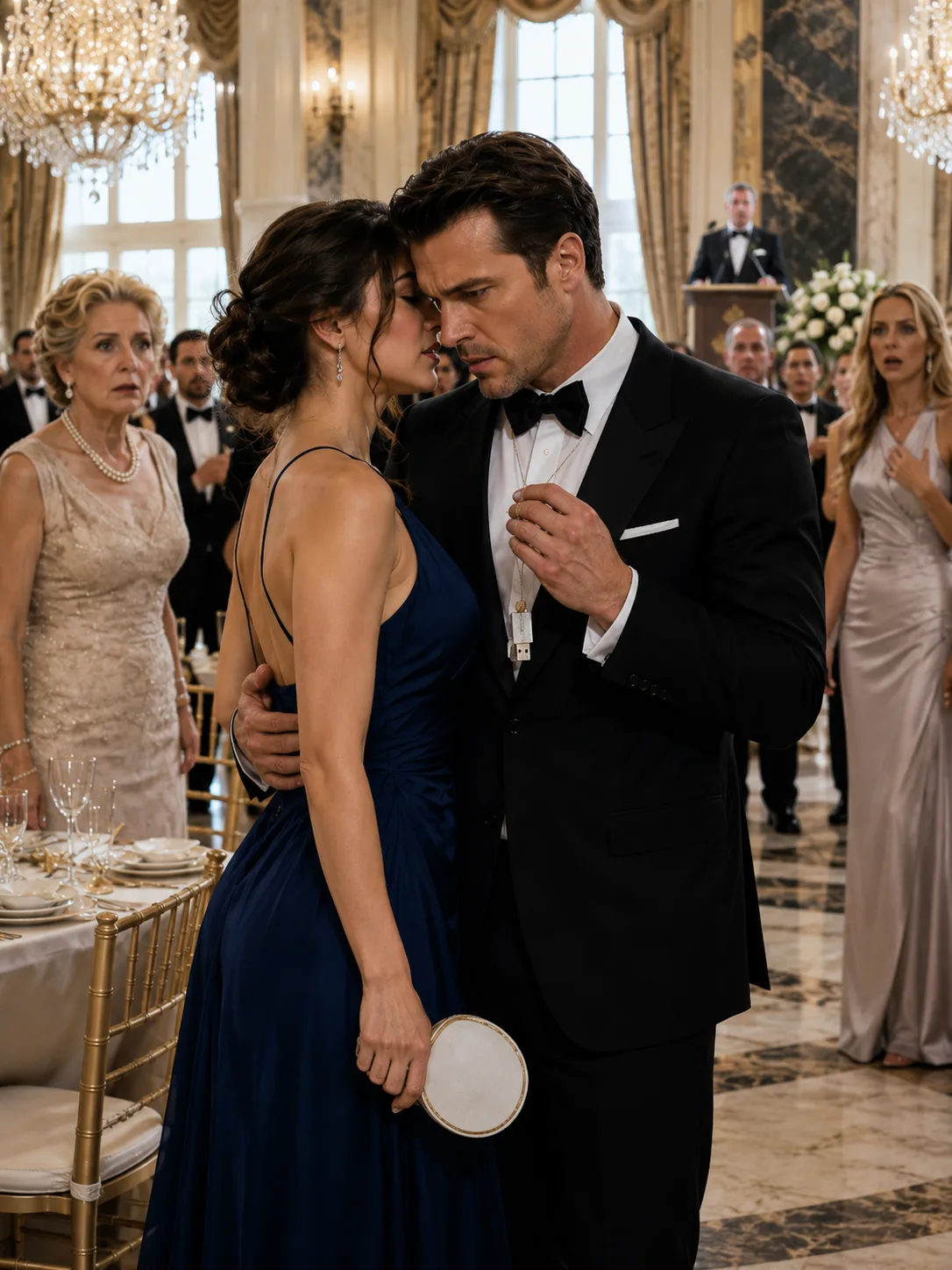
THE WOMAN WHO BOUGHT THE LAST DANCE
Opening Hook — Three Minutes Was All She Needed
Everyone laughed when the poor woman raised her paddle.
Chapter 1
Everyone laughed when the poor woman raised her paddle.
Not loudly at first.
Rich people rarely laughed loudly when cruelty could be served more elegantly in whispers.
The auctioneer paused under the chandeliers of the Sterling Foundation Gala, his smile tightening as if he had just watched a waiter drop red wine on a duchess.
“Paddle number 118,” he announced. “Ten thousand dollars.”
A ripple moved through the ballroom.
Ten thousand dollars for the final charity auction item of the night:
The Last Dance with Damian Sterling.
Damian Sterling.
Thirty-seven.
Billionaire.
Tech heir.
Philanthropist.
The man on every business magazine cover that month.
The man standing near the stage in a black tuxedo, one hand at his side, the other touching the small silver USB pendant he always wore around his neck.
The man Aria Bell had loved before his accident.
The man who now looked at her as if she were a stranger causing him a public inconvenience.
The woman beside him smiled.
Victoria Sterling.
His mother.
Chairwoman of the Sterling Foundation.
A woman made of pearls, money, and perfect lies.
She leaned toward the sponsor seated beside her and murmured something that made the table laugh.
Aria heard only one word.
“Desperate.”
She sat at the back of the ballroom in a borrowed navy dress, hair pinned with drugstore clips, her hands steady around the auction paddle someone had placed in front of her as a joke.
She had not come to dance.
She had not come to beg.
She had not come to remind Damian Sterling that once, before the world called him brilliant and untouchable, he had fallen asleep beside her in a hospital waiting room and whispered, If I ever forget myself, find the key before they lock me inside.
He had forgotten.
And they had locked him very well.
The auctioneer cleared his
throat.
“Ten thousand from paddle 118. Do I hear fifteen?”
A woman in diamonds lifted her paddle with a bored smile.
“Fifteen thousand.”
Applause.
Laughter.
A camera turned toward Aria, waiting for her humiliation.
She lifted her paddle again.
“Twenty.”
The laughter sharpened.
At the front table, Damian’s fiancée, Elise Van Holt, turned fully around to stare.
Elise was tall, pale, and expensive in a way that suggested generations of women had been instructed not to sweat. She glanced at Aria’s dress, then at her shoes, then smiled as if the comparison itself were entertainment.
Victoria Sterling lifted one eyebrow.
The auctioneer hesitated.
“Twenty thousand dollars from paddle 118.”
A board member whispered, “Can she even pay?”
Someone else whispered, “Isn’t she the ex?”
Not ex.
Not officially.
That was part of the problem.
After Damian’s accident three years earlier, Aria had been erased before she could become anything records
would respect.
The bidding continued.
Thirty.
Forty.
Fifty.
Each time another socialite raised the price, the room enjoyed watching Aria refuse to disappear.
Finally, Elise lifted her paddle.
“One hundred thousand.”
The ballroom erupted in delighted applause.
A hundred thousand dollars for three minutes with a man everyone knew already belonged to someone else.
The auctioneer beamed.
“One hundred thousand dollars from Miss Van Holt. Very generous. Going once—”
Aria raised her paddle.
“One hundred and one.”
The room died.
Not because the number was impressive.
Because it was insulting.
One hundred and one thousand dollars.
One thousand more.
A poor woman’s defiance added like a scratch across polished glass.
Elise’s smile vanished.
Victoria’s eyes narrowed.
Damian finally looked at Aria.
Really looked.
For one second, something flickered in his face.
Pain.
Confusion.
A memory trying to breathe under water.
Then it was gone.
The auctioneer swallowed.
“One hundred and one thousand dollars from paddle 118. Do I hear—”
Elise reached for her paddle again.
Victoria stopped her.
A tiny touch on the wrist.
No.
Why?
Because Victoria understood something the others did not.
Aria Bell would not bid money she did not have unless she had come with a purpose.
The auctioneer looked around.
“Going once.”
Silence.
“Going twice.”
Damian’s fingers tightened around the USB pendant.
“Sold,” the auctioneer said, striking the gavel. “The final dance goes to paddle 118.”
Applause came slowly.
Mocking.
Hungry.
The orchestra began tuning for the last waltz.
Aria stood.
Her knees wanted to shake.
She did not let them.
As she walked toward the stage, a man near the aisle murmured, “Pathetic.”
Aria passed him without looking down.
Damian met her at the edge of the dance floor.
He did not offer his hand immediately.
“Miss Bell,” he said.
Miss Bell.
Not Aria.
Not Ari, the name he used to whisper into her hair.
Her heart broke cleanly, without drama.
“Mr. Sterling,” she answered.
His voice was cold.
“You shouldn’t have done this.”
“I know.”
“Then why?”
She looked at the USB pendant at his throat.
A small silver rectangle, custom-made, hanging from a chain beneath his bow tie.
Everyone thought it was sentimental.
A lucky charm from before the accident.
They did not know he had built it himself.
They did not know it held the encrypted memory archive he used before his brain injury.
They did not know he had worn it every day after waking because some part of him knew it mattered, even though his family told him he had forgotten the password.
Aria stepped closer as the music began.
“Because I only need three minutes.”
His eyes sharpened.
“For what?”
She placed one hand on his shoulder.
His hand went to her waist.
The ballroom watched.
Victoria stood very still at the front table.
The first notes of the waltz filled the room.
Aria leaned in, close enough that only he could hear.
“The password is not a word,” she whispered. “It’s the date we buried the blue glass under the oak tree, followed by the name you gave the scar on your left hand.”
Damian stopped breathing.
His hand tightened at her waist.
Aria continued, voice barely moving.
“June seventeen. Atlas.”
The USB pendant slipped from his fingers.
His face went white.
In the front row, Victoria Sterling stood up so fast her chair scraped marble.
“Stop the music,” she ordered.
No one moved.
Damian looked into Aria’s eyes.
For the first time in three years, he did not look at her like a stranger.
He looked at her like a door had opened.
“What did you say?” he whispered.
Aria’s eyes filled.
“June seventeen. Atlas.”
The dance had cost her one hundred and one thousand dollars.
The truth only needed three minutes.
And by the time the music ended, Damian Sterling would open the USB on stage and learn that his mother had not saved his mind after the accident.
She had edited it.
Aria Bell met Damian Sterling in the only place where billionaires and broke graduate students were equally helpless.
A hospital vending machine.
It was 2:13 in the morning at St. Matthew’s Medical Center. Aria was twenty-six, exhausted, wearing a sweater with a coffee stain shaped like South America, and arguing with a vending machine that had swallowed her last dollar without delivering pretzels.
Damian Sterling stood beside her in a hoodie and jeans, holding a paper cup of coffee and looking like the richest man in the building pretending badly not to be rich.
“You have to hit the left side,” he said.
Aria did not look at him.
“I don’t take emotional advice from men drinking hospital coffee voluntarily.”
“It’s mechanical advice.”
“Worse.”
He stepped forward and tapped the vending machine once near the coin slot.
The pretzels fell.
Aria stared.
“That was infuriating.”
“You’re welcome.”
“I didn’t thank you.”
“You were about to.”
She grabbed the pretzels.
“Don’t develop expectations.”
He smiled.
That smile should have warned her.
It had the easy loneliness of a man who was used to being admired but not known.
Damian was there because his father, Charles Sterling, had collapsed after a stroke. Aria was there because her younger brother, Milo, had undergone emergency surgery after a warehouse accident and her mother was too fragile to sit alone.
They kept meeting in the vending area over the next week.
At first, they talked because waiting rooms make strangers honest.
Then because they liked each other.
Then because they began timing coffee breaks around one another and pretending coincidence was still involved.
Damian did not introduce himself as a billionaire.
Aria knew anyway.
Everyone knew Sterling.
Sterling Systems had built half the secure data infrastructure used by banks, hospitals, and government contractors. Damian had taken over the company’s innovation arm at twenty-nine and turned it into a global force. His face appeared on magazine covers beside words like visionary and reclusive.
Aria was a part-time archivist, part-time doctoral student in memory studies, and full-time person responsible for keeping her family from collapsing financially.
When she told Damian this, he said, “Memory studies?”
She said, “Yes.”
“Like neuroscience?”
“Like history, trauma, testimony, archives, the politics of what gets preserved and what gets erased.”
His expression changed.
“That sounds more important than what I do.”
“You build machines that protect information.”
“From hackers.”
“I study how people protect lies.”
He laughed softly.
“My mother would hate you.”
“Most powerful women do when I ask follow-up questions.”
He laughed harder.
That was the beginning.
Damian’s mother, Victoria Sterling, did hate Aria.
Not immediately in public.
Public hatred was inefficient.
Victoria invited Aria to lunch three months after Damian and Aria became inseparable. She wore ivory silk, spoke five languages, chaired three foundations, and possessed the emotional warmth of a locked vault.
“My son is intense,” Victoria said over tea.
“So am I.”
“Yes. But he can afford to be.”
Aria set down her cup.
“Meaning?”
“Meaning intensity is charming in men who inherit institutions. In women without protection, it becomes instability.”
Aria smiled.
“You practiced that.”
Victoria did not smile back.
“I practice many things.”
Damian apologized afterward.
“She’s protective.”
Aria looked at him.
“She’s territorial.”
He sighed.
“I know.”
“Do you?”
“I’m learning.”
He was.
That was why she stayed.
Damian was not weak. Not then. He was loyal, brilliant, stubborn, and deeply afraid of becoming the kind of man his family preferred.
He hated the Sterling estate.
He hated gala speeches.
He hated how his mother called every act of control “care.”
He loved building things with his hands when no one watched.
The USB pendant began as a joke.
Damian had always been obsessed with encrypted memory systems. He built personal archives the way other people kept journals: audio notes, video logs, design sketches, letters, medical files, financial records, fragments of life he did not want curated by family offices.
“I don’t trust legacy,” he told Aria. “It’s just memory with better lawyers.”
She loved him for that sentence.
He wore the USB because he said it kept his real archive close.
“What’s on it?” she asked once.
They were lying under an oak tree near an abandoned property outside the city, a place Damian wanted to someday turn into a school for data ethics and public memory.
“Everything important.”
“That is vague and suspicious.”
“Letters to myself. Company notes. Things my mother would call dramatic.”
“So, feelings.”
“Encrypted feelings.”
“Password?”
He smiled.
“You want access?”
“I want to know who gets the truth if you get hit by a bus.”
“That’s romantic.”
“That’s archival.”
So they made a password.
Not a simple one.
A memory.
That day, they found a piece of blue glass near the old property’s foundation. Aria said it looked like a broken sky. Damian said that was too poetic and clearly evidence she needed lunch.
They buried it under the oak tree in a small tin with a note:
If we forget what we meant to build, dig here.
Damian had a scar on his left hand from a childhood fall he claimed made him “heroic.” Aria named it Atlas because it carried too many bad stories.
The password became:
0617Atlas
June seventeen.
Atlas.
Only they knew.
Six months later, Damian proposed under that same oak tree.
No photographer.
No family.
No ring at first.
Only the USB pendant in his hand.
“If I ever forget myself,” he said, “find the key before they lock me inside.”
Aria laughed because she thought it was dramatic.
Then she saw his face.
He was serious.
So she took the pendant, kissed it, and said, “Then don’t forget me.”
He smiled.
“Impossible.”
Three weeks later, the car accident happened.
Damian’s car was found against a guardrail on a private road near the Sterling estate.
Rain.
Brake failure.
Head trauma.
Two fractured ribs.
A torn shoulder.
Brain swelling.
Memory disruption.
The official explanation arrived too quickly.
Aria learned about the accident from a news alert.
Not from the hospital.
Not from his family.
A news alert.
She arrived at St. Matthew’s before dawn, still wearing the clothes she had slept in, hands shaking so badly she could barely sign the visitor log.
Security stopped her.
“Family only.”
“I’m his fiancée.”
The guard checked a tablet.
“You’re not listed.”
“That’s impossible.”
Victoria Sterling appeared behind the glass doors like she had been waiting for that exact sentence.
“Aria.”
“Where is he?”
“He is in critical care.”
“I need to see him.”
“He needs stability.”
“He needs me.”
Victoria’s eyes were cold.
“He needs his family.”
Aria pushed past the first guard.
Two more stopped her.
Victoria stepped close enough to whisper.
“You will not turn his recovery into a performance of your importance.”
Aria stared.
“You are insane.”
“No,” Victoria said. “I am his mother.”
It took Aria two days to get inside.
Not through permission.
Through Milo’s nurse friend, who owed Aria for helping organize a malpractice petition the previous year.
Damian was unconscious.
Tubes.
Bruises.
Bandages.
His left hand wrapped.
The USB pendant still around his neck.
Aria held his uninjured hand and cried silently because sound felt like theft in that room.
She whispered the password.
Not to open anything.
To remind him.
“June seventeen. Atlas.”
His fingers twitched.
She saw it.
She knew she saw it.
Then the door opened.
Victoria entered with a doctor and two security officers.
Aria was removed.
After that, everything became war.
Victoria claimed Damian had no fiancée.
The engagement was private, undocumented.
Convenient for her.
Damian’s phone disappeared.
His apartment was cleared.
Aria’s emails bounced.
Her access to shared research files vanished.
Her calls were blocked.
Then came the story.
Damian had been under emotional strain before the accident due to “an intense but brief relationship” with a woman outside his circle.
Aria had become possessive.
Unstable.
A distraction from recovery.
The tabloids did not name her at first.
Then they did.
WHO IS ARIA BELL, THE WOMAN TRYING TO ACCESS DAMIAN STERLING’S HOSPITAL ROOM?
Trying to access.
Not fiancée.
Not partner.
Trying.
She became a threat in the public version before she could become a witness.
Damian woke after nineteen days.
Aria was not allowed to see him.
A month later, a Sterling attorney sent her a letter demanding she cease contact.
It included one sentence that destroyed her for a while:
Mr. Sterling does not remember an engagement and does not wish to pursue communication.
Aria did not believe it.
Then she saw footage of Damian leaving the hospital months later.
Thin.
Pale.
Alive.
Victoria beside him.
A reporter asked about Aria.
Damian looked confused.
Then uncomfortable.
Victoria touched his arm.
He said, “I’m focused on recovery.”
Not a denial.
Not a confirmation.
A wall.
For three years, Aria tried to reach him quietly.
Letters.
Trusted intermediaries.
Encrypted messages using old channels.
Nothing.
Sometimes she wondered if he had chosen silence.
Sometimes she hated him for it.
Most days, she hated herself for still looking for signs.
Then, one year after the accident, she saw the USB pendant around his neck in a magazine photo.
Still there.
Always there.
He wore it to board meetings, interviews, charity events, even a medical technology summit where a journalist joked that the billionaire data king carried his own backup drive like a superstition.
He had the key.
But not the password.
Aria understood then.
If Damian could open the archive, he could see his old self.
His medical directives.
His video notes.
His letters.
Maybe proof of what happened during recovery.
Maybe proof of her.
But how could she give him the password?
Victoria controlled his schedule.
His lawyers screened messages.
His assistants blocked her name.
Security had her photograph.
She needed three uninterrupted minutes beside him.
That seemed impossible.
Until the Sterling Foundation announced its annual gala.
The final auction item:
The Last Dance with Damian Sterling.
A joke item, probably created by Victoria to charm donors and humiliate anyone beneath them who dared desire access.
Aria saw the listing and understood immediately.
Victoria had built a stage.
Aria would buy three minutes on it.
She sold her car.
Emptied her savings.
Borrowed from no one because she refused to drag anyone else into Sterling danger.
She had one hundred and one thousand dollars.
Not enough to win a normal auction.
Enough to insult the right people.
Enough to make Victoria wonder.
Enough to buy the last dance.
The Sterling Foundation Gala was held at the Metropolitan Conservatory, a glass-domed building filled with palms, white orchids, and donors who enjoyed compassion under controlled lighting.
Aria arrived through the side entrance because her ticket was not elite enough for the front carpet.
She had received the invitation from an old professor whose table sponsor canceled last minute.
“You understand this is dangerous,” the professor said.
“Yes.”
“You may be removed.”
“I know.”
“You may be humiliated.”
Aria smiled sadly.
“That part already happened.”
Inside, the gala glittered.
Champagne.
Cameras.
Auction paddles.
Soft music.
Women in diamonds.
Men in tuxedos.
All of them gathered to raise money for the Sterling Foundation’s memory health initiative.
Memory health.
Aria nearly laughed.
Victoria had turned her son’s damaged mind into philanthropic branding.
On the main screen, a video played of Damian speaking about recovery, resilience, cognitive care, and the importance of protecting personal identity after neurological trauma.
His voice was smooth.
His face controlled.
His eyes empty in a way Aria recognized as practiced disorientation.
He was functioning.
He was brilliant still.
But something in him had been curated.
Edited.
Victoria sat beside him like the guardian of the final cut.
Elise Van Holt sat on his other side.
The rumored fiancée.
Not officially confirmed, but already photographed enough times to make the city comfortable with the idea.
Aria sat in the back.
People noticed.
Of course they did.
Whispers arrived before the salad.
“Is that her?”
“I thought she was banned.”
“How sad.”
“She looks thinner.”
“She looks poor.”
“She looks obsessed.”
Aria ate nothing.
She watched Damian.
Once, during the foundation film, he touched the USB pendant when the narrator said, “memory is the architecture of the self.”
His fingers held it like a man checking whether a door was still there.
Aria had to look away.
The auction began at nine.
Artwork.
Vacation packages.
Rare wine.
A private tour of a Sterling lab.
Then the final item.
The auctioneer grinned.
“And now, ladies and gentlemen, our most anticipated tradition. The Last Dance with Damian Sterling. Three minutes with our evening’s host, accompanied by the Sterling Quartet, in support of neurological recovery programs.”
Applause.
Damian smiled stiffly.
Victoria smiled fully.
Then the auctioneer added, “Let us begin at ten thousand dollars.”
Someone behind Aria whispered, “You should bid. Closure.”
Laughter.
Her paddle was already in her hand.
When she raised it, the room enjoyed itself.
They thought humiliation had arrived.
They did not understand that humiliation, once survived, can become camouflage.
By the time the gavel fell at one hundred and one thousand dollars, Aria’s entire body felt cold.
She had won.
Now she had to survive the dance.
Damian’s hand was warm.
That almost broke her.
She had expected him to feel like memory.
Untouchable.
Ghostly.
Instead, he was human.
His palm against hers.
His shoulder beneath her fingers.
The faint scent of cedar and the same soap he had used years ago.
“You shouldn’t have done this,” he said.
His voice was formal, but the edge beneath it was fear.
Not of her.
Of disruption.
“I know,” Aria said.
The waltz began.
They moved because bodies remember before minds agree.
Damian stiffened at first.
Then, for three steps, his body found an old rhythm.
They had danced in kitchens badly.
At weddings no one important attended.
In hospital parking lots after good news.
Under the oak tree after he proposed, laughing because neither of them knew what song they were moving to.
His eyes sharpened.
“You know me.”
“Yes.”
“My mother said—”
“I know what your mother said.”
His jaw tightened.
“Then you know I don’t remember what you want me to remember.”
“I don’t need you to remember everything.”
“Then why did you pay for this?”
Aria looked at the USB.
“For that.”
His hand moved reflexively to the pendant.
“My archive.”
“You still call it that?”
He looked startled.
“I don’t know why.”
“Because it is.”
The waltz turned them toward the front table.
Victoria watched, face still.
Aria leaned closer.
“Listen carefully. Don’t react until I finish.”
His eyes narrowed.
“Why?”
“Because your mother can read fear from across a ballroom.”
A faint line appeared between his brows.
He did not deny it.
Good.
Aria whispered, “The password is not a word. It’s a date and a name. June seventeenth. Atlas. No spaces. Two digits for month, two for day, then Atlas with a capital A.”
His breathing changed.
“Why would you know that?”
“Because we made it together.”
The orchestra swelled.
They turned again.
Damian’s fingers tightened around hers.
“Where?”
“Under the oak tree at the old property. We buried blue glass in a tin. You said if you ever forgot yourself, I should find the key before they locked you inside.”
Pain flashed across his face.
“I said that?”
“Yes.”
The dance had perhaps one minute left.
Aria had planned to stop there.
Give the password.
Step away.
Let him decide.
But his eyes were lost, and she could not leave him in abstraction.
So she risked more.
“You called the scar on your left hand Atlas because I told you it carried too many bad stories.”
His hand at her waist jerked.
The scar was hidden under his cuff.
No one could guess that.
No one except someone who had held it while he slept.
Damian whispered, “What was your name for me?”
Her throat closed.
“You hated it.”
“Tell me.”
“Ash.”
His face went blank.
Then shattered.
Not fully.
Not memory restored.
But something struck deep.
He stopped dancing before the music ended.
The orchestra faltered.
A hundred heads turned.
Victoria stood.
“Damian.”
He ignored her.
His eyes were on Aria.
“What did I call you?”
She smiled through tears.
“Ari.”
He closed his eyes.
The final notes of the waltz trembled through the room.
When the music ended, nobody clapped.
Damian released her hand slowly.
For one unbearable second, Aria thought he would retreat.
Then he turned toward the stage.
“Bring me a laptop.”
Victoria’s face went white.
The ballroom did not understand what was happening at first.
That made it more dangerous.
Confusion creates space for powerful people to intervene.
Victoria moved quickly.
“Damian, darling, not here.”
He walked toward the stage.
“Laptop.”
His assistant, trained to obey, looked at Victoria.
Then at Damian.
For once, Damian’s voice cut through the old hierarchy.
“Now.”
The assistant ran.
Elise stood, humiliated and angry.
“What is going on?”
Damian did not answer.
Victoria followed him to the stage steps.
“This is not appropriate.”
He looked down at her.
“What is the password to my archive?”
Victoria froze.
The ballroom quieted.
“What?”
“You told me I forgot it.”
“You did.”
“Then why are you afraid I know it now?”
A camera flashed.
Then another.
Victoria smiled tightly.
“You are having a neurological episode.”
Aria flinched.
There it was.
The phrase.
The leash.
Damian heard it too.
Something in his expression hardened.
“No,” he said. “I’m having a question.”
The assistant arrived with a laptop.
Damian climbed onto the stage, removed the USB pendant from his neck, and connected it.
Security shifted.
Victoria gestured to two guards.
Before they moved, Aria stepped toward the stage.
“Touch him and every reporter in this room will ask why the Sterling Foundation’s memory health ambassador isn’t allowed to open his own archive.”
The guards stopped.
Victoria turned on her.
“You have no idea what you’re doing.”
Aria looked at her.
“I know exactly what I’m doing.”
Damian stared at the password field.
His fingers hovered.
For a second, he looked toward Aria.
Not asking permission.
Asking for the ground beneath his feet.
She nodded.
He typed.
0617Atlas.
Enter.
The screen unlocked.
A folder structure appeared.
The ballroom screen behind him was still connected from the charity presentation.
The laptop mirrored automatically.
Everyone saw.
Folders.
MEDICAL
PERSONAL LOGS
STERLING FOUNDATION
ARIA
The name appeared on the screen.
Large.
Unavoidable.
The room gasped.
Aria covered her mouth.
Damian stared at the folder with her name.
He touched the screen as if names could be felt.
Victoria whispered, “Turn it off.”
Damian opened PERSONAL LOGS.
Videos appeared by date.
The last one before the accident was titled:
If I’m Not Myself
He clicked it.
His own face filled the screen.
Not the polished gala version.
The real Damian.
Hair messy.
Eyes tired.
Sitting in his workshop, USB pendant visible.
Video Damian smiled grimly.
“If you are watching this, either I became paranoid enough to make contingency plans useful, or something happened.”
The ballroom had gone utterly silent.
Video Damian continued.
“My name is Damian Sterling. I am engaged to Aria Bell. If anyone tells me otherwise, they are lying or I am injured.”
Aria shut her eyes.
A sob broke somewhere in the room.
On stage, Damian stopped breathing.
The video continued.
“My mother has been pressuring me to restructure the Foundation’s neurotechnology program. I have found evidence that she and Dr. Lionel Graves are pushing experimental memory-editing therapies through private recovery clinics under philanthropic cover.”
Victoria looked like death.
Video Damian leaned closer.
“If I am in a neurological accident, Aria must be allowed access to me and to this archive. She knows the password. She knows where the blue glass is buried. She knows what I wanted before the Sterling machine starts calling it confusion.”
Damian gripped the table.
Aria could barely stand.
Then the video said the line that ended Victoria Sterling’s control forever.
“If I wake up and I do not remember her, do not let my mother explain that as mercy.”
The video ended.
No one moved.
Damian opened the MEDICAL folder.
Inside were directives, treatment refusals, independent doctor notes, and a signed document explicitly rejecting experimental memory suppression or alteration except under strict consent protocols.
Then he opened a folder dated after the accident.
Not created by him.
Uploaded from clinic records.
Files labeled:
Post-Traumatic Memory Stabilization
Selective Emotional Trigger Suppression
Subject: Sterling, Damian
Authorized by: Victoria Sterling
The ballroom erupted.
Victoria Sterling did not run.
People like Victoria rarely run when they can reframe.
She climbed the stage with a face of controlled devastation.
“Damian,” she said, “you were dying.”
He looked at the medical files.
“No.”
“You were unstable.”
“No.”
“You had swelling, seizures, memory fragmentation. Dr. Graves said emotional triggers could destroy your recovery.”
Damian turned.
“So you erased her?”
“I saved you.”
The phrase echoed through the ballroom.
Saved.
Aria almost laughed.
Powerful people loved that word when the truth was uglier.
Damian opened another file.
A clinical summary appeared.
Aria read fast.
So did half the reporters.
The procedure had not literally erased every memory. It was worse in its precision.
Experimental neuromodulation.
Drug-assisted recall disruption.
Repeated therapeutic reframing.
Suppression of emotional associations tied to specific people and events.
Post-accident cognitive vulnerability exploited under medical authority.
Aria’s name appeared as:
Trigger Object A.B.
Trigger object.
Not fiancée.
Not person.
Object.
Damian read it.
His face changed.
Not rage first.
Grief.
Deep, physical grief.
“They made you a symptom,” he whispered.
Aria’s tears fell.
Victoria said, “You were obsessed with her.”
Damian looked at his mother.
“I loved her.”
“You were losing focus.”
“I loved her.”
“She was beneath you.”
The room heard it.
Every camera caught it.
Victoria realized too late.
Damian laughed once, brokenly.
“There it is.”
Elise Van Holt stood from the front table.
Her face was pale, but her voice was steady.
“For the record, I had no knowledge of this.”
Victoria turned.
“Elise—”
“No,” Elise said. “Do not involve me in medical crimes because you wanted a daughter-in-law with better table manners.”
A stunned laugh moved through the room.
Damian looked at Elise.
“I’m sorry.”
She looked at him.
“I know. But apology accepted later. Evidence first.”
Aria almost liked her.
Damian opened the Foundation folder.
Financial records.
Clinic partnerships.
Internal memos.
Payments to Dr. Lionel Graves.
Public grants for memory health used to fund private experimental interventions on wealthy patients under family authorization.
Victoria had not only controlled Damian.
She had built an entire philanthropic shield around the method.
The charity gala had been raising money for the same field she had abused.
The irony was so grotesque that no one laughed.
A journalist shouted, “Mr. Sterling, are you alleging your mother altered your memory without informed consent?”
Damian looked at the crowd.
At Aria.
At the video of himself paused on the screen.
Then at Victoria.
“I’m not alleging,” he said. “I’m reading.”
The police did not storm the gala dramatically.
Life rarely arranges justice with proper timing.
But federal health regulators were called.
So were state medical authorities.
So were Sterling Systems’ independent board counsel.
Reporters filed stories before dessert was cleared.
The Sterling Foundation froze all memory health grants within hours.
Dr. Lionel Graves disappeared from the gala guest list and was found two days later at a private airport trying to leave for Zurich.
Victoria Sterling issued no statement that night.
She simply stood under the stage lights while the empire she had curated became evidence.
Damian stepped down from the stage slowly.
Aria stood at the edge of the dance floor, unsure whether to approach.
He came to her.
Everyone watched.
He stopped an arm’s length away.
“I don’t remember everything.”
“I know.”
“I remember pieces. The hospital. The vending machine. The oak tree. Your laugh. The name Ash. The feeling of knowing you before knowing the facts.”
“That’s enough for tonight.”
“No,” he said softly. “It isn’t. But it’s what I have.”
His eyes filled.
“I am sorry.”
Aria closed her eyes.
She had imagined this apology for three years.
In her fantasies, it healed her.
In real life, it hurt more because she could see he meant it.
“You were injured,” she said.
“I know.”
“You were manipulated.”
“I know.”
“You still stopped looking.”
He flinched.
She opened her eyes.
“That part hurt too.”
He nodded.
No defense.
Good.
“I will spend the rest of my life not hiding behind what they did to me,” he said.
“Don’t say things like that at galas.”
A small, shocked laugh escaped him.
She almost smiled.
He looked down.
“I don’t know what to ask.”
“Good.”
He looked up.
She continued.
“Because I don’t know what to answer.”
Around them, chaos continued.
Victoria arguing with counsel.
Elise speaking to reporters.
Board members panicking.
Donors pretending they had always felt uneasy.
The orchestra packing up silently as if music itself wanted no association.
Damian touched the USB pendant, now lying in his palm.
“You gave me the password.”
“I gave you three minutes.”
“You gave me my life back.”
“No,” Aria said. “I opened a file. What you do with your life is yours.”
He absorbed that.
Then nodded.
Outside, cameras waited.
Inside, the old archive had finally opened.
Damian went to the oak tree before he went home.
Aria did not go with him.
He asked.
She refused.
“You need to remember something that isn’t dependent on me standing there,” she said.
So he went with Elise.
Not because it was romantic.
Because she had become a witness to the ending of the arrangement their families had almost forced into marriage, and because she possessed a shovel in the trunk of her car for reasons she refused to explain.
At dawn, Damian stood beneath the oak tree on the old property.
The land was overgrown now.
The building he had wanted to restore stood half-collapsed.
He found the spot by instinct before he trusted it.
Elise handed him the shovel.
He dug.
Six inches down, the shovel struck metal.
A small tin.
Rust at the edges.
Hands shaking, Damian opened it.
Inside was blue glass wrapped in wax paper.
A note.
Two signatures.
One written in Aria’s hand.
One in his.
If we forget what we meant to build, dig here.
Damian sat down in the dirt and wept.
Elise stood nearby, arms folded, eyes suspiciously bright.
After a while, she said, “For what it’s worth, I’m glad you didn’t marry me.”
He laughed through tears.
“Me too.”
“Rude, but fair.”
“I’m sorry.”
She sighed.
“Damian, your mother tried to make me marry a man whose memory she edited. My pride is injured, not my heart.”
He looked at the blue glass.
“I don’t know how to fix this.”
“You probably don’t.”
“Helpful.”
“You billionaires love fixing things. Maybe start by not turning the woman into your cure.”
He looked at her.
Elise shrugged.
“I listen.”
He nodded.
She was right.
When he returned to the city, Damian did three things.
First, he gave the complete USB archive to investigators and independent counsel.
Second, he resigned temporarily from Sterling Systems until medical and legal reviews could determine whether any decisions after the accident had been compromised by concealed interventions.
Third, he called a press conference and did something his mother never would have done.
He told the truth without making himself its hero.
“I was harmed,” he said. “I was also protected by wealth from consequences that many less powerful patients face without cameras, lawyers, or archives. My case is not exceptional because the abuse was rare. It is exceptional because I had proof.”
Then he named Aria.
Not as ex.
Not as unstable woman.
Not as tragic lover.
As the person he had designated before the accident to protect his memory.
He said:
“Aria Bell did not chase me. She preserved the password I gave her when I was still capable of choosing whom to trust. Last night, she used three minutes to return access to a truth my family tried to bury. I owe her public correction, not private gratitude.”
Aria watched the statement from her apartment.
She cried only when he said public correction.
Not love.
Not destiny.
Correction.
Finally.
The gala invoice arrived two weeks later.
One hundred and one thousand dollars.
Aria expected Sterling lawyers to waive it.
Instead, a formal receipt was sent showing the amount paid in full from a donor account.
She called the number immediately.
Damian answered.
“I didn’t pay it,” he said.
“Who did?”
“Elise.”
Aria was silent.
Then said, “What?”
“She said if she couldn’t buy dignity at that gala, she could at least refund yours.”
Aria sat down.
“I don’t know what to do with that.”
“Neither did I.”
Elise sent a note the next day.
Dear Aria,
I raised the bid because I thought you were humiliating yourself. Then I realized you were the only person in the room doing something useful. Please accept reimbursement as my tax-deductible apology to women underestimated at charity events.
Elise.
Aria laughed for the first time in weeks.
She kept the note.
Damian did not come to her apartment.
He did not send flowers.
He did not make public romantic declarations.
He sent documents.
Copies of retracted statements.
Legal corrections.
A formal apology from Sterling Systems.
Evidence logs.
Her restored access to the old project.
Then one handwritten letter.
Ari,
I remember your laugh before I remember the full story. I remember blue glass. I remember Atlas. I remember the shape of trusting you.
That is not enough to ask anything of you.
So I am not asking.
I am building the public memory school we planned, with independent governance and no Sterling Foundation control. Your original research proposal is attached. If you want no part of it, I will still build it under the name you chose: The Blue Glass Institute.
If you want to direct it, the board seat is yours. Not because of us. Because it was always your work.
Damian.
Aria read it five times.
Then called him.
When he answered, neither spoke at first.
Finally, she said, “The governance structure is weak.”
He laughed once.
Then cried.
She did not comfort him.
Not immediately.
“The community archive board needs veto power,” she said.
“Yes.”
“No Sterling family appointments.”
“Agreed.”
“No medical research partnerships without survivor oversight.”
“Agreed.”
“And I choose my own office.”
His voice softened.
“Of course.”
A pause.
Then she added, “Not near yours.”
He inhaled.
“Understood.”
“Good.”
It was a beginning.
Not romantic.
Better.
People later told the story as if Aria Bell bought a dance to win back a billionaire.
That was not true.
She bought time.
Three minutes.
One password.
A door.
The city remembered the spectacle: the poor woman bidding against the rich fiancée, the mocking laughter, the last waltz, the USB opened onstage, the billionaire watching his own forgotten face accuse his mother from the screen.
It became legend quickly.
Too quickly for Aria’s liking.
People turned her into a romantic heroine because romance was easier than medical abuse, family control, and the ethics of memory.
She corrected them when she could.
“I didn’t buy the dance for love,” she said. “I bought it for access.”
Sometimes the interviewer would ask, “But you did love him?”
Aria would answer, “Yes. That’s why I knew access mattered more than performance.”
Victoria Sterling faced criminal and civil investigations. Dr. Graves lost his license and far more after additional patients came forward. The Sterling Foundation’s memory health division was dissolved, audited, and rebuilt under survivor-led governance.
Sterling Systems survived, though not unchanged.
Damian returned slowly.
Not to his old self.
That self was gone, like all past selves are gone, even when no one edits them.
He became someone with gaps.
Someone who used memory aids without shame.
Someone who reviewed medical consent laws with the fury of a man reading his own cage.
Someone who learned that remembering Aria did not entitle him to her.
That lesson took longer.
Aria became the founding director of the Blue Glass Institute, housed on the old property beneath the oak tree.
The institute preserved testimonies from people whose medical, family, institutional, or legal records had been altered to control them. It trained archivists, lawyers, caregivers, and technologists to protect personal memory from powerful systems.
In the lobby, there was a glass case.
Inside lay the piece of blue glass.
Beside it, the note:
If we forget what we meant to build, dig here.
Damian visited the institute often.
At first, only for board meetings.
Then for archival projects.
Then for coffee in Aria’s office, which was indeed far from his.
They did not resume their relationship quickly.
Real love after theft is not a reunion scene.
It is paperwork.
Boundaries.
Therapy.
Awkward jokes.
Anger that returns on random Thursdays.
Small memories surfacing at inconvenient times.
A song.
A scar.
A word.
Once, while reviewing old footage from the USB archive, Damian saw a video of himself and Aria dancing badly in her kitchen.
He paused it and called her in.
“Was I always that bad?”
She watched the screen.
“You had enthusiasm.”
“That sounds like yes.”
“It is yes with kindness.”
He smiled.
Then his eyes filled.
“I hate that I have to meet us through evidence.”
Aria looked at the younger versions of them on the screen.
“So do I.”
He turned to her.
“Do you ever wish you hadn’t come to the gala?”
She thought of the laughter.
The paddle in her hand.
Victoria’s face.
The password.
The screen.
The room finally hearing what had been buried.
“No,” she said.
“Even though it hurt?”
“Especially because it hurt.”
He nodded.
Years passed.
The last dance became an annual fundraiser at the Blue Glass Institute, but with one rule: no person was ever auctioned.
Instead, guests bid to fund memory recovery projects, archive restorations, legal defense, and patient advocacy.
At the first gala, Elise attended in a red dress and bid aggressively on a box of donated historical letters because, as she told Aria, “I’m reclaiming my brand from failed engagement to archival menace.”
Aria liked her more every year.
Damian did not dance publicly at that first event.
He stood near the oak tree outside, where lanterns hung from branches and the buried tin had once waited under dirt.
Aria found him there.
“Are you hiding?” she asked.
“Strategically resting.”
“Very CEO of you.”
“Former temporarily disgraced CEO.”
“Current annoying board member.”
He smiled.
She stood beside him.
After a moment, he said, “May I ask you something?”
“You may ask.”
“Will you dance with me?”
She looked toward the music inside.
“No auction?”
“No.”
“No audience?”
“No.”
“No password needed?”
He touched the scar on his left hand.
“No. I remember enough for this.”
Aria studied him.
The man she loved.
The man she lost.
The man harmed by his mother and still responsible for what he built after.
The man learning not to turn memory into ownership.
She held out her hand.
“One song.”
His smile trembled.
“One song.”
They danced under the oak tree, badly and quietly, with no chandeliers, no cameras, no gavel, no laughing room waiting to misunderstand them.
Three minutes passed.
Then four.
Then the song ended.
Neither spoke.
For once, silence did not hide anything.
It held what they had survived.
Later, when people asked Damian what made him remember, he never said the USB.
He never said the files.
He never said the video.
He said:
“I remembered because she knew what no one could have invented. Not facts. Not headlines. Not my public life. She knew the private language of who I had been before fear, money, and medicine edited me.”
And when people asked Aria why she spent everything she had on one dance, she smiled.
“I didn’t spend everything,” she said.
“I invested in three minutes of truth.”
Then she would look toward the blue glass shining in its case and add:
“Best purchase I ever made.”
Chapter complete
You have reached the end of this chapter.
Continue reading
A few more worlds to get lost in after this chapter.




