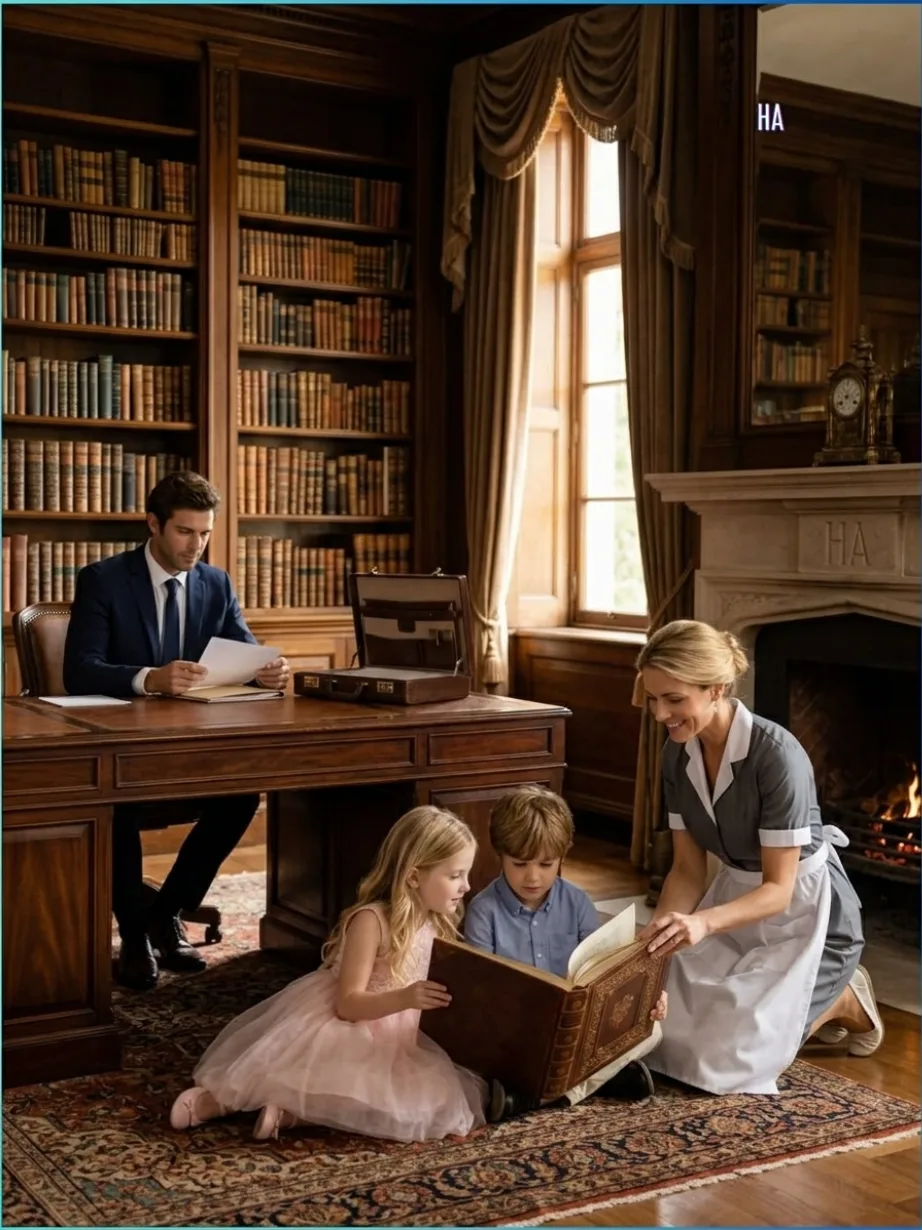
He Came Home Ready to Fire the Maid Until He Saw Her Son Dancing With His Lonely Daughter
“I thought Miss Lily laughing was worth ten minutes of mercy.”
The words hung in the room.
Chapter 1
“I thought Miss Lily laughing was worth ten minutes of mercy.”
The words hung in the room.
Ethan’s first instinct was to fire him too.
Instead, he looked at his daughter.
Lily had walked back to Noah and taken his hand. She held it with both of hers, as if she could physically keep him from being removed.
“Daddy,” she said, “please don’t send him away. I’m lonely here.”
There it was.
Not dramatic. Not rehearsed. Not screamed.
Just the truth, spoken by a six-year-old in a white dress.
I’m lonely here.
Ethan felt something inside his chest twist.
He had known it, of course. He had seen the signs. The way Lily carried her stuffed rabbit from room to room like a companion. The way she asked the chef questions just to keep someone talking. The way she sometimes fell asleep in the hallway outside his study because she had been waiting for him to finish “one last call.”
After Claire left, Ethan had told himself
he was doing what a father must do. Work harder. Build more. Protect Lily with money so she would never feel unstable.
Claire had walked out two years earlier with one suitcase, a short note, and no interest in custody until lawyers became useful. She said motherhood had made her invisible. She said Ethan’s world had swallowed her whole. Then she disappeared to California with a film producer and a new last name.
Ethan had not known how to explain abandonment to a child.
So he bought things.
And worked.
And left Lily inside a mansion full of adults paid to care, but not paid to love.
Now his daughter was holding the hand of the maid’s son like he was the first sunlight she had seen in years.
Ethan looked at Julia.
“How long have you worked here?”
She blinked, confused by the question.
“Nine months, sir.”
“Nine months,”
he said. “And in all that time, have I ever asked if you had children?”
“No, sir.”
“Have I ever asked where you live?”
“No.”
“Whether you were managing?”
“No.”
Each answer landed heavier than the last.
He had thought of himself as fair. Demanding, yes, but fair. He paid on time. He did not shout. He did not tolerate disrespect. In his world, that counted as kindness.
Now, looking at Julia’s trembling hands and Noah’s patched sneaker, he saw how small that kindness had been.
“Where is Noah’s father?” Ethan asked.
Julia’s lips parted. For a moment, she looked as though she might refuse to answer. Then she looked at Noah.
“He left before Noah was born,” she said quietly. “I was five months pregnant. I haven’t seen him since.”
Ethan looked away.
Abandonment again.
Different house. Different bank account. Same wound.
Lily tugged Noah forward.
“Can they stay
for dinner?” she asked. “Please? I’ll eat broccoli. All of it. Even the gross stems.”
Despite himself, Marcus smiled.
Julia shook her head quickly. “No, Miss Lily. That’s very kind, but we couldn’t possibly—”
“Yes,” Ethan said.
Everyone stared at him.
Even Ethan was surprised by his own voice.
“Yes,” he repeated. “They can stay for dinner.”
Lily’s mouth fell open. “Really?”
“Really.”
She screamed and threw her arms around his waist.
Noah looked up for the first time. “We won’t make a mess, sir.”
Sir.
The word from a child’s mouth nearly broke him.
“You already made a mess,” Ethan said.
Noah’s face went white.
Ethan softened his tone. “But it seems to be the first good mess this house has had in a long time.”
Lily laughed.
Julia covered her mouth with one hand.
Ethan turned to her. “What do I pay you?”
Her embarrassment returned immediately. “Mr. Caldwell, that isn’t necessary.”
“What do I pay you, Julia?”
“Two thousand dollars a month,” she said, barely above a whisper. “Plus meals during shifts.”
Ethan stared at her.
In Greenwich, two thousand dollars barely covered a bedroom in a shared apartment, much less food, child care, transportation, and school supplies. He knew what the agency charged him. He knew, suddenly and with rising anger, how little of it must actually reach her.
“Starting tomorrow,” he said, “you’ll receive four thousand a month directly from me. Not through the agency. I’ll settle the contract.”
Julia’s eyes widened.
“No,” she said instantly. “I can’t accept that. I didn’t do anything—”
“You raised a son who asked whether his mother had eaten lunch,” Ethan said. “You made my daughter laugh. You keep this house running so smoothly I forgot a human being was behind it. That is more than enough.”
Tears slipped down Julia’s cheeks.
Marcus looked out the window, pretending not to see.
Ethan continued before he lost courage.
“There is a guest cottage behind the east garden. It has been empty since the groundskeeper retired. It has two bedrooms, heat, a kitchen, and a separate entrance.”
Julia went still.
“No,” she whispered, already understanding.
“You and Noah will move in there this weekend if you want to. No rent. No commute. Lily gets a friend nearby. Noah gets a safe place. You keep your job, with a raise, and we all stop pretending this house benefits from being empty.”
Julia shook her head. “Mr. Caldwell, that is too much.”
“My daughter just told me she is lonely in a house with twelve bedrooms,” Ethan said. “I think too much is exactly the problem around here. Too much space. Too much silence. Too much pride.”
Noah looked at his mother. “Mom?”
Julia pressed her fingers to her lips, fighting sobs.
Lily squeezed Noah’s hand.
“Please,” Lily whispered. “You can live in the little house by the roses.”
The roses.
Ethan had forgotten they were there.
His late mother had planted them years ago, before wealth made everything in his life look professionally arranged and emotionally dead.
Julia tried to speak, but no words came.
Marcus stepped forward. “I can help them move Saturday.”
Ethan nodded. “Good.”
Then he looked at Noah.
“Do you play soccer?”
“A little,” Noah said.
“Lily has a soccer ball in the garden she has never used.”
“I used it once,” Lily protested. “For sitting.”
“For sitting,” Ethan repeated. “Then maybe Noah can teach you what it’s actually for before dinner.”
Lily grabbed Noah’s hand and ran toward the terrace.
The two children burst through the French doors and into the late-afternoon sun.
Their laughter returned.
This time, Ethan did not feel angry.
He watched them through the glass as they chased the ball across the lawn, Lily stumbling in her dress, Noah slowing down so she could catch up.
Julia stood beside him, crying silently.
“I don’t know how to thank you,” she said.
“Don’t,” Ethan answered. “Just don’t let me become the kind of man who needs a child to remind him people exist.”
She looked at him then, really looked at him, and Ethan noticed for the first time that her eyes were a clear, striking blue-gray, tired but steady.
“You’re not that kind of man,” she said.
Ethan gave a humorless laugh. “I’m afraid I was this morning.”
“Then maybe this afternoon matters more.”
Outside, Lily fell dramatically onto the grass. Noah dropped beside her, both of them laughing at the sky.
Ethan watched his daughter smile with her whole face.
For the first time in two years, the mansion did not feel haunted.
Part 2
The cottage behind the roses changed everything.
By Saturday afternoon, Julia and Noah arrived with two suitcases, three cardboard boxes, one laundry basket of folded clothes, and an old guitar case with a cracked handle. Ethan stood on the back terrace and watched Marcus carry most of it in one trip.
That was all they owned.
The realization embarrassed him.
Not because they had so little, but because he had lived so long surrounded by excess that he had stopped recognizing what enough looked like.
Lily treated the move like Christmas morning. She ran ahead of Noah, showing him every corner of the cottage as if she had personally built it.
“This can be your room,” she announced, throwing open the door to the smaller bedroom. “And this window looks at the big oak tree, and sometimes squirrels fight there. Not real fighting. Just rude squirrel fighting.”
Noah touched the white bedspread as though it belonged in a hotel.
“This is for me?”
Julia knelt behind him. “Yes, baby.”
He looked at her. “We don’t have to leave tonight?”
“No,” she said, her voice breaking. “We don’t.”
Noah wrapped both arms around her neck.
Ethan turned away before the moment became too private.
He had ordered new furniture, fresh paint, groceries, books, a child’s desk, and a set of dinosaur bedsheets after Lily secretly informed him that dinosaurs were “very important to Noah’s personality.” He had done what he always did when faced with a problem: he spent money.
But money was not what made Julia cry when she opened the refrigerator and saw milk, eggs, fruit, chicken, vegetables, and a chocolate cake Lily had insisted on adding.
It was safety.
Over the next few weeks, the estate transformed with a speed that startled everyone.
The front rooms stayed polished for guests, but the kitchen became the heart of the house. Lily and Noah did homework together at the breakfast table. Julia hummed while making soup. Marcus began accepting coffee in the morning instead of standing outside like a statue. Ethan, who once ate dinner in his study while reading contracts, found himself coming home before sunset.
At first, he told himself it was for Lily.
Then one Thursday night, while sitting through a conference call with investors, he caught himself watching the clock because Julia had promised to make chicken pot pie.
That was when he knew he was in trouble.
She was not like the women he knew.
The women in his world arrived perfectly styled and carefully bored. They spoke in polished fragments about galleries, foundations, ski trips, and restaurants where reservations mattered more than food. Julia spoke about library cards, bus routes, grocery discounts, childhood songs, and how children revealed their fears when adults pretended not to listen.
She had a way of making ordinary things feel sacred.
One evening, Ethan came downstairs after midnight, hungry and restless. He found the kitchen glowing under warm lights.
Flour dusted the counter. A mixing bowl sat near the sink. Lily and Noah stood on stools in pajamas, their hands covered in chocolate batter. Julia wore jeans and a soft green sweater instead of her uniform because her shift had ended hours earlier.
“Daddy!” Lily gasped. “We’re making brownies.”
“At midnight?”
“It’s only nine,” Julia said, laughing.
Ethan looked at his watch. He had lost three hours in legal documents.
“Right,” he said. “Nine.”
Noah held out an egg. “Do you know how to crack one?”
“I run a multinational logistics company.”
“So… no?”
Julia pressed her lips together to hide a smile.
Ethan removed his suit jacket and rolled up his sleeves.
“I can crack an egg.”
He could not.
The egg exploded in his hand, half into the bowl and half onto the counter. Lily screamed with laughter. Noah, with solemn patience, taught him to tap gently on the side of the bowl.
“You don’t attack it,” Noah explained. “You ask it to open.”
Ethan looked at Julia. “Is that so?”
“With eggs and people,” she said.
Their eyes met.
The kitchen noise faded for one dangerous second.
Ethan noticed the curve of her smile, the loose strand of hair near her cheek, the softness in her face when she watched the children. He wondered how many men had looked at her and failed to see the strength it took to survive.
Julia looked away first.
The brownies came out uneven, slightly burnt at the edges, and perfect.
They ate them at the kitchen table with cold milk. Lily leaned against Ethan’s arm. Noah told a long story about a dinosaur that became a crossing guard. Julia laughed so hard she wiped tears from her eyes.
Ethan could not remember the last time he had sat at a table without checking his phone.
Later, when the children had been sent to bed, Julia stayed behind to clean.
“You don’t have to do that,” Ethan said.
“It’s habit.”
“You’re off the clock.”
She looked around the kitchen. “This house doesn’t really feel like a clock anymore.”
The words settled between them.
Ethan leaned against the counter. “What did you do before this?”
Julia’s hands paused in the dishwater.
“Before cleaning houses?”
“Yes.”
She dried her hands slowly.
“I studied music education at the University of Michigan,” she said. “For almost two years.”
Ethan stared. “You played professionally?”
“No. I wanted to teach. Maybe run a children’s music program someday. Then I got pregnant, and Noah’s father decided fatherhood didn’t fit his plans. I left school. Worked wherever I could. Diners, laundry services, hotel housekeeping, private homes.”
“Do you miss it?”
“Music?”
He nodded.
She looked toward the hallway where the children slept.
“I miss who I was when I believed life opened instead of closed.”
Ethan had no answer.
The next morning, he called a director at a children’s arts nonprofit his company funded and asked about flexible music teaching opportunities. He did not tell Julia. Something in him understood that help given too quickly could feel like control.
So he waited.
Weeks became months.
The children became inseparable. Lily’s teachers reported that she was more confident, more talkative, less anxious. Noah, enrolled in the same private school after Ethan insisted on covering tuition as part of Julia’s employment benefits, proved brilliant at math and shy about praise.
The gossip began almost immediately.
Staff whispered. Neighbors stared. At a charity brunch, one woman asked Ethan with a smile as thin as paper whether it was “wise” to have the help living on the property with a child.
Ethan set down his coffee.
“Her name is Julia,” he said. “And her son is my daughter’s best friend.”
The woman laughed nervously. “Of course. I only meant—”
“I know what you meant.”
He walked away before she could recover.
But gossip was smoke.
The fire came in March.
Ethan was preparing for the most important business dinner of the year, an evening at his home with board members, investors, and the governor’s economic advisor. The deal on the table would expand Caldwell Global into three new states and secure thousands of jobs.
Julia spent two days overseeing the kitchen, flowers, guest rooms, and seating plan with such calm intelligence that even the event planner began asking her opinion.
“You see everything,” Ethan told her that afternoon as they stood in the dining room.
Julia adjusted a place card. “People tell you who they are by where they want to sit.”
“And where do I want to sit?”
“At the head of the table,” she said. “But not because you enjoy it.”
“Then why?”
“Because you think if you leave that chair empty, everything falls apart.”
Ethan smiled faintly. “And does it?”
“No,” she said. “But you might.”
Before he could answer, Lily and Noah ran in wearing school uniforms and carrying a paper crown they had made for Marcus’s birthday. The crown shed glitter across the polished floor.
Julia gasped. “Kids, not in here!”
Ethan looked at the glitter, then at the dining room set for billionaires.
“Marcus will like it,” he said.
Julia gave him a warning look. “Do not encourage glitter near crystal glasses.”
He raised both hands. “I’m terrified of you.”
She laughed.
That was the moment Claire returned.
She appeared in the doorway wearing a cream coat, dark sunglasses, and the expression of a woman entering a hotel suite she had once enjoyed and might want back.
Lily stopped smiling.
Ethan felt the room go cold.
“Hello, Ethan,” Claire said.
Julia went still. Noah moved closer to Lily.
Ethan stepped forward. “Claire.”
She removed her sunglasses and looked around the dining room. Her eyes landed on Julia’s uniform, then on Noah, then on Lily’s hand clutching Noah’s sleeve.
“Well,” she said. “This is cozy.”
Lily’s voice came out small. “Mom?”
Claire smiled brightly, too brightly. “There’s my beautiful girl.”
She crossed the room and reached for Lily, but Lily did not move.
Ethan saw the flash of irritation in Claire’s eyes before she hid it.
“What are you doing here?” he asked.
“I came to see my daughter.”
“After two years?”
Claire’s smile hardened. “Careful. I still have rights.”
“You gave up regular visitation.”
“I was healing.”
“You were in Malibu.”
“I needed space.”
Lily looked at the floor.
Ethan lowered his voice. “Not here.”
“Oh, I think here is perfect,” Claire said. Her gaze shifted to Julia. “Especially since I hear my daughter is being raised by the maid now.”
Julia’s face went white.
Ethan’s voice dropped dangerously. “Leave her out of this.”
“That confirms it, then.” Claire laughed softly. “Unbelievable. I leave, and you replace me with someone who cleans your floors.”
Noah stepped forward before anyone could stop him.
“My mom is a good person.”
The room froze.
Claire looked down at him as if noticing an insect.
“And you are?”
Lily grabbed his hand. “He’s my brother.”
The word landed like a glass breaking.
Ethan looked at Lily.
Julia covered her mouth.
Noah blinked in surprise, then squeezed Lily’s hand.
Claire’s expression sharpened. “Brother? Ethan, what exactly has been happening in this house?”
“Something you wouldn’t recognize,” Ethan said. “A family.”
Claire’s face twisted.
Then she smiled.
It was not a kind smile.
“I came to talk privately, but maybe this is better. My attorney will contact yours tomorrow. I’m filing for joint custody again.”
Lily began to cry.
Ethan’s pulse roared in his ears.
“You can’t walk in after two years and terrify her.”
“I’m her mother.”
“You left her.”
“I left you.”
“You left a six-year-old asking why Mommy didn’t want pancakes with her anymore.”
For the first time, Claire flinched.
Then her eyes moved again to Julia.
“And now what? You’re playing house with your employee? Do you have any idea what this will look like in court? The billionaire who moved his young maid into the garden cottage and let her child sleep down the lawn from his daughter?”
Julia stepped back as if struck.
Ethan saw shame flood her face, and with it came rage so clean he almost shook.
“Get out,” he said.
Claire put her sunglasses back on.
“With pleasure. Enjoy your dinner. I’m sure your guests will find all of this fascinating.”
She turned and left as suddenly as she had arrived.
For several seconds, nobody moved.
Then Lily burst into tears.
Ethan knelt and pulled her close.
“She can’t take me, right?” Lily sobbed. “Daddy, don’t let her take me away.”
“She won’t,” Ethan said, though his own fear had already begun crawling under his skin. “I promise.”
Across the room, Julia looked like she was disappearing into herself.
“I should go,” she whispered.
Ethan looked up. “What?”
“I should take Noah and go back to the cottage. Maybe farther. This is my fault.”
“No,” Ethan said.
“She’s right about how it looks.”
“She is not right about anything.”
Julia’s eyes filled. “I won’t be the reason you lose your daughter.”
Noah grabbed her hand. “Mom, no.”
Ethan stood.
“Julia, listen to me. You and Noah are not a scandal. You are the reason this house became livable.”
“But people like her know how to make kindness look dirty.”
Ethan could not deny it.
That night, the business dinner went forward.
The guests arrived in black cars with polished shoes and expensive watches. They complimented the food, the flowers, the view, the wine. Ethan moved through conversations like a machine, but his mind remained upstairs, where Lily slept with a tear-stained face and Noah refused to leave her door.
Halfway through dinner, one of the investors, Richard Voss, leaned toward Ethan with a glass of bourbon in hand.
“Word travels fast,” Voss said. “You may want to handle your domestic situation before it affects the vote.”
Ethan stared at him.
“What domestic situation?”
Voss smiled. “Come on, Ethan. Estranged wife returns, housekeeper installed on the grounds, child calling the maid’s kid her brother. It’s messy. Family instability makes boards nervous.”
Ethan understood then.
Claire had not come only for Lily.
Someone had sent her.
And he suspected the man smiling across from him had everything to gain if Ethan looked compromised before the expansion vote.
For years, Ethan had mastered boardrooms, contracts, leverage, acquisitions. But this attack had not come through a spreadsheet.
It had come through his daughter’s fear.
His hand tightened around his glass.
Across the room, Julia entered quietly to speak with the caterer. She moved with lowered eyes, trying to be invisible in a house where everyone had suddenly begun to look at her.
Ethan watched a board member glance at her uniform, then whisper to his wife.
Something in him snapped.
He stood and tapped his glass.
The table quieted.
“I want to thank everyone for coming,” he said. “Before we discuss the expansion, I need to correct something.”
Julia looked up, alarmed.
Ethan continued.
“There is a rumor moving through this room tonight that my home has become unstable because I helped a hardworking single mother and her son. Let me be clear. The only instability in this house came from years of silence, arrogance, and the belief that money could replace presence.”
No one breathed.
“My daughter was lonely,” he said. “I failed to see it. Julia Bennett saw it. Her son saw it. They brought laughter back into this home when I had forgotten what it sounded like.”
Julia’s eyes shone with tears.
Richard Voss shifted in his chair.
Ethan looked directly at him.
“If anyone at this table believes compassion is a liability, you should vote against me tonight. If anyone thinks treating employees with dignity makes me weak, leave now. But understand this. Caldwell Global will not expand by sacrificing people in private while praising family values in public.”
The silence was absolute.
Then Marcus, standing near the wall, began to clap.
One clap.
Then another.
Slowly, surprisingly, others joined.
Not everyone.
But enough.
Richard Voss did not clap.
By midnight, the vote passed without him.
Part 3
The custody petition arrived three days later.
Claire wanted joint custody, expanded financial support, and temporary restrictions preventing “unrelated adults residing on the estate” from having unsupervised access to Lily. The language was elegant. The meaning was cruel.
Julia read the letter once and quietly packed a suitcase.
Ethan found her in the cottage folding Noah’s dinosaur pajamas with shaking hands.
“No,” he said from the doorway.
She did not turn around. “You can’t stop me from protecting your daughter.”
“I can stop you from punishing yourself for Claire’s choices.”
Julia pressed both hands to the edge of the bed.
“Ethan, I have spent my whole life being reminded where I don’t belong. Restaurants. Schools. Waiting rooms. Homes like yours. I know what people see when they look at me.”
He stepped inside.
“What do they see?”
“A woman who got lucky. A woman who should be grateful and quiet. A woman who must have planned something if a rich man treated her kindly.”
“And what do you see when you look at me?” he asked.
She finally turned.
“I see a man trying so hard to fix what he missed that he might not notice the damage coming.”
Ethan absorbed that.
Then he said, “Stay through the hearing. If the court says changes are needed, we face that together. But don’t run because cruel people are good at sounding official.”
Her eyes searched his.
“Together?”
“Yes.”
The word changed the room.
Not because it solved anything, but because neither of them could pretend anymore.
The weeks before the hearing were brutal.
Claire’s attorney painted Ethan as emotionally negligent, then accused him of overcorrecting by creating an inappropriate household arrangement. Richard Voss quietly fed gossip to business blogs. A headline appeared online with a photo of Julia leaving the grocery store: Billionaire CEO’s Maid Moves Into Estate Before Custody Battle.
Julia stopped singing.
Lily had nightmares.
Noah got into a fight at school after a boy said his mother was “renting herself a rich dad.”
When Ethan picked him up from the principal’s office, Noah sat in the back seat staring out the window.
“I’m sorry,” he whispered.
“For what?”
“For making things worse.”
Ethan pulled the car over.
He turned around and looked at the boy.
“You listen to me. Children are never responsible for adult ugliness. Not you. Not Lily. Never.”
Noah’s chin trembled.
“I punched him.”
“I heard.”
“Are you mad?”
“Yes.”
Noah looked down.
“I’m mad you felt alone enough to think your fists had to defend your mother’s honor.”
Noah began to cry silently.
Ethan unbuckled his seat belt, got into the back seat, and pulled the boy into his arms.
It was the first time Noah let him.
The hearing took place on a rainy Thursday in Stamford.
Claire arrived in a navy dress, holding tissues she never used. Julia sat behind Ethan, pale but composed. Marcus sat beside her. Lily waited in a child advocate’s room down the hall, clutching a stuffed rabbit and refusing to let go of Noah’s friendship bracelet.
Claire’s attorney spoke beautifully.
He described a mother seeking reconnection. A father overwhelmed by work. A household blurred by questionable boundaries. A vulnerable child confused by the presence of an employee’s son.
Then Ethan’s attorney stood.
She did not attack Claire first.
She played the voicemail.
Claire’s voice filled the courtroom, sharp and careless.
“Richard, I don’t care about custody long-term. I care about leverage. Ethan will pay anything if he thinks I’ll take Lily. And if that little maid gets humiliated in the process, good. Maybe she’ll learn not to sit in my chair.”
Claire went white.
Richard Voss had made one mistake. He called Claire from a company phone recorded under compliance policy during an internal investigation Ethan had launched after the dinner. The recording was legal, admissible, and devastating.
But the real turning point came when the child advocate read Lily’s statement.
“I know my mom gave birth to me,” Lily had said. “But Julia helps me when I’m scared. Noah plays with me when grown-ups forget kids can hear everything. Daddy comes home now. I don’t want anyone punished for making me happy.”
Ethan lowered his head.
The judge took less than an hour.
Claire received supervised visitation, contingent on counseling. Ethan retained primary custody. No restriction was placed on Julia or Noah.
Outside the courthouse, Claire approached Ethan alone.
For once, she looked tired instead of glamorous.
“I was angry,” she said.
“You were cruel.”
“Yes.”
He waited.
She looked toward the hallway where Lily stood beside Julia and Noah.
“I don’t know how to be her mother anymore.”
Ethan’s anger softened, though it did not disappear.
“Then start by not using her as a weapon.”
Claire nodded, tears finally real.
“I’ll try.”
“You’ll do more than try,” Ethan said. “Or you’ll stay away until you can.”
That evening, back at the estate, Lily asked for music.
Julia hesitated.
Then she picked up the guitar.
The first notes trembled. The second line steadied. By the chorus, Noah and Lily were dancing again on the living room rug.
Ethan stood in the doorway, exactly where he had stood months before.
Only this time, he did not feel like an intruder in his own home.
Julia looked up at him while she played.
He walked in, took Lily’s hand, then Noah’s, and let the children pull him into the dance.
He was terrible.
The children laughed until they fell over.
Julia laughed too, and the sound of it healed something the court could never name.
By summer, Julia was no longer Ethan’s housekeeper.
The transition had been her decision. With Ethan’s encouragement, she began teaching part-time at a children’s music center in Stamford while finishing her degree online. Ethan hired a full staff through fair contracts, raised wages across his household, and created an employee emergency fund at Caldwell Global that Julia helped design.
“You don’t have to make a foundation out of guilt,” she told him one evening.
“I’m not.”
“Then why?”
He looked through the kitchen window at Lily and Noah chasing fireflies.
“Because I should have done it years ago.”
Julia accepted that.
Their love did not arrive like lightning. It arrived like morning.
Slowly. Gently. Then all at once.
It was in coffee cups left warm. In school pickup lines. In Noah asking Ethan to check his science project. In Lily falling asleep with her head in Julia’s lap during movie night. In quiet talks on the terrace after the children went to bed.
One September night, under a sky crowded with stars, Ethan finally said what had been living in him for months.
“I love you.”
Julia closed her eyes.
“I’m scared,” she whispered.
“I know.”
“People will say things.”
“They already have.”
“They’ll say I wanted your money.”
“Then they don’t know you.”
“They’ll say you wanted someone easy to save.”
Ethan took that in because it was the only accusation that frightened him.
Then he said, “You saved me first.”
Julia looked at him.
He stepped closer.
“I was raising Lily inside a beautiful tomb. I thought providing meant disappearing so I could earn more. You taught me that dinner matters. Songs matter. Showing up matters. I don’t love you because you needed help. I love you because you made me brave enough to become human again.”
Tears slid down her face.
“You really mean that?”
“With everything I have.”
She laughed softly through tears. “That is a very billionaire answer.”
He smiled. “I mean it with everything I am.”
That answer, she accepted.
When he kissed her, it was not a scandal. It was not a rescue. It was not a rich man claiming a poor woman.
It was two wounded people choosing peace.
The children found out the next morning because Lily was impossible to fool.
“You kissed,” she announced at breakfast.
Noah choked on orange juice.
Julia turned scarlet. “Lily Grace Caldwell.”
“You did,” Lily said. “You’re smiling weird.”
Ethan hid behind his coffee.
Noah studied him seriously. “Are you going to be nice to my mom?”
Ethan set down the cup.
“Yes.”
“Even when she’s tired?”
“Yes.”
“Even if people are mean?”
“Yes.”
“Even if she burns pancakes?”
Julia gasped. “I burned pancakes one time.”
Noah ignored her. “Even then?”
Ethan looked at Julia.
“Especially then.”
Noah nodded. “Okay.”
Lily threw both hands in the air. “Finally.”
The proposal came the following spring.
Ethan did not choose a restaurant full of strangers. He did not hire a violinist or hide the ring in champagne. He proposed in the garden near the rose cottage, where the whole story had truly begun.
Lily held a bouquet of wildflowers. Noah held the ring box and looked more nervous than Ethan.
Julia stepped outside at sunset and stopped when she saw them.
“Oh,” she whispered.
Ethan walked to her.
“I used to think this estate was proof I had won at life,” he said. “Then I came home one day and found your son dancing with my daughter, and I realized I had built walls, not a home.”
Julia’s eyes filled.
He knelt.
“You gave Lily laughter. You gave Noah courage. You gave me a second chance I did not deserve but will spend my life honoring. Julia Bennett, will you marry me?”
Noah opened the box upside down.
The ring nearly fell into the grass.
Lily screamed.
Julia laughed and cried at the same time.
“Yes,” she said. “Yes.”
Their wedding was small, bright, and full of children.
They married in the garden beneath white roses, with Marcus walking Julia down the aisle because she said he had been the first person in that house to treat her like she belonged. Lily served as flower girl with extreme seriousness. Noah carried the rings, this time correctly.
During the vows, Julia looked at Ethan and said, “You did not give me dignity. You reminded me I had never lost it.”
Ethan nearly broke.
He promised not wealth, not comfort, not perfection, but presence.
“I will come home,” he said. “Again and again, for the rest of my life.”
After the wedding, Julia and Noah moved into the main house. The cottage became a music room, then a playroom, then a place where all three children would one day build forts out of blankets.
Because one year later, Julia gave birth to a baby boy named Samuel.
Lily adored him instantly. Noah pretended to be mature, then cried when Samuel wrapped one tiny hand around his finger. Ethan, holding his newborn son in the hospital room, looked at Julia with awe.
“I thought my life was full before,” he said.
Julia smiled sleepily. “Your life was loud before. Now it’s full.”
Years passed, as years do when a house is busy.
Lily grew into a compassionate teenager who volunteered at children’s hospitals because she remembered what loneliness felt like. Noah became tall, thoughtful, and fiercely protective of anyone being mocked for having less. Samuel followed both of them around like a joyful shadow.
Julia finished her degree with honors and later became director of community programs at Caldwell Global, creating scholarships, child care assistance, emergency housing funds, and music grants for children whose parents worked long hours in invisible jobs.
At sixty, Ethan stepped down as CEO.
At first, business magazines called it shocking.
Then they learned Julia would chair the Caldwell Foundation, Lily was studying medicine, Noah had earned an engineering scholarship, and Samuel wanted to become a child psychologist. Suddenly, people began calling Ethan wise.
He laughed every time.
Wisdom, he knew, had not found him in a boardroom.
It had found him on a rug.
On Ethan’s seventieth birthday, the garden filled with family, employees, neighbors, and friends. The rose cottage glowed with string lights. Children ran across the lawn. Music drifted through the warm evening air.
Lily, now grown, stood to give a toast.
“My father built companies,” she said, raising her glass. “But that was never his greatest success. His greatest success was admitting that a huge house could still be empty. He changed because one little boy danced with one lonely little girl, and instead of closing the door, he opened it wider.”
Ethan looked at Noah, who stood with his wife and young daughter near the roses.
Noah raised his glass.
“To the man who chose to be my dad,” he said.
Ethan could not speak for a moment.
Julia took his hand under the table.
Many years later, when Ethan was old and silver-haired, he would still ask Julia to play the guitar in the evenings. Sometimes Lily visited with her children. Sometimes Noah repaired something that did not need repairing just to stay longer. Sometimes Samuel brought students from his child therapy program to meet the woman who had inspired the family’s music foundation.
And sometimes, when the house grew quiet, Ethan would stand in the living room doorway and remember that first afternoon.
The briefcase falling.
The music stopping.
Julia’s frightened face.
Noah’s patched sneaker.
Lily’s hand holding his.
He had come home exhausted, ready to restore order.
Instead, he found the beautiful disorder that saved his life.
When Ethan passed away peacefully at eighty-three, he was not alone. Julia held one hand. Lily held the other. Noah and Samuel stood close, their children gathered around the bed.
At his funeral, hundreds came.
Executives. Drivers. Teachers. Former maids. Scholarship students. Single parents. Workers whose names Ethan had once not known, and later made sure he never forgot.
But the most important words came from Julia.
She stood beside the roses and said, “Ethan used to believe a home was something you owned. Then he learned it was something you gave. He gave us shelter at first, but in the end, he gave us his whole heart.”
Afterward, Lily and Noah returned to the living room with their own children.
Someone found Julia’s old guitar.
A little girl began to dance.
Then a little boy joined her.
And for a moment, the years folded back on themselves, and the house filled once more with the laughter that had started everything.
Not wealth.
Not power.
Not reputation.
Just two children dancing where silence used to live.
THE END
Chapter complete
You have reached the end of this chapter.
Continue reading
A few more worlds to get lost in after this chapter.




