PART 3 — THE DAY I CHOSE MYSELF
“Perhaps someday, but not now.
Chapter 3
PART 3 — THE DAY I CHOSE MYSELF
“Perhaps someday, but not now.
Now I need you to leave. I need to reclaim my space, my life, my dignity.”
“And what if we can’t do it? What if we end up on the street?”
“You won’t end up on the street. You have family, friends, resources. You just have to stop expecting me to solve everything.”
Lauren nodded slowly and stood up. Before leaving, she stopped at the door.
“Mother-in-law… Patricia, I’m sorry. I really am sorry.”
“I know.”
And I think it was true. I think she did feel it. But sometimes apologies arrive too late, when the damage is already done, when the trust is already broken.
The following days passed in a tense calm. Ethan and Lauren began to pack slowly, with resentment, with pain. I watched them from afar. I didn’t offer help. I didn’t offer advice. I just watched.
One afternoon, while they were packing boxes in their
room, Ethan came down to the living room where I was reading.
“Mom, we found an apartment in Queens. It’s small, old, but it’s what we can afford.”
“I’m glad you found something.”
“You’re glad?” His voice had a bitter tone. “Are you really glad to see us like this? Struggling, suffering?”
“I’m not glad to see you suffer, Ethan. But I am glad to see you struggle because it means you’re growing. That you’re learning.”
“Learning what? To hate my own mother.”
Those words cut through me like knives.
“If that’s what you feel, I can’t change it. But I hope that someday you understand that what I’m doing is not out of hatred. It’s out of love.”
“Love?” He let out a dry laugh. “This doesn’t look like love at all, Mom.”
“True love is not always pleasing. It’s not saying yes to everything. It’s not allowing yourself
to be trampled. True love is also saying no. It’s setting boundaries. It’s teaching by example.”
“Well, your example is destroying me.”
He left without saying anything more. And I stayed there with the book open in my hands, feeling the tears finally begin to fall.
I cried. I cried like I hadn’t cried in days because it hurt. It hurt so much. It hurt to know that my son saw me as a villain. It hurt to know that he might never understand. It hurt to carry the guilt of a decision that I knew was right but felt terrible.
Roberta was right. Boundaries hurt, especially when you never set them before.
On the Wednesday of the following week, a moving truck arrived, small, old, with two men who loaded the few things Ethan and Lauren had. I stayed in my bedroom. I didn’t go down to say goodbye.
I couldn’t. I knew that if I saw Ethan loading his boxes onto the truck, if I saw him closing the door for the last time, I would break. And I couldn’t break. Not yet.
I heard voices, footsteps, the sound of boxes dragging, the engine of the truck starting, and then silence.
I walked down the stairs slowly. The house was empty, completely empty. The bedroom they had occupied for two years was clean. The beds made, the windows open. They had left a note on the nightstand. I took it with trembling hands. It was Ethan’s handwriting.
“Mom, I don’t know if I will ever be able to forgive you for this, but I want you to know that despite everything, I love you. I will always love you. You are my mom, and nothing will change that. I hope that someday you understand the damage you did to us. I hope that someday you regret it, but also I hope that someday I understand why you did it. Take care, Ethan.”
I folded the note. I put it in the pocket of my blouse. I walked through the house. My house, now completely mine again.
I went out to the backyard. The red bugan villias were still there. The lemon tree was still bearing fruit. The air smelled of wet earth because it had rained in the early hours. I sat on the iron bench that Robert had installed years ago, the same bench where we used to sit on Sundays to drink coffee, the same bench where he used to braid my hair. And there, under the shade of the lemon tree, with the sun filtering through the leaves, I allowed the tears to come out.
I cried for everything. For the hair I lost. For the son who left. For the relationship that broke. For the woman I had to become in order to survive. But I also cried with relief, because I was finally alone. I finally had my house back. I finally could breathe without feeling like I was walking on eggshells.
I didn’t know if I had done the right thing. I didn’t know if Ethan would ever forgive me. I didn’t know if I would ever forgive myself. But I knew one thing, one thing with absolute certainty: I had recovered my dignity. And that—that was worth all the pain in the world.
Do you think a mother can love her son and still let him go? Tell me. Because I’m still asking myself.
The first few weeks after they left were the hardest. Not because I missed the chaos, not because I missed the tension, but because the house, my house, felt too big, too silent, too full of absences. I would wake up at 6:00 in the morning as always. But there was no one to cook for anymore. There was no one to serve anymore. There were no voices in the living room, no footsteps on the stairs, no doors slamming shut. Just me and my silence.
The first few days I cried a lot. I cried while I prepared coffee just for myself. I cried while I watered the plants in the backyard. I cried while I folded my clean clothes, aware that I was only folding mine, not anyone else’s.
Roberta came to visit me three times a week. She brought food. She brought company. She brought that laugh of hers that filled empty spaces.
“Have you heard anything from Ethan?” she always asked me.
“No, nothing.”
“Have you called him?”
“No.”
“Why not?”
“Because I need to give him space. I need him to process this in his own way. I need—I need him to decide for himself if he wants to talk to me again.”
Roberta nodded. She didn’t insist. She just squeezed my hand and served me more tea.
One afternoon, while cleaning the closet of the bedroom that had been Ethan’s, I found things they had left behind. A box with old photographs. Ethan as a baby. Ethan at his first communion. Ethan at his high school graduation. Robert holding him when he was three years old.
I sat on the floor surrounded by memories and I asked myself, At what moment did everything go wrong? At what moment did the child who was laughing in these photographs turn into the man who looked at me with resentment?
Perhaps it was gradual. Perhaps it was my fault. Perhaps I spoiled him too much. Perhaps I gave him everything without teaching him to value anything. Or perhaps—perhaps that’s just how things are. Sometimes children grow up, they leave. And sometimes when they come back, they are not the same. And neither are you.
I put the photographs away. I put them in a box marked with his name. Someday I would give them to him when he was ready, when I was ready. But not that day.
Weeks passed. October turned into November. The mornings were colder. The lemon tree began to lose some leaves. The bugan villias continued to bloom. Stubborn, beautiful, resilient.
I began to create a new routine. I got up early. I did yoga in the backyard as the sun rose. I prepared breakfasts just for myself. I read. I painted watercolors, something I had abandoned years ago. I visited museums. I went to coffee shops alone and enjoyed my own silence.
Slowly, very slowly, I began to feel whole again, as if I had been broken for so long that I no longer remembered what it felt like to be complete.
One Saturday morning, while having coffee in the backyard, my phone rang. It was an unknown number. I hesitated. I almost didn’t answer, but something made me respond.
“Hello?”
“Mrs. Patricia Mendoza?”
“Yes, that’s me.”
“Good morning. I’m calling from the city hospital. We have a patient who has you listed as an emergency contact. Ethan Mendoza Riley.”
My heart stopped.
“What happened? Is he okay?”
“He suffered a car accident. Nothing serious, but he has some bruises and a fractured arm. He’s stable. He’s asking for you to come.”
“I’m on my way. I’m coming right now.”
I hung up. I grabbed my purse, my keys. I ran out. The road to the hospital was endless. Saturday morning traffic was dense. My mind didn’t stop creating scenarios. What if it was more serious than they said? What if he was alone? What if he needed surgery?
When I arrived at the hospital, I ran to the emergency room. I gave his name. They took me to a waiting room. And there, after 20 minutes that felt like hours, a nurse called me.
“You can go in. Room four.”
I walked in slowly, and there he was, Ethan, in a hospital bed, his right arm in a cast, a large bruise on his forehead, his eyes closed.
“Ethan,” I whispered.
He opened his eyes. He saw me and he began to cry.
“Mom.”
I ran to him. I hugged him carefully so as not to hurt his arm. And I cried with him. I cried like I hadn’t cried in weeks. I cried with relief, with fear, with love.
“I’m here, my love. I’m here.”
“Forgive me, Mom. Forgive me for everything. For how I treated you. For what I did to you. For—”
“Shh, let’s not talk about that now. All that matters now is that you’re okay.”
We stayed like that, hugging, crying, healing something that had broken.
After a while, I sat in the chair next to his bed. He told me what had happened. He was driving to a job interview. A car ran a stop sign. It hit him on the passenger side. It wasn’t serious, but the impact was hard.
“And Lauren?” I asked.
“She left.”
“What do you mean she left?”
“Two weeks ago, she left me. She said she couldn’t continue living like this, without money, in that horrible apartment, with me being a failure.”
“Ethan…”
“You’re right, Mom. I am a failure. I haven’t been able to get a job. I haven’t been able to pay the rent. I ran out of money, without food, without anything.”
“Why didn’t you call me?”
“Because I had pride. Because I was angry. Because—because I thought I could do it alone. And now, now I know I can’t. Not without help. And all I want is to ask for your forgiveness. And if you give me another chance, I swear I’m going to change. I’m going to work. I’m going to value you. I’m going to be the son you deserve.”
I looked at him. My son, my little boy, so broken, so lost. And I felt something change inside me.
“Ethan, I love you. I will always love you. You are my son. But—but you don’t want me to come home. I understand.”
“It’s not that. Or, well, not exactly. It’s that I need you to understand something. What happened wasn’t just your fault. It was my fault, too. I gave you everything without teaching you to value anything. I solved everything for you without letting you learn. I protected you so much that I didn’t prepare you for life.”
“Mom—”
“Let me finish. Now you have a chance, a chance to start over, to build your own life. And I’m going to help you, but not in the way I did before. Not by giving you everything, but by supporting you so you can achieve it yourself.”
“What does that mean?”
“It means I’m going to pay for three months of rent for a decent apartment. Not a luxury one—a decent one. And I’m going to give you money for food for that same amount of time, but only three months. After that, you have to support yourself.”
“And if I can’t do it?”
“You will do it. Because now you know what it feels like to have nothing. Now you know what it feels like to struggle. And that—that is going to make you stronger.”
He squeezed my hand with his healthy hand.
“And can we talk again like before?”
“Better than before. Because now we are going to be honest. Now we are going to set boundaries. Now we are going to build a real relationship. Not based on me giving and you receiving, but on both of us respecting each other.”
“I promise you I’ll try.”
“Don’t try. Do it.”
I stayed with him until he was discharged that same afternoon. I took him to his apartment in Queens. It was small, dark, cold, but it was his.
“Tomorrow, we’ll look for a better apartment,” I told him. “And we’re going to make a plan, a real plan, with goals, with deadlines, with responsibilities.”
“Thank you, Mom.”
“Don’t thank me yet. Thank me when you’ve gotten your first paycheck, when you can pay your own rent, when you can look me in the eye and tell me, ‘I did it.’”
That night, on the way back home, I drove slowly, thinking, reflecting. I had recovered my son, but not in the way I had lost him. I had recovered him in a new way—healthier, more real. I was no longer the mother who solved everything. I was no longer the mother who sacrificed herself until she disappeared. Now I was the mother who guided, who accompanied, who set limits, who loved intelligently. And that—that was better than everything before.
When I arrived home, the backyard was illuminated by the moon, the bugan villas shone, the lemon trees swayed in the wind. I sat on the iron bench, the same one where Robert used to braid my hair, the same one where I cried the day Ethan left. And there, under the starry sky, I felt something I hadn’t felt in months.
Peace.
It wasn’t the peace of the ending. It was the peace of the beginning, of the rebirth, of understanding that sometimes you have to let go to hold on better, that sometimes you have to break to rebuild stronger.
I took out my phone, opened the gallery, looked at the photographs of Ethan when he was a child, and then I looked at the recent photographs, the few we had together in recent years, and I saw something I hadn’t seen before. In the old photographs, I was genuinely smiling, with my eyes, with my soul. In the recent photographs, I was smiling with my lips, but my eyes were sad, empty, lost.
When did I stop being myself? When did I allow that to happen?
It didn’t matter, because now I was finding my way back.
I stood up, walked into the house, went up to my bedroom, and in front of the mirror, I saw the woman looking back at me—short hair, more noticeable wrinkles, tired but clear eyes. It wasn’t the same woman I had been months ago. It wasn’t the same one who had slept while her hair was being cut. It wasn’t the same one who stayed silent for fear of being alone. It was someone new, someone stronger, someone who had learned that true love also has to include self-love.
I touched my short hair. It had grown a little. Soon I would have to go back to the salon with Martha to fix it. And I realized something. I didn’t miss it anymore. The long hair, that identity I had carried for 30 years—I no longer needed it because I had found a new identity. One that didn’t depend on my appearance or my son or being a wife or being a sacrificing mother. An identity that only depended on me, on who I chose to be every day.
I smiled at my reflection and for the first time in a long time, it was a real smile.
“Well done, Patricia,” I said out loud. “Well done.”
That night I slept deeply, without nightmares, without guilt, without fear, because I knew that the worst was over and that the best—the best was just beginning.
Have you ever had to lose something to find yourself? Tell me your story, because we all need to know that we are not alone on this journey.
Three months passed. Three months in which I kept my word. I paid Ethan’s rent for a small but clean apartment in the suburb of Linda Vista. I gave him money for food, for transportation, for the basics, but nothing more.
And something extraordinary began to happen. Ethan got a job. It wasn’t his dream job. It was an administrative assistant position at a logistics company. The salary was modest. The hours were long. But it was a job. A real job with a bi-weekly paycheck that had his name on it.
The first time he called me to tell me, I heard something in his voice that I hadn’t heard in years. Pride. Genuine pride.
“Mom, I got paid. My first paycheck. It’s not much, but it’s mine. I earned it.”
“I’m proud of you, son.”
“And Mom, I want to invite you out for lunch. Something simple, a diner near my job. But I want to treat you with my money.”
That lunch was one of the most important moments of my life. Not because the food was special—it was chicken soup with rice at a neighborhood diner—but because I saw my son pay the bill with his own money, with money he had earned through his effort, and I saw how his eyes shone, as if he had conquered the world.
“You know what the best part is?” he told me as we walked back to the subway. “That now, when I get to the apartment tired with a sore body, I feel complete, as if I’m finally doing something worthwhile.”
“Because you are, Ethan. You’re building your own life.”
“Yes. And Mom, I want to apologize again because now I understand. Now I understand what you tried to teach me. That money is not just money. It’s effort. It’s time. It’s sacrifice. And I never valued it. I never valued everything you did for me.”
I hugged him right there in the middle of the street, with people walking around us.
“I forgive you, son. And I forgive myself, too, for not having taught you this sooner.”
We began to see each other every week. Sometimes he would come to the house. I would prepare food for him and he would pack it in containers for the week. Other times I would go to his apartment and I was surprised to see how he had transformed it. It was still small, but it was clean, tidy. It had plants on the window, books on a makeshift shelf made of wooden crates.
“I’m learning to live alone,” he would tell me with a smile. “I’m learning to cook, to clean, to pay my own bills.”
“And how does it feel?”
“Terrifying, but also liberating.”
One afternoon in February, while we were having coffee in my backyard, Ethan told me something.
“Mom, do you remember Lauren?”
Of course, I remembered. But I hadn’t asked about her. I hadn’t wanted to open that wound.
“Yes, I remember.”
“She called me a few days ago.”
“Yes? And what did she want?”
“She wanted to come back. She said she made a mistake. That she misses me. That we can try again.”
I felt something tighten in my chest.
“And what did you tell her?”
“No.”
“No?”
“No. Mom, I told her no because I realized something. Lauren never loved me. She loved what I could give her. The money, the comfort, the big house. And when all that went away, she went away, too.”
“I’m glad you understood that.”
“Yes. And I’m also glad I met her because she taught me something important. She taught me that true love is not being with someone when everything is easy. It’s being there when everything is difficult. Like you, Mom. You stayed. Even when I hurt you, even when I disrespected you, you stayed.”
“I am your mother. I will always stay.”
“I know. And now I’m going to stay for you, too. When you need me, when you’re the one who needs support, I’ll be there. I promise you.”
That promise was worth more than any apology.
But the story doesn’t end there, because karma—karma has its own way of delivering justice.
One day in March, while I was at the grocery store, I ran into a neighbor, Mrs. Margaret, an older woman who lived three houses down.
“Oh, Patricia, have you heard about your ex-daughter-in-law, Lauren?”
“No, I haven’t heard anything. What happened?”
“Well, it turns out she went to live with an older gentleman, a businessman, they said, rich, with a house in the Hamptons. And at first, everything was fine. But recently, my friend, who knows Lauren’s sister, told me that the man turned out to be married and his wife found out and she kicked him out, and she kicked Lauren out, too.”
“And where is she now?”
“Well, she went back to her parents in New Jersey, but her parents are very upset with her because she left her husband, your son, for a married man, and now she has nothing. No house, no money, no dignity.”
I didn’t feel joy when I heard that. I didn’t feel satisfaction. I felt something more complex, a mixture of sadness and understanding, because Lauren had made choices, bad choices, choices based on greed, superficiality, self-interest, and now she was paying the consequences. Not because I had punished her, not because I had done anything against her, but because life has its own way of balancing things.
“Thank you for telling me, Mrs. Margaret,” I said simply.
That night, sitting in my backyard, I thought about everything that had happened. About how Lauren, who had cut my hair to make me feel small, was now living with her parents, without autonomy, without freedom. About how Ethan, who had defended Lauren and disrespected me, was now working hard and valuing every dollar he earned. About how I, who had allowed so much, who had erased myself so much, now had my house, my peace, my dignity.
There was no vengeance in that. There was no malice. Just natural consequences.
When I told Ethan what had happened with Lauren, I expected him to be sad, to want to help her. But it wasn’t like that.
“Honestly, Mom, I’m not surprised. Lauren always looked for the easy way out. She always wanted someone else to solve her life. And when that person couldn’t give her what she wanted, she looked for another. But she reached a point where there was no one else, where she had to face herself, and she didn’t like what she saw.”
“You don’t feel like helping her?”
“No. It sounds cruel, but no. Lauren has to learn just like I had to learn. And if someone solves everything for her now, she will never understand.”
My son had grown. He had truly grown.
The following months were about rebuilding. Ethan got a promotion at his job. Small but significant. He started saving. He would tell me excitedly every time he managed to save a little more.
“Mom, I’ve saved enough for two months of rent. Two full months. If something happens, if I lose my job, I have a cushion.”
“I’m very happy for you, son.”
“And Mom, I’m thinking of going back to school. There’s an online master’s degree in administration. It’s expensive, but I can pay for it little by little with my salary.”
“Do you want me to help you?”
“No, thank you. But no. I want to do it myself because if I do it myself, it will mean more. It will truly be mine.”
That son, that hardworking, responsible, aware man—that was the son who was always there, waiting to be discovered, waiting to be liberated from the comfortable prison I had built for him myself.
And I—I was changing, too. I resumed my painting classes. I met other women in similar situations. Women who had had to set boundaries, who had had to choose themselves after years of self-erasure. One of them, Alice, told me something I will never forget.
“Patricia, do you know the difference between sacrifice and martyrdom?”
“No.”
“Sacrifice is giving something with love, knowing it’s your choice. Martyrdom is giving everything expecting to be recognized for it, to be thanked for it, to be repaid for it. You were being a martyr. Now you are learning to love for real.”
She was right. For years I had sacrificed myself, yes—but expecting something in return, expecting Ethan to see me, value me, put me on a pedestal. And when he didn’t, I felt betrayed. Now I was learning to give without expecting, to love unconditionally, but also to love with boundaries, because love without boundaries is not love. It’s codependency.
One Saturday in April, Ethan invited me to his apartment for dinner. He had cooked himself. Pasta with homemade tomato sauce. It wasn’t perfect. It was a little salty. But it was made with love, with effort, with pride.
“Mom, there’s something I want to give you.”
He took out an envelope. Inside were bills. One hundred dollars.
“What is this?”
“It’s for you. I know it’s not much. I know you gave me much more. But it’s what I can give you now. And I want to give it to you because I want you to know that I’m learning, that I’m growing. That someday I’ll be able to pay back everything you did for me.”
Tears ran down my cheeks.
“Ethan, you don’t have to pay me back anything.”
“Yes, I do, Mom. I have to pay you back for the peace of mind I took away, the respect I didn’t give you, the dignity I trampled on. And this”—he held up the envelope—”is just the beginning.”
I took the money, not because I needed it, but because rejecting it would have been taking away the gift he was giving me. The gift of his growth, of his change, of his renewed love.
That night, on the way back home, I passed the street where Lauren and Ethan used to live. The building was still there, old, worn. And I thought about how she had chosen to leave, how she had chosen money over love, comfort over loyalty. And now she was alone, without money, without a home, without dignity. Not because I had cursed her, not because I had done anything against her, but because the universe has a very particular way of returning what we give.
Lauren gave contempt. She received contempt. She gave betrayal. She received betrayal. She gave selfishness. She received solitude.
And I—I gave boundaries. I gave self-respect. I gave love with intelligence. And I received my son back. Not the dependent and resentful son, but a hardworking, grateful, conscious son. I received my house back. Not just the physical space, but the emotional space, the peace, the tranquility. I received my life back, my identity, my dignity, my future.
That night, sitting in my backyard with the lemon tree full of ripe fruit and the bugenvillas redder than ever, I thought about Robert, about how proud he would be of me, of how I had found the strength that was always there but that I had forgotten I had.
“I did it, my love,” I said to the wind. “I did it. It was painful. It was terrible, but I did it, and it was worth it.”
The wind moved the leaves of the lemon tree, and for a moment, just for a moment, I felt as if Robert were there, approving, smiling, proud.
I closed my eyes, took a deep breath, and knew with absolute certainty that everything, absolutely everything, had been worth it. Because justice doesn’t always come in the way we expect it. It’s not always dramatic. It’s not always immediate. Sometimes justice is simply life teaching you what you need to learn. Sometimes it’s karma giving you back exactly what you gave. And sometimes—sometimes it’s the silence after the storm, the peace after the chaos, the dignity recovered after having lost it.
That was enough. More than enough. It was perfect.
Have you seen how karma does its work without you having to do anything? Tell me your story. Because sometimes all we need is time and confidence that life knows what it’s doing.
A year has passed since that Sunday afternoon when I woke up without my hair. A year since I heard those words that changed me forever: “That’s how you learn your place.”
Today I am 59 years old. My hair has grown a little, not as long as before. It no longer reaches my waist. Now it barely reaches below my shoulders. And you know what? I like it this way. It’s easier to care for, more practical. And every time I see myself in the mirror, I don’t think about what I lost. I think about what I gained.
I gained clarity. I gained strength. I gained the ability to look at myself in the mirror and recognize myself.
I’m sitting in my backyard this Sunday morning. The lemon tree is full of fruit. The red bugan villars shine in the morning sun. The coffee is hot in my favorite mug, the one Robert gave me for our 10th anniversary. It has a small crack in the rim, but I refuse to throw it away because broken things can also be beautiful. They can still be useful.
Ethan is coming for lunch today. He comes every Sunday, but he no longer lives with me. He no longer depends on me. Now he comes because he wants to, because he chooses to be here. And that difference—that difference changes everything.
Last week, he called me excitedly.
“Mom, I got another promotion. Now I’m area coordinator, with a better salary, with full benefits.”
“Son, what pride. Truly, what pride.”
“And Mom, I found a bigger apartment. It has two bedrooms, one for me and one I want to use as a study for when I finish my master’s degree.”
“Have you enrolled yet?”
“Yes, it starts in August. I’m nervous, but excited. I’m going to do this, Mom. I’m going to finish what I started.”
Every achievement of his fills my heart. Not because they are my achievements, but because they are his. Completely his. He earned them. He built them. He deserves them.
Three months ago, on Ethan’s birthday, he gave me a surprise. He came to the house with a bouquet of flowers—white roses, my favorites.
“Mom, there’s something I want to tell you. Something I’ve wanted to say for a long time, but couldn’t find the right words.”
We sat right here in this backyard, under this same lemon tree.
“I want to thank you,” he said, his voice trembling. “For having told me no, for having set boundaries, for having forced me to grow. I know it was the hardest decision of your life. I know you suffered. I know you doubted. But it was the best thing you could have done for me.”
“Ethan—”
“Let me finish. For a long time, I hated you. I saw you as a villain, as a cruel mother who abandoned me when I needed her most. But now I understand. Now I understand that you didn’t abandon me. You freed me. You freed me from the prison I had built for myself. The prison of comfort, of dependence, of victimhood.”
Tears ran down my face, down his too.
“And I want you to know that I admire you, that you are the bravest woman I know, because it is very easy to give everything. It is very easy to sacrifice yourself without limits. But it is very difficult to say no when you love so much. It is very difficult to let go when you are so afraid of losing.”
I hugged him. I cried on his shoulder as I hadn’t cried in months.
“I love you, son. I will always love you.”
“And I love you, Mom, more than I can express.”
That day, I understood something fundamental. I understood that true love is not giving everything. It is giving what is necessary. It is knowing when to hold and when to let go, when to hug and when to step away.
Roberta still visits me. Now she not only comes to comfort me, she comes to celebrate with me, to laugh with me, to plan trips with me.
“Patricia, we should go to Arizona, you and I, a whole week. Eat some great American food, visit the national parks, walk around the old towns.”
“You know what? Yes, let’s go. Let’s do it.”
And we did it. We went to Arizona in March, and it was wonderful, liberating. I realized that my life didn’t end with being a mother. That there was so much more, so much to discover, so much to live.
On that trip, I met other women. Women my age, some widowed, others divorced, others who had simply decided to live alone. And we all had something in common. We had all reached a point in our lives where we had to choose—choose between continuing to be what others expected or becoming who we truly were.
One of them, Theresa, told me her story. Her husband had cheated on her for 20 years, and she knew it, but she stayed—for the children, for society, for fear—until one day, she told me, as we drank cocktails on a terrace in Arizona:
“I looked in the mirror and no longer recognized myself, and I asked myself, ‘Is it worth living a life that is not yours?’ And the answer was no. Absolutely no.”
She got divorced at 60, and now, at 65, she has a small business selling local crafts. She lives alone and she is happy, profoundly happy.
“I don’t regret staying so long,” she told me, “because I wasn’t ready before. But I would regret having stayed longer, because there came a moment when I was ready, and not acting would have been betraying myself.”
Those words resonated in me for days, because I was ready, too, and I acted. And although it was painful, although there were nights of doubt and tears, I do not regret it.
Two weeks ago, Martha, my stylist, asked me something while she was styling my hair.
“Patricia, did you ever think about letting it grow out again, like before?”
I thought about it. I really thought about it.
“No,” I answered. “This hair is mine. It is part of who I am now, and I like who I am now.”
She smiled.
“I’m glad to hear you say that, because when you first came in after what happened, I saw a broken woman. And now I see a complete woman.”
That word—complete. Yes, that’s how I feel. Complete. Not because I have everything, but because I have the essential thing: I have myself.
This morning, while preparing lunch for Ethan, I thought about Lauren. Not with rancor, not with sadness, just with neutrality. I heard recently from Mrs. Margaret that Lauren got a job in a department store as a sales associate. It’s not much, but it’s something. It’s a beginning. And I’m glad. I’m truly glad, because no one deserves to be trapped in their mistakes forever. We all deserve a chance to change, to grow, to learn.
Perhaps someday Lauren will understand what I understood. That life is not about what you can get from others. It’s about what you can build for yourself. And perhaps someday, when she is ready, when she has learned her lessons, she can look back and be grateful. Grateful even for the falls, because the falls teach us how to get up.
The doorbell rings. It’s Ethan. He arrives early, as he always does now, because he learned to value time, not to take it for granted. I open the door. He brings flowers again and a bag with pastries from an artisanal bakery.
“Hi, Mom. It smells delicious. What did you cook?”
“Turkey and mashed potatoes. The best in the world.”
We go in together. He sets the table while I serve the food. And there is something beautiful in this simplicity, in this new routine, in this relationship rebuilt from stronger foundations.
During the meal, he tells me about his job, about his colleagues, about his future plans. And I listen to him. I really listen to him, without interrupting, without advising unless he asks me to, without trying to solve his problems, because that is no longer my role. My role now is to accompany, to be present, to celebrate his achievements, and to comfort him in his falls, but not to live his life for him.
“Mom,” he says suddenly, “there’s something I want to ask you.”
“Tell me.”
“Are you happy?”
The question takes me by surprise. No one had asked me that in a long time. Maybe never.
“Yes,” I answer. And I feel the truth of that word in my whole body. “Yes, I am happy.”
“I’m glad. I’m truly glad, because you deserve to be. After all you gave, after all you endured, you deserve to be happy.”
“You too, son. You also deserve to be happy.”
“I am, Mom. For the first time in my life, I am. I have a job. I have my own place. I have goals. I have an honest relationship with you. I have—I have my life. And that’s more than I ever thought I would have.”
After eating, we sit in the backyard. We drink coffee. We watch as the sun begins to set, as the sky is painted orange and pink.
“Mom, there’s something else I want to tell you.”
“Yes?”
“I met someone. A woman. Her name is Andrea. She’s an accountant, hardworking, independent, and she’s different. Very different from Lauren. Completely. Yes, she’s different from Lauren. She doesn’t want me to support her. She doesn’t want me to solve her life. She just wants companionship, mutual support—to build something together.”
“I’m glad, Ethan. I’m very glad.”
“I want you to meet her, but not yet. I want to make sure first that it’s real, that I’m not falling into the same mistakes.”
“Take your time. And when you’re ready, I’ll gladly meet her.”
He stays until nightfall, then says goodbye, hugs me tightly like when he was a child.
“Thank you, Mom, for everything.”
“Thank you, son, for giving me this opportunity—for allowing me to be your mother again, but in a better way.”
When he leaves, I close the door slowly. I walk through the house—my house—silent, calm, full of me, and I don’t feel alone. I don’t feel empty. I feel at peace.
I go up to my bedroom, open the drawer where I keep important things, take out the letter Robert left me. I read it again, as I have done so many times this year: “Sometimes the greatest love we can give is to say no.”
I smile because I finally understand those words with all their weight, with all their truth.
I put the letter away, but now I take out something else—a new notebook, empty, waiting to be filled—and I start to write.
“Dear woman who is reading this, if my story reached you, it is probably because you needed to hear it. Because you probably also erased yourself. You sacrificed yourself until you disappeared. You allowed yourself to be disrespected for fear of being alone.
“I want you to know something. Something that took me 58 years to learn. Your worth does not depend on how much you give. It does not depend on how much you sacrifice. It does not depend on how much you endure. Your worth exists simply because you exist. Because you are human. Because you deserve respect, dignity, love—and true love never asks you to disappear.
“True love celebrates you, respects you, includes you. If someone in your life makes you feel small, insignificant, invisible—it is not love. It is control. It is abuse. It is manipulation. And it is okay to say no. It is okay to set boundaries. It is okay to choose yourself.
“You will not be a bad mother for setting boundaries with your children. You will be a wise mother who teaches them that respect is mutual. You will not be a bad wife for demanding dignity. You will be a woman who knows her worth. You will not be a bad daughter for prioritizing your well-being. You will be a woman who understands that you cannot give from emptiness.
“And if you are afraid, that’s okay. Fear is part of the process. But don’t let fear paralyze you. Don’t let fear steal years of your life that you will never recover. Because in the end, when you look back, you will not regret the times you chose yourself. You will regret the times you didn’t.
“This is my story, my truth, my lesson. And if it helps even just one woman to open her eyes, to find her strength, to recover her dignity, it will have been worth it. Every tear, every moment of doubt, every sleepless night—everything will have been worth it.
“With love,“Patricia Riley Mendoza, 59 years old, widow, mother, and finally myself.”
I close the notebook. I put it on my nightstand. Tomorrow, I will continue writing it. I will continue telling my story. Not to judge, not to give lessons from a pedestal, but to share, to accompany so that other women know that they are not alone.
I lie down in my bed, turn off the light, close my eyes, and for the first time in over a year, I don’t think about the hair I lost. I don’t think about the days of pain. I don’t think about the confrontation or the tears. I think about the lemon tree that continues to bear fruit. About the bugan villars that bloom every spring. About the morning coffee. About Ethan’s visits. About the trips with Roberta. About Robert’s words. About the woman I see in the mirror.
And I smile, because I learned my place—but not in the way Lauren wanted to teach me. I learned that my place is not beneath anyone. It is not to be invisible. It is not to be convenient. My place is here—in my house, in my life, in my own skin. And that place, that place is sacred. It is mine. And no one, absolutely no one, will ever take it from me again.
If this story touched your heart, subscribe and hit the bell icon to hear more stories of women who transformed their pain into wisdom. Every day, a woman, a life lesson. Share this story with someone you love. Sometimes a story like this can change an entire day. God bless you, and until next time.
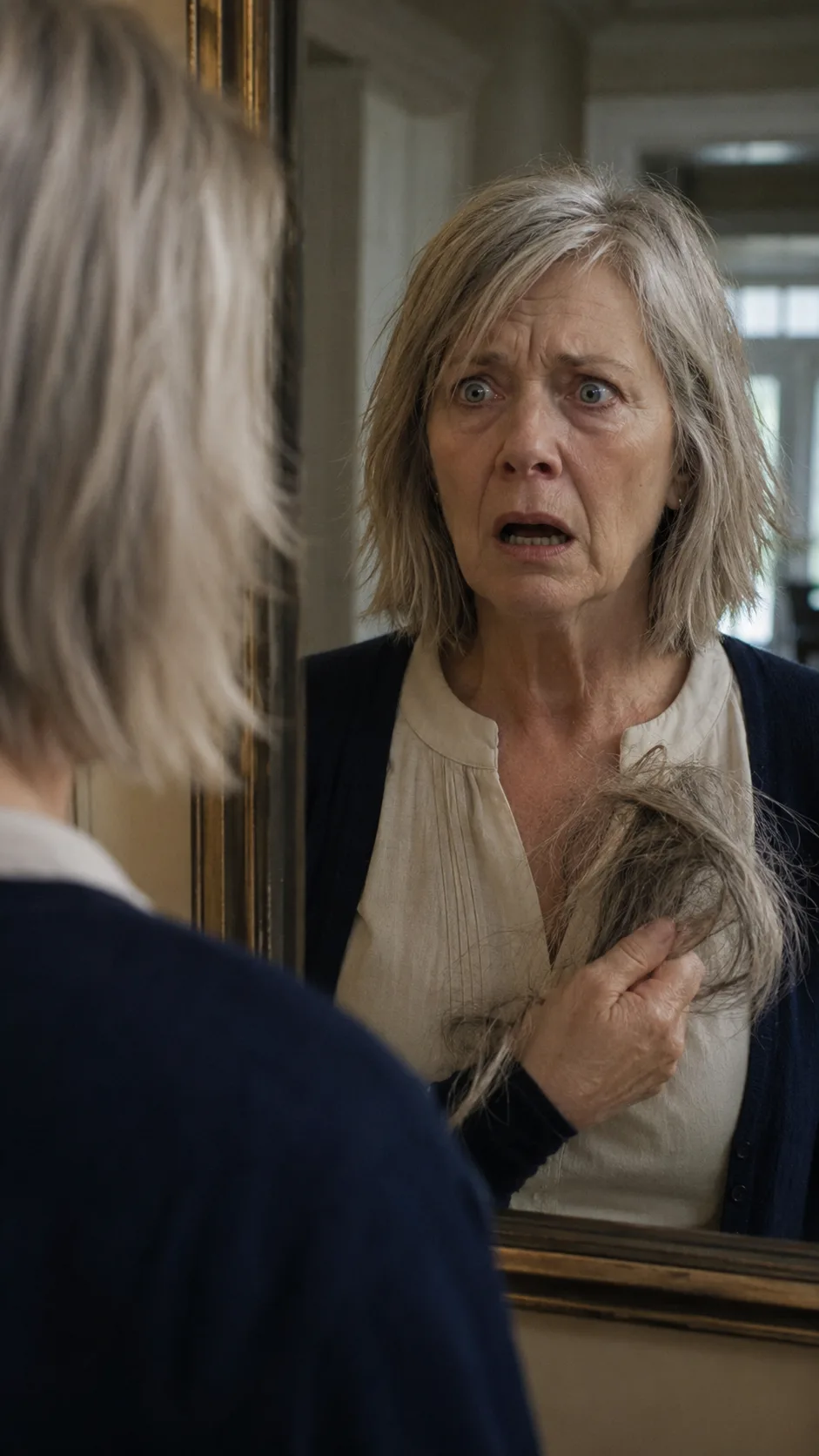
My daughter-in-law secretly cut my hair while I was sleeping. When I woke up in shock, she smiled and said, “Now you know your place.” My son sided with his wife: “Mom, you need to learn a lesson.” I held myself back. Three days later, I told her to sit down in the living room of my New York home and said, “You have thirty days to move out of my house.”
THE END.
Chapter complete
You have reached the end of this chapter.
Continue reading
A few more worlds to get lost in after this chapter.




