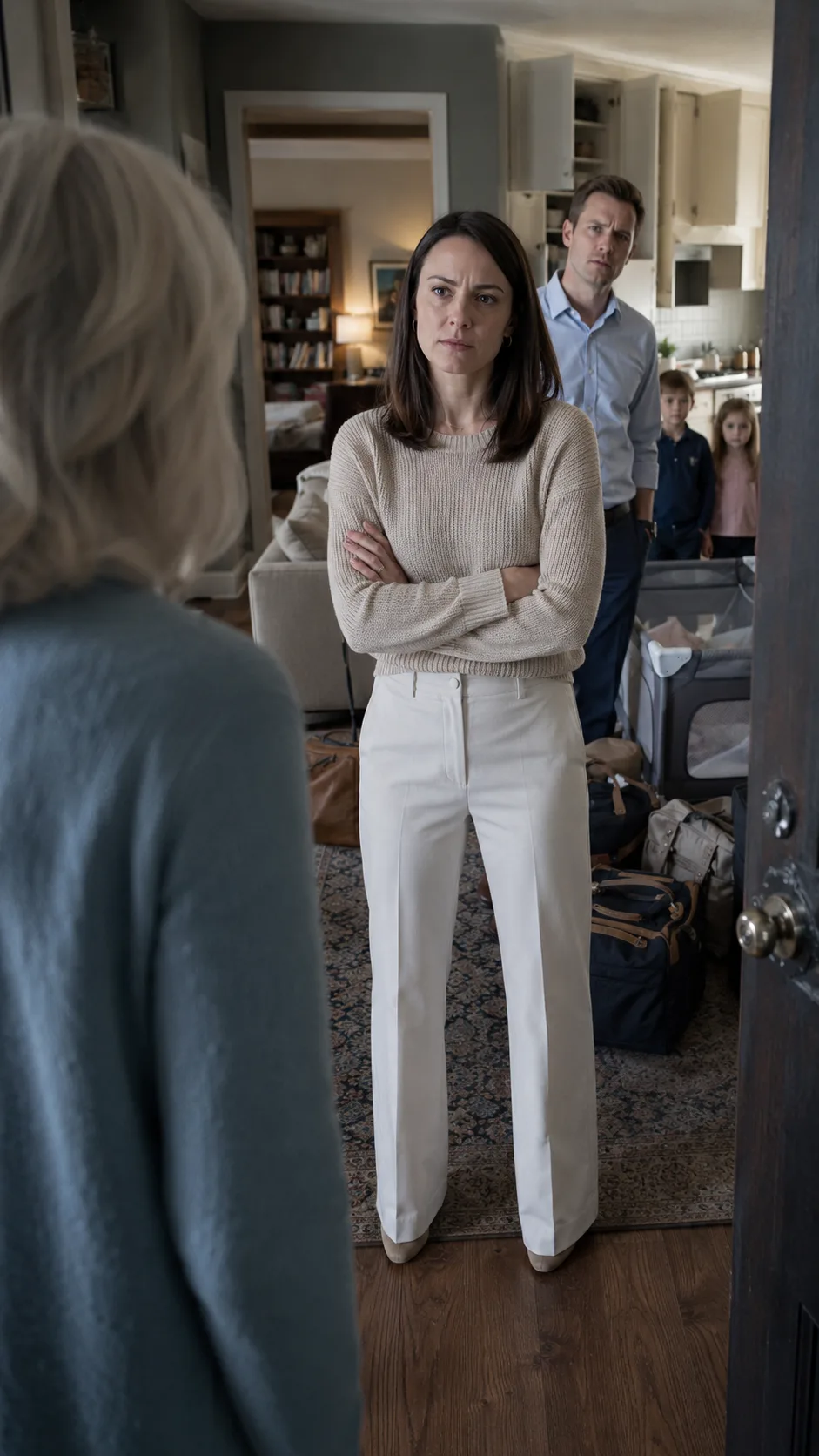
PART 4 — The Door They Finally Learned to Knock On
Claire pushed her chair back slightly.
Chapter 4
PART 4 — The Door They Finally Learned to Knock On
Claire pushed her chair back slightly.
“This is excessive.”
Rebecca closed the folder.
“Then the matter can continue formally.”
Their attorney asked for a private discussion.
Matt and Claire left the room with him.
Through the glass wall, I could see them in the hallway. Claire spoke rapidly, pointing toward the conference room. Matt remained still with one hand in his pocket.
At one point, he looked through the glass at me.
I did not look away.
Ten minutes later, they returned.
Matt sat down without opening his notebook.
“We’ll agree,” he said.
Claire turned toward him.
“We have not finished discussing—”
“I said we’ll agree.”
His voice was quiet.
For the first time that day, he looked like Paul.
Not physically. Matt had my eyes and Claire often said he carried himself like neither parent.
But the stillness in him belonged to his father—the stillness of a man who finally understood a repair could no
longer be postponed.
Claire removed her hand from the table.
The documents were revised and signed over the next two weeks.
When the first loan payment arrived, I stared at the bank notification and felt almost nothing.
The money did not repair the relationship.
It did not give me back the ease I once felt when Matt’s name appeared on my phone.
But it marked a change.
For the first time, he was carrying a consequence I had not lifted away.
I changed my estate plan that fall.
The decision was not made in anger.
I created education trusts for my grandchildren, administered independently so the money would support school, training, housing, and healthcare without passing through their parents.
Matt remained a beneficiary of a smaller personal account, but he would not control my home, retirement savings, or the funds intended for the children.
Rebecca asked whether I was certain.
“Yes.”
“Some clients reconsider after relationships improve.”
“If the relationship improves, we will have the relationship. The documents do not need to pretend for us.”
She nodded.
“That is a wise distinction.”
My sixty-fourth birthday arrived in March.
Joan flew in from Minnesota.
We had dinner at a small Italian restaurant near the park. The server brought a slice of lemon cake with one candle, and Joan sang quietly enough that only the next table heard.
Matt did not call.
At nine that evening, a message arrived from an unfamiliar number.
Happy birthday, Mom. I know you may not want to hear from me. I hope you had a good day.
I read it once.
Then I placed the phone face down.
Two weeks later, another unfamiliar number appeared.
I answered because I was expecting a call from the library.
“Mom?”
Matt’s voice stopped me beside the kitchen counter.
“Yes.”
“I’m sorry.”
He said it quickly, as though the words had been rehearsed.
“I hear you.”
“I mean it.”
“I hope you do.”
“I don’t know how to fix this.”
Neither did I.
But I had finally learned that not knowing how to fix something did not require me to fix it for everyone.
“I need time,” I said.
“It’s been almost a year.”
“That does not mean I’m finished needing it.”
“Claire thinks—”
“This is not Claire’s decision.”
He became quiet.
“I miss you.”
The words hurt.
“I miss who we were,” I said.
“Can we ever get back there?”
“No.”
His breath caught.
I softened my voice, not the truth.
“We might build something different. But we cannot return to a relationship where you believe love gives you access to whatever is mine.”
“I understand.”
“Do you?”
“I’m trying.”
That was the first answer he gave me that did not ask for immediate forgiveness.
I looked through the balcony doors.
A woman pushed a stroller along the path below. The trees were beginning to flower.
“I’ll reach out when I’m ready.”
“Okay.”
He paused.
“Mom?”
“Yes?”
“I should have asked where you lived.”
The sentence reached a place in me the legal documents never had.
“Yes,” I said. “You should have.”
After the call, I stood at the counter beside the ceramic rooster.
It had returned to its proper place after I found Claire’s letter. A tiny chip marked one wing where Paul dropped it while painting our first kitchen.
I ran one finger over the rough edge.
My son had apologized, but apology did not erase planning.
Time would reveal whether remorse became behavior.
I no longer believed words had to be accepted before they were tested.
Over the following months, Matt wrote letters.
Actual letters.
He mailed them through Rebecca at first because he knew I had not given him my address again, even though he obviously knew the building.
The first letter was mostly explanation.
He said Claire had found my building information through the old laptop. He admitted collecting the fob. He said he convinced himself that because I was family, the normal rules did not apply.
The second letter contained fewer explanations.
He wrote about his father.
He remembered Paul refusing to enter Matt’s bedroom without knocking, even when Matt was twelve and the door was only partly closed.
“Dad treated privacy like respect,” he wrote. “I forgot that respect still counts when the person is your mother.”
The third letter described the children.
I missed them terribly.
That was the cost no one included in the settlement.
Boundaries protected me, but they did not make me immune to longing. I missed my granddaughter’s questions and my grandson’s habit of lining up toy cars along the baseboard.
I cried after reading that letter.
Then I called Joan.
“Missing them does not mean you made the wrong decision,” she said.
“I know.”
“Do you?”
“Not every day.”
“That’s normal.”
Eventually, I agreed to meet Matt alone in a café.
No Claire.
No children.
No attorney.
He arrived early and chose a table beside the window. When I walked in, he stood but did not move toward me.
“Can I hug you?”
The question nearly undid me.
Not because I wanted the hug.
Because he had asked.
“Yes.”
He held me carefully.
Then we sat.
For the first twenty minutes, we discussed ordinary things. His work. My book club. The children’s school. The park outside my apartment.
He did not ask for my address, money, access, or forgiveness.
Finally, he placed an envelope on the table.
Inside was a printout showing the remaining balance on the old loan.
“We’re paying it off next month,” he said.
“How?”
“We sold Claire’s car and bought something less expensive. I took on an extra project. We refinanced part of the house.”
“You did not have to pay it early.”
“I know.”
I studied him.
“Why are you doing it?”
“Because every month the payment reminds me that you carried us while we treated your help like a permanent condition.”
His eyes filled, but he did not look away.
“I can’t change the apartment. I can stop leaving the old debt open.”
I placed the page back inside the envelope.
“That matters.”
He nodded.
We met again six weeks later.
Then once more.
I did not see Claire for nearly two years.
When we finally met, it was at a counselor’s office suggested by Matt. She entered wearing a gray coat and carrying nothing in her hands.
She looked tired.
“I’m not going to explain why I thought it was acceptable,” she said after we sat. “Every explanation sounds like I’m asking you to make it smaller.”
I waited.
“I was angry that you had sold the house without telling us,” she continued. “I believed family decisions included us, especially financial ones.”
“It was my house.”
“I know that now.”
“You knew it then.”
She closed her eyes briefly.
“Yes. I knew it legally. I did not accept it emotionally.”
That was more honest than I expected.
“You wanted the sale money,” I said.
“Yes.”
The counselor shifted slightly but did not interrupt.
Claire folded her hands.
“I believed it should help Matt and the children because eventually it would have become part of the family anyway.”
“Eventually meant after I was gone.”
Color rose in her face.
“Yes.”
The room remained quiet.
She continued.
“I treated your future as though it were just a waiting period before the assets moved to us.”
The words were painful.
They were also true.
“And the apartment?” I asked.
“I saw it as evidence that you had more than you needed.”
“Who decides what I need?”
“I thought I did.”
She looked at me.
“I am ashamed of that.”
I did not forgive her in that room.
Forgiveness was not a document to be signed once both sides had presented enough information.
But I heard her.
Over time, contact resumed carefully.
Matt brought the children to a public park first. My granddaughter ran toward me, then stopped several feet away because her father had told her to ask.
“Can I hug you, Grandma?”
“Yes.”
She crossed the distance.
My grandson showed me a drawing of a building with a yellow chair on the balcony.
“Dad says this is your home.”
“It is.”
“Can we visit someday?”
I looked at Matt.
He did not answer for me.
“Someday,” I said.
That someday arrived months later.
Before their first visit, I created a list of rules.
No keys.
No mail sent to my address.
No overnight stays.
No access without a direct invitation.
The children could play in the reading room, but the apartment remained my home rather than a family extension.
Matt read the list and said, “Understood.”
Claire read it without comment.
They arrived at two on a Sunday afternoon carrying a bakery box.
Matt pressed the intercom button from the lobby even though he knew I was expecting them.
I buzzed them in.
When they reached my door, they knocked.
That sound mattered.
I opened it.
My granddaughter noticed Paul’s photograph on the end table.
“That’s Grandpa.”
“Yes.”
My grandson ran toward the balcony, then stopped.
“Can I go outside?”
“Yes, but an adult goes with you.”
Claire followed him.
She did not open a cabinet.
She did not move a photograph.
She stood on the balcony with her hands resting on the railing, looking down at the park.
Before leaving, she placed the bakery box in the trash and wiped crumbs from the counter.
Then she looked at the ceramic rooster.
“I moved that,” she said.
“Yes.”
“I’m sorry.”
“I know.”
The visit lasted ninety minutes.
When the door closed behind them, the apartment felt quiet but not invaded.
That was the difference consent made.
It turned presence from an occupation into a visit.
The loan was paid in full the following spring.
Matt mailed the final confirmation with a handwritten note.
Dad was right about documenting things. You were right about enforcing them.
I placed the satisfied agreement in my file cabinet beside Paul’s papers.
I did not frame it or celebrate.
The money went into my retirement account and a portion into the grandchildren’s trusts.
The rest paid for a trip Joan and I had talked about for years.
We went to Maine in September.
I stood beside the ocean beneath a sky so clear it seemed newly made. Wind pulled at my coat, and Joan shouted something about lobster over the sound of the waves.
I laughed.
For most of my adult life, pleasure had required justification.
A vacation had to be affordable after everyone else’s needs.
A new chair had to replace something broken.
A dinner out had to mark an occasion.
That trip existed because I wanted to go.
Nothing more.
When I returned, there was no letter on my kitchen counter.
No moved photograph.
No child’s cup between the cushions.
Only the apartment as I had left it, afternoon light across the yellow chair and my coffee mug drying beside the sink.
I opened the balcony door.
The park below was turning gold with autumn.
I made coffee and sat outside beneath a blanket.
Joan called.
“How are you?” she asked.
“I’m on the balcony.”
She laughed because she understood.
Those words meant more than a location.
They meant I was safe.
They meant the door had remained closed until I opened it.
They meant my home did not become available because I traveled, retired, aged, or lived alone.
I had earned the money that purchased it.
I had chosen every piece of furniture inside it.
I had protected it when people I loved treated it as theirs.
These things sound like the minimum a person should expect.
At sixty-three, I learned the minimum can be difficult when you have spent a lifetime being praised for giving more.
There is still sadness in what happened.
My relationship with Matt will never return to its old shape.
Perhaps that is not a tragedy.
The old shape required me to remain useful, available, and quiet.
The relationship we are building now contains closed doors, direct questions, and answers that do not always please everyone.
It is less effortless.
It is more honest.
Paul used to say a good lock was not an insult to the people outside. It was simply an agreement that entry required permission.
I understand that now.
The hardest lock I ever changed was not the one on my apartment door.
It was the one inside me—the place where guilt had always opened the door before anyone knocked.
That lock works now.
The people who love me can still enter my life.
They simply have to ask.
And I get to decide when to open it.
I am still here.
Still on my balcony.
Still living on my own terms.
Still mine.
THE END.
Chapter complete
You have reached the end of this chapter.
Continue reading
A few more worlds to get lost in after this chapter.




