PART 2 — The Family Who Thought My Home Was Theirs
They married when Matt was twenty-five.
Chapter 2
PART 2 — The Family Who Thought My Home Was Theirs
They married when Matt was twenty-five.
The wedding took place at a restored mill outside Columbus, with exposed brick walls, hanging lights, and a reception menu that cost more per person than Paul and I had spent on our first weekend away together.
Matt called me six months before the ceremony.
“Mom, the final estimate came in higher than we expected.”
“How much higher?”
There was a pause.
“Claire’s parents can cover part of it, but we still have a gap.”
The gap was forty-two thousand dollars.
I sat at my kitchen table with Paul’s old calculator and went through my savings. I had the money, though taking it out meant postponing several repairs and reducing what I planned to contribute to retirement that year.
I said yes.
Matt cried when I told him.
“You’re the best, Mom.”
For a while, I believed the gratitude would become something permanent.
What I actually created was a pattern.
Two years later, Matt and Claire found a house in a suburban neighborhood with maple trees, sidewalks, and a school district Claire described as essential. They had enough income for the monthly payment but not the full down payment.
They needed twenty thousand dollars.
“This isn’t a gift,” Matt told me. “We’ll repay you.”
Paul’s voice lived in the back of my mind.
Document it.
I printed a one-page loan agreement from a template, entered the amount, and asked Matt to sign it. He laughed gently.
“You don’t trust me?”
“I trust you. Your father believed everything should be written down.”
Claire skimmed the page.
“This feels formal for family.”
“It is still money.”
Matt signed.
There was no fixed payment schedule. The document stated they would repay me when they refinanced, sold the house, or otherwise became able to do so. At the time, that seemed flexible and kind.
For the next eight years, they never repaid a dollar.
Instead, the requests continued.
I watched their children every Thursday and most Saturdays because daycare was expensive. When I mentioned having plans, Claire would become quiet.
“We understand,” she would say. “We’ll figure something out.”
She never raised her voice. She did not need to. Her disappointment had a way of turning my refusal into evidence of selfishness.
I canceled lunches, medical appointments, and weekend trips.
I carried diaper bags through the grocery store, sat through children’s programs, and learned exactly which dinosaur-shaped nuggets my grandson would eat.
I loved those children.
That was what made the arrangement complicated.
Every unreasonable demand arrived attached to someone innocent.
When property taxes increased, Matt called me.
When Claire’s car needed a new transmission, they called me.
When they wanted to take the children to Cancún and discovered they were short on spending
money, Claire called it a once-in-a-lifetime family experience.
“You know how quickly kids grow,” she said.
I transferred the money.
At my sixty-first birthday, I sat alone at the same kitchen table and finally calculated what I had given them.
The wedding.
The house loan.
The car.
The taxes.
The trips.
The groceries purchased during weeks Claire said things were tight.
I stopped adding when the total passed an amount that made my chest feel heavy.
The numbers were not the only problem.
I was still living in the three-bedroom house Paul and I had purchased when Matt was seven.
The house had become too large for me.
The yard required more strength than I wanted to spend on it. The roof needed attention. The furnace made a low knocking sound every winter, and I had begun avoiding the basement stairs when carrying laundry.
Still, every time I considered selling, I felt as though I were leaving Paul again.
His workbench remained in the garage with jars of screws organized by size. Pencil marks tracking Matt’s height were still visible inside the hall closet. The kitchen floor had a pale square where our old table once stood.
Memory had settled into the walls.
But memories did not clean gutters.
They did not replace a roof or make stairs easier on aging knees.
During the summer I turned sixty-two, I began making a plan.
Quietly.
I did not tell Matt.
I especially did not tell Claire.
By then, I understood that any financial information I shared with her became an opening.
Once, I mentioned receiving four thousand dollars from an aunt’s estate. Before the check had cleared, Claire sent me photographs of backsplash tile for a kitchen renovation.
“We’re only a little short,” she wrote.
I declined.
She did not respond to me for nine days.
So I hired a real estate agent from a town twenty miles away. Her name was Marlene Shaw, and she had no connection to my neighborhood or Matt’s circle of friends.
Marlene walked through the house carrying a clipboard.
“You’ve taken good care of it,” she said.
“My husband did most of the important work.”
She looked at the labeled breaker panel.
“I can tell.”
We listed the house without a sign in the yard. Showings happened while I was at work. I removed family photographs, packed Paul’s tools, and told neighbors only that I was simplifying.
The house sold in three weeks.
On the morning I signed the closing papers, I sat in a conference room with a blue folder open before me. The pen felt heavier than it should have.
Marlene waited without rushing me.
“I lived there thirty-four years,” I said.
“You can take your time.”
I looked at the signature line.
Then I remembered Paul standing beneath the kitchen light, laughing because he had installed a cabinet door upside down. I remembered Matt racing through the hallway in soccer cleats after being told not to. I remembered my own younger hands painting the nursery.
Selling the house did not erase any of it.
I signed.
The profit, combined with my retirement account and years of careful investing, gave me more freedom than I had allowed myself to imagine. I could retire within eighteen months without depending on Matt or anyone else.
That fact brought a relief so deep it frightened me.
I purchased a two-bedroom apartment in a newer building on the other side of the city.
It had a staffed front desk, secure entry, underground parking, and a fourth-floor balcony overlooking a small park. The kitchen had pale cabinets, wide counters, and enough light to make morning coffee feel ceremonial.
The second bedroom became a reading room.
Not a guest room.
I made that distinction intentionally.
I hired movers from a company I found online. I forwarded my mail. I gave the new address only to my doctor, my bank, my sister Joan in Minnesota, and the attorney who had updated my estate documents after Paul died.
I told my office I would retire in February.
I told no one in my immediate family.
At first, the secrecy felt wrong.
I had been raised to believe good news should be carried directly to family. But I knew what would happen if I told Matt.
He would congratulate me.
Claire would ask how much I had made on the sale.
Then she would begin suggesting ways the money could help everyone.
I wanted one decision in my life to remain mine long enough for me to enjoy it.
The first night in the apartment, I slept on a mattress surrounded by boxes. At three in the morning, I woke expecting to hear the old furnace.
There was only silence.
I walked into the living room and opened the balcony door. Cold November air entered the apartment. Below me, streetlights reflected on damp sidewalks, and the small park sat empty beneath bare trees.
I began to cry.
Not because I regretted leaving the house.
I cried because the apartment belonged entirely to the life I still had, rather than the life I had lost.
During the next several months, I felt lighter.
I joined a library book club. I walked through the park after breakfast. I bought a yellow chair I would never have chosen when Paul was alive because he disliked bright furniture.
I slept through the night.
That may sound like a small achievement, but it was not.
For years, I had gone to bed braced for the next request. A car problem. A tax problem. A childcare problem. A message from Claire that began with, “I hate to ask, but…”
In the apartment, the phone stopped feeling like an alarm.
Matt called occasionally.
I answered and spoke normally. I asked about the children. He talked about work, home repairs, and school schedules.
He never asked where I was living.
That detail bothered me more than I wanted to admit.
If he had come to my old house even once, he would have known I had moved. If he had asked one direct question, I might have told him.
Instead, he assumed my life remained exactly where he had left it.
Thanksgiving arrived.
Claire sent a text three days before the holiday.
Dinner at two. Hope you can make it.
No phone call. No conversation. Just an instruction dressed as an invitation.
I went.
I brought an apple pie from a bakery near my apartment. Claire talked through dinner about remodeling their upstairs bathroom. She passed tile samples around the table and mentioned rising labor costs several times.
Matt asked whether I still drove the same car.
I said yes.
No one asked where I had driven from.
I returned to my apartment after dark and sat in the yellow chair without turning on the television.
The distance between us had become something I could feel but not measure.
I retired in February.
My coworkers held a luncheon in the hospital administration building where I had worked for thirty-one years. They gave me a framed photograph, a watch, and a binder filled with messages.
Reliable appeared in nearly every note.
Ellen always showed up.
Ellen knew how to fix things.
Ellen never let anyone down.
I read those pages at home and wondered when reliability had become the only version of me that people recognized.
The morning after retirement, I slept until eight-thirty. I made eggs with too much butter and ate them on the balcony beneath a wool blanket.
The park was covered in frost.
I lifted my coffee toward the empty chair across from me.
“We did it, Paul,” I said.
For the first time in years, I believed the difficult part was over.
The first sign that Matt and Claire were searching for me arrived in April.
Matt called on a Tuesday evening.
“Are you still at the same place?”
The question sounded casual.
I looked through the balcony doors at the trees beginning to turn green.
“Yes.”
It was technically true. I was still living in the apartment where I had spent Christmas.
He did not ask for an address.
The call ended five minutes later.
Three weeks after that, Claire texted.
We’re thinking about coming to your side of town this weekend. Want to have lunch?
My side of town.
She did not name a restaurant or neighborhood. She wanted me to supply the missing location.
I replied that I already had plans.
She did not answer.
I told myself I was becoming suspicious. Families asked casual questions. Not every vague sentence concealed a purpose.
Then June arrived.
Joan had invited me to spend a week with her in Minnesota. We planned to drive along the North Shore, stop in small towns, and eat more pie than either of our doctors would recommend.
On the second morning of the trip, I sat at her kitchen table while she made coffee.
My phone buzzed.
The building’s resident app displayed a notification.
Entry recorded for Unit 412.
I stared at it.
My key fob was in my purse beside me.
No guest fobs were registered to my account.
Joan entered carrying two mugs.
She saw my face and set them down.
“What happened?”
“Someone entered my building.”
“Maintenance?”
“I didn’t request anything.”
I called the front desk.
A young attendant named Jordan answered. I had spoken to him several times when packages arrived.
“Could you check the entry log for my unit?”
Keyboard sounds clicked over the line.
“Yes, Ms. Mercer. A fob registered to Unit 412 was used at eleven-oh-four.”
“I have my fob with me.”
There was a pause.
“Is another resident registered to your account?”
“No.”
“I can review the lobby camera.”
“Please.”
He called back twelve minutes later.
“A man and woman entered with two children. They had grocery bags and what looks like a portable crib. They went directly to the elevators.”
I knew before he described them.
Still, I asked him to send the entry information to the building manager.
Then I opened the camera app connected to the small device inside my apartment.
I had installed it facing the front door because living alone had made me cautious. Most days, it recorded nothing more interesting than me carrying groceries.
I moved backward through the timeline.
At eleven-six, my apartment door opened.
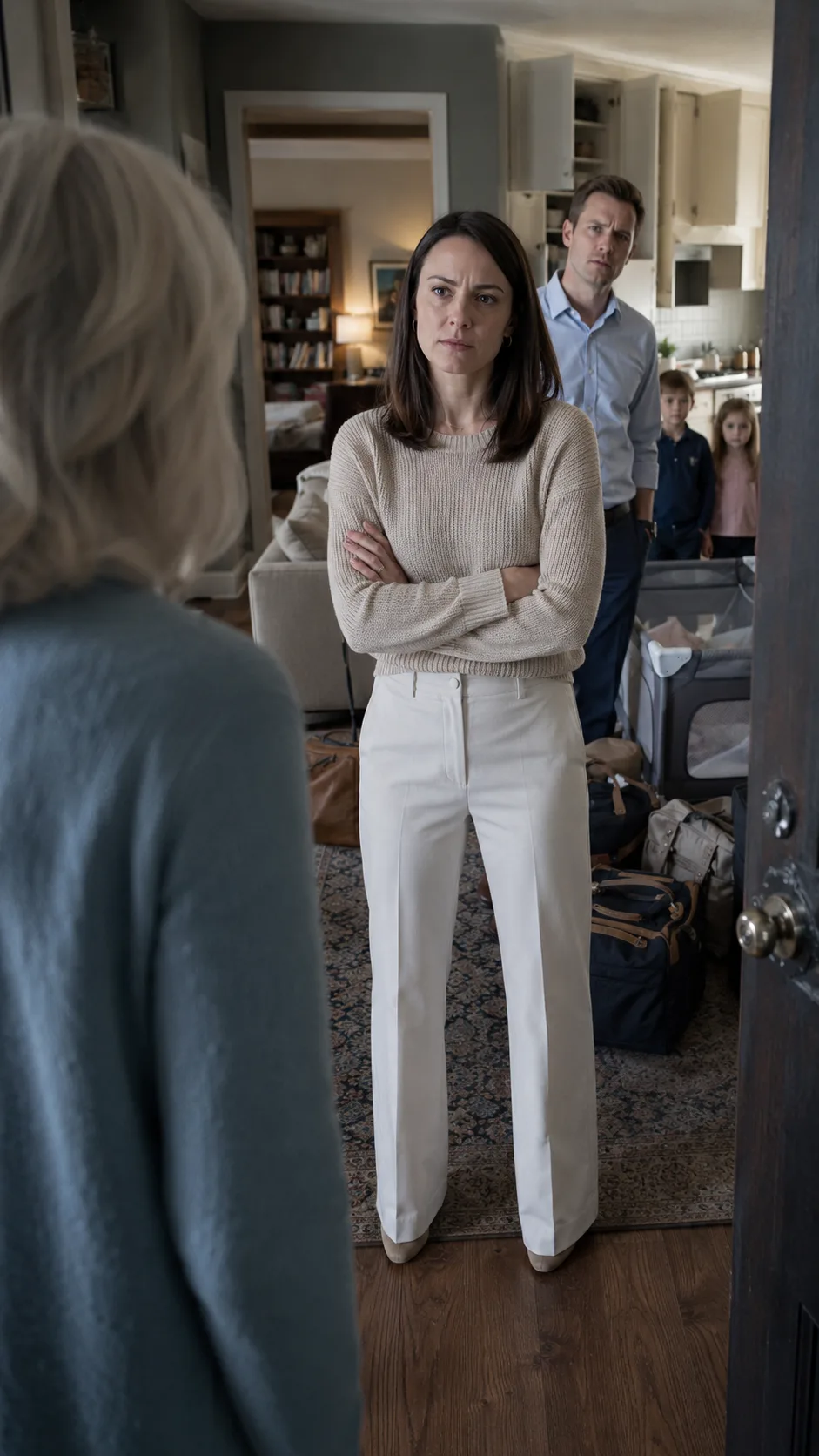
Claire entered first.
She wore white pants and carried two shopping bags. Matt followed with their younger child in his arms. Their daughter walked behind him dragging a pink backpack.
Claire placed her bags on my kitchen counter.
She did not look around like someone entering an unfamiliar home.
She walked directly to the cabinet where I stored coffee. Matt carried the portable crib into my reading room without checking which doorway led there.
Their daughter opened the lower drawer containing napkins.
They knew the apartment.
They had been inside before.
I watched Claire remove my framed photograph of Paul from the end table and place it on the bookshelf to make room for the children’s things.
That small movement hurt more than the door opening.
She lifted his image by the top edge, glanced at it briefly, and relocated it as though rearranging a rental property.
Click the blue “PART 3” below to read the next part:
Chapter complete
You have reached the end of this chapter.
Continue reading
A few more worlds to get lost in after this chapter.




