PART 2 — THEY PLANNED TO DRIVE ME OUT OF MY OWN HOME
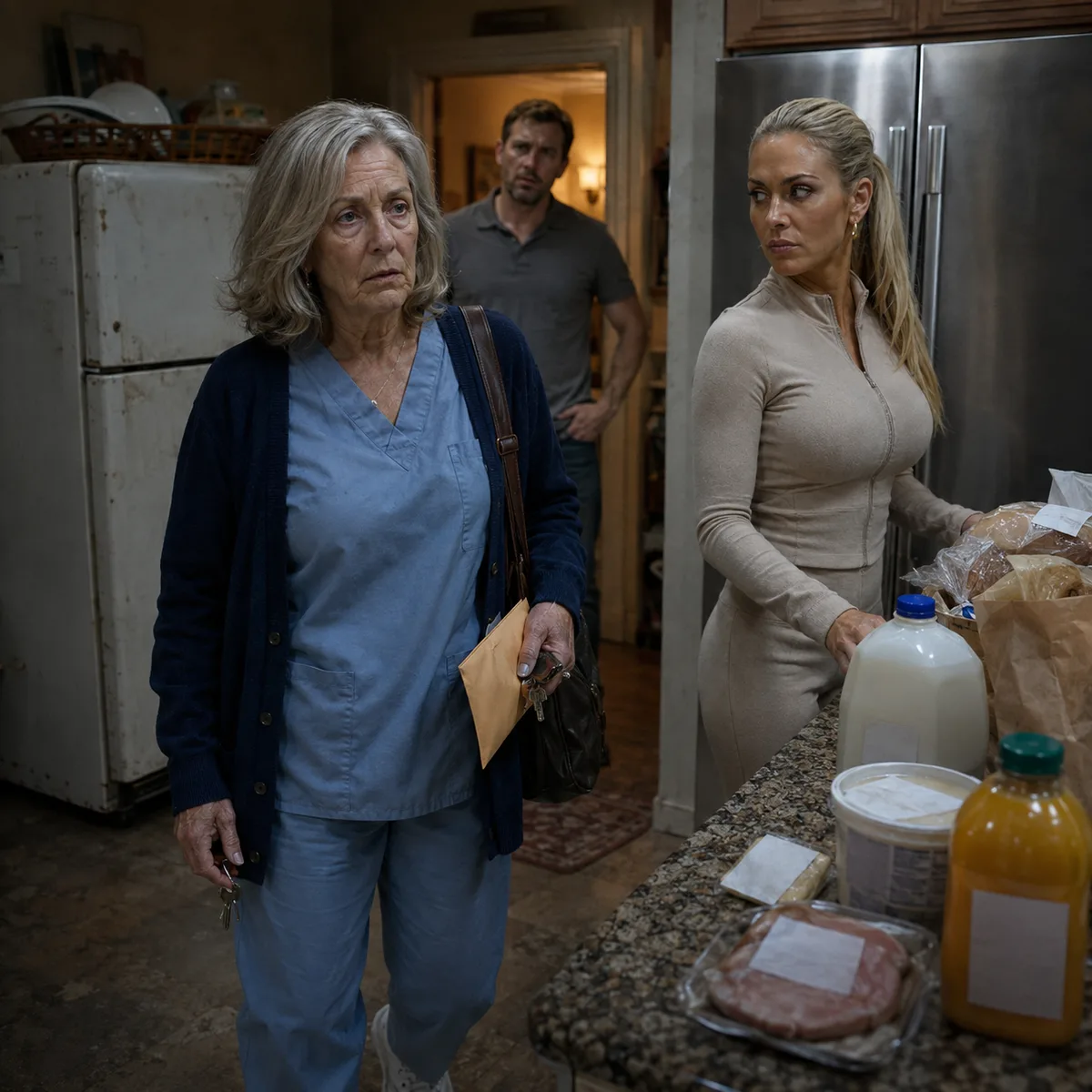
I watched in stunned silence as she methodically placed stickers on items I had purchased with my own money, in my own house, for my own consumption.
Chapter 2
PART 2 — THEY PLANNED TO DRIVE ME OUT OF MY OWN HOME
I watched in stunned silence as she methodically placed stickers on items I had purchased with my own money, in my own house, for my own consumption.
The yogurt I ate every morning for breakfast.
The sandwich meat I packed for lunch.
Even the butter I used for cooking.
“Thalia, this is my house,” I said, my voice barely above a whisper. “This is my food.”
She paused in her labeling and looked at me with what could only be described as pity.
“Oh, Estelle, I know this might be hard to understand, but Desmond and I have been talking, and we think it’s time for some new arrangements around here. More organized arrangements.”
The way she said my name, like I was a child who needed things explained in simple terms, sent a chill down my spine.
This was the same woman who had smiled sweetly at me for months.
The same woman who had thanked me repeatedly for letting them stay in my home.
The same woman who had hugged me just last week and
called me the best mother-in-law ever.
“Where’s Desmond?” I asked, looking around the kitchen as if my son might materialize and explain this bizarre situation.
“He’s sleeping. He has that early meeting tomorrow with the potential employer I found for him.”
She finished with the yogurt container and moved on to my package of English muffins.
“He really needs his rest, so I’d appreciate it if you could keep the noise down.”
Keep the noise down.
In my own house.
After working a twenty-six-hour shift to help keep the roof over all our heads, I stood there swaying slightly from exhaustion and shock, watching this woman, this stranger who had somehow replaced the grateful daughter-in-law I thought I knew, systematically claim ownership of my groceries.
Each small white sticker felt like a tiny act of war.
“I don’t understand,” I finally managed to say. “What’s happening here?”
Thalia closed the
refrigerator door and turned to face me fully.
In the harsh fluorescent light of the kitchen, her features looked sharper than I remembered.
More angular.
“What’s happening is that we’re all adults here, and adults have boundaries. This is mine.”
She patted the big refrigerator.
“And that’s yours.”
She nodded toward my old refrigerator, now pushed into the corner like a punishment.
“But I paid for everything in there,” I protested weakly.
“And now I’m taking responsibility for the household food budget,” she replied smoothly. “It’s actually better this way, don’t you think? Less confusion, less mixing of resources.”
Less mixing of resources.
As if my forty years of steady paychecks and careful budgeting were somehow contaminating her superior lifestyle.
I opened my mouth to argue, to demand an explanation, to ask where my son was in all of this, but nothing came out.
The fluorescent light buzzed overhead.
The
new refrigerator hummed its expensive hum.
And I realized that something fundamental had shifted in my house while I was away saving lives at the hospital.
Thalia smiled then.
The same bright smile I had grown used to over the past months.
“You look exhausted, Estelle. You should get some sleep. Tomorrow we can talk more about the new arrangements.”
She walked past me toward the hallway, pausing only to add, “Oh, and I moved some of your things from the pantry to make room for my supplies. They’re in that box by the back door. You might want to find a place for them in your bedroom or something.”
I was left alone in my kitchen, staring at two refrigerators.
One full of food I could not touch.
One nearly empty and shoved in the corner like an unwanted relative.
The box by the back door contained my coffee.
My oatmeal.
My modest collection of spices.
All the small things that had made this kitchen feel like home.
Standing there in the harsh light, surrounded by the evidence of my own displacement, I felt something crack deep inside my chest.
Not break.
Not yet.
But crack like ice under too much pressure.
Something was very, very wrong in my house.
And I had the terrible feeling that the second refrigerator was only the beginning.
I barely slept that night.
Every time I closed my eyes, I saw those white stickers.
My yogurt.
My butter.
My sandwich meat.
All marked with Thalia’s name like tiny flags claiming conquered territory.
By 5:30 in the morning, I gave up on sleep entirely and shuffled to the kitchen to make my usual cup of coffee.
That was when I discovered the next change.
My coffee maker was gone.
Not broken.
Not packed away.
Gone.
In its place sat a gleaming espresso machine that looked like it belonged in an Italian café.
A small placard leaned against it, written in Thalia’s neat handwriting.
Please ask before using. Settings are very delicate.
I stared at the note, reading it three times before the meaning sank in.
I needed permission to make coffee in my own kitchen.
“Looking for something?”
Thalia’s voice made me jump.
She stood in the doorway wearing a silk robe that probably cost more than my monthly utility bill.
Her hair was perfectly styled despite the early hour.
“My coffee maker,” I said, my voice raw from exhaustion. “Where is my coffee maker?”
“Oh, that old thing. It was taking up so much counter space, I packed it away.”
She moved past me to her espresso machine, running her fingers along its chrome surface like she was petting a beloved cat.
“This is so much better. Don’t you think it makes real coffee?”
Real coffee.
As opposed to the fake coffee I had apparently been drinking for the past three years.
“I don’t know how to use that,” I said quietly.
Thalia began pressing buttons with practiced ease.
The machine hissed and gurgled, filling the kitchen with the rich aroma of expensive coffee beans.
“It’s quite simple once you learn, though the settings really are delicate. One wrong move and you could damage the grinding mechanism. That would be a disaster. This machine cost over two thousand dollars.”
Two thousand dollars for a coffee maker.
I thought of my weekly grocery budget, usually around one hundred dollars, stretched carefully to cover all my basic needs.
Her machine cost twenty weeks of my food money.
“Where did you put my coffee maker?” I asked again.
“Storage closet in the basement, along with some of your other appliances.”
She poured herself a perfect cup of coffee, the crema floating on top like something from a magazine advertisement.
“I had to make room for my kitchen essentials. You understand?”
My kitchen essentials.
I looked around the space that had been mine for fifteen years, seeing it now through different eyes.
The decorative canisters my sister had given me for my birthday were gone.
The small herb garden I had kept on the windowsill had been replaced with some architectural succulent arrangement.
Even my kitchen towels had been swapped out for expensive-looking ones in shades of gray and white.
“Thalia, we need to talk about this,” I said, trying to keep my voice steady. “This is my house.”
She paused with the coffee cup halfway to her lips, tilting her head slightly like a confused puppy.
“Of course it is, Estelle. But we all live here now, don’t we? It makes sense to optimize the space for everyone’s comfort.”
“Everyone’s comfort, or just yours?”
Her smile never wavered, but something flickered behind her eyes.
“I don’t know what you mean.”
Before I could respond, Desmond appeared in the doorway.
My forty-two-year-old son looked rumpled and blurry-eyed, wearing the same wrinkled polo shirt he had worn yesterday.
“Morning, Mom,” he mumbled, barely making eye contact.
“Desmond, we need to discuss these changes your wife has been making.”
I gestured around the transformed kitchen.
He glanced nervously at Thalia, who had moved to stand beside him, her free hand resting possessively on his arm.
“What changes?”
“The refrigerator, the coffee maker, all my things being moved around without discussion.”
“Oh, that.”
He rubbed his face with his hands, still not quite meeting my gaze.
“Yeah, Thalia mentioned she was going to organize things better. Makes sense, right? More efficient.”
“Efficient for whom?”
Thalia stepped forward, her voice taking on that patient, condescending tone I was beginning to hate.
“Estelle, I know change can be difficult for people your age, but this really is better for everyone. You’re working such long hours. When was the last time you had time to cook a proper meal or maintain a decent grocery inventory? This way, you don’t have to worry about any of that.”
People your age.
The phrase hit like a slap.
I was sixty-six, not ninety-six.
I had been managing my own household perfectly well for decades.
“I don’t want you managing my grocery inventory,” I said, my voice getting stronger. “I want my coffee maker back. I want my things back where they belong.”
Desmond shifted uncomfortably, looking anywhere but at me.
“Mom, maybe we could compromise. I mean, if Thalia is willing to handle more of the household stuff, doesn’t that make things easier for you?”
“It would,” Thalia agreed quickly. “If everyone could just be a little more flexible.”
She moved to the big refrigerator and opened it, revealing shelves packed with expensive food.
“I’ve already done all the meal planning for the week. Everything’s organized by day and by nutritional requirements. It’s actually quite sophisticated.”
I stared at the color-coded containers, the precisely arranged produce, the rows of bottled water that probably cost more than my monthly phone bill.
It was impressive.
I had to admit that.
It was also completely foreign.
A kitchen system designed by and for someone who had never worried about the price of groceries.
“What am I supposed to eat?” I asked quietly.
“Well, you’ll need to shop for yourself, obviously,” Thalia said. “There’s still some room in your refrigerator for personal items. Not much, but if you’re careful about portions and stick to basics, it should be adequate.”
Basics.
Portions.
Like I was a tenant renting space in my own kitchen.
“I can’t afford to buy all my own groceries and pay all the household bills,” I said, the admission scraping against my throat.
An uncomfortable silence filled the kitchen.
Desmond studied his feet.
Thalia arranged her already perfect hair.
Finally, Thalia spoke, her voice dripping with false sympathy.
“Oh, Estelle, I didn’t realize money was such a concern. Maybe it’s time to think about adjusting your situation.”
“What kind of adjusting?”
“Well, you’re working such demanding hours at your age. It can’t be healthy. Maybe it’s time to consider retirement, or at least cutting back to part-time.”
My heart started pounding.
Retirement meant living on Social Security, maybe twelve hundred dollars a month if I was lucky.
Part-time meant even less.
There was no way I could maintain this house, pay utilities, buy food, and cover my medications on that kind of income.
“I can’t retire,” I said. “I need to work.”
“But if you didn’t have to worry about maintaining such a large house,” Thalia continued smoothly, “you might find you need less money than you think. There are lovely senior communities where everything’s taken care of for you. No cooking, no cleaning, no worries about household management.”
Senior communities.
She was talking about moving me out of my own house.
I looked at Desmond, waiting for him to speak up, to defend me, to tell his wife that this was his childhood home and his mother was not going anywhere.
Instead, he cleared his throat and said, “Maybe we should all think about what’s best for everyone involved.”
What was best for everyone involved.
Not what was best for me.
What was best for everyone.
Standing there in my transformed kitchen, surrounded by appliances I was not allowed to use and food I was not allowed to eat, I felt something fundamental shift inside me.
The crack that had started the night before widened into something deeper.
Something that might eventually become dangerous.
“I need to get ready for work,” I said, my voice barely above a whisper.
“Oh, you’re working again today?” Thalia asked, sounding genuinely surprised. “After yesterday’s marathon shift? That seems unwise.”
“Bills don’t pay themselves,” I said, heading for the hallway.
“Actually,” Thalia called after me. “I meant to mention, I’d appreciate it if you could use the back entrance when you come home from work. Your uniform shoes are quite loud on the hardwood, and the sound carries to our bedroom. We really need our sleep.”
I stopped walking but did not turn around.
Use the back entrance.
Like a servant.
Like hired help.
“Of course,” I said quietly. “I wouldn’t want to disturb you.”
As I climbed the stairs to my bedroom, the only space in the house that still felt like mine, I could hear them talking in low voices in the kitchen.
Planning more changes, no doubt.
More optimizations.
More ways to make my own home more comfortable for everyone except me.
I closed my bedroom door and leaned against it, my hands shaking as I tried to process what was happening.
Six months ago, my son had asked for temporary help.
Now, his wife was systematically erasing me from my own life, and he was letting her do it.
But as I got dressed for another long shift at the hospital, one thought kept circling through my mind.
Thalia had made a crucial mistake in all her reorganizing and optimizing and territory-claiming.
She had forgotten that this house was still in my name.
And my name alone.
The third week of living under Thalia’s new regime had worn me down to nothing.
Every morning brought fresh humiliations.
My toothbrush moved from the bathroom counter to a drawer.
My favorite chair in the living room repositioned to face the wall.
Even my mail opened and sorted by someone else’s standards.
But it was the casual cruelty that hurt most.
The way Thalia would ask loudly if I had remembered to wipe my feet before entering her clean kitchen.
The way she would sigh dramatically whenever I used the wrong entrance or forgot one of her ever-expanding house rules.
That Tuesday evening, I came home from another grueling shift to find a note taped to the front door.
Estelle, please use side entrance. Having guests for dinner. Thank you for understanding.
Guests in my dining room.
Using my china.
Sitting at my grandmother’s table.
I walked around to the side of the house, my nurse’s bag heavy on my shoulder, and let myself in through the laundry room like some kind of unwanted relative.
The sounds of laughter and conversation drifted from the dining room as I climbed the back stairs to my bedroom.
Through the banister, I caught glimpses of well-dressed people holding wine glasses, their voices animated and happy.
Thalia’s friends, no doubt.
People who would never know that the woman hosting this elegant dinner party was living rent-free in someone else’s home.
I closed my bedroom door and sank onto my bed.
Every muscle in my body screamed from the twelve-hour shift.
The orthopedic unit had been brutal that day.
Three hip replacements.
Two knee surgeries.
And one elderly woman who kept crying for her deceased husband.
I had held her hand during the worst of it, whispering reassurances I was not sure I believed anymore.
The laughter from downstairs grew louder.
Someone was telling a story about a vacation in Europe, their voice carrying the casual confidence of someone who had never worried about money.
I pressed my pillow over my head, but it did not help.
The sound of my own exclusion seeped through the floorboards like poison.
Around eleven, long after the guests had gone home, I crept downstairs to get a glass of water.
The house was dark except for a thin line of light under Desmond and Thalia’s bedroom door.
As I passed by on my way to the kitchen, I heard voices.
Low.
Urgent.
“She’s becoming a problem,” Thalia was saying.
I froze, my heart hammering against my ribs.
They were talking about me.
“She’ll adjust,” Desmond replied.
But his voice lacked conviction.
“She just needs more time.”
“Time for what? To accept reality? Desmond, your mother is sixty-six years old and working herself into the ground. It’s not sustainable.”
“The job market is tough right now. Once I find something steady—”
“That’s not what I’m talking about.”
There was a pause.
And when Thalia spoke again, her voice was clearer.
More focused.
“I’m talking about the bigger picture. This house is worth what? Four hundred thousand, maybe more in today’s market?”
Four hundred thousand.
My breath caught in my throat.
I had had no idea the house had appreciated that much since I had bought it fifteen years ago for one hundred eighty thousand.
“I guess,” Desmond said uncertainly. “Why?”
“Because your mother is sitting on a gold mine while working herself to death for what? Sixty thousand a year? Seventy at most?”
“Thalia, what are you getting at?”
“I’m getting at the fact that we could all be living much better lives if she’d just be reasonable about the situation.”
My legs felt weak.
I pressed my back against the hallway wall, straining to hear every word.
“Reasonable how?”
“Think about it.”
Thalia’s voice took on that patient, explaining tone I had grown to hate.
“She signs the house over to you, her only son, her natural heir anyway, and we use the equity to set everyone up properly. She could move into one of those nice senior-living places. No more worrying about maintenance or property taxes or any of that stress. And we could finally start building the life we deserve.”
The life they deserved.
With my house.
My home.
My life’s work reduced to equity to be cashed in for their convenience.
“I don’t know,” Desmond said slowly. “That seems kind of…”
“Kind of what? Smart? Practical? Desmond, your mother isn’t going to live forever. Eventually, you’ll inherit the house anyway. This way, everyone benefits now instead of waiting for some tragic accident or illness.”
Some tragic accident or illness.
The casual way she said it made my skin crawl.
“She’d never agree to it,” Desmond said.
“She might, if we approach it right. Frame it as helping her, not helping us. Emphasize how much easier her life would be without all these responsibilities. Hell, we could even find her a place near that hospital where she works. Shorter commute. More time to rest.”
“And if she says no?”
There was a long silence.
When Thalia finally spoke, her voice was so quiet I had to lean closer to the door to hear her.
“Then we make her life here uncomfortable enough that moving out starts to look appealing.”
My blood turned to ice.
Make her life uncomfortable enough.
All the changes.
All the rules.
All the casual cruelties.
None of it had been about organization or efficiency.
It had been a campaign.
A systematic effort to drive me out of my own home.
Click the blue “PART 3” below to read the next part:
Chapter complete
You have reached the end of this chapter.
Continue reading
A few more worlds to get lost in after this chapter.




