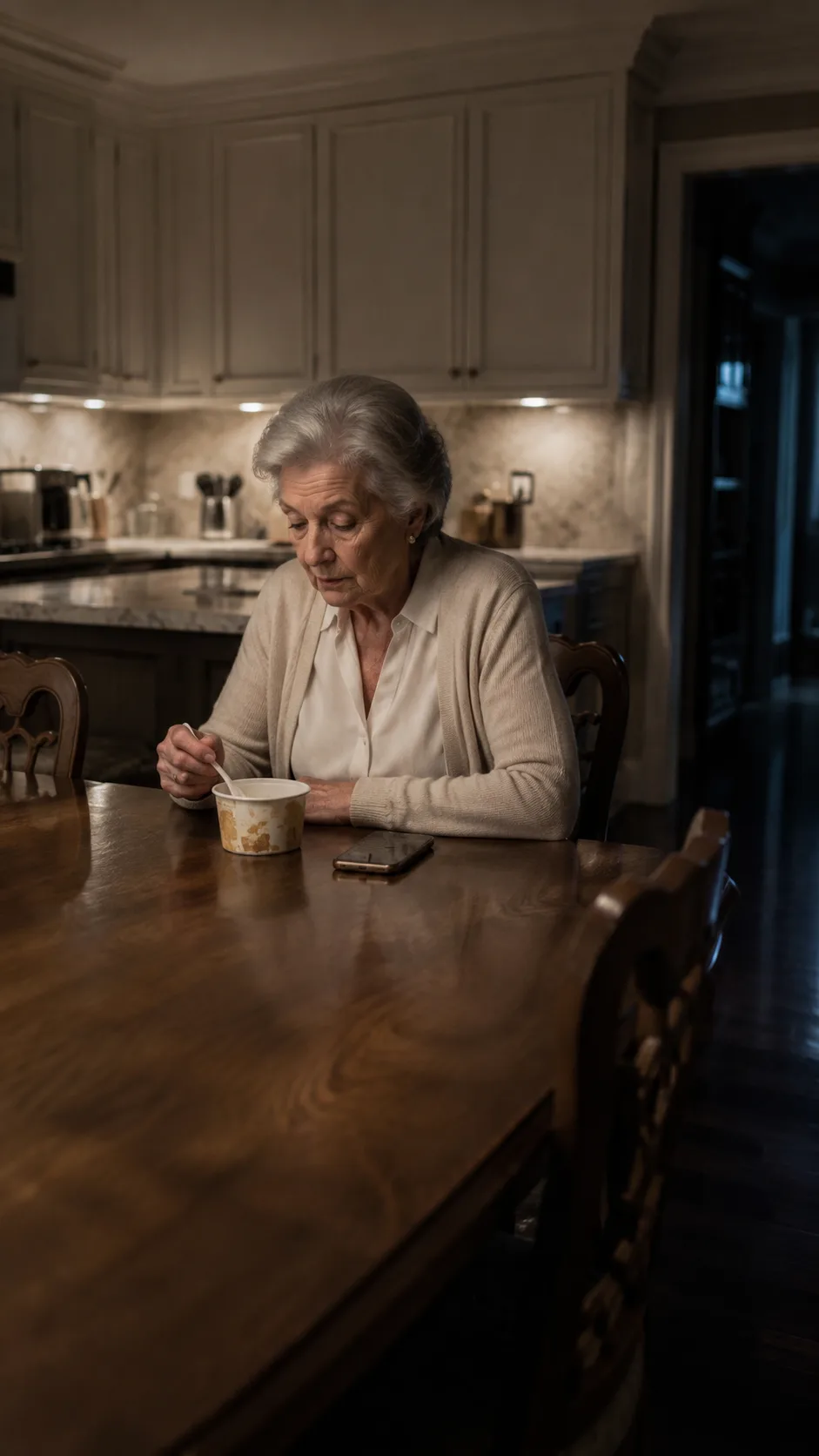
Beatrice’s conditions were not what Emily expected.
Chapter 3
Beatrice’s conditions were not what Emily expected.
Emily had expected revenge.
An eviction notice.
A demand for every dollar by Friday.
Maybe even a scene dramatic enough to make her feel like the victim.
But Beatrice did not raise her voice.
She simply unfolded the paper and read.
“I will not move back into that house.”
Daniel looked up sharply.
“Mom—”
Beatrice lifted one hand, and he stopped.
“I am staying with Linda until I find my own apartment. My bedroom in that house is no longer mine. I outgrew it the night I left.”
Daniel’s eyes reddened.
Emily stared at the conference table.
Beatrice continued.
“The house will be restructured legally. I will keep majority ownership until Daniel and Emily either buy me out through a formal payment plan or sell the property and repay what I invested.”
Megan nodded, already prepared.
“Until then,” Beatrice said, “my portion of the home will be leased.”
Emily blinked.
“Leased?”
“Yes.”
“To who?”
“To a family I choose.”
Emily sat back as if the chair had shifted beneath her.
“You want strangers living with us?”
Beatrice met her eyes.
“I want you to understand what it feels like when your home is not entirely yours.”
Daniel closed his eyes.
He understood immediately.
Emily did not.
Or maybe she did and hated that she did.
Beatrice’s voice remained even.
“For three years, I lived in a house where I was useful but not respected. I cooked in a kitchen that was not treated as mine, though my money helped buy it. I raised children in rooms where my opinion became interference. I slept under a roof I legally owned while being made to feel grateful for shelter.”
Emily’s face crumpled.
“I was wrong.”
“Yes,” Beatrice said.
The word was not cruel.
It was clean.
Emily cried quietly then, but Beatrice
did not soften the truth simply because tears had arrived.
Megan explained the structure. Beatrice would lease her protected share of the property to Teresa Campos, a widowed schoolteacher with two children who had lost her apartment after medical debt. Teresa would pay modest rent directly to Beatrice. The Ruiz family would remain in the home, but the house would no longer operate under the fantasy that Emily controlled every room.
Shared kitchen.
Shared laundry.
Shared yard.
Shared walls.
Emily pressed her fingers to her temples.
“This is humiliating.”
Beatrice nodded.
“Yes.”
Emily looked up.
Beatrice said, “Now imagine being humiliated by people you cook for.”
No one spoke.
Daniel covered his face with both hands.
“I did this,” he whispered.
Beatrice turned to him, and for the first time that morning, her voice softened.
“You allowed it. That is different from starting it, but not different enough to erase
the damage.”
He looked at her like a boy again.
“What can I do?”
“You and I will attend therapy together once a week for six months.”
Daniel broke.
Not loudly.
His face simply folded under the weight of the sentence.
“After everything, you still want that?”
Beatrice’s eyes shone.
“You are my son. You failed me deeply. But I am not ready to bury you while you are still alive.”
Daniel stood, walked around the table, and knelt beside her chair.
Emily watched, stunned.
Daniel took his mother’s hand the way he used to when he was small and afraid of thunderstorms.
“I am sorry, Mom.”
Beatrice let herself cry then.
Not because the apology fixed anything.
It did not.
But because for the first time in years, her son looked directly at what he had done.
Emily whispered, “Is there anything I can do?”
Beatrice wiped her cheek.
“Yes. Stop performing regret and begin practicing respect.”
Emily nodded.
“Call me Beatrice,” she added.
Emily’s lips trembled.
“Beatrice.”
The name sat between them like the first honest brick in a wall that might one day become a bridge.
Two weeks later, Teresa Campos arrived at 847 Jurist Circle with a rented moving truck, two children, and a nervous smile.
Emily opened the door.
For one second, every old habit crossed her face.
Possession.
Annoyance.
Control.
Then she saw Beatrice standing behind Teresa.
Emily stepped aside.
“Come in,” she said.
It was not warm, but it was not cruel.
That was a beginning.
Teresa’s son, Miguel, carried in a box of books. Her daughter, Andrea, held a plant in both hands as if it were fragile treasure. Michael came downstairs and immediately offered to help. Sarah ran to Beatrice and hugged her around the waist.
“Grandma, are you coming back?”
Beatrice knelt carefully.
“Not to live, sweetheart.”
Sarah’s face fell.
“But I’ll visit,” Beatrice said. “And you can visit me.”
“Where will you live?”
“In a place I choose.”
Sarah seemed to think about that.
Then she nodded with the seriousness only children can manage.
“That sounds good.”
That first evening, Teresa cooked green chicken enchiladas.
The smell filled the house.
Emily came into the kitchen and stopped near the stove. Beatrice watched her from the dining room, recognizing the battle taking place on Emily’s face.
Three years ago, Emily would have corrected the pan placement.
Two months ago, she would have complained about the smell.
That night, she swallowed.
“Do you need help?” Emily asked.
Teresa looked surprised, then smiled.
“You can set the table.”
Emily nodded and opened the drawer.
Beatrice saw Daniel watching from the hallway.
He looked at his mother.
She looked back.
Neither of them spoke.
The table was crowded that night.
Daniel, Emily, Michael, Sarah, Teresa, Miguel, Andrea, and Beatrice, who had agreed to stay for dinner because Sarah had begged and Teresa had made extra.
No one ate from paper sleeves.
No one sat alone.
The children adapted first.
Michael and Miguel became friends over video games and bike rides. Sarah and Andrea drew pictures on printer paper and taped them to the refrigerator. They did not understand ownership percentages or legal agreements. They only knew the house felt louder, fuller, and less sharp around the edges.
Adults changed more slowly.
Emily struggled.
She hated sharing the laundry room. She hated waiting for the oven. She hated finding someone else’s shoes near the back door.
But each discomfort taught her something Beatrice had been forced to learn in silence: a home is not dignity if you use it to shrink someone else.
One evening, Andrea sat at the kitchen table crying over math homework. Emily passed by with a glass of water, paused, and then sat down.
“I used to be good at this,” she said awkwardly. “May I?”
Andrea nodded.
For forty minutes, Emily explained fractions.
When Andrea finally understood and said thank you, Emily went into the pantry and cried.
Teresa told Beatrice later.
“She is learning,” Teresa said.
“Learning hurts,” Beatrice answered.
“Yes,” Teresa said. “That is how you know it is real.”
Daniel and Beatrice began therapy the same week Teresa moved in.
The first session was mostly silence.
The second was mostly tears.
By the fourth, Daniel said the thing Beatrice had needed to hear.
“I chose peace with my wife over protection of my mother.”
Beatrice looked at him.
“No,” she said gently. “You chose comfort. Peace requires truth.”
He cried then.
So did she.
Their relationship did not heal like a movie.
There was no single hug that erased three years.
Daniel called more often, sometimes clumsily. He asked if she had eaten. He asked how she slept. He asked about her knees, her books, her knitting group. At first, the questions sounded like guilt wearing a costume.
Then, slowly, they became real.
One Sunday, he arrived at Linda’s house with wildflowers.
Beatrice opened the door.
“What are these for?”
Daniel shrugged, embarrassed.
“Because you’re my mom.”
She cried over those flowers after he left.
Not because flowers were enough.
Because once, he had forgotten she deserved anything at all.
Six months later, Emily asked to meet Beatrice alone at a café.
Beatrice almost said no.
Then she went.
Emily was already seated when she arrived. No red dress. No armor. Just a tired woman with a folder in front of her and coffee she had not touched.
“I’m in therapy,” Emily said.
Beatrice waited.
“I know that does not repair what I did.”
“No,” Beatrice said. “It does not.”
Emily nodded.
“I grew up watching my mother clean houses for women who never learned her name. I thought success meant never being treated that way. Then I became the kind of woman who treated someone else that way.”
Beatrice studied her.
It was the first time Emily had said something honest without trying to excuse herself.
“I was jealous of you,” Emily continued. “The children loved you so openly. Daniel trusted you in ways he didn’t trust me. You knew how to make a house feel safe, and I only knew how to make it look impressive. So I made you smaller.”
Beatrice’s eyes softened, but her voice stayed firm.
“You did not make me smaller. You only made the room too narrow for me to stand.”
Emily began to cry.
“I am not asking you to forgive me today.”
“Good.”
“I am asking for the chance to become someone you may one day believe.”
Beatrice looked out the window.
Outside, people passed with shopping bags and strollers, carrying lives no one else could fully see.
“Then become her,” Beatrice said. “Without applause.”
Emily nodded.
A year and three months after the night of the leftovers, Beatrice moved into her own apartment in downtown San Antonio.
It was not large.
It did not have marble counters.
But the kitchen was hers.
The first morning, sunlight fell across the floor in a clean golden rectangle. Beatrice stood there with coffee in her hand and cried because nobody was about to ask why breakfast was late.
Emily and Daniel eventually signed a formal payment plan to buy back Beatrice’s ownership share over five years, with interest. Teresa’s family stayed as tenants by choice, not as punishment. The children remained close. The house became something strange and imperfect, but more honest than it had ever been when everyone pretended kindness lived there.
Beatrice taught knitting classes twice a week.
She walked with Linda every morning.
Daniel came every Sunday.
Sometimes he brought the children. Sometimes he came alone and sat by the window, drinking coffee from the mugs Beatrice chose herself.
Emily sent recipes, photos, and small messages that no longer sounded like instructions.
One Saturday afternoon, Beatrice sat in the park with Michael and Sarah, eating ice cream beneath a tree.
Michael had grown taller. Serious, too.
“Grandma,” he asked, “do you regret leaving that night?”
Beatrice looked at him.
Then at Sarah, who had sticky fingers and a paper crown from a birthday party nearby.
“Never,” Beatrice said.
“Not even a little?”
“Not even a little.”
Sarah climbed into her lap.
“Are you happy now?”
Beatrice thought about the soup, the text message, the restaurant video, the suitcase, the deed, the first night at Linda’s house, the first morning in her apartment, Daniel’s wildflowers, Teresa’s laughter, Emily’s difficult honesty, and the strange mercy of starting over late in life.
“Yes,” she said.
Sarah leaned against her.
“Why?”
Beatrice kissed the top of her head.
“Because now I live where I am chosen,” she said. “Not where I am merely tolerated.”
The afternoon light moved softly through the leaves.
For a long time, Beatrice had believed leaving meant losing everything.
But sometimes leaving is the only way a woman finds out what was still hers.
Her name.
Her house.
Her dignity.
Her life.
THE END.
Chapter complete
You have reached the end of this chapter.
Continue reading
A few more worlds to get lost in after this chapter.




