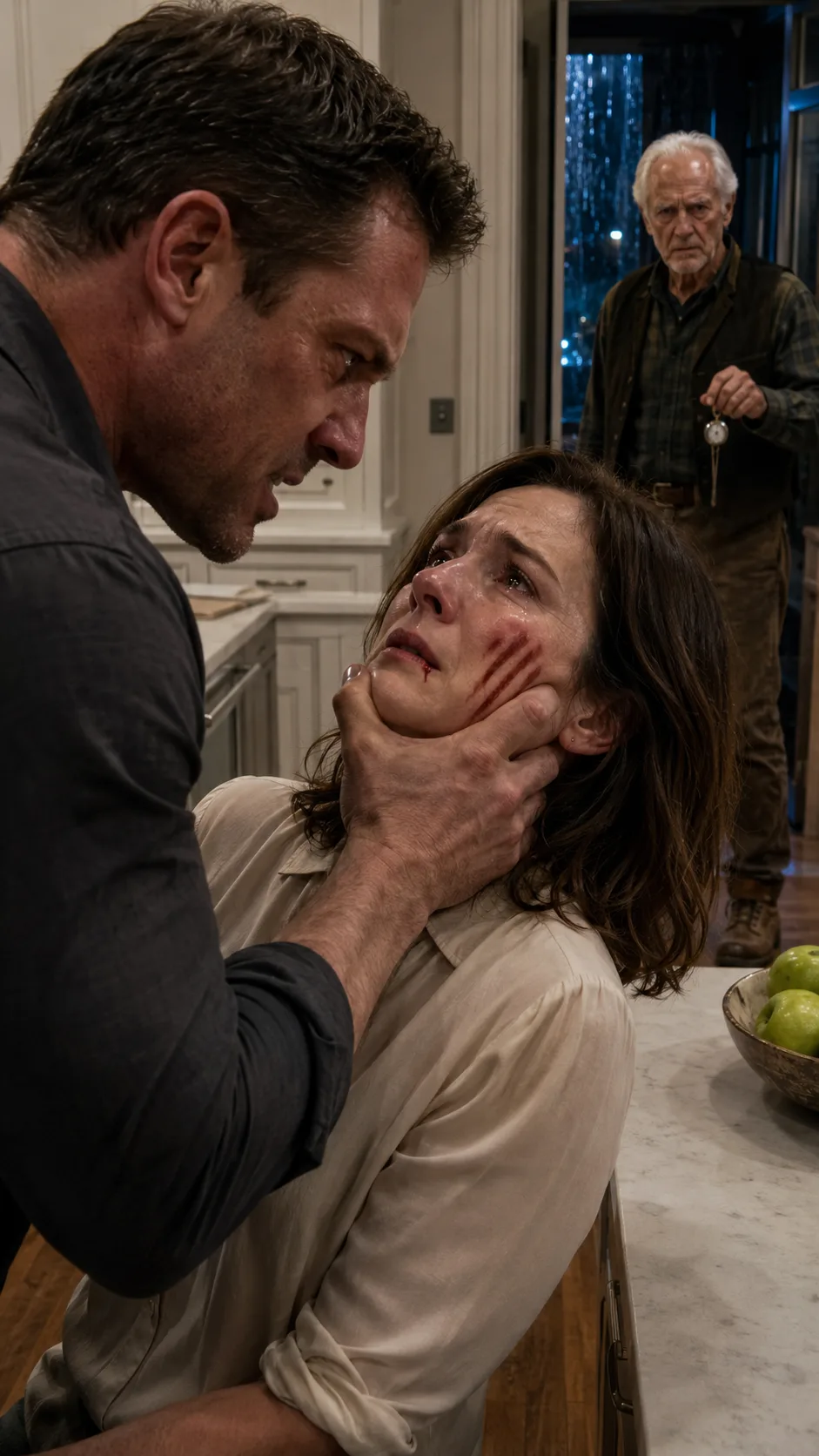
Richard stared at the settlement documents spread across the kitchen island.
Chapter 3
Richard stared at the settlement documents spread across the kitchen island.
The house was silent except for the rain tapping against the windows and the steady ticking of my father’s watch.
“You can’t make me sign,” Richard said.
His voice sounded smaller now.
Arthur stood beside the study doors with his hands relaxed at his sides.
“I am not making you do anything.”
“You broke my shoulder.”
“You attacked my daughter repeatedly.”
“You have no proof.”
My father opened the blue binder again.
He removed photographs of the bruises I had tried to hide. Some had been taken during Sunday dinners without my knowledge. Others came from security footage inside our own home.
Richard stared at them.
“You were watching us?”
“I was watching you.”
Arthur placed a small recording device on the counter.
“Your threats tonight were also recorded.”
My husband’s eyes moved toward the ceiling.
The kitchen security camera blinked above the pantry door.
Richard had installed it himself
after accusing our housekeeper of stealing liquor.
Now it had captured him gripping my jaw and threatening to punish me unless my father surrendered his property.
Arthur continued calmly.
“The evidence of domestic abuse goes to the police. The fraud records go to federal investigators. The gambling records go to your creditors. Or you sign.”
Richard looked at me.
“Sarah, tell him to stop.”
For years, that command would have been enough.
I would have apologized for upsetting him. I would have protected his reputation. I would have told myself that one peaceful night was worth surrendering another piece of myself.
But I could still feel his fingers on my face.
I could taste blood in my mouth.
“No,” I said.
Richard blinked.
“What?”
“No.”
It was the first time I had said the word to him without lowering my eyes.
His face twisted.
“You ungrateful—”
Arthur took one step
forward.
Richard stopped.
My father did not touch him. He did not need to.
“Finish that sentence,” Arthur said.
Richard looked away.
Arthur set the documents on the desk inside the study. He placed the pen on top.
“Ten minutes began two minutes ago.”
“I need a lawyer.”
“You may call one.”
“My phone is in the kitchen.”
Arthur retrieved it and placed it beside him.
Richard dialed his attorney.
The first call went unanswered.
He called again.
On the third attempt, a tired voice finally answered. Richard spoke in a hurried whisper, explaining the debt transfer, the tax documents, and the proposed settlement.
His attorney remained silent for a long time.
Then Richard’s expression collapsed.
“No,” he said. “There has to be another option.”
More silence.
Richard listened.
“What if I refuse?”
The reply came through faintly.
I could not hear every word, but I heard three phrases clearly.
Criminal exposure.
Asset seizure.
Prison sentence.
Richard ended the call.
He sat against the bookshelf, staring at the papers.
“You ruined me,” he said to Arthur.
My father’s voice remained calm.
“No. You built this yourself.”
“I made mistakes.”
“You made choices.”
“I was under pressure.”
“So was Sarah every time you placed your hands on her.”
Richard turned toward me.
“I never meant to hurt you.”
A bitter laugh escaped me.
“Which time?”
He flinched.
“The first time you slammed me into the counter?”
“Sarah—”
“The night you threw a coffee mug past my head?”
“I was angry.”
“When you bruised my arms because I asked about the mortgage?”
“I said I was sorry.”
“No. You bought me flowers and told me not to provoke you again.”
Richard lowered his eyes.
I had imagined confronting him many times. In those fantasies, I screamed. I broke dishes. I demanded explanations.
But standing in that kitchen, I felt no need to shout.
The truth sounded stronger when spoken quietly.
“You made me afraid inside my own home,” I said. “Then you called that fear loyalty.”
Richard’s face hardened.
“You’ll regret leaving me.”
Arthur glanced at the watch.
“Six minutes.”
Richard grabbed the pen.
He read the first page, though his swollen eyes could barely focus.
The agreement transferred his interest in the Bellevue house to me. He waived any claim against my savings, retirement accounts, inheritance, and future earnings. He agreed to leave the property by noon the following day.
A separate clause prohibited him from contacting me except through attorneys.
Another required him to disclose all undiscovered debts.
“You can’t keep everything,” Richard said.
“I’m not taking everything,” I answered. “I’m taking back what you tried to steal.”
He signed the first page.
Then the second.
With each signature, his anger seemed to drain away.
Arthur watched without satisfaction.
He did not smile.
He did not gloat.
He simply turned the pages when necessary and pointed to each signature line.
When Richard reached the final page, he hesitated.
“If I sign this, the debt disappears?”
“The debt to me will be canceled once the property transfer is complete,” Arthur said. “Your other debts remain your responsibility.”
“And the tax evidence?”
“It stays in my possession unless you violate the agreement, threaten Sarah, conceal assets, or attempt to contact her.”
“You’d destroy my life.”
“You already tried to destroy hers.”
Richard signed.
The pen scratched across the paper.
That small sound ended eight years of marriage.
Arthur collected the documents and checked every page. Then he called his attorney.
“It’s done,” he said. “File at nine.”
He listened briefly.
“Yes. All signatures witnessed and recorded.”
He ended the call and turned to me.
“Pack a bag, sweetheart. You’re coming home with me.”
The tenderness in his voice broke something open inside me.
My knees weakened.
I covered my face and began sobbing.
“I’m sorry,” I said. “I’m so sorry. I should have left sooner. I should have told you. I thought I could fix him.”
Arthur crossed the kitchen and pulled me into his arms.
His sweater smelled of cedar, beeswax, cold air, and rain.
“You are not stupid,” he whispered. “You were kind.”
“I let him hurt me.”
“You survived him.”
“I kept making excuses.”
“Cruel men train good people to blame themselves.”
His voice shook slightly.
It was the first sign of emotion he had shown all night.
“When you were born,” he continued, “I promised your mother that the dangerous part of my life would never touch you. I thought distance was enough. I thought if I became quiet and ordinary, the past would disappear.”
He looked toward Richard.
“But I should have paid closer attention.”
“This isn’t your fault.”
“No,” he said. “And it isn’t yours.”
He released me and wiped the tears from my face with a clean handkerchief.
“Go upstairs. Take what you need for a week.”
“What about Richard?”
“An ambulance is coming.”
Richard looked up.
“You called one?”
“I called before entering the house,” Arthur said. “I knew one of you might need medical attention.”
Richard gave a humorless laugh.
“You knew you were going to do this.”
“I knew what I might find.”
I went upstairs.
The bedroom looked exactly as it had that morning. The bed was made. Richard’s expensive watches sat in a polished box. Our wedding photograph stood on the dresser.
In the picture, he was smiling at me as though I were the only person in the world.
I turned the frame facedown.
I packed clothing, toiletries, my mother’s jewelry box, and the small wooden bird my father had carved for me when I was ten.
Then I opened the closet and saw the cream dress I had worn on my first anniversary.
For years, I had kept it as proof that our marriage had once been beautiful.
I left it hanging.
When I returned downstairs, two paramedics were examining Richard. A police officer stood nearby taking notes.
Arthur had already given him the security recording.
Richard did not protest.
He avoided looking at me as the paramedics secured his shoulder and lifted him onto a stretcher.
At the doorway, he finally spoke.
“Sarah.”
I stopped.
For one moment, I expected an apology.
Instead, he said, “Your father is a monster.”
Arthur stood beside me.
I looked at the man I had once loved.
“No, Richard. He’s the man who finally made you stop.”
The paramedics carried him into the rain.
Arthur picked up the Hamilton watch from the island. He wiped a small fingerprint from its silver case and hooked the leather fob back into his vest.
“Why do you always remove it?” I asked.
He looked at the watch.
“It belonged to your grandfather.”
“That doesn’t explain it.”
Arthur clicked open the cover.
Inside was a faded photograph of my mother.
“When I came home from the war, your grandfather gave me this watch and told me that every man has two lives—the one ruled by anger and the one ruled by purpose.”
He closed the cover.
“I remove it because I never want violence close to the people I love.”
“And tonight?”
“Tonight, violence had already reached you.”
He slipped the watch back over his heart.
“Come on, sweetheart. Let’s go home.”
My father’s house was warm when we arrived. Barnaby met us at the door, wagging his tail so hard his entire body moved.
Arthur made tea.
I sat at the kitchen table while he placed an ice pack against my cheek.
Neither of us slept.
At sunrise, his lawyer called to confirm that the divorce filing, title transfer, and emergency protective order had been submitted.
By noon, movers hired by Arthur had packed Richard’s belongings.
He never returned to the house.
Over the following months, I learned how thoroughly my father had protected me. He arranged counseling but never forced me to speak before I was ready. He helped me organize my finances without controlling them. When nightmares woke me, he sat at the kitchen table and listened.
He never told me to forget Richard.
He taught me to remember myself.
The Bellevue house was eventually sold. With my share of the equity, I purchased a sunlit two-story home four blocks from Arthur’s place near Puget Sound.
I opened an antique restoration shop.
My father helped me build the workbenches. He taught me how to repair cracked joints, replace damaged veneer, and recognize when a piece of wood could be saved.
“Most things don’t need to be replaced,” he told me one afternoon. “They need the damage removed and the structure strengthened.”
I knew he was not speaking only about furniture.
Three years have passed.
Richard moved to Eastern Oregon and found work at a freight yard. He never contested the divorce. He never contacted me.
According to a mutual acquaintance, he tells people he was once married to a woman whose father was the devil.
He is wrong.
My father is eighty-two now. Every morning, he walks Barnaby along the beach at sunrise. He still spends afternoons in his workshop building rocking chairs for the children’s hospital.
Every evening at six, Arthur removes the silver Hamilton watch from his vest, checks the time, clicks the cover shut, and smiles at me across the dinner table.
Some fathers teach their daughters how to speak louder.
Mine taught me that strength does not always announce itself.
Sometimes it enters quietly through a front door.
Sometimes it rolls up its sleeves.
And sometimes it places a silver watch on a kitchen island before reminding a cruel man that kindness and weakness were never the same thing.
THE END
Chapter complete
You have reached the end of this chapter.
Continue reading
A few more worlds to get lost in after this chapter.




