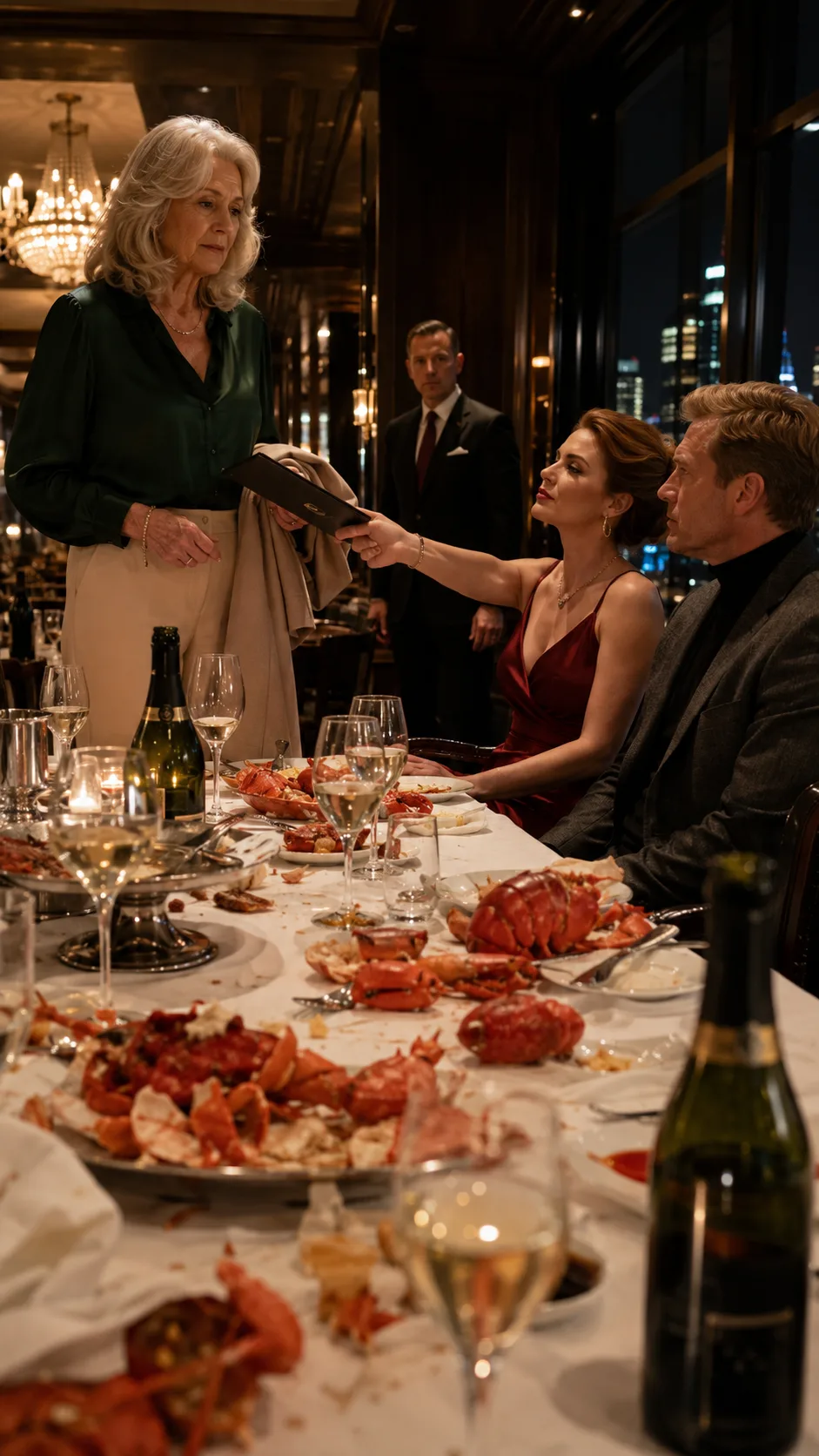
PART 2 — THE DAY I STOPPED BEING THEIR CASH COW AND MAID
My name is Hope Robinson.
Chapter 2
PART 2 — THE DAY I STOPPED BEING THEIR CASH COW AND MAID
My name is Hope Robinson.
I am sixty-eight years old, and every line on my face was earned. When I was twenty-five, Arnold and I got married in a small chapel in Queens. He was a civil engineer. I had just finished my accounting degree and started the long climb toward becoming the kind of woman no one hands anything to, and no one can quietly erase.
We lived at first in a tiny two-room apartment with secondhand furniture we bought from flea markets and church sales. Two years later Steve was born, and for a while I believed that meant life had finally opened into something simple and bright. I worked through most of my pregnancy. I went back to the office when he was three months old, not because I wanted to, but because that was what survival looked like.
Arnold earned well, and I earned steadily, but we wanted more for our
son than either of us had received. Over forty years I worked at Mendes & Associates, one of those respected accounting firms in Midtown where people speak softly, dress expensively, and remember every mistake you have ever made. I started as an assistant. I finished as a senior accountant handling the books of companies worth more money than I had ever imagined as a girl. I was never late. I was never careless. I earned every dollar that entered my life.
When Steve was fourteen, Arnold began complaining of stomach pain. We told ourselves it was gastritis. Something stress-related. Something fixable. It was pancreatic cancer.
They gave him six months.
He lasted eight.
I paid for everything. Specialists. Treatments. Experimental medication that promised miracles in careful voices and fine print. I emptied our savings. I took out loans. I sold my car. None of it saved him. By the time
he died, I was fifty-six years old, widowed, with a son still in school and twenty thousand dollars in debt.
I did not collapse.
I worked double shifts. I took weekend consulting jobs. I finished paying off two commercial units Arnold had left half-covered. Four years later they were mine, and eventually they began bringing in steady rental income. I paid for Steve’s entire education. Every tuition bill. Every textbook. Every fee. Every white coat. Every exam. He studied medicine for six years, and never once did he have to leave school because his mother could not afford another semester.
I bought my house with money I earned myself. A three-story house in the suburbs with a terracotta facade, a carved wooden front door Arnold and I chose together on a rainy Saturday, and a garden with oak trees we planted when Steve was still a baby. The first appraisal
years ago put it at around eight hundred thousand dollars. By the time Vanessa and Steve began plotting over it, a newer one valued it far higher. Either way, it was worth more than money to me. It was forty years of discipline turned into walls, stairs, sunlight, and safety.
I also had savings—more than most people guessed. Around three hundred thousand dollars spread across investments that produced steady returns. I never advertised it. I learned young that when a woman has resources, everyone around her suddenly develops a reason she should part with them.
Arnold understood that too. Three days before he died, in a hospital room that smelled like antiseptic and fear, he looked at me and said, “Don’t confuse generosity with foolishness, Hope. Help people, but do not empty yourself.”
At the time, I thought grief was speaking.
I did not understand those words until Vanessa entered our lives.
I met her five years ago at a dinner Steve organized in an Italian restaurant downtown. He called that afternoon with a lightness in his voice I had not heard in years.
“Mom, I want you to meet someone special.”
I arrived carrying a bouquet of white flowers, thinking it would be something intimate, maybe the three of us sharing pasta and cautious smiles. Instead I walked into a large table full of strangers. Vanessa’s parents. Her sister Rachel. An aunt. A cousin. A few more relatives who introduced themselves so quickly I forgot their names before I sat down.
Vanessa stood up in an ivory dress and sky-high heels that made her look elegant and a little imposing. She hugged me as if we already had a history.
“Hope,” she said brightly, “Steve has told me so much about you. You’re his hero.”
I would like to tell you I saw through her then. I did not. I liked hearing that. I liked the warmth of it. I liked the idea that perhaps, after years of being only a mother and a widow and a woman who handled everything, I might also gain a daughter.
The dinner itself should have warned me. They ordered expensive wine, appetizers, truffle pasta, extra courses nobody really needed. And when the bill arrived, a silence fell over the table so suddenly it was almost theatrical. Everyone stared at their plates. Steve gave me that look he had perfected since childhood—the one that said please rescue me, but without forcing him to say the words.
“Mom, could you…?”
I paid four hundred dollars that night. I told myself it was the first dinner with my future daughter-in-law’s family. I told myself I was being gracious. That was my first mistake.
The months that followed moved fast. Steve was in love. Vanessa came by my house every week, always with a little gift. A cake from an expensive bakery. Flowers. Once, even a knitted shawl she claimed her grandmother had made.
“I want us to be close,” she told me one afternoon over coffee in my kitchen. “Like mother and daughter.”
I did not have daughters. I had always imagined what that softness might feel like. That is why I opened my heart too quickly.
The signs began small.
“Oh, Hope, that pressure cooker is so old-fashioned. You should get one of those modern electric ones.”
“This sofa feels dated, doesn’t it? In my dream house I’d do something much cleaner.”
“You still use that phone? It doesn’t even have a good camera.”
Each remark came wrapped in laughter. Each one was easy to dismiss on its own. Together they formed a pattern, though I was slow to admit it.
Six months later they announced the engagement. Then the wedding planning began, and with it, the first real hook.
Vanessa wanted the Crystal Plaza, one of the most exclusive venues in the city. The full package was twenty-five thousand dollars. She told me it had been her dream since childhood. Her father, she said, was having financial problems. Steve had just finished residency and was beginning work at a private hospital, but he was not yet earning what people imagined doctors earned.
“We could do something smaller,” I suggested gently. “Beautiful, but more reasonable.”
Vanessa looked at me as though I had suggested they marry beside a dumpster.
“It’s your only son,” she said softly. “Your one chance to see him get married. Don’t you want it to be special?”
Guilt. That was the first real weapon.
I ended up paying eighteen thousand dollars toward the wedding. They promised it was temporary help. They promised repayment once they were settled.
The wedding was beautiful. Flowers everywhere. A five-course dinner. Live music. Vanessa looked like a princess and Steve looked at her as if she had hung the moon. I smiled for the photographs. Inside, I felt a hollow I did not yet know how to name.
Two months later came the honeymoon.
“Greece, Mom,” Steve said over the phone, his voice carefully casual. “We always wanted to go, but after the wedding—”
“It’s our dream trip,” Vanessa added on speaker, warm as honey. “We’ll pay you back in six months. I promise.”
That promise cost me another six thousand dollars.
I never saw a single dollar returned.
Promises turned into excuses. Excuses turned into silence. Silence turned into mockery.
“In my family, things are done differently.”
“My mother would never say something like that.”
“People from your generation are so strange sometimes.”
At some point Vanessa started calling me “absent-minded Hope” in front of her friends, as if it were a joke affectionate enough to hide the insult. Steve laughed awkwardly at first. Then naturally. Then without even noticing.
That should have been the moment I stopped everything. I did not. I loved my son. I thought kindness, if given enough time, might still teach people how to behave. I was wrong.
Things did not improve. They got worse.
Much worse.
The true nightmare began three years ago on a September afternoon when Steve arrived unannounced with two large suitcases and a worried expression.
“Mom, we have a problem. The apartment has mold. They’re fumigating. Can we stay here for two months? Maximum.”
Vanessa came in behind him carrying three boxes. She kissed my cheek before I even answered.
“You’re saving our lives,” she said. “Two months, and we’re gone. I promise.”
Two months became fourteen.
The first week was manageable. They took the guest room on the second floor. I still had my bedroom. The third floor—my study—was still untouched. That room was sacred to me: a cedar desk where I handled my rental accounts, shelves lined with novels and accounting manuals, a huge window overlooking Lincoln Park, and beside it the old German wall clock my grandmother left me, made of dark wood with bronze inlay, its pendulum ticking with the same rhythm that had once lulled me to sleep as a child.
That clock was worth money, yes. But what it truly held was memory. It was my grandmother’s voice in wood and brass. She was the woman who taught me that a woman without her own money is a woman without a voice.
Vanessa, of course, had plans for my house.
“This dining room is so dark,” she said one morning. “Would it bother you if I put up lighter curtains?”
She did not wait for my answer. Three days later my windows were dressed in beige curtains I had not chosen.
“This living room needs to be modernized.”
The sofa Arnold and I had bought when we were newly married ended up in storage. A gray minimalist piece she found on sale took its place.
“Oh, this tablecloth was stained, Hope. I had to throw it away.”
It was not just a tablecloth. It was my mother’s embroidered cloth, hand-stitched with bright flowers fifty years earlier.
“Never mind,” I heard myself say. “It’s fine.”
Steve never looked up from his phone.
Then things began disappearing. The Christmas china. The framed photographs of my parents from the hallway. A box of keepsakes I later searched for in the basement and never found.
One afternoon, while cleaning the kitchen, I found Arnold’s engagement ring in the trash can buried beneath coffee grounds and eggshells. The one he had slipped onto my finger on a bench in Central Park. The one I had worn for thirty years until arthritis made my knuckles too swollen. I used to keep it in a small velvet box on my nightstand.
When I asked Vanessa about it, she barely blinked.
“Oh, I thought it was costume jewelry,” she said. “It looked old. Opaque. I didn’t realize it mattered. Do you want me to dig it out?”
“I already did,” I said.
“Well, that’s good. It definitely needs cleaning.”
That night I cried holding that ring against my chest.
And still, somehow, the worst was not even that.
Because Vanessa did not only move herself into my house. She brought her family with her. Rachel began appearing “just for weekends.” Then she started leaving clothes behind. Daphne came “for a few days” and treated my kitchen, my television, and my living room as if the house had quietly changed ownership without bothering to tell me.
“My mother gets lonely,” Vanessa said. “Aren’t you glad to have company?”
My house used to smell like rosemary, coffee, and old books. After a while it smelled like Daphne’s cheap perfume, Rachel’s hair products, and takeout I had not ordered. My sanctuary turned into a free hotel for a family that treated me like staff.
Every time I tried to speak, Steve said the same thing.
“Mom, it’s just for a little while. Don’t exaggerate.”
A little while became a year.
By then, my home life and my finances had become the same kind of slow theft.
It started six months after the wedding when Steve sat down in my living room with the face of a man about to ask for mercy.
“Mom, I need a huge favor.”
Vanessa sat beside him with her hands folded in her lap, wearing that sweet, composed expression she used whenever money was about to enter the room.
“The hospital is offering me the chance to buy my own office,” Steve said. “And we need a car if I’m going to make house calls. I need ten thousand for the down payment.”
“It’s an investment in your son’s future,” Vanessa added smoothly. “We’ll pay you back in a year. With interest if you want.”
I transferred the money the next day.
A year passed. No repayment came.
Three months later Vanessa had a new dream. An online clothing store with exclusive designs, suppliers already lined up, a future full of profit—if only I could help with initial inventory.
“How much?” I asked.
“Fifteen thousand.”
I made the transfer. She wrote out a little promise by hand saying I would be repaid in eight months with profit.
The store never existed.
When I asked about it later, she shrugged. “The market was too competitive.”
Then came her “medical emergency.”
“I can’t breathe well at night,” she told me one Tuesday morning, touching her nose delicately. “The doctor says I need surgery.”
It was rhinoplasty. Cosmetic, obvious, unnecessary. Five thousand dollars.
After that there was the family trip to Cancun “to strengthen bonds.” I was not invited, but three thousand dollars of my money went with them. Then seven thousand in credit card debt. Then smaller asks. Emergency after emergency. Need after need. Always the same words. Always the same promise. Always the same silence afterward.
By the time I added it all up in my maroon notebook, the total was forty thousand dollars in thirty-six months.
That notebook mattered more than anyone in my family understood. It had leather covers the color of dark wine, and Arnold and I had bought it twenty years earlier from a stationery shop. In the beginning we wrote down expenses, plans, dreams, vacations we wanted to take, improvements we wanted to make to the house. After he died, I kept writing in it. Dates. Amounts. Names. Promises. Important conversations. Things people assumed I would forget.
I was not absent-minded.
I was observant.
The day I truly understood the scale of what was happening came at the Short Hills mall. I had stopped after the market and was walking to my car with bags of vegetables and fruit when I saw them coming out of Louis Vuitton. Steve. Vanessa. Rachel. Five shopping bags between them. They were laughing. Vanessa had a new purse hanging from her arm.
They saw me.
Vanessa looked me directly in the eye and smiled.
“What a coincidence, Hope. Incredible sale.”
I stood there watching them climb into the car I had helped them buy while I still carried the same old leather purse Arnold had given me two decades earlier. That night I opened my notebook, added the numbers again, and projected forward. If it continued, they would drain everything. My savings. My investments. My safety net. All the years of sacrifice would end up funding people who did not love me. They simply knew how to use me.
That was the night I made a decision.
If they could lie, I could investigate.
The next morning I hired a private investigator. His name was Roger Reed, forty-two years old, a former police detective with tired eyes and a discreet way of speaking that made him seem like the kind of man who had heard everything and judged nothing.
“I need to know where my money is going,” I told him. “I need proof.”
He said it would cost a thousand dollars.
It was the best investment I ever made.
But before Roger brought me his file, my sixty-eighth birthday arrived, and with it, the moment something inside me finally broke.
A week before, Steve said, “Let’s do dinner at the house, Mom. Something intimate. Family.”
Vanessa smiled and added, “I’ll help with everything. You just relax and enjoy.”
The morning of my birthday, I woke up early. Sunlight was coming through my window. Outside, the first spring bloom had begun. I went downstairs thinking—what? That maybe someone would have made coffee. That there might be a small cake. A flower. A card. A hug.
The kitchen was empty.
Steve and Vanessa slept late on the second floor. I heard their alarms go off, then stop, then go off again. I made my own coffee. I ate a sweet roll alone at the dining table. No one said happy birthday until nearly eleven, when Vanessa came down yawning and looking at her phone.
“Oh, right. Happy birthday, Hope.”
At two in the afternoon she called me into the kitchen.
“The guests will be here at seven. I invited my family. About eighteen people. Nothing crazy.”
I stared at her.
“Eighteen?”
“Oh, don’t be like that. The more people, the more joy. Besides, your stew is famous. It would be insulting to bring in outside food.”
Then she looked around. “You have everything you need, right? I didn’t have time to go shopping.”
I did not have everything.
At three o’clock I was at the farmers market buying vegetables, spices, meat, rice, dessert ingredients. Two hundred dollars from my own pocket. I came home carrying heavy bags. No one helped me.
For eight hours I cooked.
I chopped onions until my eyes burned. I browned beef. I peeled potatoes. I boiled rice. I made side dishes. I prepared three desserts because, according to Vanessa, “everyone loves sweets.” By the time the first guests arrived, my back ached, my feet were swollen, and my hands smelled of garlic and cinnamon.
Then her family poured in. Daphne with her suffocating perfume. Rachel with her boyfriend. Aunts. Cousins. Friends. People I did not know walking through my house as if I were hosting an event hall, not my own birthday dinner.
No one brought flowers.
No one brought a gift.
They only said, “Something smells amazing.”
I served twenty-three plates that night. I filled glasses. I brought water. I brought bread. I cleared dirty dishes. I became the waitress at my own birthday, in my own home, while Vanessa sat at the head of my table toasting with wine I had paid for.
“To family,” she said, lifting her glass.
Everyone applauded.
No one toasted to me.
At eleven, after everyone had eaten and laughed and taken photographs, I was in the kitchen washing dishes when Rachel passed the doorway, speaking into her phone.
“It’s so useful having a mother-in-law like that,” she said, giggling. “My sister’s so lucky. She’s basically a free maid.”
She saw me standing there. She smiled. She kept walking.
At midnight I went upstairs, took my maroon notebook out of the drawer in my nightstand, and wrote with a trembling hand:
March 15 My sixty-eighth birthday.The day I stopped being a mother and became a maid.The day I decided this was over.
To be continued… Click “PART 3” to read the final part: 👉 PART 3 👈
Chapter complete
You have reached the end of this chapter.
Continue reading
A few more worlds to get lost in after this chapter.




